




“No matter what political reasons are given for war, the underlying reason is always economic.”1
AJP Taylor, British Historian
Introduction
Historically, different currencies and precious metals have played a dominant role in international trade in centuries past. While history may be repeating itself, the pace at which the global economy is altering the geopolitical world order has never happened before. The changing world order has been an area of interest for both economists as well as strategists. In his recent book, The Changing World Order: Why Nations Succeed and Fail, Ray Dalio studies the economic rise and fall of past empires.2 Paul Kennedy, in his book ‘The Rise and Fall of the Great Powers: Economic Change and Military Conflict from 1500 to 2000’ postulates that empires have declined not only due to lengthy military campaigns, but also as a consequence of the falling economy of that empire in decades before the conflict.3 His work primarily covers the post renaissance period and reveals how the world order changes in economic terms even in absence of a military conflict. The period after 1500 AD is relevant since global trade and finance started flourishing on a scale not seen before. Money and goods started crossing borders at a record rate. In the past six centuries, six different currencies have held the status of reserve/global trade currency.4 The jury is still out for the next likely currency dollar will pass the baton to.
Reserve currency or global trading currency status of these six currencies was drawn from the military and economic might of the respective empire or state. Portuguese currency (Escudo) was prominent between 1450 to 1530. Portuguese empire declined as a result of the succession crisis in 1580 when its ruler Sebastian I and his successor Henry I died with no immediate heirs.5

Fig 1: Global reserve/trading currency
Based on Paul Kennedy’s Rise & Fall of the Great Powers
Portuguese succession battles ended with Spain gaining control over Portugal and the union of Portuguese and Spanish crowns in the Iberian Union. Spanish currency (Peso de Ocho) soon gained prominence between 1530 to 1641. The 30 year war in Europe and the revolt of Catalonia accelerated the transition of global trading currency from Spanish to Dutch.6
Dutch currency (Guilder) became the de facto global currency between 1642 to 1720.7 The Iberian Union was soon challenged by the Dutch to rule the profitable overseas trade routes. The Dutch invaded overseas Portuguese colonies in Asia, Africa and America and were victorious in Asia and the Far East and established Dutch East India and Dutch West India companies, whose bonds and shares were owned by the public and traded in the world’s first modern-day stock exchange set up at Amsterdam. Dutch merchantmen soon became bankers and could be credited for inventing modern day economics, shares and the stock exchange. They truly used economic warfare to rule the world. Public money was used to finance its vast fleet of ships and military. Despite its small size, the Republic of the Netherlands proved that it is economy that dictates world order. It became a colonial power with a relatively large empire and through its Navy, controlled major trades across the world.8
Four Anglo-Dutch wars fought for control of the overseas trade. These wars for its Asian colonies and other conflicts with the French led to a gradual decline of Dutch and the rise of French. The French currency (Franc) was at the helm between 1720 to 1815. The French revolution and Napoleonic wars led to another transition of power from the French to the British and made the UK currency (Pound) the global leader from 1815 to 1920.9
Dutch concept of balance of power between politics and economics has since remained unchanged and the average life of reserve currencies as global leader turns out to be approximately100 years. Further, the transition has often been violent either in form of a war or a military conflict or a major debt restructuring or economic turmoil. Lessons from history and the average age of past reserve currencies do hint at the dollar reaching the fag end of its monopoly and global dominance. The transition and underlying reasons for the change of global currencies can be tabulated as below:- 10

Table 1: Underlying reason for the change of global currencies
Rise of the Dollar
Since the end of World War II, the USA has enjoyed unrivalled economic dominance in the world due to the exorbitant privilege the dollar got because of the Bretton Woods System. This system was agreed to by 44 allied countries in the backdrop of World War II in 1944 to maintain international currency exchange rates by pegging their currencies to the dollar, which was in turn tied to gold ($35 an ounce). The Bretton Woods System was adopted to bridge the temporary imbalance of payments due to the World War and to prevent a currency war. USA draws its hegemonic powers indirectly from the monopoly the dollar has enjoyed since then. Today, USA is at a critical juncture and is intricately involved in a trade war, policies of sanctions and nationalist policies for empire building.11 It advocates easy credit (fiat currency) and reckless spending (a huge federal debt).12 In addition, it is on the verge of a confrontation with China.13 As per “usdebtclock.org,” the US federal debt to GDP ratio in Dec 2020 is at an astonishing high of 128.9%.14 If all these signs and economic indicators are to be believed, the transition of reserve currency from the dollar to the next global currency is currently well underway. In 2021, there has been a hypothesis that the Chinese Renminbi is poised to replace the dollar as the reserve currency. This might appear to be uncertain and questionable due to restrictive fiscal policies of the CPC, but China’s rapid advance in internationalising its currency and projecting it as the sole heir to the dollar cannot be neglected anymore. The launch of indigenous digital currency in August 2020 by the People’s Bank of China (PBOC) is one step in this direction.
Rising Asia
Trade wars and fraying relations with the US and the rest of the world in COVID 19 era has forced China to accelerate the launch of its version of digital currency. The trials of its digital Yuan commenced on 04 Aug 2020 in various provinces of China. Meanwhile, the US Federal Reserve is collaborating with Massachusetts Institute of Technology to build USA’s Central Bank Digital Currency (CBDC) framework for launch of digital dollar. Digital currency is fast emerging as a new battlefield and a currency war between China and US is aimed at creating and ruling the new financial world order. India might be left behind in this race for dominance in the digital currency market, which might become a start point for a new global and universal payment instrument bypassing the US dominated SWIFT system. China currently owns almost a quarter of the US foreign debt. As its rivalry with the US grows, China might use its growing power to compel trading partners to start trading directly in Yuan for their bilateral trade. In its World Economic League 2021 report (Fig 2), The Centre for World Economic and Business Research, London has predicted that China will overtake US to become biggest economy in 2028 and India might dethrone Japan as the third largest economy in 2029.15 The period from 2025 to 2030 may see a new economic order being established, wherein economics might may shift to Asia and may dominate monetary and fiscal policies world over. This limited window of opportunity for China to take over the reins of global currency, and for the US to slow this drift, may not be open for long before a new world order emerges.

Fig 2: World Economic Predictions upto 2035 based on the 12th edition of World
Economic League report 2021 published by The Centre for World Economic and Business Research, London
Internationalisation of Renminbi
Special Drawing Rights (SDR) were created by International Monetary Fund for implementing, overseeing, and managing Bretton Woods System.16 After the collapse of the Bretton Woods System in 1969, when the US gold supply was no longer adequate to account for the number of dollars printed and in circulation, SDR was redefined as a basket of currencies. Currently, the value of the SDR basket is based on a basket of five currencies namely US Dollar, Euro, Chinese Renminbi (included in 2016), Japanese Yen and British Pound Sterling. IMF’s inclusion of the Renminbi in SDR can be considered as a major step towards the internationalisation of the Renminbi.
Immediately after the global financial crisis of 2008, Dr Zhou Xiaochuan, then Governor of PBOC, wrote an essay titled ‘Reform the International Monetary System’ in Bank of International Settlements Review in March 2009.17 The essay questioned the reserve status of Dollar and proposed that the reserve currency not only be anchored to a stable benchmark, but it also be disconnected from economic conditions and not linked to sovereign interests of any single country. Dr Zhou proposed that international reserve currency’s supply should be managed and controlled based on rules. He pointed out that the issuing country of reserve currency provided liquidity, but failed to maintain its value. The essay promoted the idea that instead of using single sovereign currency as reserve currency of the world, basket of SDR could be used as world’s reserve currency. This essay is important because Dr Zhou was the longest-serving governor of the PBOC from 2002 to 2018 and is often credited as the father of the digital yuan. Dr Zhou not only challenged the reserve status the dollar had enjoyed without any opposition for almost six decades, but also laid the foundation for altering the status quo and hinted at China’s growing desire to become the next superpower.
China and Digital Currencies
Money offered many advantages when compared to the barter system and gradually replaced it. Paper money, while itself being valueless, derives its true value from the global standing of the sovereign nation legally controlling it; its value appreciates or depreciates based on several factors and market forces. China led the second currency revolution and transitioned to paper money currency in the 12th Century due to shortage of bronze currency and a growing population. The idea of the state as the sole creator and guarantor of money has developed over the centuries, but is now being challenged by modern day crypto currencies. For the third time, China is trying to change the form of money and has become the first major economy to launch a sovereign digital currency. Digital currencies, while still in their infancy, have the potential to radically change payments, banking, central banking, and perhaps the economic order.
Digital Currencies (DC) are digital money or electronic currencies and include virtual currencies, crypto currencies and Central Bank Digital Currency (CBDC). DC can be either centralised with one central point of control over the supply, or decentralised with no central control over the supply. On 04 September 2017, PBOC, the Central Cybersecurity and Information Technology, the Ministry of Industry and Information Technology, the State Administration for Industry and Commerce, China Banking Regulatory Commission, China Security Regulatory Commission and China Insurance Regulatory Commission, jointly banned all initial coin offerings, crypto currency exchanges and mining activities in China paving way for state controlled digital currency. China’s sovereign digital currency is based on a centralised model.18
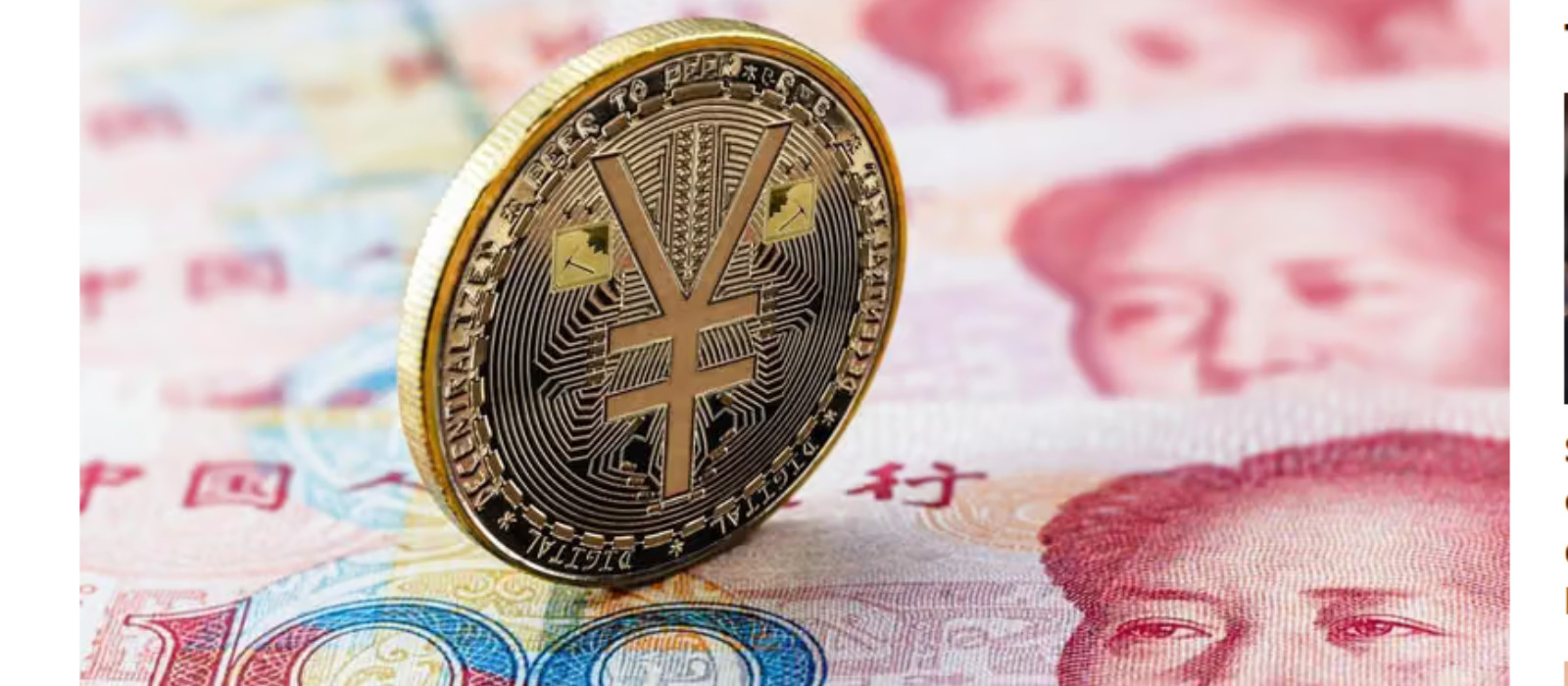
Digital Currency Electronic Payment (DCEP) or e-yuan is a sovereign digital currency created and sanctioned by the Chinese Government. DCEP is designed as a replacement of the Reserve Money System, cutting back the cost and friction of bank transfers.19 DCEP is being showcased as an alternative to paper money and its functions and attributes are the same as paper money, except that its form is digitised. The e-yuan could considerably reduce the risks of offline paper money transactions such as anonymous counterfeiting, money laundering and illegal financing. Regulators would be able to better monitor digital currency transactions, probably improving financial and monetary supervision. The e-yuan could also reduce the costs involved in maintaining and recycling banknotes and coins
Dethroning the Dollar
According to Chinese media, “The issuance of e-yuan is conducive to reshaping the t rade settlement system and promoting the internationalisation of the Renminbi.”20 Chinese see the world passively stuck in a tight liquidity cycle from dollar surplus to constricted dollar, a process that has often been used by US to buy other countries’ assets at a low price when the dollar is oversupplied and then sell them at a high price when the dollar is constricted for huge profits. China is of the view that the world has been suffering from the dollar for a long time, so the emergence of an alternate monetary system to challenge the dollar system is an inevitable trend.21
China is fully cognisant of the importance of dethroning the dollar as the world’s de facto reserve currency as the Centre of Gravity. The Chinese, in absence of any historical discourse for a path to currency supremacy, are following an uncharted path to internationalise their currency.
A strong economy assisted by assured internal credit currency and largescale international use are pre-requisites for the internationalisation of any currency. For the Renminbi to become the next global currency, a large and growing domestic economy, substantial and open capital markets and trusted and effective institutions to manage economy and markets are a must. With the continuous rise of the Chinese economy, the Renminbi may also grow proportionately. When China emerges as the biggest economy by the end of this decade, the Renminbi could be in a commanding position.22
Xi Jinping in his speech titled “Work Together to Build the Silk Road Economic Belt,” delivered (at the Nazarbayev University, Kazakhstan on 07 September 2013) said that to forge economic ties and expand cooperation in the Eurasian region, there was a requirement to enhance monetary circulation and provisions to settle trade in local currencies along the Silk Road.23 He highlighted that local currency settlement under current and capital accounts could reduce circulation cost, fend off financial risks and make them competitive internationally. Incidentally, the speech also appears in the book, “The Governance of China,” which is a Compilation of Xi Jinping’s work from 2012 to 2014 and offers an insight into their current leadership’s thoughts and philosophy for CPC and China. If we were to read the speech between the lines, he already seemed to be visualising a new financial system along the BRI, which could fend the current SWIFT system by encouraging settlement in local currencies bypassing US controlled systems. Xi’s words are important since he is China’s most powerful president since Mao Zedong. After all, on 29 October 20, he had his recommendations for a five-year economic plan and a blueprint for China’s development till 2035 ratified by the strong CPC’s Central Committee. Furthermore, any leadership succession plan was laid to rest in 2018 by revising the constitution and scrapping the limit of two terms for the President/Chairman. China’s dream of creating a new financial system is likely to be a focus area at least until Xi continues to rule. Few initiatives by China to ensure Renminbi internationalisation are enumerated below.24
Belt and Road Initiative (BRI). This scheme aims to link more than 70 countries that are home to over 70% of the world’s population and accounts for 70% of the world’s GDP. BRI has already started showing an impact on the trade between European Union and China. As per the Eurostat Euro Indicators report 10/2021 released on 15 January 2021, China displaced the US as the main partner of the European Union in 2020. At the same time, trade with the US recorded a significant drop in both imports and exports.
Easy Loans. China’s global presence in terms of large investments overseas and lending by the state owned/controlled China Development Bank, Asian Infrastructure Investment Bank and New Development Bank is well known. China has surpassed the World Bank and IMF as the world’s largest creditor in bilateral debts. However, its role in international finance will continue to be under reported till China starts sharing data on international lending more openly. As per World Bank’s 2021 International Debt Statistics Report, China’s external debt stock at the end of 2019 stands at $2.1 trillion in direct loans and trade credits to over 150 nations. The more the world owes China, the faster will be the transition to Renminbi as the world’s reserve currency.
Cross border Interbank Payments System (CIPS) to circumvent SWIFT network. The number of BRI countries transacting through CIPS has gradually increased to 59 and 1017 banking institutions run their settlement businesses through CIPS. This system uses international ISO 20022 standards and will help banks reduce processing time and make cross-border Renminbi payments efficient while being interoperable with SWIFT.
Bilateral swap agreements with over 40 countries.25 China is effectively using another instrument of bilateral currency swap between PBOC and the central banks in these countries to increase its global influence in developing countries worldwide. The World Bank’s International World Statistics 2021, indicates that China has concluded over 40 of these swap arrangements (to the tune of $500 billion), which will further accelerate renminbi internationalization. Argentina, Mongolia, Pakistan, Turkey and Russia had to use Renminbi currency swap lines during market distress indicating the growing clout of China and Renminbi.
Hong Kong as Renminbi Intermediator for International Trade. Hong Kong is being used by China as a Renminbi gateway and intermediary for payments connecting different countries of the world with China. Hong Kong based instruments and banks bridge China’s debt markets to the world. The dual system of the exchange rate is being continued for onshore and offshore trading of the Chinese currency to insulate domestic and international currency rates. Offshore trading unit denoted by CNH was created as a parallel currency and presently operates from Hong Kong.
Relaxation of capital market controls. China has rapidly made a series of regulatory changes to progressively open the market to more foreign investments. Approval of business investment deal between European Union and China in January 2021 is a clear indication of China disengaging from the US and clutching in with EU by opening its markets to European firms.
Promoting FinTech companies (like Alipay and WeChat pay) for Cashless Transactions. World’s consumer finance systems are slowly moving away from US controlled Master and Visa to the digital platforms, which have globalised faster than conventional banks and payment networks. Today payments through Alipay and WePay are accepted by merchants in over 56 countries and used by over a 100 crore (i.e one billion) people across the globe.
Dual Circulation Strategy. To decouple the Chinese economy from heavy reliance on international and US markets, Xi Jinping incorporated dual circulation as one of the guiding principles into China’s 14th plan (2021 to 2025). Dual circulation policy essentially aims to make domestic consumption a driver of Chinese growth in the next decade. In its 15 August 2020 edition, ‘The Economist’ carried a cover story on Xi Jinping’s new form of state-controlled capitalism.26 The story projected that containment as a form of trade warfare between the world’s open societies and China’s state controlled economy might not work because of the size of China’s economy and its highly sophisticated integration with the rest of the world. According to Xi, in order to ensure a large and growing domestic economy, there is an urgent requirement for China to have self-developed and controlled supply chains and at least one alternate source of supply for vital products. Xi also emphasises that to thwart foreign powers from pressurising China in future, it must rebalance domestic demand and weaponise its markets by making foreign firms strategically dependent on Chinese markets. The policy of dual circulation and simulating domestic demand will challenge the dollar as a reserve currency as domestic payments will be solely in digital yuan and instead of integrating with global payment gateways like Visa, Master Card etc, China could force foreign firms to accept the digital yuan.
Cross Border Central Bank Digital Currency Trials. In February 2021, China, Hong Kong, Thailand and the United Arab Emirates announced collaboration for testing central bank digital currencies in cross border payments. Addressing cross border payments is a key step in development of digital Renminbi and achieving a long-term strategic goal of internationalising China’s currency.
Thus, China seems to be formulating a very well thought out strategy to internationalise its currency. The primary aim of these initiatives is to dethrone the dollar. The sudden push of trials of e-yuan not only in the domestic market, but also internationally, has finally caught the attention of the US Treasury, the State Department, the Pentagon and the National Security Council. They are studying the potential implications of a digital yuan .
While the US is still the world’s biggest economy and strongest military power, it is faltering in several ways. We must note that none of the past reserve currencies has ever lasted more than 100 years. This change from one currency to another has often been preceded by war, debt restructuring, debt crises, currency breakdowns and peaceful or violent internal revolutions. While the US dollar dominance might continue till 2030, the emergence of the digital Yuan and a new payment ecosystem will accelerate the transition to a new landscape of reserve currencies.
China is the only country that can truly challenge the dollar. Many political pundits had anticipated China moving towards democracy as a result of increased economic coupling, but exactly the opposite has happened. Today China is more authoritarian, and CPC’s grip over the economy has further tightened. China is not only becoming increasingly assertive, but it is also challenging the US economically, diplomatically and militarily and is willing to step into the US’ shoes when required.
We are already staring at the emergence of China as the world’s largest economy by the end of this decade. The US and China are engaged in much economic and geopolitical mudslinging. All these could well be indicators of looming change in the financial order and reserve currency. US economy may be on a path of decline and the fall of the dollar system may be unpredictable. The pushback against the dollar is slowly gathering momentum as more countries opt to diversify their reserve portfolios and look at Euro, Gold, Renminbi and non-dollar currencies as an alternative. The new world order might give rise to a China led parallel financial universe that would compete with the dollar, forcing all other nations, including India, to make difficult choices.
The US has long used economic sanctions as a foreign policy tool against its adversaries. China wants to encash on the growing number of countries and entities bullied due to US economic sanctions and other economic measures as part of its foreign policy. The US misuses global financial systems, which should have remained neutral, to push its agenda using these instruments. China today seems to be better armed to provide an alternate means to these unhappy parties by offering them free trade in either Renminbi or non-dollar currencies and creating systems that can circumvent US monitoring. More and more countries are moving their trades to non-dollar currencies and building mechanisms to circumvent the US-dominated financial system. By equating its digital currency to physical Renminbi, China is blurring the lines between digital and physical currencies and all assumptions which are true for Renminbi can be assumed for digital currency as well.
Today opinions are fractured if DCEP is a way for Beijing to challenge Dollar’s monopoly.28 In statecraft, there is nothing static, be it economic might, military power or reserve currency status. The way the USA displaced the UK after World War II remains a good example. While the world’s reserve currency share of the dollar is still high, it is slowly decreasing and non-dollar currencies like Euro and Renminbi are steadily increasing.
India is destined to jump to the third largest economy in next 10-15 years overtaking Japan. The Rupee may well have a greater role in the world economy. However, 38% of international payments depends on SWIFT (as per figures released by SWIFT in Oct 2020) and are made in dollars.29 India with heavy reliance on energy import and global commodity market for imports and exports presently uses SWIFT for oversea settlements. In future, India will be forced to join either a USA or China led cross border payment system unless alternate means are explored and tested. In September 2021, the Reserve Bank of India and the Monetary Authority of Singapore (MAS) announced a project to link their respective fast payment systems i.e. Unified Payments Interface (UPI) and PayNow to be made operational by July 2022. To bypass US or China led financial blocks for future cross border payment systems, India should consider having similar arrangements with major trade partners driving faster, cheaper and more transparent cross border payments.
Conclusion
India’s foreign reserve as on 10 September 2021 stand at Rs 4714298 Crores as per weekly statistical supplement released by RBI. 90% of these reserves are in terms of Foreign Currency Assets and only 5.8% and 3% in terms of Gold and SDR respectively. While no one can predict the future, India should not put all eggs in the same basket and diversify reserve portfolios and consider SDR Gold and non-dollar currencies as an alternative.
Concurrently, India could start developing legal framework for introduction of digital currency sooner than later. Large scale mobile penetration can be effectively used to migrate to the new form of digital currency. The regulation of digital currency bill proposed by the government must be passed by the parliament at the earliest to pave way for Digital Rupee. The RBI’s decision to introduce Digital Rupee is recognition of the widespread trend towards cashless payments. The promotion of modern technologies and assistance from friendly foreign countries could help transition to digital currencies and clutch them for direct cross border transfers bypassing SWIFT and CIPS, making India secure from the vagaries of a fluctuating currency basket.
Endnotes
-
Mason, Steven. Faith and Logic Social Natural Laws. N.p.: Lulu.com, 2021.
-
Ray Dalio, Changing World Order: Why Nations Succeed and Fail. (S.l.: AVID READER PR, 2021).
-
Paul M. Kennedy, The Rise and Fall of the Great Powers: Economic Change and Military Conflict from 1500 to 2000, 1st Vintage Books ed (New York: Vintage Books, 1989).
-
Gal Luft and Anne Korian, De-Dollarization: The Revolt against the Dollar and the Rise of a New Financial World Order (Independently published, 2019).
-
Harold Livermore, A New History of Portugal (Cambridge: Cambridge University Press, 1976).
-
Elliott, J. H. Imperial Spain 1469-1716. United Kingdom: Penguin Books Limited, 2002.
-
Cassis, Youssef. Capitals of Capital: The Rise and Fall of International Financial Centres, 1780-2009. United Kingdom: Cambridge University Press, 2010.
-
Ko Unoki, Mergers, Acquisitions and Global Empires: Tolerance, Diversity, and the Success of M&A (Abingdon, Oxon ; New York, NY: Routledge, 2013).
-
Ibid
-
“3 Major Signs That Precede the Fall of World Reserve Currencies | Economics Bitcoin News,” Bitcoin News (blog), https://news.bitcoin.com/3-major-signs-that-precede-the-fall-of-world-reserve-currencies/., accessed on 20 August 2020.
-
Boylan, Brandon M, McBeath Jerry and Wang Bo, “US–China Relations: Nationalism, the Trade War, and COVID-19”, Fudan Journal of the Humanities and Social Sciences, March 2021, https://doi.org/10.1007/s40647-020-00302-6 , accessed on 10 March 2021
-
Andrew Mullen, “US-China relations: is there still a trade war under Joe Biden’s presidency?” South China Morning Post, May 23, 2021, https://www.scmp.com/economy/global-economy/ article/ 3134191 / us- china- relations- there- s t i l l - t rade- war- under- joe-bidens?module=inline&pgtype=article
-
Zolan Kanno-Youngs and David E. Sanger, “Biden Speaks With Xi Amid Low Point in U.S.-China Relations”, New York Times, September 10 , 2021, https://www.nytimes.com/ 2021/09/10/us/politics/biden-xi-china.html, accessed on 10 September 2021
-
“U.S. National Debt Clock : Real Time,”, https://www.usdebtclock.org/. accessed on 31 December 2020.
-
“World Economic League 2021 report, December 2020, 12th edition”, The Centre for World Economic and Business Research, London https://cebr.com/wp-content/uploads/2021/02/WELT-2021-final-15.01.pdf
-
“Special Drawing Right (SDR),” IMF, https://www.imf.org/en/About/Factsheets/Sheets/ 2016/08/01/14/51/Special-Drawing-Right-SDR. , accessed on 04 February 2021.
-
Dr Zhou Xiaochuan “Reform the international monetary system” , 23 March 2009, https://www.bis.org/review/r090402c.pdf ,accessed on 12 August 2021
-
“Progress of Research & Development of E-CNY in China” Working Group on E-CNY Research and Development of the People's Bank of China July, 2021, http://www.pbc.gov.cn/en/3688110/3688172/4157443/4293696/2021071614584691871.pdf
-
“China’s National Digital Currency DCEP / CBDC Overview,” Boxmining (blog), January 13, 2021, https://boxmining.com/dcep/. accessed on 13 January 2021.
-
“China Says It Has No Desire to Replace Dollar With Digital Yuan”, Bloomberg, April 18, 2021, https://www.bloombergquint.com/global-economics/china-to-focus-on-domestic-use-of-digital-fx-first-zhou-says , accessed on 20 April 2021
-
“媒体:中国央行数字货币是射向美国的巨浪3|数字货币_新浪军事_新浪网,”https://mil.news.sina.com.cn/china/2020-04-21/doc-iircuyvh8957899.shtml#. accessed on 10 August 2020.
-
William H. Overholt, Renminbi Rising: A New Global Monetary System Emerges (Chichester, West Sussex, UK: John Wiley & Sons, Inc, 2016).
-
Jinping Xi, Xi Jinping, the Governance of China, First edition (Beijing: Foreign Languages Press, 2014).
-
SWIFT RMB Tracker 2017 Will the Belt and Road revitalise RMB internationalisation? https://www.swift.com/swift-resource/125726/download, accessed on 12 April 2021
-
CP Chandrasekhar/Jayati Ghosh, “Bilateral Swaps’ Role in China’s Rising Global Footprint,” @businessline, https://www.thehindubusinessline.com/opinion/bilateral-swaps-role-in-chinas-rising-global-footprint/article33330279.ece. accessed on 05 February 2021.
-
The Economist 15 August 2020 edition
-
Saleha Mohsin, “Biden Team Eyes Potential Threat From China’s Digital Yuan,” Bloomberg, April 12, 2021, https://www.bloomberg.com/news/articles/2021-04-11/biden-team-eyes-potential-threat-from-china-s-digital-yuan-plans accessed on 12 April 2021
-
“Digital yuan gives China a new tool to strike back at critics”, April 21, 2021 https://economictimes.indiatimes.com/markets/forex/digital-yuan-gives-china-a-new-tool-to-strike-back-at-critics/articleshow/82177595.cms?utm_source=contentofinterest&utm_medium= text&utm_campaign=cppst
-
“RMB Tracker Monthly reporting and statistics on renminbi (RMB) progress towards becoming an international currency”, SWIFT, https://www.swift.com/swift-resource/243556/ download
