


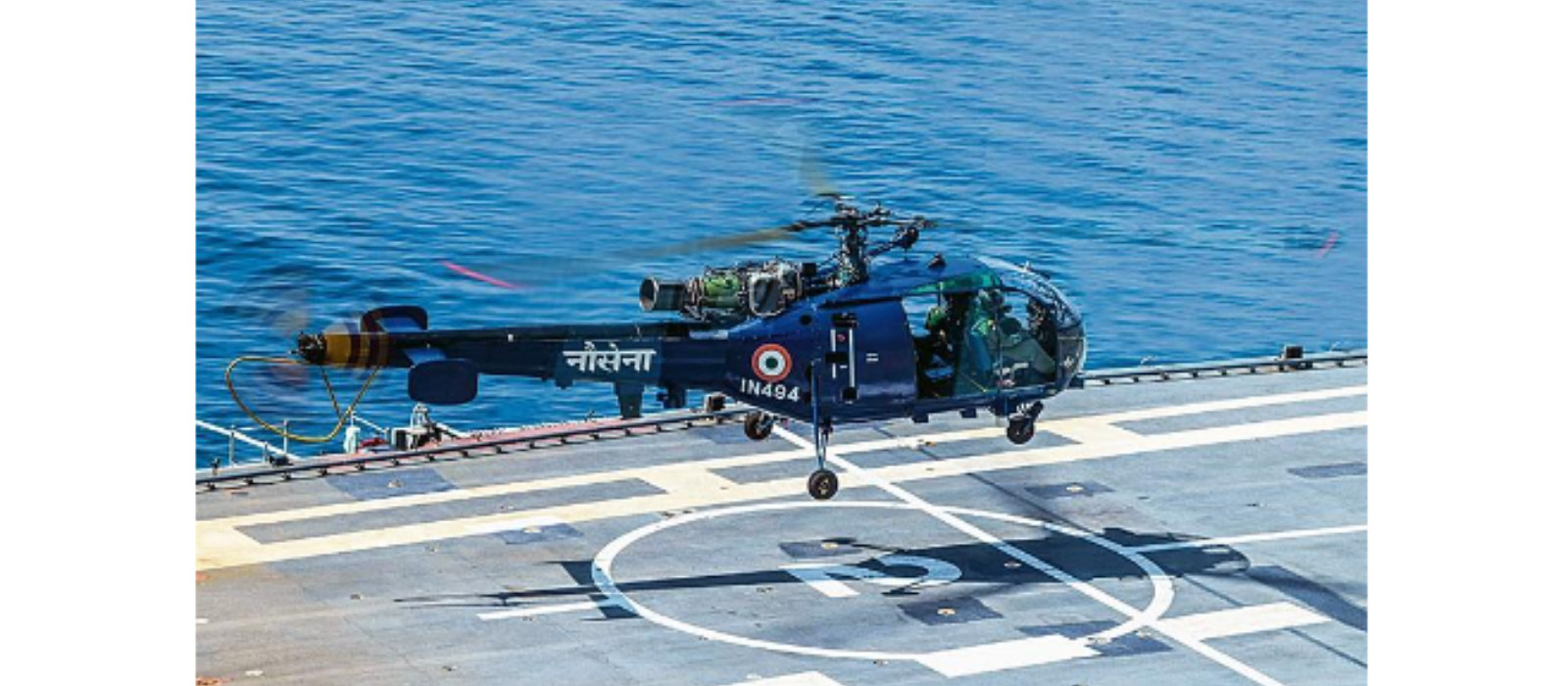


“The air constitutes a battlefield of equal importance.”
Giulio Douhet1
Introduction
The Indian Naval Air Arm is poised for a quantum leap with several new inductions done in the recent past and some planned in the future. MiG 29K fighters, P8I Long Range Maritime Reconnaissance (LRMR) aircraft and Hawk Advanced Jet Trainers (AJT) have significantly enhanced the Navy’s capabilities. The future line up of planned inductions is also very impressive - the follow-on P8I aircraft, Twin Engine Deck Based Fighters (TEDBF) to replace MiG 29K, Medium Range Maritime Reconnaissance (MRMR) aircraft, Multi-Role Helicopters (MRH), Naval Utility Helicopters (NUH) and a variety of Unmanned Combat Aerial Vehicles (UCAV). Indeed, media is already abuzz with catchy headlines such as “Super Hornet is Jumping to Impress the Indian Navy.”2 Another report wonders,“MH 60 Seahawk: Why India is in love with this ‘Romeo’helicopter.”3
Lost in this pleonism of plaudits and aggrandization is the need for rational thought that would shape Indian Navy’s strategy for the Fleet Air Arm (FAA). The history of Indian naval aviation is chequered, to say the least. From an ambitious plan of a four fleet carrier force with 280 aircraft and the initial euphoric years of naval aviation, India was the first Asian country to operate an aircraft carrier after the Second World War.4 The growth of the FAA divagated towards the end of the last century, only to be revived in the second decade of this century.5 A scathing report in 2010 by the Comptroller and Auditor General reflected the alarming state of naval aviation in a series of observations.6 Yet, by most metrics, the growth of the Navy’s air arm has been impressive, even if sporadic. It is the absence of a coherent and articulated strategy for the employment of naval aviation which is disconcerting.
Naval aviation has of course, always been regarded as an ‘organic’- and at times subordinate - component of sea power in most navies. While this may appear logical because the ultimate effect of the winged component is at or from the sea, it also abridges the expansive theory of air power and its application in naval warfare. Capt Robert Rubel, a former aviator of the US Navy points to this ‘theory vacuum’ and makes a case for developing a theory of naval air power.7 Rubel, of course, was more concerned with the US Navy’s need to preserve operational control of its aviation. In the context of the Indian Navy too, naval aviation is not firmly grounded in theory, or so it appears. As one author posits, the Indian Maritime Security Strategy IMMS-2015 “does not delineate what roles Indian carriers would fulfill during wartime, other than that they will be a key contributor to sea control.”8 In contrast, Air Forces globally have been founded on an elaborate, even if exaggerated, concept of air power. Douhet’s postulates about the indivisibility of airpower, its independent nature and the advantages of mass and offensive employment have resonated even in modern times. At the same time, most navies have neglected the theoretical underpinnings of naval airpower and much less cared to evolve a coherent theory of its application.
Naval Aviation and Seapower: Why Maritime Strategy is Not Enough?
Naval aviation undoubtedly is a component of seapower; it must not claim independent status because seapower is its raison d’etre. Functionally, it serves the broader purpose of seapower and though it has the ability to influence all three physical domains - surface, sub-surface and air - naval aviation is rigidly wedded to maritime strategy. On the other hand, air power is itself fundamentally different from seapower and land-based power. Air power has characteristic responsiveness, flexibility and the ability to strike deep in enemy territory.9 Its peculiar limitations such as impermanence, base dependency and vulnerability however, have set it apart from land and sea power.10 These characteristics of air power, which been so elaborately written about must also inform maritime doctrine, to the extent that navies need to use air power. In a future contingency, the Navy might need to operate aircraft over enemy territory, either singly or in coordination with the Air Force. Such a situation would necessitate a deeper understanding of air power.
A bigger problem is the seemingly restrictive lexicon that navies have adopted in their doctrines. For example, the Indian Maritime Doctrine appears to have tied aircraft carriers to sea control although a carrier is as much an instrument of sea denial, power projection and much about everything else at the further end of the spectrum of naval warfare. So, although the Indian Navy considers sea control as the ‘central concept’ around which it is structured, linking the aircraft carrier to sea control could result in a dogma declaring that carriers only do sea control. Instead, if one were to view the aircraft carrier as a component of air power, the characteristics of responsiveness and strike capability would be limned. Therefore, it is essential to look at naval aviation as much as an instrument of air power, as it is of seapower.
The classical evolution of seapower theory did not consider the capabilities of aircraft, or for that matter submarines, simply because it predated these relatively new technologies. That is why air power did not grow as a foundational tenet of seapower despite the near simultaneous employment of military aircraft over land and sea. Dyndal writes about the early separation of air forces across the globe as independent services, which resulted in a “clear gap with regard to a cross-service body of literature and thought between naval and air force researchers, strategists and philosophers.”11 This thought gained credence even though his own definition of maritime air power being applied in the ‘maritime theatre’ to fulfil ‘maritime objectives’ is debatable. For example, carrier-based aircraft striking deep in enemy’s territory in support of land objectives would still count as maritime air power, even when it is not applied in the maritime domain. While air power theorists were enthused by the novelty and almost revolutionary capabilities of aircraft, maritime strategists merely subsumed this capable platform in the larger construct of seapower. Yet thinkers like Panikkar were quick to realise the implications of the advent of air power at sea. He noted that the “indivisible sea is no longer indivisible” because “air power has introduced a new factor in the control of the sea.”12
While the conflation of naval air strategy with naval strategy may be the logical and natural progression of maritime strategic thought - after all the effects of both ships and naval aircraft are eventually felt upon the maritime domain - there is a danger in this one-sided marriage. This is because naval air power has the potential to not only support ships and submarines, but it can also be applied independently and effectively. Therefore, viewing naval aviation merely as an adjunct to seapower would be ignoring the capability of the air arm. Evidence of this argument is to be found in the domain of undersea warfare. Submarines are also applied in the maritime domain, yet their employment is underpinned by a radically independent theory. This article, therefore, suggests an independent theory of naval air power which would achieve two useful ends. First, it would de-hyphenate naval aviation from the traditional bridge-centric perspective, which tends to view maritime strategy from the ‘sea-level.’ This could, in turn, promote a more cogent understanding of naval aviation and its justification. The second advantage that might accrue is the invention of naval air strategy as a distinct domain, contributing to maritime strategy but retaining its own merits.
Air power and the Indian Navy
It is not without a sense of incredulity that one notes the prescience with which KM Panikkar wrote the following passage in 1945:
“Equally important, especially for a country like India, with a vast coast line is the development of a naval air arm, as an integral part of the sea forces. The function of the air force should not be confused with the function of the naval air arm. The air force is an independent service whose objectives are governed by other factors. The naval air arm has an important part to play in naval warfare, by patrolling the coasts, by keeping the sea clear and affording air cover to the navy.”13
The Indian Navy created a Directorate of Naval Aviation in 1948, five years before the first Sealand aircraft were inducted.14 In fact, the Navy under then C-in-C Royal Indian Navy, Vice Admiral Sir Edward Parry, spelt out a ten-year expansion plan in 1947, which inter alia included two light fleet carriers.15 However, due to the vicissitudes of limited budgets versus enormous demands for public spending from all sectors, this somewhat grandiose plan was trimmed in 1950 to only a Fleet Requirement Unit (FRU) with 12 aircraft.16 Notwithstanding the vagaries of the defence budget, Indian naval aviation embarked upon a sure footed even if somewhat unsteady growth - from Sealand aircraft to Firefly, Vampire, Alize, Sea Hawk, Sea Harrier and MiG 29K; from Super Constellations to IL 38, Tu 142, Dornier and P 8I; a variety of helicopters and augmentation of infrastructure, technological base and quality manpower. The growth of the Navy’s air arm is well-chronicled. There remained however, a gap in the theoretical foundation of naval aviation and strategic thought about the employment of the fleet air arm.
The story of the Indigenous Aircraft Carrier (IAC) aptly illustrates the main argument of this article. Conceived in 1979, the project received CCS approval two decades later.17 It is expected to enter service in 2021.18 What is intriguing however, is the change in nomenclature that the project has undergone during this long gestational period. Initially, it was called the Sea Control Ship (SCS), later the Air Defence Ship (ADS) and now the IAC.19 On the other hand, each of those names, if construed in their true sense, would be indicative of subtler nuances in the envisaged role of the ship. Another example is the transfer of Maritime Reconnaissance (MR) role from the Air Force to the Navy. After the 1965 Indo-Pak conflict, the Navy had proposed taking over the responsibility of MR operations from the IAF, which was opposed by the latter. It was perhaps only after the heavy price paid in 1971 (sinking of the Khukri) that the government saw reason and eventually vested the responsibility for maritime reconnaissance with the Navy in 1976.20 It will be apparent that it does not suffice merely to possess a capability. It is equally important to buttress capability with a sound and rational strategy.
Naval aviation brings along a unique and powerful capability to shape maritime operations and thus, it deserves more sophisticated theoretical treatment than it has received so far. This article posits that the theoretical and foundational thought on naval aviation has not yet found an appropriate expression in Indian maritime strategic thought. Furthermore, there is a need for a greater understanding of air power and its theoretical precepts, if we wish to employ aviation to its fullest potential.
Naval Aviation and Theory of Air Power. One of the useful approaches in evaluating the role of naval air power and thence, in evolving an independent theory of its application is to view naval aviation through the lens of air power theory. The Basic Doctrine of the IAF and the postulations of air power theorists would perhaps be helpful in doing so. While the overarching role of naval air power would continue to be in support of maritime operations, it needs to develop an inherent and tailored understanding of missions such as counter air (offensive as well as defensive), counter surface force, combat-enabling operations and strategic campaign. The first three missions largely relate to the employment of naval air power in conjunction with ships, submarines and occasionally, with land forces and the Air Force. Strategic campaign on the other hand, pertains to the independent use of naval air power.21 In addition, although the Air Force doctrine does not envisage the use of aircraft against submarines, for naval aviation, undersea operations represent a significant role.
Naval Aviation and the ‘Ends-Ways-Means’ Construct. Another approach for evolving a strategy for naval air power would be the Ends-Ways-Means construct wherein naval aviation signifies the ‘means’ to deliver the ‘ends’ using naval air strategy as the ‘way.’ Effectively, though similar to the air power theory approach, it requires contemplation of viable objectives or ends for naval aviation as a start point. To do that, there will be a need to understand the attributes of naval air power. These certainly are similar to the attributes of air power, but have more sea-specific characteristics.22 Dyndal, for example, specifies five core capabilities of maritime air power - Information Exploitation, Surface Warfare, Air Control Warfare, Subsurface Warfare and Force Projection.23 Rubel has acknowledged the attributes of naval air power and further gives three ‘fleet rules’ - concentration of the fleet, avoiding decisive engagement with land-based forces and, preserving fleet’s mobility - and applies them to carrier aviation.24 These roles or capabilities - power projection, achieving air superiority, anti-shipping strikes, destruction of hostile submarines, vertical envelopment and other - thus, constitute elements of what could be termed naval air strategy. Such naval air strategy should logically link ‘ends’ or ‘objectives,’ which might themselves either lie in the maritime domain or beyond. The means of course, comprise the assets, infrastructure and manpower.
Some Pointers for Naval Air Strategy
The Indivisibility of Air Power. Naval air strategy must not only draw from the attributes of naval air power, it should also be founded on the principles of air power. For instance, Jasjit Singh emphasises the indivisibility of air power and its corollary, the unity of command of air space.25 Naval aviation must seek concord with this key characteristic. Should the Navy’s air arm be within the ambit, if not subordinate to, of the Air Force? How does naval aviation reconcile to this universally acknowledged principle? Interestingly, it is the air power theorists who offer a solution. Douhet, for one, has suggested that ‘aerial means used by the army and the navy’ are their integral part and must be regarded as such.26 Rubel makes another valid point; because naval aviation is fundamentally an extension of ships, its command and control would always vest with the Navy.27 That said, unity of command of air space needs greater deliberation because ‘maritime air space’- where the Air Force might neither possess the reach nor the situational awareness - is quite distinct from ‘terrestrial air space’ although air space itself is a continuum. Therefore, to exercise unity of command of air, the simplest and the most optimum command, control and communications mechanisms would be required. In Desert Storm, for example, US Navy aircraft could not freely operate with other joint assets within the framework of an Air Tasking Order (ATO).28 This deficiency was subsequently, eliminated in Operation Iraqi Freedom. On the importance of joint procedures, PS Das writes that the “exercise of maritime power is about the marriage and the union of the Navy and the Air Force.”29
Control of the Air. “The offensive power of aircraft is so great that to command the sea we must first command the air over the sea,” said Captain George Montgomery of the US Navy in one of his lectures at the US Naval War College.30 Maritime strategists have traditionally viewed control of the air as part of the larger concept of sea control.31 Naval aviation however, must specifically concern itself with the control of the air since it looks at limiting the ability of the enemy’s air power to interfere with own operations. In any case, it will be the fleet air arm that would have the greatest stakes and the responsibility for seizing control of the air in the maritime domain.

Fig 1: Naval Air Strategy
Anti-Air Operations. Anti-Air operations will incorporate most of the aspects of Offensive Counter Air and Air Defence envisaged in air power doctrine. Additionally, Anti-Air operations will also need to integrate with submarine operations (which can destroy aviation-capable enemy ships as well as air defence ships), missile warfare, anti-submarine warfare and even mine warfare.
The proponents of air power aver that an offensive strategy is more effective in the struggle for air superiority for which they offer a direct approach (counter air operations) as well as an indirect approach (air interdiction).32 Naval aviation would need to work out the most viable and effective strategy for achieving the desired degree of the control of air.
Anti-Surface Force Operations. The capabilities of aircraft against ships at sea has been sufficiently demonstrated in past conflicts, notably in the Second World War and in the Falklands conflict. It is however, anti-surface force operations over land that deserve greater attention. In 1965, Vikrant being in refit, the Navy had deployed Seahawks at Jamnagar (under the operational control of the Western Air Command) with plans to attack the Badin radar station in Pakistan in conjunction with the Air Force.33 An Alize, based at Ambala, flew sorties with the Air Force along the border from Pathankot to Jamnagar in order to locate the enemy’s shore radars, the only aircraft in the Indian armed forces with the capability to do so.34 Naval Dorniers have also been used in Rajasthan to pickup ESM chatter.35 More recently, the Navy is reported to have deployed the P 8I during the Doklam crisis in 2017.36 The P 8I and MiG 29K were also utilised in the aftermath of Galwan incident.37
It is worth considering however, what role does the Navy, and the air arm in particular, see itself performing in the anti-surface campaign over land. For one, the sensors onboard maritime aircraft are optimised for sea. The aircrew is also trained for and accustomed to a much less dense environment, which is the case at sea. The weapons designed for use against land targets such as buildings, blast pens, troops and strategic infrastructure are also very different from the armament for use at sea. These factors should determine the future acquisition of aircraft and aviation armament and training of aircrew.
Undersea Warfare. Aircraft are eminently suitable for anti-submarine warfare (ASW). They operate in a medium different from that in which the submarines operate and can interfere with a submarine’s operations more effectively and with impunity than ships. Yet, the magnitude of air effort needed to counter a submarine is often underestimated. In the Falklands War for example, two British helicopter squadrons flew a total of 2,253 sorties and spent 6,847 hours on anti-submarine patrols in just three months to counter a lone Argentinian submarine and still failed to sink it.38 The effort needed to insure one’s ships and shipping against a credible submarine force would place great demands on naval aviation. Fixed wing aircraft also have certain limitations in anti-submarine warfare; their capability to search and locate submarines is limited to small areas. More importantly, a priori information about the presence of submarines, with a fair degree of reliability, is a pre-requisite in planning air ASW operations.
Strategic Bombardment. Strategic bombing, although ‘strategic’ as an adjective to bombing is overstated, has long been considered the preserve of air forces. Douhet has argued that an air force should have “maximum bombing power.”39 He also said that “the objective must be destroyed completely in one attack making further attacks unnecessary.”40 In fact, the capability of the Air Force in carrying out strategic strikes was the primary argument against the aircraft carrier and indeed threatened the very existence of the United States Navy in the Post-War years.41 The irony that the Doolittle raid was only made possible from the flight deck of USS Hornet was somehow lost in championing this new found ‘strategy.’ As a consequence, perhaps, naval aviation gradually distanced itself from the concept and even though carrier launched strikes on shore targets is a validated naval aviation role, the term ‘strategic bombing’ has rarely been used. One possible result of this long held view against strategic bombing was the limited effectiveness of the US Navy’s air power in Desert Storm and the subsequent acceptance of the value of strategic air campaigns and the idea that naval air forces must be more influential players in them.42 Indeed, with the advent of modern deck-based fighters, navies must embrace bombing as one of the significant roles of their air arm.
Combat Enabling Operations. Although these are less glamorous than other elements of air strategy, they are nevertheless extremely crucial for enabling, sustaining and supporting the other elements. For example, the absence of the Gannet AEW aircraft in the Falklands War, whose carrier platform had been retired a few years ago by the Royal Navy, cost the British forces dearly.43 In Operation Enduring Freedom, special forces were able to provide fine resolution target imagery to F-14s.44 This enhanced the effectiveness of carrier launched strikes on shore targets. The Indian Air Force has an elaborate list of combat enablers like Remotely Piloted Aircraft (RPAs), Aerostats, Special Forces, etc., and combat enabling operations such as Air Transported Operations, Air-to-Air Refuelling, Runway Rehabilitation, Maintenance, Integrated Logistics, CBRN Defence, training etc.45 These enablers are also critical to naval aviation and must be recognised as such.
Elements of Naval Aviation
Aircraft Carriers. Carrier aviation is ostensibly the bellwether of a navy’s aviation prowess. That is perhaps the reason why those who possess it desire to preserve it and those who do not, aspire for it. There is no dearth of literature in support of carriers, and to an increasing extent, in its opposition. Critics have termed the aircraft carrier as a “white elephant,” highlighting the need for a large number of escorts to protect the carrier.46 On the other hand, carrier proponents cite that “no carrier has been sunk since 1945 and the vulnerability of carriers is not a military matter but an enduring one for budgetary and inter-service battles.”47
Former Navy Chief, Admiral Arun Prakash, also posits that “rather than needing protection from a large number of escorts, the carrier actually provides protection to the force that may accompany it.”48 This capability, of course, has a caveat - the level of threat in the environment in which the carrier is operating. While the vulnerability of the carrier must be accepted (and suitably mitigated), its need in battle cannot be overstated. The United States and the United Kingdom learnt this the hard way in the Korean War and the Falklands War respectively. In the former case, the United States Secretary of Defence Louis Johnson, who was instrumental in scuttling the US Navy’s ‘super carrier’ project, found himself in a rather desperate situation as the North Korean forces crossed the 38th Parallel. Realising that it was only carrier borne aviation that could swiftly respond to the Communist onslaught in Korea, he is believed to have promised the Chief of US Navy, “I will give you another carrier when you want it.”49
Naval air power theory however, must concern itself more with the employment of carriers and less with offering justification for their existence. In this context, some arguments can hardly escape critical evaluation. For example, one article suggests a force of three aircraft carriers for the Indian Navy - one for each seaboard and the third to cater for repairs and refits. First, it may not be correct to link an aircraft carrier - a highly mobile platform - to a seaboard, which itself can be defended by shore-based aircraft. Naval air power theory, and the history of aircraft carriers in battle, informs us that they must be used for projecting power away from own shores. Secondly, the number and type of aircraft carriers that a navy needs will be dictated by the threat it is likely to encounter.
Admiral Arun Prakash has summarised the key attributes of naval aviation as “the ability to respond, with minimum delay, in any geographic location on a 24 x7 basis, to reconnoitre and detect targets much beyond the ship's own sensor range, and, to deliver ordnance, while the ship remains outside the enemy's weapon danger zone.” While it is true that naval air power permits quick response at practically any location, the imperative of the launch platform remaining outside the enemy’s weapon danger zone appears tenuous. Aircraft carriers are fundamentally mobile airfields at sea and much of what they can do emanates from this one principal capability. Therefore, a sound naval air strategy should endeavour to position the aircraft carrier where it must, and use its striking power to achieve desired objective(s). That said, this fundamental understanding of carrier aviation should be further developed based on the capability of the aircraft carrier that a navy operates and the number of carriers that it operates. Rubel has classified this in hierarchical ‘levels’ of the Air Fleet, Carrier Strike Force and Aviation Capable ships and has even offered the potential roles for aircraft carriers at varying degrees of aggregation and sophistication.50
Aircraft carriers can sometimes substitute land-based air power (eg Operation Enduring Freedom) and sometimes they are the only available option for wielding air power (eg Falklands War).51 Very often, though, aircraft carriers supplement land-based air power, as evidenced by the performance of the US Navy’s carriers in Operation Iraqi Freedom. History offers valuable insights into how aircraft carriers can effectively be employed over a wide range of operational scenarios - from the carrier battles in the Pacific during the Second World War to the Afghanistan campaign in 2001. Yet, most large-scale carrier employments lie at the ‘higher level’ of Rubel’s stylisations of naval air power. In Operation Enduring Freedom, for example, six carrier battle groups participated, with five on station simultaneously.52 A typical carrier air wing of the US Navy at that time comprised “ten F-14s, 36 F/A-18s, four EA-6Bs, eight S-3Bs, four E-2Cs, and seven SH-60s or HH-60s.”53 In contrast, of the 42 Harriers of HMS Hermes and Invincible during the Falklands campaign, two-thirds had to be employed for air defence, with about 83 percent of all Harrier sorties dedicated for combat air patrol.54
The operational history of the IN’s carriers is illustrative of the capabilities and limitations of the use of light carriers. In the 1971 war, Vikrant’s material state, lack of adequate escorts, the threat from Pakistan’s submarines and concern about the consequences of its possible loss, resulted in the carrier being assigned to the newly constituted Eastern Fleet while the “main naval battles and activity would take place in the North Arabian Sea.”55 Eventually, Vikrant did acquit herself well in that war as its judicious deployment overcame its vulnerabilities and enabled it to dominate the Eastern maritime theatre. GS Khurana has also listed some of the possible roles of Indian aircraft carriers, which range from supporting the land battle and security of SLOCs to protecting vital interests overseas and defence of island territories.56 However, practice must also support theory and in this context the aircraft carrier has been rather inconspicuous in the vast canvas of Indian Navy’s operational experience, much less become its centrepiece.
Therefore, there is a need for defining more specific roles for aircraft carriers in India’s naval strategy and indeed, in Indian Navy’s air strategy. Clearly, there are significant implications and pre-conditions for a carrier to be used for power projection or fleet air defence or simply as an aviation capable ship. In one among very few works on this subject, Ben Ho has examined the options of employing an aircraft carrier and has concluded that the Indian carrier would have a ‘limited’ offensive role in a hypothetical India-Pakistan scenario. He has instead suggested that a defensive role such as SLOC protection would perhaps be more viable for a light carrier of the size of either the Vikramaditya or Vikrant.57
It should also not be construed that light or small-deck carriers represent a compromise. The US Navy’s Battleforce 2045, for example, has examined options for light carriers that support short takeoff or vertical landing aircraft for presence missions while ‘freeing-up’ the large carriers for high-end combat.58 Although it is true that smaller carriers aren’t as versatile or capable as their larger counterparts, it is the specific role of these ships instead of their size in the strategic design that eventually makes them relevant.
Integral Air Element. Integral air element, be it helicopters or ship-based UAVs, is an equally significant component of naval aviation. As the organic extension of the ships’ sensors and weapons, it exponentially increases their capabilities. At the same time, deck-based aviation may also have an independent role in naval aviation strategy. The ability of modern multi-role helicopters and UAVs to operate from different types of platforms and bases ashore, along with a degree of autonomous capability makes them significant in contributing to the naval air strategy.
Shore Based Aviation. Interestingly, the majority of naval aviation in the world is land based. The Chinese Navy’s air arm, for example, comprises about 800 aircraft of various types including long range bombers, tankers and transport aircraft.59 The Soviet emphasis on long range reconnaissance and bomber aircraft to harass American ships during the Cold War exemplifies its potential capabilities.60 Another example is Japan’s use of land based aviation to establish a thousand mile maritime cordon.61 Yet, notes Rubel, for all the ability of land based naval aviation, there has been a disconnect between it and embarked naval aviation. He attributes this disconnect to differences in culture and the dichotomy in missions.62 It will be amply apparent that because a major part of naval air strategy rests on land based aviation (see Fig 1), the Navy’s strategic thought must also focus on this important aspect, specifically in order to harmonise the deck-based and land based components of naval aviation.
India’s peninsular geography and off-lying island territories offer a natural role for land-based air power. It is perhaps in recognition of this great potential of naval aviation, Panikkar writes that “an inferior navy with lighter aircraft, supported by land based planes, can ensure the safety of considerable stretches of sea.”63 How the Navy will leverage this geographical advantage to formulate a strategy for its air arm remains to be seen. At the same time, we must also recognize that the ever-expanding footprint of land based Anti-Ship Ballistic Missiles (ASBMs) and long range cruise and hypersonic weapons, combined with increasing intelligence, surveillance and reconnaissance capabilities in our primary areas of interest will eventually blunt, if not nullify, the advantages that geography bestows upon us. We must therefore, critically examine current and future capability shortfalls and evolve means to counter potential threats.
Infrastructure and Training. Strategy and infrastructure go hand-in-hand; the latter provides the backbone upon which the former is modelled. Whether it be the coaling stations of yester-years or the possession of strategic outposts like Aden and Singapore by colonial powers, a sound strategy needs commensurate focus on infrastructure. So is the case with naval aviation. The ten year expansion plan of 1947 envisaged a number of naval air stations for basing the Fleet Aircraft Requirement Units, Transport Squadron, Air Sea Rescue Squadron, Communication Squadron and the First Line Squadron when not embarked on carriers. In addition to these, air stations were proposed for basing training squadrons and the Operational Flying Training School. A College of Naval Air Warfare, with its several wings (Advanced Training Wing, School for Naval Air Gunners and School for Naval Observers), requiring another air station, was also proposed.64 In retrospect, like the four-carrier plan, these requirements might also be now considered an ‘overreach.’ However, history may be useful in charting the course of naval aviation for the future.
Conclusion
It is through perspicacity of the Navy’s earliest leadership and the consistent guidance and course corrections of their successors, that the Indian Navy has built a credible and effective air arm today. There appears little doubt that naval aviation is poised for a quantum leap in years to come - both as a fruition of decades of hard work and, more importantly, as a matter of utmost necessity. More than four decades ago, Admiral SN Kohli had written:
“As the Indian Navy grows, so will its air arm. The percentage of manpower and resources likely to be utilised in this long arm of the Navy is also likely to increase, because of the changing pattern of warfare at sea. Naval aircraft will continue to be used in our environment for many, many years... Whether aircraft will operate at all at sea is difficult to foretell. That it will undergo much change and increase in sophistication is, however, beyond doubt. And that it will continue to be one of the most vital elements of warfare at sea in the present century is also a certainty.”65
This article has made the case for a naval air strategy; a de novo examination of the theory of air power in the context of naval warfare. It has identified significant points of departure between naval air power and seapower, even while affirming the former’s inalienable role in the latter. The use of naval air power must be guided by the broader precepts of air power theory while seeking to accomplish maritime missions. The article also suggests that there is a need for naval professionals to understand the theory and concepts of air power. Naval aviation will also increasingly need to synergise with the Air Force, in so far as the employment of the latter in support of maritime objectives is concerned. More importantly, because naval air power will almost always be challenged by an adversary’s naval aviation or air force, it is imperative that the Navy must think air strategy to formulate a more coherent concept for its aviation arm and the effects that it would be expected to deliver in future.
Endnotes
-
Giulio Douhet, The Command of the Air, eds. Joseph P Harahan, Pichard H Kohn and trans. Dino Ferrari (Alabama: University of Alabama Press, 2009), 4.
-
Dave Makichuk, “Super Hornet is Jumping to Impress the Indian Navy,” Asia Times, 21 Au-gust 2020. https://asiatimes.com/2020/08/f-a-18-super-hornet-is-jumping-to-impress-indian-navy/, accessed 21 September 2020.
-
“MH 60 Seahawk: Why India is in love with this ‘Romeo’ Helicopter,” The Economic Times, 27 February 2020. https://economictimes.indiatimes.com/news/defence/mh-60-seahawk-why-india-is-in-love-with-this-romeo-helicopter/articleshow/74220157.cms?from=mdr, accessed 22 September 2020.
-
Satyindra Singh, Blueprint to Bluewater: The Indian Navy 1951-65 (New Delhi: Lancer Inter-national, 1992), 128.
-
Anup Singh, Blue Waters Ahoy! (Noida: HarperCollins Publishers India, 2018), 229-239.
-
Comptroller and Auditor General of India, Performance Audit of Union Government (Defence Services) - Air Force and Navy, Report No. 7, 2010. https://cag.gov.in/content/report-no-7-2010-performance-audit-union-government-defence-services-air-force-and-navy, accessed 24 Septem-ber 2020.
-
Robert C Rubel, “A Theory of Naval Airpower,” Naval War College Review vol. 67, no. 3 (Summer 2014), 64.
-
Ben Wan Beng Ho, “The Aircraft Carrier in Indian Naval Doctrine: Assessing the Likely Use-fulness of the Flattop in an Indo-Pakistani War Scenario,” Naval War College Review vol. 71, no. 1 (Winter 2018), 71.
-
Basic Doctrine of the Indian Air Force 2012 (New Delhi: Air Headquarters Vayu Bhavan, 2012), 18-20.
-
Ibid., 21-22.
-
Gjert Lage Dyndal, “A Theoretical Framework of Maritime Air Power,” Tidskrift, NR4 (Oc-tober-December 2015), 109. https://fhs.brage.unit.no/fhs-xmlui/bitstream/handle/11250/2446605/dyndal_a_theoretical.pdf?sequence=1&isAllowed=y, accessed 15 October 2020.
-
KM Panikkar, India and the Indian Ocean: An Essay on the Influence of Sea Power on Indian History (London: George Allen and Unwin Limited, 1945), 15.
-
Ibid., 98.
-
GM Hiranandani, Transition to Triumph: History of the Indian Navy 1965-1975 (New Delhi: Lancer Publishers, 2000), 262.
-
Satyindra Singh, Under Two Ensigns: The Indian Navy 1945-50 (New Delhi: Oxford and IBH Publishing Company, 1986), 181.
-
Ibid., 183.
-
GM Hiranandani, Transition to Guardianship: The Indian Navy 1991-2000 (New Delhi: Lanc-er, 2009), 163.
-
“India's First Indigenous Aircraft Carrier Vikrant Likely to be Commissioned by Early 2021: Sources,” The Economic Times, 09 January 2020. https://economictimes.indiatimes.com/ news/defence/indias-first-indigenous-aircraft-carrier-vikrant-likely-to-be-commissioned-by-early- 2021 - sources/ articleshow/ 73157111 . cms? utm_source=contentofinterest &utm_medium=text&utm_campaign=cppst, accessed 28 September 2020.
-
Hiranandani, Op Cit., n.17, 163.
-
GM Hiranandani, Transition to Eminence: The Indian Navy 1976-1990 (New Delhi: Lancer, 2005), 100-101.
-
Jasjit Singh, Air Power in Modern Warfare (New Delhi: Lancer International, 1985), xxx-xxxi.
-
Op Cit., n.9, 18-22.
-
Arun Prakash, “India's Maritime Air Power- Outlook for the 21st Century,” Naval War Col-lege Journal, vol. 32 (2020), 8.
-
Rubel, Op Cit., n.7, 64-65.
-
Singh, Op Cit., n.21, xxiv-xv.
-
Douhet, Op Cit., n.1, 71-72.
-
Rubel, Op Cit., n.7, 77.
-
Benjamin S Lambeth, American Carrier Airpower at the Dawn of a New Century (Santa Mon-ica: RAND Corporation, 2005), 3-4. http://ebookcentral.proquest.com/lib/dssc-ebooks/detail.action?docID=300518, accessed 23 September 2020.
-
PS Das, “AView From the Sea,” Air Power and Joint Operations, ed. Jasjit Singh (New Del-hi: Knowledge World, 2003), 243.
-
Hal M Friedman, Digesting History: The U.S. Naval War College, the Lessons of World War Two and Future Naval Warfare, US Naval War College Historical Monograph Series No. 17, (Newport: Naval War College Press, 2010), 161.
-
Integrated Headquarters Ministry of Defence (Navy), Indian Maritime Doctrine (Sivakasi: Standard Press, 2009), 67.
-
Op Cit., n.9, 42-56.
-
Singh, Op Cit., n. 21, 19-20.
-
Hiranandani, Op Cit., n. 14, 46.
-
Vikas Gupta, “When the Indian Navy Flew Over the Desert,” Defence News of India, 22 May 2020. https://defencenewsofindia.com/when-the-indian-navy-flew-over-the-desert-defence-news-of-india/, accessed 29 September 2020.
-
“India Deployed P-8I Naval Jets to Keep Eye on Chinese Troops During Doklam Face-off,” The Times of India, 17 February 2020. https://timesofindia.indiatimes.com/india/india-deployed-p-8i-naval-jets-to-keep-eye-on-chinese-troops-during-doklam-face-off/articleshow/ 74178145.cms, accessed 24 September 2020.
-
“Indian Navy Deploys MIG-29 Fighter Jets in Ladakh”, ABP News Bureau, 22 July 2020. https://news.abplive.com/videos/news/india-indian-navy-deploys-mig-29-fighter-jets-in-ladakh-1292426, accessed 24 September 2020.
-
Jun Yanagisawa, “Military Implications of the Falklands War: From Japan’s Point of View,” International Forum on War History: Proceedings, 2013, 130.http://www.nids.mod.go.jp/english/event/forum/pdf/2013/10.pdf, accessed 15 October 2020.
-
Douhet, Op Cit., n.1, 34.
-
Douhet, Op Cit., n.1, 20.
-
Lisle A Rose, Power at Sea: A Violent Peace 1946-2006 (Columbia: University of Missouri Press, 2007), 15-35.
-
Lambeth, Op Cit., n. 28, 3-4.
-
Yanagisawa, Op Cit., n. 38, 131.
-
Lambeth, Op Cit., n. 28, 33.
-
Lambeth, Op Cit., n. 28, 102.
-
Max Channon, “Royal Navy Carriers are 'Vulnerable White Elephants Built to Annoy China' Says Defence Chief,” Plymouth Live, 15 January 2020. https://www.plymouthherald.co.uk/ news/uk-world-news/royal-navy-carriers-vulnerable-white-3741076, accessed 02 October 2020. 47 Lee Willet, “More than Just Spare Airfields’: Defence Policy, Defence Reviews and the Queen Elizabeth -Class Aircraft Carriers,” British Naval Aviation: The First Hundred Years, ed. Tim Benbow (Surrey: Ashgate Publishing Limited, 2011), 248.
-
Prakash, Op Cit., n. 23, 7.
-
Rose, Op Cit., n. 41, 43-44 and Richard P Hallion, The Naval Air War in Korea (Baltimore: Nautical and Aviation Publication Company of America, 1986), ix.
-
Rubel, Op Cit., n. 7, 65-69.
-
Benjamin S Lambeth, “Lessons from Modern Warfare: What the Conflicts of the Post–Cold War Years Should Have Taught Us,” Strategic Studies Quarterly (Fall 2013), 44.
-
Ibid., 45.
-
Lambeth, Op Cit., n. 28, 89.
-
Ho, Op Cit., n. 8, 74.
-
Hiranandani, Op Cit., n. 14, 131-184.
-
GS Khurana, “Aircraft Carriers and India’s Naval Doctrine,” Journal of Defence Studies (Summer 2008), 99-101.
-
Ho, Op Cit., n. 8, 85-86.
-
Loren Thompson, “Why Esper’s Call For Light Carriers Would Make The U.S. Navy Weak-er,” Forbes, 13 October 2020. https://www.forbes.com/sites/lorenthompson/2020/10/13/why-secretary-espers-call-for-light-carriers-would-make-the-us-navy-weaker/#7ae4b69970f0, accessed 15 October 2020.
-
Prakash, Op Cit., n. 23, 10.
-
Rose, Op Cit., n. 41, 185.
-
Prakash, Op Cit., n. 23, 8.
-
Rubel, Op Cit., n. 7, 70.
-
Panikkar, Op Cit., n. 12, 97.
-
Singh, Op Cit., n. 15, 123.
-
Singh, Op Cit., n. 15, 95.
