




Editor’s Note: This is an adapted version, with permission of the author, and DESA/NHQ since it was first published in Quarterdeck 2021.
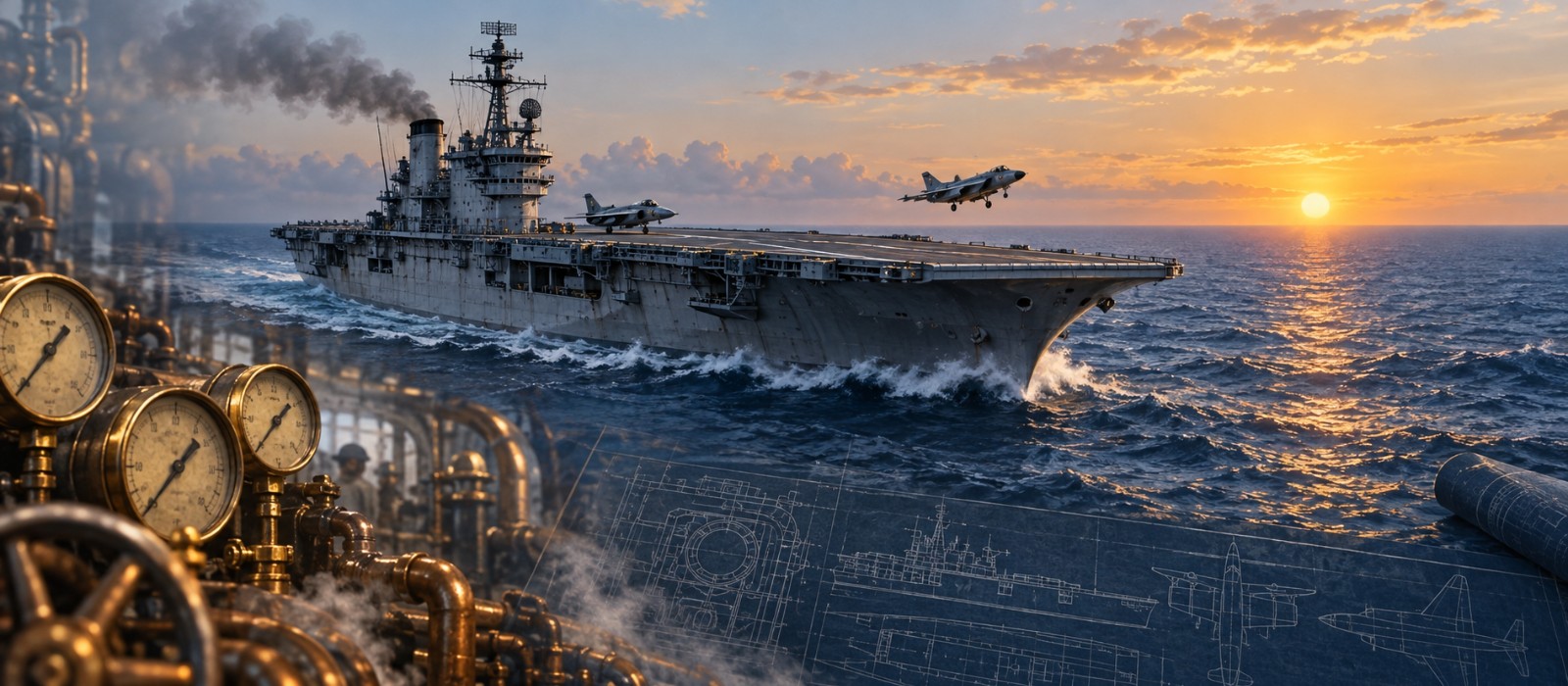
Several decades after the event, I have penned some recollections of my thoughts from the time I was a young, newly promoted Lieutenant in the Engine-Room department of INS Vikrant during the 1971 war. The motto of the NBCD school - To float, to move, to fight - comes to mind when I think of the role played by our Department during the ‘71 operations. It has been widely acknowledged that the performance of that Engine Room (E/R) team was legendary even in the official history of the IN and in other recollections. They managed an impaired propulsion system so well, that flying operations continued without a glitch and Vikrant’s air wing excelled.
You Can’t Raise Hell if You Can’t Raise Steam
In March 71, while the civil war and liberation struggle had ignited in East Pakistan, Vikrant was literally a sitting duck in Bombay with one boiler cracked and all other boilers indicating sub-surface cracks. One couldn’t believe when a POME doing his evening rounds, detected and located water seepage from one of the water drums of the A1 boiler. A more detailed examination revealed that the drum had a crack along its riveted joints. In those days the Navy did not have the facility to radiograph such thicknesses of steel and Bhabha Atomic Research Centre (BARC) had to be brought in. They examined all four boilers and sent their results in strips of film. I was made to sit in the hallowed corner office of the then CSO (Tech) to convert them into pencil sketches so that the severity of the problem could be understood by all. Although only the A1 boiler water drum had displayed physical signs in the form of slow seepage of water, all other drums had a few sub-surface cracks that might have worsened at any moment.
A Carrier Without a Skipper!
Quite inexplicably, when Captain Kirpal Singh left in early 71, after completing his tenure, no new Captain was appointed. The ship was tied up at Ballard Pier Extension (now Cruiser Wharf) for nearly three months as no one seemed to know any better. The ship was “cold moved” to anchorage before the onset of the monsoon to avoid any damage to the hull. An Acting Captain was appointed as all the other senior Captains sought more dashing appointments to command other frontline ships. Once we were at anchorage, we could sense a wind of change. After swinging on her anchor for 100 days, the ship was dry-docked for some essential repairs and within two weeks of undocking we set sail to the East Coast.
Into Harm’s Way, but on the other Seaboard
Captain (later VAdm) Swaraj Parkash took over command. Before we left, we were told in no uncertain terms, what was in store for us at the other end. I vividly remember the thundering speech made by Admiral Kuruvilla, the Fleet Commander, and another one by Babu Jagjivan Ram, our Defence Minister. We knew we were heading in harm’s way. However, most of the crew onboard, especially those involved with flying aircraft off the deck, were unsure how we would ever be able to operate with such a doubtful propulsion system.
Only three of the four boilers were available; the A1 boiler - critical for charging steam to the catapult - was out of action. After months of lying idle, all other machineries were also suspect and even a simple snag could make flying operations risky. Moreover, the East Coast had no shore support to offer, with only a small “Binny’s” workshop available at Madras. We in the E/R put up a bold front and carried on as if everything would be fine. Fortune, as usual, favoured the brave. The Commander (E) had only one thing to say to all of us, “If I am ever to be seen in a boiler suit, shame on you all.” We knew our honour was at stake.
Make and Mend
Our defence against possible boiler burst were elementary methods such as placing a protective steel band around the riveted joints of the boiler drums or reducing the boiler pressure by a few PSI. At best, they were psychological buttresses. While these steps might sound rudimentary, the drills we went through were not. Boiler emergencies were practised to perfection and so were other contingencies. For example, an additional watchkeeper near the boiler gauge glass kept a close watch on the gauge, especially during catapult charging. The main steam range was cross-connected between both engine rooms so that the only boiler in the forward engine room was supported adequately, especially when the catapult was charged. All junior engineer officers went through completely blindfolded drills from the Wardroom in the 4R compartment up to the 4M compartment to start the M7 Diesel Generator.
Even before we left the harbour, we had a serious problem. We couldn’t make feed water with our evaporators because the water in Bombay Harbour was dirty due to monsoon turbulence; we had just enough feed water to last about three watches. However, we set sail, struggling with the five evaporators. Finally, before we reached Goa, we started making surplus feed water.
Just as we reached Madras, one of the extraction pumps had a bearing failure. Apart from many “I told you” looks in the Wardroom, everyone suddenly seemed to know the critical role of the extraction pump. Well, they had miscalculated the resolve of the E/R. Within a couple of days, we were back in business with the extraction pump humming as ever. Thereafter, the ship ran like a proverbial sewing machine. Spirits were high and almost no one realised we were still sailing on three tenuous boilers. There were many occasions when major jobs, normally undertaken by the dockyard, were completed by the ship staff using the limited workshop facility onboard.
Turning Into the Wind
The first few aircraft launches were nail-biting. Over time, the drill of charging the catapult somewhat slowly (to reduce pressure variations of the boilers) and building up ship speed delicately to achieve the “wind on deck condition” was perfected. As the ship gained confidence, everyone and everything fell in place and flying operations were conducted with relative ease. It was not perfect, but it was good enough, I suppose.
Boiler and Flying Suits Together
Today’s readers might not even understand the way the “old Navy” saw us “boiler-suit walas” in general in those decades. In 1971, I lived through engineers growing in esteem within the ship and being given minor privileges like cabins with port holes or being permitted to grab a beer from the rear door of the ante-room bar. The departmental spirit of the E/R showed in various ‘fun” activities. There was nothing that we could not do. We won most of the interdepartmental competitions, including a famous football match, decided by a penalty shootout. I vividly recall how popular LME Patil of the flight deck team was in concerts, belting out Kishore Kumar songs. Or the Senior Engineer, Lt Cdr Bhushan keeping the wardroom in splits with his jokes or a bawdy rendition of the song Dekho Dekhoji Bhool Naa Jaana. The camaraderie in the wardroom was superb.
Since we left Bombay in a hurry, the welfare officer had not found time to pick up any 16 mm movies from the film library in INS Angre. So, we were left with just two Hindi movies Karwan and Mera Sayaa which God knows how many times we saw until most of us knew the dialogues by heart. Monica ... Oh My Darling from Karwan and Aur Phir Kya Hua from Mera Saaya were “adapted” suitably during ward room banter.
CNS’ Visit
Admiral Nanda, the CNS visited the ship to see for himself how well the she had worked up the squadrons. Murphy’s Law was in action when, with the first Hawk on the chocks, the “Billy” (as the “Cat” was called in Hindi) was down and that’s when the FDO, Lt Cdr Soota’s expertise came very handy. His sixth sense told him why one particular lamp did not light up in the HOWDAH panel. He ran from his station near the HOWDAH to the fore end of the catapult, opened up a flap and with his handkerchief cleaned the lens near the “Snail’s eye” lamp. Before the bridge fully realised what happened, the Cat was up and ready to launch. The Hawks were launched in fairly good sequence and fired at the towed target. Lt Cdr SK Gupta, “Tiger” leader was so good that he shot off the towed target entirely on his first run of rocket firing. Later, the CNS remarked in jest that the Squadron CO was perhaps covering up the marksmanship of his other pilots. Vikrant had finally proved to the rest of the Navy, that even a limping ship could put out to sea and perform her intended role if the men behind the machines bent their hearts and souls to their jobs.
The CNS went around the ship and went straight to the boiler room to see the A1 Boiler, now lying cold. Before heading back, he had a few words with POME H. Singh who “owned” the A2 boiler. He asked him about letters from home and enquired what was his wife writing about. His reply was spontaneous. “Sir, likhti hain, Dacca jaoge tho zaroor mul mul lekay aana!” (If you go to Dacca, get me some muslin!) CNS got a whiff of the spirit in the ship’s bowels and must have realised that the Vikrant was indeed “Stood To” for the conflict that seemed around the corner.
He was so happy with his visit, that he granted permission for the ship to return for a quick visit to Bombay for Diwali. There was much merriment when this was announced and the SRE operator quickly played “Bombay Meri Hai” on the main broadcast right in the middle of working hours. Of course, the trip to Bombay never happened, as we were diverted from Madras to Port Blair and thereafter to Port Cornwallis. That was a beautiful lagoon and there couldn’t have been a better place to rest and recuperate before the balloon went up. The Engine Room could not relax, though. We were at short notice and the two-watch system could not be eased. We sailed from there on 02 Dec and in the evening the Captain addressed the ship’s company over the main broadcast to let us know that for all purposes we were at war.
Making Steam with the Battle Ensign Hoisted
After all the rigorous workup, the war itself seemed to be a “breeze.” Every time aircraft were launched, there was that pregnant eagerness for their safe return and recovery. A few Alizes got back with some bullet holes. Apart from the official debriefing sessions, there was a more light-hearted debrief for the wardroom. Lt Mohan Varghese had some hilarious situations to narrate. The pilots were always a bubbly lot and their enthusiasm kept our spirits up always.
We were blessed to have outstanding role models leading us from the front. Captain Parkash himself was an admirable man of very few words, but always with clear intent. His address to the ship’s company on the eve of 2nd Dec was very clear and powerful. All HODs were stalwarts and stood tall amongst us juniors. Cdr HML Saxena, the XO, was exceptional as a team leader. He had an endearing way of getting things done. Cdr (E) BR Chowdhury (Later VAdm), was a quiet man with clear ideas and pragmatic vision. The “Senior,” Lt Cdr Bharat Bhushan (Later VAdm), was an outstanding professional, with a cherubic smile and unending stock of Punjabi jokes. Lt Cdr Suresh Soota the Flight Deck Engineer Officer was as sharp as a knife. Shepherding us junior officers was Senior Watch Keeper Lt Kulwant Singh Bhasin, whose domineering spirit was dreaded by those who crossed his path. We had a bunch of very spirited sailors such as the legendary MCHMECH BR Sharma; on the flight deck, we had CHERA Mathews, a bundle of energy. Then we had younger sailors like Shaukeen Singh Yadav, Awasthi, Ratra, RP Singh, Vijay Sood, H M Sharma, A K Bhalla, Aurora, Nathan and many others. Looking back, each one was a role model and we youngsters learnt from their collective experience. We were a happy lot and interacted with ease at all levels.
Sounding Retreat
The war came to a rather abrupt end on 16 Dec. We had entered Paradip harbour for refuelling. Certainly, we could have continued pummelling the Pakistanis forever if there was a need. VAdm Krishnan, the FOCINC East, flew back after participating in the surrender ceremony in Dacca and addressed the ship’s company to give us a first-hand feel of what a stupendous victory the nation had won. There was much merry-making onboard and the trip back to Bombay was memorable, with heart-warming receptions at Paradip, Madras and Cochin.
The efforts of the Engineering department were well recognised. The Cdr (E) was awarded Vir Chakra, the Senior Engineer and the FDO were awarded Nausena Medal and the Senior Watchkeeper and several key sailors were Mentioned-in-Despatches.
Rarely does an Engine Room department ever get a chance to be so acknowledged for having proved their mettle so demonstratively. Very often, men who run the machines are taken for granted and seldom get any adulatory attention beyond the gangways of a ship. A limping Vikrant gave us a chance to show our skills and chutzpah. It might be difficult for the current generation, used to better technology and touch-type controls, to imagine what we went through in the mind-numbing heat of the engine rooms, with so many uncertainties of operating boilers which could have burst anytime. Those moments of danger and elation could only be felt and not described. So today when some youngster asks me what we did in the Vikrant during the war I just reply “Oh! We put the screws on.”
