


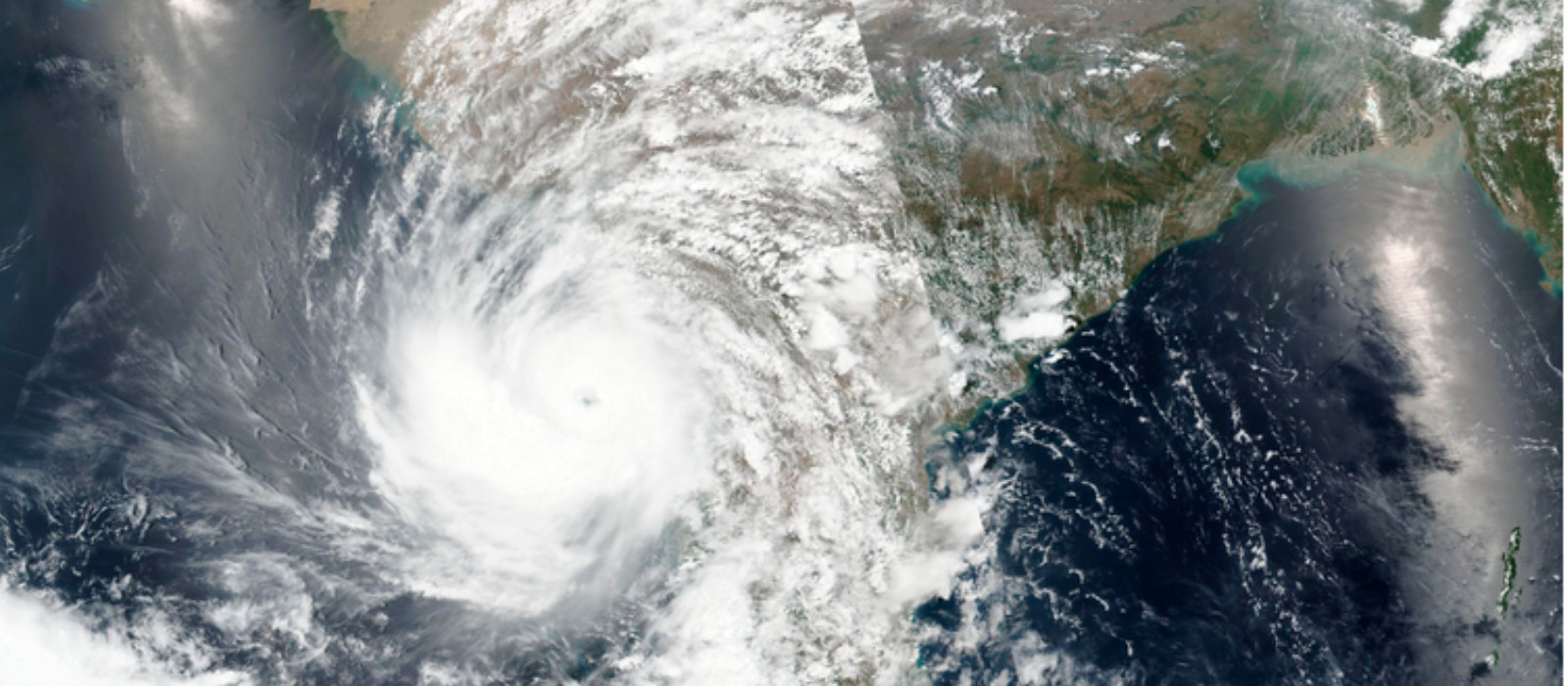


This is a short narrative about one ship, INS Kochi, one super cyclone named Tauktae and of a SOS sortie in which several hands from our ship reached out figuratively and literally to rescue the crew of a sinking barge. What Kochi did was part of the Navy’s effort to mount several Search and Rescue (SAR) missions in extremely adverse conditions from 17 May 21 and which lasted for several days. This is Kochi’s story from the SCO’s (Signals Communications Officer, always nicknamed “Flags”) eyes. The cyclone, of course, had been building up and weather warnings were severe. We need not go into why the crew of a service barge, P-305, on task near an oil platform, had not been evacuated in time. Our orders were to reach the area with despatch and save the crew who were in grave danger. It is difficult to paint a picture with words of the fury of nature’s elements, winds, and waves as they rose on the scale. On the Beaufort’s scale, the prevailing condition were corresponding to force 9 to 10. This measure, so familiar to seamen, gives the relationship between wind, wave height and overall wind force on a scale from 0 to 12. On that fateful day, we were responding to distress signals in a sea state veering from 8 to 10 and it is not something that mariners wish to encounter. We were overwhelmed by the fury of nature that day. It was raining heavily and the wind was gusting at more than 50 to 55 knots while the ship was rolling heavily upto 30-35 degrees.

Fig 1: Picture of the Bridge’s WSDS Repeater showing True Wind as 53 Knots.
From any officer’s earliest days of learning seamanship and navigation, there are lessons on specific steps and methods of avoiding Tropical Revolving Storms (TRS). Given the weather prediction systems and information sharing available in the past few decades, there would hardly be any justifiable reason for ships to find themselves in one. Ours was justifiable, of course; it was to reach other seamen in distress and Kochi pressed on in those mountainous seas with a grim determination. Indeed, there were souls to be saved.

Fig 2: Waves breaking on ship’s foxle during the storm.
“They said you would come!”
After leaving Mumbai harbour at around 1400h the ship could establish MMB communication with Barge P-305 through a relayed message passed by ONGC’s Neelam control centre. Around 1530h, we could establish direct communication and as soon as I established radio contact with the barge on Channel 16, the common VHF frequency to get more details, I heard, ‘Sir you are here. We were waiting for you. They said Navy would come.’ It was the radio officer and I must say that this one sentence was a reminder of the great responsibility and immense amount of faith reposed in the Indian Navy and in its ships closing in. Everyone in the stranded barge may have been very anxious and even fearful to be caught in a cyclone, but in a sense, everyone on our bridge probably thought that the Radio Officer had voiced a simple statement of their hope as well as confidence in us. Without anyone saying anything, all on the bridge seemed to be silently resolved to doing whatever it would take to rescue them. We realised that we were more than 15 miles away and charting a direct course seemed impossible in the heavy sea. We steered on a series of headings. To jump to a happier ending, we (IN ships and aircraft) did come back home with a very large number of survivors. Kochi alone rescued more than 125 survivors of the 261 workers and crew of P-305. Winds, waves, and a floundering barge did claim several lives, though. I had a lump in my throat when I met Chandan Kumar Sinha in the ship’s hangar amongst the other survivors. He was the radio officer I had spoken to on Ch 16! In an understated way, he said, “You guys did well,” then he said thank you. I replied, “We just did our duty and gave our best.”
But the larger point to think about is how could we have done it? How could we have pulled it off? After all, the same elements and conditions that were responsible for the barge sinking were the ones in which we needed to reach out and pluck dozens of survivors from the tumultuous sea. Perhaps there is no right answer. My first response would be that I don’t know how we did it.
What Did We Do?
We did nothing out of the ordinary. We followed our Standard Operating Procedures (SOPs), anticipated and analysed the likely risks and their implication for our mission. We adapted our internal organisation to mitigate those risks whilst ensuring the safety of personnel and machinery onboard. Here is a broad overview of the sequence of events that unfolded on that fateful day.
Upon leaving Mumbai harbour, we had strong winds of more than 55 - 60 knots in sea state that seemed like 9. We were experiencing wave height of about 12 metres and an unusual northerly set of 5 knots. The scene outside was even more intimidating. The churning of ocean had turned the blue ocean into a muddy whirl. Flotsam of different sizes and shapes could be seen swirling around just as the wind did.
Attempts to close the barge on a direct course resulted in ship rolling almost to her limits and this was seemingly against the principles of calculated risks. The impact of the weather was such that despite ordering revolutions for 14 knots, we were making good only 8 knots on a SW-ly heading. Similarly, on a NNE heading at ordered revolutions for 6 knots the ship was making good 14 knots on ground. The set we experienced was more than 60 - 70 degrees and seemed to be constantly changing. In that confused sea, we could steer only two courses within the acceptable limits of roll for the safety of personnel onboard and to avoid undue damage to ship’s machinery. So, we zigzagged towards P-305. As many readers can imagine, this took all the skills and experience that our old man could muster, and the ship was handled deftly.
After the initial radio communication, the barge’s radio officer frequently contacted us and urged us to close them faster. In Search and Rescue (SAR) there is also the equivalent of the golden minute or golden hour depending on the circumstances, and time of course, is precious. Our responses to the barge were a combination of assurance that we would be there soon, and a bit of tough talk to also calm them and so that they could focus on their part in the rescue. By the time we arrived in the vicinity, the barge was already sinking having taken on a fair bit of water. The crew had begun to “abandon ship” with only life jackets.
“We did not have any life-raft with us. We were hoping someone would come and save us. The Indian Navy and OSV rescued men in the sea. But they could not come near our barge due to rough waters.”1
-Monu Kumar, P - 305 Survivor
We immediately lowered our own rafts on a chosen heading with an appreciation that they would drift towards the sinking barge so that the survivors could board them. After some time, we spotted some men and noticed that they were drifting at a very fast rate. The ship itself was drifting at 5 knots. Lowering of additional life rafts was pointless due to strong drift and confused seas and lowering of boats was out of the question too. Therefore, after a quick brainstorming in the bridge, it was decided to lower scramble nets. We had four of them - two on each side. Rescue teams comprising 10 to 15 sailors with one officer and MCPO as in-charge were quickly briefed and were kept stand by near the scramble nets, in alleyways and near the Sick bay. The real test of ship handling began now as the ship manoeuvred in close vicinity of survivors to bring them on the leeward side while experiencing heavy roll and a strong drift. Only those who have experienced such heavy seas would appreciate that in the driving spray, grey skies, likely rain, swell and waves, it is sometimes impossible to locate survivors. One can spot a man in water one second and lose him the next. We must complement those survivors who stayed in groups together, which helped in their rescue during the night. As the darkness fell, the groups could be located by the marker lights fitted on life jackets.
Since they were drifting at a very fast rate and many had lost their orientation due to heavy seas, it was important to quickly direct them towards recovery points where scramble nets were lowered. We used signalling projectors and loud hailers for this. On a personal note, I recall hailing one of the survivors the next morning. He seemed lifeless but, on hearing me he shook his tired body to indicate he was alive. We soon recovered him aboard. That man showed that there is nothing stronger than the will to survive and coupled with hope, it can be empowering.
“I jumped into the sea with a life jacket. I had no idea where to go and what to do. I was directionless, Like an aimless wanderer, With only hope to cling on. And then God sent the Indian Navy to take me out of the well of death.”2
-Ravinder Singh (Cook), Survivor
Apart from other Indian Naval and Coast Guard ships and a few aircraft in the area, there were the small offshore support vessels/ tugs sent by ONGC. They too rallied to the task at hand and gave their very best. Despite skeletal crews and in such trying conditions, they remained dauntless and responded to our instructions on channel 16. Apart from plucking some men from the water, they sometimes could indicate the position of survivors using their high-powered search lights. In fact, after recovering 42 personnel around sunset we thought we may have lost the others, but for a timely input from MV Great Ship Ahalya on MMB about another group of survivors. By dawn the next morning, we had rescued 112 seamen. Later by sunset of the next day, we had recovered a total of 125 survivors.
One of the other important aspects of a rescue operation is the medical care available to survivors. The ship’s medical officer inspiringly led his small team. This team was soon augmented by others from the ship’s company including the logistics officer. We set up makeshift arrangements in one of the hangars for the large number of mariners we had rescued. The MO categorised them in three groups, so that those with severe injuries could be helped on priority. Further, he and his team also provided psychological counselling to those experiencing post-traumatic stress; they had been through a harrowing time, as anyone could see. The silent contribution of ship’s chefs and other galley support volunteers needs a special mention here. Despite the heavy rolling and pitching, they worked indefatigably to ensure a constant supply of hot drinks and meals to survivors as well as to our own crew.
Some Life Lessons
In essence, Tauktae was a test of leadership, our Navy’s culture and a ship’s own sprit, teamwork and organisational efficiency. A ship’s culture is a microcosm of the organisational culture at large and we were no different. In a sense, these are matters of standards we have seen, try and maintain or improve, as well as about SOPs. High standards and SOPs combine well always. While destiny chose us to save so many lives in those difficult circumstances, one is certain that any other Indian Naval Ship would have done it too.
It was also the result of our overall training and years of executing our core professional tasks that enabled us to perform as a team. Every man onboard understood what was expected of him. In another sense, the crew’s will to serve, reaching out into swirling waves and howling winds to rescue mariners coupled with a mariner’s will to survive came together to tame Tauktae. The sea, like the mountains, can humble any mariner, and we felt humbled to have weathered the storm and returned as an even stronger and tightly knit team to harbour. Everyone onboard grew taller personally and professionally in their own eyes while weathering the storm to save lives. As Nasim Taleb has put it, we were Anti - fragile that day!3
Endnotes
-
“Scared Yet Strong, Brave Survivors P-305,” The Times of India, 04 June 2021.
-
Amit Arora and Sachin Gaad, “ONGC Barge P -305: It was all Dark for Survivors Till Navy Rescued Them,” The Free Press Journal, 18 May 2021.
-
Nassim N. Taleb, Antifragile: Things that Gain from Disorder (UK: Penguin Books, 2013), 3-5.
