


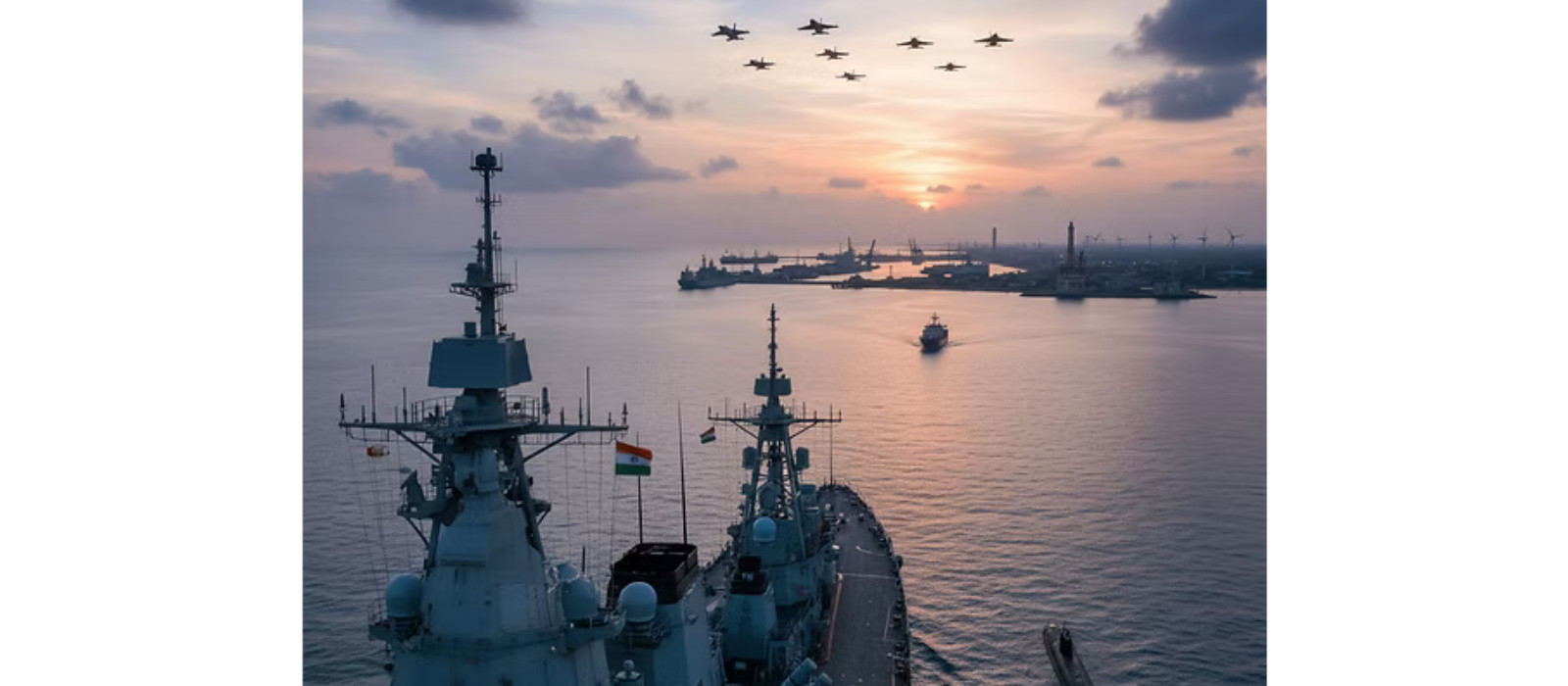


“Separate ground, sea, and air warfare is gone forever. If we ever again should be involved in war, we will fight with all elements, with all services, as one single concentrated effort.”
Gen Dwight Eisenhower House of Commons Debates, Official Report - Volume 5 Page 5083
Introduction
The Indian Armed Forces are in the process of undergoing significant transformation with the Government of India’s landmark decision on the appointment of the Chief of Defence Staff (CDS). The CDS-headed Department of Military Affairs is mandated to facilitate a restructuring of military commands and bring jointness in operations with optimal utilisation of resources. The idea of ‘Theaterisation of Military Commands’ has been under deliberation at the political, military and academic levels at an increased pace since the PM’s address at the Combined Commanders Conference 2015, where he highlighted the need for reforms in senior defence management. On 17 February 2020, the CDS stated that the restructuring of the Indian Armed Forces would include forming a “Peninsula Command” (Joint Maritime Theatre Command) by the end of 2021, integrating the Western and Eastern Naval Commands, along with earmarked Army and IAF assets.1
In recent years, the threat of a ‘Two-Front War,’ on the Western and Northern fronts, has been acknowledged as a major concern by successive Chiefs of Army Staff. Accordingly, the Indian Navy has been preparing to undertake maritime operations against a Sino-Pak collusive threat in the Indian Ocean (IO), exercising its responses in the biennial theatre level exercise TROPEX-19.2
The 1991 First Gulf War is a good example of joint warfighting after the Goldwater-Nichols reforms of the US military in 1986. In 2016, the PLA formed five Theatre Commands to optimise forces available to affect operations in a coherent manner, which was a continuation of the transformation initiated by the PLA after the First Gulf War.3 Similarly, India’s Maritime Theatre Command (MTC) is intended to enhance synergy and coordination among all services and subordinate commands to counter the Sino-Pak collusive threat in the Indian Ocean Region (IOR). However, integrated application of combat power can be challenging. MTC can achieve success only through the strengthening of its ‘Unity of Effect’ by developing ‘Joint Maritime Theatre Strategies’ for peace and war and create integrated force capabilities to counter future threats and fight a ‘Two-Front War.’
The term ‘Unity of Effect’ taken from Edgar Allen Poe’s essay on “The Importance of the Single Effect in a Prose Tale,” describes a joint approach that seeks to employ forces in multiple ‘Lines of Operations’ so as to attain an overall effect greater than individual sums, wherein the same assets can be applied in more than one domain, delivering ordnance at the desired point. The creation of an Integrated Theatre Command would ensure ‘Unity of Command’ and ‘Unity of Effort’ due to establishment of joint command structures, centralised operational planning and direction. ‘Unity of Effect’ is therefore, considered appropriate for examination and for defining warfighting capabilities of the MTC.
The Collusive Maritime Threat
China’s Maritime Strategy in IOR. China has deep maritime and military interests in the IOR owing to the ‘Chinese Dream of National Rejuvenation,’ to be achieved by 2049. Central to this grand strategic vision are two interleaved economic interests. The first is President Xi Jinping’s Belt and Road Initiative (BRI), which includes Pakistan, Myanmar, Sri Lanka, Bangladesh and the Maldives, all of whom are in India’s strategic neighbourhood. The second is China’s dependence on energy from the Middle East and its endeavour to overcome the ‘Malacca Dilemma’ by operationalising Gwadar and the China Pakistan Economic Corridor (CPEC). Xi Jinping has articulated this as “offshore water defence and open seas protection” and the transition of Peoples Liberation Army Navy (PLAN) into a “strong and modernised naval force” which strengthens China’s ability to project force and protect its maritime interests beyond the West Pacific.4
PLA Capabilities for Deployment in IOR. The PLAN has rapidly transformed into a ‘Blue Water’ Navy in the last decade. China’s warship building pace will enable the PLAN to deploy in large numbers in the IOR while maintaining adequate force levels for eventualities in the Western Pacific. By 2025, China is likely to have around 400 warships.5 By 2030, PLAN is likely to possess a total of 76 submarines, which will include 13SSN/ SSGNs, eight SSBNs and 55 Yuan variants with Air Independent Propulsion (AIP). There will be 200 major surface combatants, up from the present 135, including aircraft carriers and amphibious ships. China is also acquiring carriers primarily for global power projection for operations in ‘far seas.’6 Therefore, with four to five aircraft carriers and a large number of major surface combatants available by 2030, the deployment of a Carrier Task Force (CTF) in the IOR is likely.
PLA Long-Range Vectors (LRVs) during Conflict in IOR. PLA LRVs can suitably support the deployment of Chinese naval forces in IOR. The DF-21D Anti-Ship Ballistic Missile (ASBM) with a range of 1500 km has a reach up to the Bay of Bengal and the DF-26B ASBM Intermediate Range Ballistic Missile (IRBM) with a range of 4000 km can cover the Arabian Sea, the Bay of Bengal (BoB) and the North Indian Ocean. The maritime strike capable H-6J long-range bomber, equipped with six supersonic YJ-12 Anti-Ship Cruise Missiles (ASCMs), provides PLAN Aviation significant capabilities to strike into the peripheries of the East Indian Ocean and the BoB, with overflight through a neutral country’s airspace or international air routes with AAR support.7 Supported by a constellation of Electronic Intelligence (ELINT) and Electro Optical-Infra Red (EOIR)/ Search and Rescue (SAR) satellites for continuous surveillance, the LRVs can be employed against IN fleets, especially the CBGs, restricting their freedom of action in the Eastern theatre.
PN Forces and Capabilities. The PN has traditionally maintained a strategy of ‘offensive sea denial’ and ‘coastal interdiction’ through the deployment of submarines, missile boats, Long Range (LR) precision strike missiles and special forces. The restructuring of PN by expanding and diversifying naval bases (Karachi, stationing submarines at Ormara and rotating surface vessels to Gwadar), future acquisitions of ships and submarines, and upgradation of ships and maritime strike aircraft with LR ASCM, provides considerable offensive capabilities.8
Notwithstanding economic turmoil and severe fund crunch, the PN has been a major beneficiary of Chinese military largesse in the last decade since the signing of the ‘Treaty for Friendship, Cooperation and Neighbourly Relations’ in Apr 2005.9 Four F-22P frigates and four FAC(M) were inducted into the PN in the following years. Further, China is building four new Type 054C/P frigates and eight Yuan AIP diesel submarines, for induction from 2021. The jointly developed JF-17 multi-role fighter aircraft (designated as J-10 in PAF) fitted with the supersonic (Mach 4+), CM400 AKG air-to-surface missiles (range:180-250 km) provides formidable anti-ship capability. China and Pakistan are also cooperating in many other defence sectors, which include space and cyber capabilities as well.
PLAN and PN Joint Operations. The PLAN has maintained a permanent presence in Western IOR with its Anti-Piracy Escort Force (APEF) since 2008. This is now better facilitated by the PLA military base in Djibouti, inaugurated in 2017. In addition to Djibouti, Gwadar port can be readily used by PLAN ships, including their larger ships. A sizeable port area is available for shore facilities to support the PLAN fleet.10 Further, collaboration between the two navies is being reinforced through bilateral exercises that cover a broad spectrum of naval operations.11 In January 2020, PLAN and PN ships participated in Sea Guardian-2020, a nine-day exercise, with one of the objectives as ‘Defence of CPEC.’ The exercise took place in the North Arabian Sea and involved special forces, warships, aircraft and for the first time, submarines (including a PLAN submarine).12 These exercises have progressively been upgraded to include live-firings, indicating greater interoperability and leveraging common capabilities.
Space and Cyber Collaboration. China could also employ its space and cyber forces to degrade and disrupt the IN’s warfighting capabilities. PLA Strategic Support Force (PLASSF) has developed considerable offensive and defensive capabilities in space and cyber warfare to achieve a range of objectives including disruption of enemy C4ISR.13 Pakistan has contracted the use of the Chinese Beidou satellite navigation system allowing China to set up a monitoring station in Pakistan, that could be used for cyber espionage. Besides, China has provided remote sensing satellites to Pakistan and is assisting it in building its cyber warfare capabilities.14 Basing of such disruptive space and cyber capabilities in Pakistan may significantly degrade IN’s warfighting capabilities in the maritime theatre. Such threats can be further aggravated by China’s Anti-Satellite (ASAT) capabilities that could disrupt IN’s space-based Command and Control (C2) network.
Collusive Military Threats in the Indian Ocean. There is a discernible confluence of military-strategic interests and interdependence in the Sino-Pak strategic partnership, and most so in the maritime domain. Sino-Pak combined naval forces, supported by LRVs, will be formidable in the IOR. The effectiveness of the PLAN in IOR can be debated on the factors of operating on ‘exterior lines’ and extended ‘Lines of Communication.’ However, PLAN forces have developed adequate capabilities to have sustained reach and mobility in the IO in the form of sea and hard basing.15 In a ‘Two-Front War,’ Sino-Pak cooperation could manifest in all theatres – West, East and also within the Indian Ocean.
Challenges for the Joint Command
Naval Component. The IN is the largest resident naval force in the IOR and has transformed into a network-enabled blue water navy. It is envisaged to be a 200 ship and submarine navy by 2050, a substantial increase from the current size of 132 ships. Compared to the expected PLAN forces that China can deploy in IOR in a likely conflict in the near-term, the IN enjoys a ‘favourable balance.’16 With the availability of one aircraft carrier, which is likely to be two by 2025, the IN will be capable of exercising limited sea control over larger sea areas. However, against a combined force of PLAN and PN, the future naval force may not be sufficient in terms of numbers and firepower (Type 055, Renhai Class, is an example of firepower overmatch) to simultaneously counter the threats in the multiple theatres of the IO Front. Consequently, the application of naval power simultaneously in the large Area of Operations (AO), especially in a ‘Two-Front War’ will remain a challenge with the current force levels.
The IN’s submarine force level is an area of concern, which is being addressed through Projects 75 and 75I. However, with the delayed delivery of Project 75 submarines (non-AIP) and Project 75I yet to take off, submarine numbers will remain critical in a ‘Two-Front War.’ The IN is at present operating one SSN on a lease, which will end in 2022 and is extendable by three years. While negotiations for leasing another SSN are underway, with no indigenous SSN programme firmed up as yet, the range of capabilities that submarines bring would be less than those necessary.17
The increased proliferation of nuclear and AIP submarines in the IO Front is a major developing threat. At present, the IN’s P8I aircraft and towed array ships are the primary assets for anti-submarine operations. The induction of MH60R helicopters, procurement of six P8Is (in addition to the eight plus four aircraft) and shallow-water ASW ships, will provide an impetus to counter the growing underwater threat.
Air Component. Air dominance in the entire maritime AO is practically impossible. However, adequate airpower must be available to be employed in the theatres of operations as and when the need arises. The primary objective would be to deter enemy naval forces from operating with impunity and particularly to deny freedom of action to the enemy CTF. The IAF has three maritime air squadrons and uses the SU-30MKI aircraft, along with the air-launched BrahMos Anti-Ship Missile (AShM), have become a potent platform for long-range maritime strikes, adding to the capabilities of these squadrons. During Exercise Gagan Shakti 2018, the IAF demonstrated the capability of undertaking maritime strikes in the Western and Eastern theatres sequentially, while operating to achieve air dominance in a continental war.18
The IAF’s force levels are at a mere 30 fighter squadrons as against the ideal sanctioned strength of 42 squadrons. During a ‘Two-Front War’ the availability of sufficient maritime air power will be doubtful until air dominance is achieved on both frontiers. Even the latter will be a difficult objective to achieve. Simultaneously, the Western theatre in IO Front will demand a Favourable Air Situation (FAS) for the naval forces to exercise sea control as well as Sea Lines of Communication (SLOC) protection and interdiction closer to the Pakistani coast extending to the Gulf of Oman. This will require combined CTF, as well as shore-based airpower effort.
Land Component. The Indian Army (IA) unit with a maritime role is the re-tasked (in 2009) 91 Infantry Brigade for amphibious warfare to meet any exigencies, requiring the employment of troops from the sea.19 For the defence of Andaman and Nicobar (A&N) Islands, the 108 Mountain Brigade is based near Port Blair. In a conflict or during any Out of Area Contingency (OOAC), such as India’s response to the Maldives crisis in 1987, the amphibious brigade and naval/ air transport forces could be called upon to respond. However, compared to 21st Century amphibious capabilities and concepts of operating in complex environments, the Indian amphibious forces currently lack quick mobilisation and operational capabilities.
Integration of Joint Forces. In joint operations employing diverse forces, success may be achieved only with deep integration, which includes common procedures and precisely coordinated actions. Operating philosophies of Indian Armed Forces, information-sharing practices, equipment and training, are presently inclined towards single-service operations. Lack of interoperability between services is what needs to be addressed. Further, continuous joint training of all forces, for effective output is a necessity. As an example, in the 1971 War, both the IN and IAF undertook missile attacks and air strikes respectively, on oil installations at Karachi, without any coordination. The planning and coordination of operations, by an integrated Theatre Command, to achieve the desired ‘Unity of Effect’ during operations will be difficult, but necessary.
Flag Posts of the Future
In a ‘Two-Front War,’ the MTC will be responsible for planning and fighting the maritime war. As is evident from the foregoing, a collusive PLAN and PN, being a formidable force, will have to be countered with a combination of sea, air and land forces, with integrated support in space and cyber domains. To counter such a threat, the MTC will need a coherent strategy for deterrence and conflict, develop forces and capabilities to counter the collusive threats, and apply joint combat power to achieve ‘Unity of Effect.’ The MTC can achieve success and effectiveness through a continuous objective assessment of the operational environment. Further, the acquisition of capabilities needs to be planned based on the threats expected during conflicts and situations less than war.
Joint Operations. The types of maritime operations under the ambit of MTC should be defined after extensive deliberations. Should it be limited to undertaking only Joint Maritime Air Operations and Joint Amphibious Operations, or could it be entrusted to undertake operations with ‘tailored joint forces’ that may include single-service operations or OOAC, coastal security and HADR? The consideration of all types of operations in the maritime AOR with a ‘unitary view of war,’ at the military-strategic level, can provide a conceptual framework with which joint warfighting capabilities can be developed.20 Notwithstanding the character of forces, to achieve economy of effort and cost benefits, the MTC should be operationally responsible for undertaking missions and tasks with single-service components or joint forces drawn from the component commands whilst maintaining an overall maritime outlook. It would mean that the integrated Theatre Command will not only fight a maritime war, but would also undertake Military Operations Other Than War (MOOTW), HADR, Flood Relief Ops and other peacetime operations with tailored joint forces.
Conceptual Framework. The Joint Doctrine Indian Armed Forces, 2017 states “undertaking of Integrated Theatre Battle with an operationally adaptable force, to ensure decisive victory in a networked centric environment across the entire spectrum of conflict in varied geographical domains.” To develop forces and capabilities for future conflicts, the strategies that will be required in the IO Front can be broadly categorised as ‘Offensive Sea Denial’ in the South and Eastern theatres against PLAN ingress into IOR and ‘Sea Control’ for freedom of action in the Western theatre. Hence, the development of a ‘Joint Maritime Theatre Strategy’ will provide the required Unity of Effort and aid in developing significant capabilities in countering maritime threats during peace and war.
Creating Asymmetry of Forces. The IN’s advantage in the IOR, against PLAN and PN individually, would continue to exist until the PLAN CTF remains in the West Pacific, wherein the USA and its allied naval forces keep the PLAN engaged. However, should the PLAN CTF start operating in the IOR, the MTC will have to create adequate presence through the deployment of asymmetric joint forces (Unmanned Vehicles, LRVs, Shore-Based Maritime Strike Aircraft). On the other hand, power projection in the South China Sea (SCS) as a countermeasure, should be included as an option in the joint operational plans. Therefore, the MTC should examine and propose the joint force elements required, to deter Chinese forces in the IOR, achieve limited sea control in the IOR and threaten Chinese interests in the SCS.
Integrated Forces. In future warfare, jointness at the operational and tactical levels are essential, and major militaries, including the PLA, have integrated joint forces. The ‘Unity of Effect’ in joint operations is possible with tailored force allocation, deconfliction of tactical plans, and C2 at the tactical level, aided by network-centric operations. To achieve this effect, the Joint Operations Centre of MTC should integrate the service component forces, within a network that provides a Common Operational Picture (COP) and facilitates target information exchange between units. The current individual services’ operational networks need to be modified with appropriate gateways to allow sharing of the COP. However, to achieve unit-level integration, a common datalink with joint radio protocols, such as the U.S. tactical datalink, Link-16, and compatible radio equipment, such as SDRs are essential on the platforms/ units of the MTC’s component forces.
Capabilities for a Two-Front War. The threats in a Two-Front War and the challenges to the MTC will require a review of the planned inductions and acquisitions of the three services to cater for the changing dynamics in the IO Front. The capabilities essential for the maritime command are: -
-
Sea Power. To achieve comprehensive ‘control of the seas’ in the IO Front, the MTC must have two operational CTFs to counter a Sino-Pak collusive threat. This can be realised by maintaining a minimum of three aircraft carriers.
-
Sea Denial. India’s depleted submarine force should be enhanced with the early realisation of Project 75I. Further, the development of indigenous SSNs must be given priority, which is essential to deny freedom of action to PLAN CTF thereby, deterring its deployment in the IOR.
-
ASW. Given the proliferation of Chinese nuclear and AIP submarines (also PN) in the IOR, countering underwater threats requires an ‘ASW Theatre Strategy,’ complemented with Underwater Domain Awareness and adequate ASW air, surface and sub-surface platforms.
-
Air Power. Dedicated shore-based air power for application in the maritime theatre against a collusive threat is a necessity. It will complement the strategy in the Eastern IO Front to have a combination of sea control and sea denial, and create a FAS in the Western theatre. Identification of a standard multi-role aircraft for the IN and IAF with extended reach and LR precision weapons will provide greater synergy and logistical efficiency for the effective employment of maritime air power.
-
Dedicated Amphibious Force. Though the 91 Infantry Brigade was re-tasked for a maritime role, the formation is yet to be designated as an ‘Amphibious Brigade.’ While India renounces an expeditionary role for its armed forces, the changing geo-strategic environment can compel India to respond to OOACs, as well as project power in the Indo-Pacific region, which can be better accomplished with a dedicated amphibious land force, along with heavy sealift and airlift capabilities. The heavy sealift capabilities can also be optimally utilised for MOOTW, such as the recent Operation Samudra Sethu in 2020.
-
LRVs and Ballistic Missile Defence (BMD). A potent weapon for Anti-Access Area Denial (A2AD) strategy, the MTC should examine the feasibility of employing LRVs from the A&N Islands against PLAN forces. Upgrade of Mobile Missile Coastal Batteries (MMCB) on the west coast may also be pertinent. To counter the threat of Chinese ASBMs and regular Ballistic Missiles, in the Eastern theatre, robust land and sea-based BMD capabilities, integrated with Joint AD Command are essential.
-
Technological Revolutions. Budget constraints and the IN’s force level disadvantage in a ‘Two-Front War’ can be mitigated with the incorporation of technologies such as drones and AI. Unmanned combat vehicles have demonstrated their lethality in recent conflicts. Therefore, the joint maritime forces should be augmented with such capabilities. The induction of High Altitude Long Endurance (HALE) armed drones and UUVs can significantly increase ASV and ASW capabilities.
-
Integration of Joint Forces. Adoption of National Maritime Domain Awareness (MDA) and integration of the Integrated Air Command and Control System (IACCS) will be the way ahead. Creation of joint operational situational awareness applications (an amalgamation of Trigun and IACCS) riding on ‘Network for Spectrum,’ along with joint interoperable voice and data waveforms on SDRs and datalink must be expedited.
Conclusion
In the event of a ‘Two-Front War’ in the Indian sub-continent, Sino-Pak collusive naval forces will be a formidable adversary in the maritime theatres over the vast expanse of the IO. A primary objective of the JMTC will be to create operational capacities and capabilities to counter and deter threats, particularly the Sino-Pak collusive threat. At the same time, the growing primacy of cyber and space domains, as well as due to the advent of disruptive technologies such as AI and drones. These when applied with integrated forces capable of cohesive fighting in all the domains may create asymmetric advantages and allow victory without fighting.
Restructuring is likely to fail if the mere integration of existing distributed resources, through an added layer of the joint command staff, is attempted. Instead, theatrisation should have a long-term impact with tangible benefits at strategic, operational and tactical levels. Considering the challenges in terms of current force capabilities and modernisation, the MTC will have to evaluate the structure and capabilities of its fighting forces. Like the transformation of modern militaries, including the PLA, into integrated multi-domain capable forces, the MTC should strive to create cohesive fighting forces capable of conducting joint network-centric operations. A ‘Joint Maritime Theatre Strategy’ for activities during peace and war and promoting a joint culture will provide the right perspective for jointness among the component forces. Success in a ‘Two-Front War’ in the maritime theatres can be guaranteed by strengthening the MTC’s ‘Unity of Effect’ with networked and multi-domain capable forces operating within the framework of a ‘Joint Maritime Theatre Strategy.’
Endnotes
-
Dinaker Peri, “Peninsular Command by Next Year End, Theatre Commands by 2022: Gen. Rawat,” The Hindu, 17 February 2020. https://www.thehindu.com/news/national/peninsular-command-by-next-year-end-theatre-commands-by-2022-gen-rawat/article30840974.ece, accessed 07 June 2020.
-
“Admiral Sunil Lanba CNS addressing media during Navy Day Annual Press Conference 2018 at Kota House,” PRO Indian Navy, 03 December 2018.https://www.youtube.com/watch?v=MNDApfmL4ok, accessed 28 May 2020.
-
Maj Gen PK Chakravorty (Retd), “Impact of PLA: New Theatre Commands,” Bharat Shakti, 05 August 2017. https://bharatshakti.in/impact-of-plas-new-theatre-commands/, accessed 28 May 2020.
-
“Xi Jinping Speech, 19th National Congress of the Communist Party of China,” Xinhuanet, 18 October 2017. http://www.xinhuanet.com/english/download/Xi_Jinping's_report_at_19th_CPC_National_Congress.pdf, accessed 21 August 2020.
-
“China Naval Modernization: Implications for U.S. Navy Capabilities – Background and Issues for Congress,” Congressional Research Service, 24 August 2020. https://fas.org/sgp/crs/row/RL33153.pdf, accessed 29 August 2020.
-
“Updated China: Naval Construction Trends vis-à-vis U.S. Navy Shipbuilding Plans, 2020-2030,” Federation of American Societies, 06 February 2020. https://fas.org/irp/agency/oni/plan-trends.pdf, accessed 29 August 2020.
-
U.S. Department of Defence, Military and Security Developments Involving the PRC 2020, Annual Report to Congress, 21 August 2020, 55-57.
-
Iskander Rehman, “Tomorrow or Yesterday’s Fleet? The Indian Navy’s Emerging Operational Challenges,” India’s Naval Strategy and Asian Security (New York: Routledge, 2017), 52-55.
-
“China Pakistan Sign Friendship Treaty,” China Through a Lens, 06 April 05. http://www.china.org.cn/english/2005/SouthasiaTour/124825.htm, accessed 28 August 2020.
-
Isaac B Kardon, Conor M Kennedy and Peter A Dutton, “Gwadar: China’s Potential Strategic Strongpoint in Pakistan,” CMSI China Maritime Report 7 , 12 August 2020 . https://www.andrewerickson.com/2020/08/cmsi-china-maritime-report-7-gwadar-chinas-potential-strategic-strongpoint-in-pakistan/, accessed 28 August 2020.
-
Manpreet Singh Chawla, “CPEC Drives China-Pakistan Naval Cooperation,” National Maritime Foundation, 03 January 17.
-
Keegan Elmer, “China, Pakistan complete Sea Guardians 2020 Joint Naval Exercise in Arabian Sea,” South China Morning Post, 14 January 2020. https://www.scmp.com/news/china/diplomacy/article/ 3046064/china-pakistan-complete-sea-guardians-2020-joint-naval, accessed 28 August 2020.
-
Colonel Mandeep Singh, “China’s Cyber Warfare Capabilities,” Indian Defence Review, 05 October 2020. http://www.indiandefencereview.com/news/chinas-cyber-warfare-capabilities/, accessed 05 October 2020.
-
Abhishek Bhalla, “Chinese BeiDou: The New GPS for Pakistan Military,” India Today, 21 August 2020. https://www.indiatoday.in/world/story/chinese-beidou-the-new-gps-for-pakistan-military-1713725-2020-08-21, accessed 05 October 2020.
-
Type 901 Hulun Hu Class Replenishment ships and heavy jackstay capabilities of merchantmen provide PLAN CBG and TFs extended reach and sustenance. Use of FOBs such as Djibouti and commercial ports of Gwadar and Hambantota during pre-hostilities and covert replenishment of merchantmen during hostilities.
-
Sujan Dutta, “Indian Navy to get 56 New Warships in Next 10 Years,” The Print, 03 December2018. https://theprint.in/defence/indian-navy-to-get-56-new-warships-in-next-10-years-including-third-aircraft-carrier/157929/, accessed 05 October 2020.
-
Vivek Raghuvanshi, “India Signs $3 Billion Contract with Russia for Lease of a Nuclear Submarine,” Defense News, 08 March 2019. https://www.defensenews.com/global/asia-pacific/2019/03/08/india-signs-3-billion-contract-with-russia-for-lease-of-a-nuclear-submarine/, accessed 01 November 2020.
-
“Gagan Shakti 2018: All You Need to Know about India’s Biggest Military Exercise,” Times of India, 18 April 2018. https://timesofindia.indiatimes.com/india/gagan-shakti-2018-all-you-need-to-know-about-indias-biggest-military-exercise/articleshow/63814321.cms, accessed 01 November 2020.
-
Abhijit Singh, “In the Far Seas: Projecting India’s Naval Power,” India’s Naval Strategy and Asian Security, eds. Anit Mukherjee and C Raja Menon (New York: Routledge, 2017), 68.
-
Hew Strachan, “One War Joint Warfare,” The RUSI Journal, vol. 154, no. 4 (2009), 14 September 2009, 20.
