


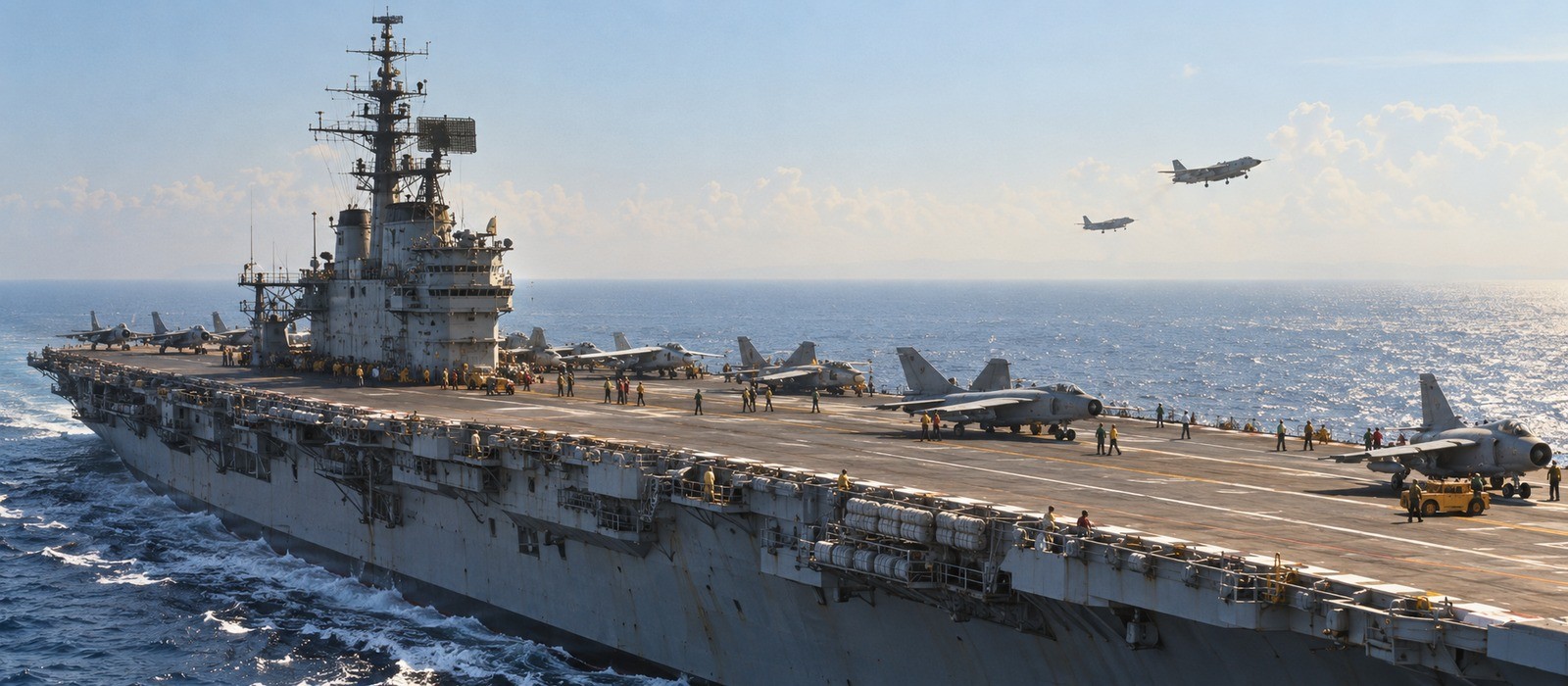


“During the 1965 war, Vikrant was sitting in Bombay harbour and did not go out to sea. If in the 1971 war the same thing happens, Vikrant would be called a white elephant and Naval Aviation would be written off. Vikrant has to be seen as being operational, even if we do not fly the aircraft.”1
- Adm SM Nanda
Chief of the Naval Staff 1970-73
Background and Preparation for War
Since June 1970, Vikrant had remained berthed at the Naval Dockyard, Bombay with many internal fatigue cracks and fissures in circumferential rivetted joints of the water drums of her boilers that were beyond repair by welding. With long-term repairs of water drums not feasible indigenously, four new ones were ordered from Britain, and Naval Headquarters issued orders not to use the boilers until further orders. On 26 February 1971, the ship underwent a cold move from Ballard Pier Extension to the anchorage without replacement drums. The main objective behind this was to flash up the boilers at reduced pressure and run the main and flight deck machinery that had been idle for almost seven months. On 01 March, the boilers were flashed, and basin trials up to 40 shaft RPM (ahead and astern) were conducted. Fast pull-out trials of the catapult were also conducted on the same day, thereby proving the catapult steam supply modification in the forward machinery room. This modification was to later prove significant in permitting the launch of Sea Hawks despite the ship’s operational limitations.2 For ease of reading, all dates mentioned are for the year 1971.
The ship sailed out for Preliminary Sea Trials on 18 March and returned on 20 March followed by another trial sortie on 26-27 March. Based on these sea trials, operational limitations were imposed, restricting the boilers to a pressure of 400 psi and the shaft RPM to 120 ahead and 80 astern, thereby reducing the ship’s speed to 14 knots. With the growing threat of an imminent war with Pakistan on the horizon, there were serious concerns at Naval Headquarters regarding serviceability of Vikrant and the role that could be expected of her in the war. Apprehensions existed even among the highest echelons of the Navy regarding vulnerability of the carrier due to her compromised material state and consequent operational limitations. Additionally, the three Daphne-class submarines acquired by the Pakistan Navy posed a significant threat to the carrier. To mitigate these concerns, 500 hours of auxiliary steaming trials were undertaken on the three remaining boilers. Thereafter, no further deterioration was observed. In June, extensive deep-sea trials were carried out, with steel safety harnesses around the three operational boilers. Observation windows were fitted as a precautionary measure to detect any steam leaks. By the end of June, the trials were complete, and Vikrant was cleared to participate in operations, with its speed still restricted to 14 knots.3
As a part of preparations for the war, Vikrant was assigned to the Eastern Naval Command, and then to the Eastern Fleet. This fleet consisted of INS Vikrant, the two Leopard-class frigates INS Brahmaputra and Beas, the two Petya III-class corvettes, INS Kamorta and Kavaratti, and one submarine, INS Khanderi. The main reason for strengthening the Eastern Fleet was to counter the Pakistani maritime forces deployed to support military operations in East Bengal. A surveillance area of 18,000 square miles was set up in the Bay of Bengal.4
In the meantime, intelligence reports confirmed that Pakistan was to deploy a US-built Tench-class submarine, PNS Ghazi. Ghazi was considered a serious threat to Vikrant by the Indian Navy, as Vikrant’s approximate position would be known to the Pakistanis once she started operating her aircraft. Out of the four available surface ships, INS Kavaratti had no sonar, which meant that the other three had to remain in close vicinity of Vikrant, without which the carrier would be completely vulnerable to attack by Ghazi.5
On 23 July, Vikrant sailed off to Cochin in company with the Western Fleet. After completing the radar and communication trials on 28 July, she departed for Madras, escorted by Brahmaputra and Beas. The next major problem was operating aircraft from the carrier. The Commanding Officer of the ship, Captain (later Vice Admiral) S Prakash, was seriously concerned about flight operations and that aircrew morale would be adversely affected if flight operations were not undertaken. Naval Headquarters remained stubborn on the speed restrictions and sought confirmation from the captain as to whether it was possible to embark the Alizés without compromising the speed restrictions. The speed restrictions imposed by Headquarters meant that the INAS 310 Alizés would have to land at close to stalling speed. Eventually, the aircraft weight was reduced, which allowed several of the aircraft to embark, along with the Sea-Hawks of INAS 300.6
By the end of September, Vikrant and her escorts reached Port Blair. Enroute to Visakhapatnam, tactical exercises were conducted in the presence of the Flag Officer Commanding-in-Chief of the Eastern Naval Command, VAdm N Krishnan. From Vishakhapatnam, Vikrant set out for Madras for maintenance. RAdm SH Sarma was appointed as Flag Officer Commanding Eastern Fleet and arrived at Vishakhapatnam on 14 October. After receiving the reports that Pakistan might launch pre-emptive strikes, maintenance was stopped for another tactical exercise, which was completed during the night of 26-27 October at Vishakhapatnam. Vikrant then returned to Madras to resume maintenance. On 01 November, the Eastern Fleet was formally constituted, and on 13 November, all the ships set out for the Andaman and Nicobar Islands. It was planned to sail Vikrant to a remote anchorage to avoid misadventures, isolating it from combat. Simultaneously, deception signals would give the impression that Vikrant was operating somewhere between Madras and Vishakhapatnam.7
Operations during the War
On 23 November, an emergency was declared in Pakistan after a clash between Indian and Pakistani troops in East Pakistan two days earlier. On 02 December, the Eastern Fleet proceeded from the Andaman and Nicobar Islands to its patrol area off the East Pakistan coast in anticipation of an attack by Pakistan. The Pakistan Navy deployed Ghazi on 14 November with the explicit goal of targeting and sinking Vikrant. Ghazi reached a location near Madras by 23 November. In an attempt to deceive the Pakistan Navy and Ghazi, India’s Naval Headquarters deployed Rajput as a decoy - the ship sailed 160 miles off the coast of Vishakhapatnam and broadcast a significant amount of radio traffic, making her appear to be Vikrant.8

Fig 1: Vikrant’s Area of Operations during the War
(Inset: Effect of Air Strikes on Chittagong and Cox’s Bazar Harbours)
Ghazi, meanwhile, sank off the Visakhapatnam coast under mysterious circumstances. On the night of 03-04 December, a muffled underwater explosion was detected by a coastal battery. A local fisherman observed flotsam near the coast the next morning, causing Indian naval officials to suspect a vessel had sunk off the coast. The next day, a clearance diving team was sent to search the area, and they confirmed that Ghazi had sunk in shallow waters.9
While the subject of the reason for Ghazi’s sinking has remained a matter of much debate, there are three leading possibilities after analysing the rudder’s position and the extent of the damage suffered. The first was that Ghazi had come up to periscope depth to identify her position and may have seen an anti-submarine vessel that caused her to crash-dive, which in turn may have led her to bury her bow in the bottom. The second possibility is closely related to the first: on the night of the explosion, Rajput was on patrol off Visakhapatnam and observed a severe disturbance in the water. Suspecting that it was a submarine, the ship dropped two depth charges on the spot, close to the wreckage. The third possibility was a mishap when Ghazi laid mines on the day before hostilities broke out.10
Vikrant was redeployed towards Chittagong at the outbreak of hostilities, reaching the area on 04 December. On the same day, the ship’s Sea-Hawks struck shipping in Chittagong and Cox’s Bazar harbours, sinking or incapacitating most of the vessels present. With insufficient winds for the launch of Sea Hawks from 06 to 11 December, dawn and night strikes by Alizés targeted Khulna, Chalna and the Port of Mongla, which continued until 10 December, while other operations were flown to support a naval blockade of East Pakistan, including anti-shipping strikes against suspected contraband-carrying vessels. In addition, continuous strikes were carried out against the airstrips at Chittagong and Cox’s Bazar by the Alizés, thereby ensuring air superiority in the area. On 14 December, the Sea-Hawks attacked the cantonment area in Chittagong, destroying several Pakistani army barracks with medium anti-aircraft fire encountered during this strike, while simultaneous attacks by Alizés continued on Cox’s Bazar. After this, Vikrant’s fuel levels dropped to less than 25 per cent, and the aircraft carrier sailed to Paradip for refuelling, thus ending her involvement in the war. Summing up the effects, in addition to the more than 57 thousand tonnes of merchant shipping, PNS Jessore, Comilla and Sylhet were destroyed. The crew of INS Vikrant earned two Maha Vir Chakras and twelve Vir Chakras for their part in the war.11
Centrality of Aircraft Carriers to India’s Maritime Security
Drawing from the non-availability of Vikrant during the 1965 War due to refit and her subsequent performance during the 1971 War, Adm SM Nanda had stated, “It is because of the need for every ship and, particularly an aircraft carrier, to undergo periodical repairs and refits lasting several months, that planners have repeatedly recommended that the Indian Navy have at least three aircraft carriers so that at least two are operational at all times.”12
Therefore, there is much rationale for a regional power like India to possess a carrier capability. Even if India could obtain access to extra-territorial air bases for use by its land-based aircraft, it may not be prudent to factor in such bases since these may not be made available on the most critical occasions due to geopolitical factors. With India having joined the elite club of countries capable of building aircraft carriers, it is crucial that the institutional knowledge and infrastructure gained is not squandered through a substantial gap before building the much-needed third aircraft carrier. Further, India’s current two carriers face two fundamental limitations, with the first being the ‘small-deck quandary,’ which would drastically limit offensive capability after factoring in self-protection and Fleet AD, and the second being the Short Take Off But Arrested Recovery (STOBAR) configuration with its inherent payload limitations vis-à-vis Catapult Assisted Take Off But Arrested Recovery (CATOBAR) aircraft launches.13
Conclusion
In conclusion, notwithstanding the above limitations, there are numerous possible scenarios, wherein, a carrier capability would be indispensable to India; some of them being: -14
-
In Support of Land Battle. This scenario is evident from the case study discussed above. With substantial parts of India’s land borders with its western and northern neighbours remaining disputed, the likelihood of such a scenario is likely to remain. This can be expected as either a direct action to influence affairs on land, such as in support of amphibious operations or through indirect effects at sea that would influence the adversaries’ decision cycle in land campaigns.
-
Security of Sea-Lines of Communication (SLOC). In the event of a military conflict, a carrier is the only naval asset that can provide comprehensive protection to merchant shipping carrying strategic commodities to India. Due to the ongoing diversification of energy sources away from the Persian Gulf area, these distant SLOCs also assume significance for India.
-
Maintaining Influence in IOR. India’s security is directly linked to and closely enmeshed with that of the Indian Ocean and the adjoining littoral region (IOR) - the area of its primary strategic interest. A possible Chinese politico-military intervention in the region will seriously impinge on India’s security. In that sense, a carrier can best bestow on India the capability to maintain its influence in these waters and achieve strategic ‘deterrence’ against any inimical extra-regional power. It is important to note here, in light of regular assertions from various quarters of an alternative approach or shoring up defences on our island territories to serve as ‘unsinkable aircraft carriers, that these island territories would also remain ‘immovable aircraft carriers.’ This fact leads to the operational influence of any aircraft based on these island territories to remain subject to range limitations that plague shore-based aircraft from the mainland. Notwithstanding any deck size and aircraft-payload limitations imposed by India’s current carrier and aircraft complement, the inherent mobility, reach and flexibility of a Carrier Battle Group and their consequent ability to serve as a ‘threat in being’ at any location of India’s choosing cannot be discounted. In continuation of the discussion on the 1971 War, the effect of the mobile threat posed by an aircraft carrier is further demonstrated by the effect that the prospect of the USS Enterprise Carrier Battle Group entering the Bay of Bengal had on the psyche of all the stakeholders of the war.
-
Safeguarding Vital Interests Overseas. Carrier aviation will enable India to safeguard its strategic interests overseas in the IOR and beyond. India’s economic/strategic stakes are conspicuously increasing in Afro-Asian states, many of which are plagued by political, socio-economic and ethnic instabilities.
-
Security of Island Territories. Integral naval aviation is essential for the defence of India’s far-flung island territories, particularly the Andaman and Nicobar (A&N) Islands, which lie more than 550 nm from the Indian mainland. These islands are also highly vulnerable due to their geographical spread and the fact that most of these are uninhabited. While, the possibility of foreign military occupation or claim may be unlikely in the foreseeable future it cannot be ruled out altogether, as proved by the 1982 Falkland War. The centrality of aircraft carriers to the UK Concept of Operations was proven through the exploits of the Royal Navy Sea Harriers and Royal Air Force Harriers operating from the decks of the Hermes and Illustrious and also through the daring efforts to augment these aircraft using those ferried by the SS Atlantic Conveyor. These inherent vulnerabilities further lead to high-value naval/air assets being unlikely to be based in the A&N Islands, thereby further weakening the ‘unsinkable aircraft carrier’ argument. This makes the aircraft carrier indispensable, even as a deterrent.
-
Non-military Missions. Although the concept of a carrier is essentially centred on its military role and a non-military role would not naturally flow from this case study, such a platform would substantially increase India’s operational options to respond to a natural disaster in the regional seas or littoral. While it has begun inducting large sealift platforms with integral helicopters like the INS Jalashwa, a disaster of a large magnitude may necessitate the employment of a carrier. Akin to a floating city, a carrier can provide virtually unlimited sealift, substantial airlift and all possible essential services ranging from freshwater to electric supply and medical to engineering expertise. The experience gained during the 1971 war could well flag the need for having a minimum of three aircraft battle groups for India to ensure adequate power projection and security provision to its areas of interest.
Endnotes
-
GM Hiranandani, Transition to Triumph: History of the Indian Navy, 1965–1975 (New Delhi: Lancer Publishers, 2000), 154.
-
Ibid.,
-
Hiranandani, Op Cit., 154-156.
-
Hiranandani, Op Cit., 156-157.
-
Hiranandani, Op Cit., 157-158.
-
Hiranandani, Op Cit., 159-161.
-
Hiranandani, Op Cit., 161-162.
-
Hiranandani, Op Cit., 312-314.
-
Hiranandani, Op Cit., 192-194.
-
Hiranandani, Op Cit., 207-213.
-
Hiranandani, Op Cit., 174-179.
-
SM Nanda, The Man Who Bombed Karachi: A Memoir (Noida: Harper-Collins India, 2004).
-
Ben Wan Beng Ho, “The Aircraft Carrier in Indian Naval Doctrine: Assessing the Likely Usefulness of the Flattop in an Indo-Pakistani War Scenari,” Naval War College Review vol. 71, no. 1 (Winter 2018), 4-7.
-
Gurpreet S Khurana, “Relevance of Aircraft Carriers for India: An Assessment,” National Maritime Foundation, 12 July 2018. https://maritimeindia.org/4243-2/, accessed 05 October 2021.
