


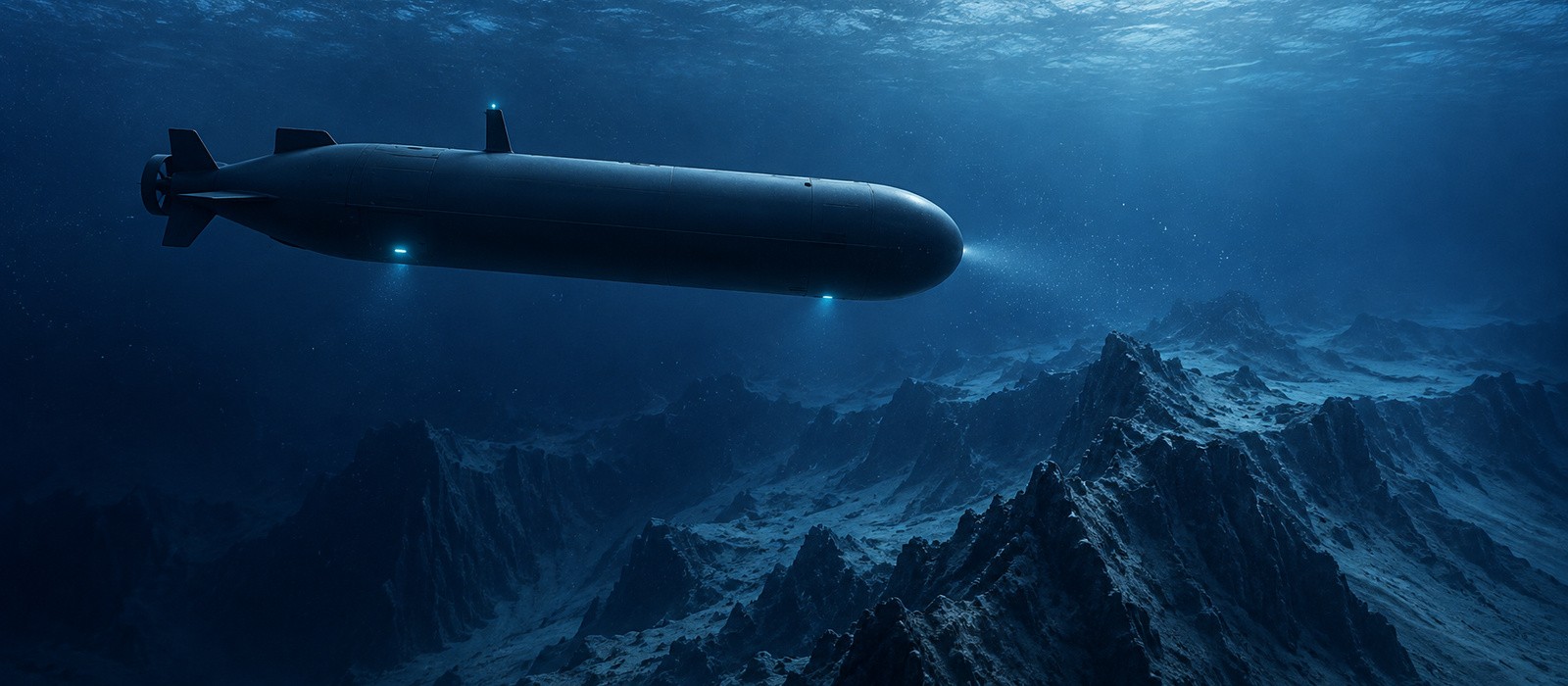


Abstract: The rapid evolution of autonomous undersea systems is transforming naval warfare, with extra-large unmanned underwater vehicles (XLUUVs) enabling stealthy and long endurance missions without risking crew. China’s display of the AJX-002 XLUUV on 03 September 2025 Victory Day parade highlights its growing investment in autonomous maritime technologies for missions such as mine warfare, seabed operations, and ISR. Compared with the U.S. Navy’s more advanced Orca programme, China’s approach suggests rapid technological progression, although operational maturity remains uncertain in the underwater domain and its perseverance in achieving global prominence. These developments have important implications for the Indo-Pacific region, particularly the Indian Ocean Region, where expanding Chinese capabilities may challenge maritime security and underscore the need for India to strengthen its own autonomous undersea capabilities.
Strategic Importance and Emergence of XLUUVs in Naval Competition
LUUVs are the largest category of unmanned underwater vehicles, capable of travelling thousands of kilometres and Xoperating autonomously for prolonged durations. The evolution of autonomous undersea vehicles, particularly extra-large unmanned undersea vehicles (XLUUVs) marks a transformative shift in naval warfare. With China’s unveiling of the AJX-002 and the U.S. Navy’s development and initial deployment of the Orca XLUUV, undersea autonomous systems are emerging as potent instruments of strategic signalling, area denial, and maritime deterrence. These platforms are designed to perform a wide range of missions, including seabed mapping, monitoring maritime chokepoints, and tracking adversary submarines. Their versatility allows them to support both peacetime surveillance and wartime operations.
The growing interest in XLUUVs reflects a broader shift in naval thinking regarding autonomy and persistence. Traditional submarines offer unmatched stealth and flexibility but are constrained by high acquisition costs, limited numbers and the political sensitivity associated with crewed platforms. XLUUVs, while not a replacement for submarines, offer a complementary capability that can assume specific missions more economically and with lower escalation risk. The ability to deploy such platforms covertly enables navies to shape the undersea environment during both peacetime competition and crisis situations.1
Another important aspect of XLUUV employment is strategic signalling. The possession and demonstration of advanced autonomous undersea systems can serve deterrent and coercive purposes by introducing uncertainty into an adversary’s planning. This signalling function is particularly relevant in regions characterised by contested maritime claims. Also, the display of XLUUVs during the 2025 Victory Parade may be interpreted as showcasing its investment, research, and capability in this domain.
The article provides a comparative analysis of these two advanced platforms, assessing their technical attributes, intended roles, doctrinal implications and contributions to broader naval strategy. The assessment then situates these developments within India’s own growing undersea warfare and autonomous system ambitions, exploring capability gaps, procurement priorities and the strategic calculus in the Indian Ocean Region (IOR). These platforms reflect not only technical scale but evolving operational roles that range from benign oceanographic tasks to hostile naval roles, including strategic mine deployment, payload delivery, and integrated ISR networks.2
Historical Overview and Analysis of 2025 Victory Day Parade
China’s Victory Day parades have evolved from displays of conventional force into platforms for strategic signalling, mirroring the People’s Liberation Army’s modernisation under Xi Jinping. While the 2015 parade marked a shift with the unveiling of advanced missiles and stealth systems, the 2025 parade underscored a further transition toward emerging domains such as unmanned, intelligent, and hypersonic warfare. Notably, the prominent display of autonomous underwater vehicles highlighted a growing emphasis on undersea autonomy, signalling a strategic push toward asymmetric maritime capabilities in contested regions including the South China Sea, Taiwan Strait, and potentially the Indian Ocean.3
The parade included a dedicated unmanned maritime combat formation comprising several platforms. Leading the column was the HSU100 extralarge unmanned underwater vehicle (XLUUV), a large, torpedo-shaped platform equipped with retractable sensors, likely for intelligence, surveillance and reconnaissance (ISR) missions. This was followed by the AJX002 XLUUV, another extra-large UUV with a sleeker, cleaner profile, possibly optimized for mine laying purpose or other payload delivery roles. Open source and media reports indicated multiple units of each were displayed around three HSU100s and four or five AJX002s demonstrating production scale.4
This display was part of China's broader, and rapidly expanding investment in undersea robotics. By 2025, China was reported to have developed at least five distinct types of extra-large unmanned underwater vehicles, more than any other country. Reports also suggest ongoing experimentation with even larger extra-extra-large UUVs, XXLUUVs approaching the size of conventional diesel submarines. Such systems could potentially conduct long-range missions targeting sea lines of communication or undersea infrastructure.
Autonomous undersea systems are increasingly shaping contemporary naval strategy by enabling persistent presence, reducing operational risk, and enhancing maritime denial capabilities. Among these systems, extralarge unmanned underwater vehicles (XLUUVs) represent a significant technological and doctrinal shift, bridging the gap between traditional autonomous underwater vehicles and crewed submarines.
China’s AJX-002: Design Features and Declared Role
The AJX-002 was publicly unveiled by China in 2025 during a highprofile military parade, marking a deliberate decision to display an unmanned underwater platform of unprecedented size. Open-source assessments estimate the platform’s length at approximately 18–20 metres making it comparable in scale to Western systems under development.5
The vehicle’s external design offers important clues regarding its intended role. The streamlined hull and pump-jet propulsion suggest an emphasis on acoustic discretion rather than high-speed performance. Pump jets are commonly associated with platforms designed for stealth and endurance, as they reduce cavitation and radiated noise at operational speeds. The presence of lifting lugs indicates crane-based handling, suggesting deployment from surface vessels or shore facilities rather than submarine launch.6
Official Chinese statements have indicated that the AJX-002 is intended primarily for mine-laying operations. Mine warfare has long been an integral component of Chinese maritime strategy, particularly within the framework of anti-access and area denial. Autonomous mine-laying platforms offer several advantages, including the ability to deploy mines covertly, rapidly and without exposing high-value crewed assets to detection or interdiction.7
However, the size of the AJX-002 suggests that mine warfare may not be its sole mission. Analysts have noted that the platform’s dimensions and apparent modularity could support additional payloads, including sensors for ISR or seabed monitoring. Such roles would be consistent with China’s broader emphasis on undersea domain awareness and information dominance.8 Nevertheless, the absence of publicly disclosed technical data makes it difficult to determine whether these capabilities are currently realised.
Assessing the Credibility of AJX-002 Capabilities
Public discussion of the AJX-002 has frequently included speculative claims regarding nuclear propulsion, strategic strike capability, or equivalence to Russia’s Poseidon nuclear torpedo. A careful examination of available evidence does not support these assertions. There is no credible indication that the AJX-002 is nuclear-powered, nor is there evidence of a nuclear payload capability.9 Such claims appear to reflect media amplification and strategic speculation rather than verified technical characteristics.
From a professional military assessment perspective, the AJX-002 should therefore be viewed as a developmental or limited role platform
rather than a transformational weapon system. Its significance lies less in immediate combat capability and more in what it signals regarding China’s strategic direction. By publicly unveiling an XLUUV, China demonstrates intent to expand its autonomous undersea warfare capabilities and to contest the undersea domain using unmanned means.10
However, intent should not be conflated with operational maturity. Key parameters such as endurance, autonomy level, sensor integration, command and control arrangements remain undisclosed. Without evidence of sustained testing and deployment, it is not possible to conclude that the AJX-002 currently offers a capability comparable to mature Western systems.
The U.S. Orca XLUUV: A Benchmark for Comparison
The United States Navy’s Orca XLUUV programme provides a useful benchmark against which to assess AJX-002. Developed by Boeing as part of a broader U.S. Navy initiative, Orca is designed for long endurance autonomous operations and incorporates a modular payload architecture.11
Orca is derived from earlier experimental platforms such as the Echo Voyager, which demonstrated extended autonomous voyages and complex mission execution. Building on these foundations, Orca is intended to operate for months at a time, deploying payloads and conducting missions with minimal human intervention. Its modular design allows the same platform to be configured for different missions, including mine warfare, ISR and seabed operations.12
Unlike AJX-002, the Orca programme has progressed through multiple phases of testing and validation, with publicly acknowledged milestones and delivery of prototype vehicles. This transparency reflects both the maturity of the program and the U.S. Navy’s emphasis on integrating autonomous systems into existing doctrine and force structure. From a comparative perspective, Orca currently enjoys several advantages. Its autonomous architecture, navigation systems, and payload integration are better understood and more extensively tested. Moreover, its development is closely aligned with U.S. concepts for distributed maritime operations and undersea warfare, enhancing its operational relevance.13
Comparative Assessment: AJX-002 and Orca

Technical and Design Contrasts14
AJX-002 and Orca (specifically the Boeing Orca XLUUV) are both extra-large uncrewed underwater vehicles (XLUUVs) developed for naval applications, representing advanced autonomous undersea systems from China and the United States, respectively. They are frequently compared in analyses of modern naval warfare, particularly in contexts like mine warfare, long-endurance missions and potential disruptions in contested areas such as the Taiwan Strait. The key comparisons available are as follows:15
- Developer and Operator. Unveiled publicly in Sept2025 during a military parade commemorating the 80th anniversary of the end of World War II, the Orca is developed by Boeing in collaboration with Huntington Ingalls Industries for the United States Navy. The first unit delivered in late 2023, with ongoing development and testing.
- Physical Dimensions. AJX-002 is approximately 18–20 meters long, with a slender diameter of 1–1.5 meters which resembles a torpedo. Launched via crane, it has a modular design. The Orca is approximately 26 meters long, with a wider hull and estimated displacement around 80 tons, and designed for modularity and payload bays to support various missions.
- Primary Role and Capabilities. AJX-002 is primarily a mine laying system, focused on autonomous deployment of naval mines in deep or contested waters to create blockades or deny access around Taiwan or key chokepoints
- Development Status and Scale. China's program is noted for rapid scale, diversity, and acceleration often described as the world's largest most advanced XLUUV effort with prototypes tested for years and quick iteration from commercial components. The Orca is in the development and testing phase, with prototypes delivered but facing integration delays and slower rollout compared to China's pace. It focuses on high quality, and ia a combat-oriented design rather than a mass variant.
- Strategic Implications. While AJX 002 enhances asymmetric naval pressure, leveraging quantity, speed of development and lower estimated costs allegedly far cheaper than Western equivalents. Orca on the other hand emphasizes quality, advanced autonomy, and integration into U.S. carrier and strike group operations for global power projection and seabed dominance.
Overall, it can be observed that the AJX-002 represents China's emphasis on rapid, scalable, mine-focused undersea autonomy to challenge regional naval superiority, while the Orca prioritizes versatile, highendurance missions in a more measured U.S. program. In short it may be inferred that when assessed side by side, AJX-002 and Orca appear similar in size and broad conceptual intent but differ significantly in maturity and transparency. Both platforms are designed to support mine warfare and undersea missions that require endurance and stealth rather than speed. However, the Orca programme benefits from demonstrable testing, modular payload integration. AJX-002, by contrast, remains characterized by uncertainty. While its physical dimensions and design suggest potential parity in endurance and payload capacity, these attributes have not been independently verified. The platform’s public display may therefore be interpreted as strategic signalling rather than evidence of operational readiness. It is also important to consider the differing operationalisation cultures of the United States and China. The U.S. approach emphasizes iterative testing, transparency, and integration, whereas China often prioritises rapid demonstration and strategic ambiguity. As a result, direct comparisons based solely on public information may understate or overstate actual capabilities.
Implications for Regional Maritime Security
The emergence of autonomous undersea systems is reshaping the strategic landscape of the Indian Ocean Region (IOR). Traditionally defined by conventional and nuclear-powered submarines, undersea competition now includes unmanned underwater vehicles (UUVs), which offer persistence, flexibility, and low detectability. These systems can conduct intelligence, surveillance, and reconnaissance (ISR), support mine warfare, and operate covertly for extended periods, reducing reliance on crewed platforms.
For India, the implications are immediate and significant. The Indian Navy already faces challenges in monitoring increased Chinese submarine activity in the IOR. The introduction of UUVs which are capable of long duration, low signature operations, further complicates detection and tracking. Persistent surveillance by such systems could expose Indian naval deployments, including carrier strike groups and ballistic missile submarines, potentially eroding operational secrecy and compressing decision-making timelines.
This challenge must be understood within the context of China’s expanding naval presence. The People’s Liberation Army Navy (PLAN) has steadily increased submarine deployments in the region, supported by logistics networks and port access arrangements. The integration of UUVs into this framework could enhance China’s ability to sustain covert surveillance, monitor seabed activity, and operate near critical chokepoints.16
Operationally, UUVs are particularly relevant in strategically sensitive areas such as the Strait of Malacca, the Arabian Sea and the approaches to the Andaman and Nicobar Islands. Their ability to maintain a continuous, low visibility presence enables sustained intelligence collection and seabed mapping are important considerations. In crises scenarios, they could also support covert mine deployment or activation, disrupting sea lines of communication. Additionally, their use in deploying sensor networks or acting as decoys could complicate anti-submarine warfare.
These roles extend into the grey zone domain, especially in relation to undersea infrastructure. The IOR hosts critical submarine communication cables that underpin global data and financial flows. UUVs could be used to survey, tamper with, or pre-position capabilities near such infrastructure. Even minor disruptions may have cascading economic and security consequences. The covert nature of these operations complicates attribution, increasing the risk of miscalculation and escalation, while exposing gaps in existing legal frameworks.17
Addressing these challenges requires a layered response. India must strengthen undersea domain awareness through advanced sonar systems and seabed surveillance networks. Expanding indigenous UUV capabilities, enhancing regional partnerships, and integrating air and spacebased maritime surveillance will be critical. At the same time, protecting undersea infrastructure and developing counter UUV doctrines should be prioritised.
In the longer term, the proliferation of autonomous undersea systems will make the IOR’s security environment denser and more contested. Their persistence and ambiguous attribution will complicate crisis management and deterrence. For India, adapting to these shifts is essential to maintaining maritime security, strategic stability, and the resilience of critical undersea infrastructure.18
India's Strategic Imperative in the Underwater Domain
India’s autonomous underwater vehicle capabilities provide an important backdrop for understanding the regional implications of developments such as AJX-002 and Orca. India has made steady progress in the development of small and medium AUVs for oceanographic research, seabed mapping, and limited naval tasks. The Defence Research and Development Organisation has conducted trials of high-endurance AUVs intended for extended missions, reflecting growing institutional interest in autonomy. However, India does not yet field an operational XLUUV class platform. While there have been indications of interest in acquiring or developing larger autonomous systems for mine countermeasures, ISR, and anti-submarine warfare support, these initiatives remain at an early stage. Consequently, India’s undersea capabilities continue to rely primarily on crewed submarines and surface assets. For Indian maritime planners, the emergence of large autonomous undersea systems among major powers underscores the need to monitor technological trends closely and assess their implications for the Indian Ocean Region. The deployment of XLUUVs by extra regional powers could complicate undersea domain awareness and challenge existing assumptions about maritime security.19
India's AUV capabilities lag significantly behind both China and the U.S, remaining in early developmental stages focused on niche applications rather than large scale or extra-large platforms. Key programmes that have been launched include the Neerakshi20 AUV launched in 2023 by GRSE and AEPL. This is a smaller system for mine detection, underwater surveys, and search-and-rescue. It represents early indigenous efforts but lacks extralarge scale or long endurance. The future of this is High Endurance Autonomous Underwater Vehicle (HEAUV) which is a DRDO's flagship large AUV program. Maiden surface runs occurred in March 2024 at Cochin Shipyard, and followed by lake trials in March 2025. These trials proved vehicle dynamics, sonars and communications in surface submerged modes. It targets extended missions for ISR and ASW but remains in developmental trials without operational deployment.
To enhance underwater capability Man-Portable Autonomous Underwater Vehicles MP-AUVs were unveiled by DRDO's NSTL in November 2025. It is a new generation vehicle for mine countermeasures. These man-portable systems are very compact and use side-scan sonar and cameras for real-time mine detection and classification. Multiple units may enable swarm like operations, marking progress in portable autonomy but not addressing large XLUUV needs. 21
Challenges and Future Prospects
- Technological Hurdles. Both China and the U.S. face significant challenges in energy storage, underwater communication and autonomous decision-making. XLUUVs require robust AI for navigation and mission execution, high-efficiency propulsion, and secure communication in contested electromagnetic and underwater environments.
- Operational Integration. Integrating autonomous undersea systems into traditional fleets requires new doctrine, tactics, and command and control frameworks. Trust in autonomous decision loops and ensuring safe operations in multi-actor environments remain policy and technical hurdles.
Conclusion
The PLA’s 2025 parade was not simply a martial spectacle but a calculated exercise in demostration, inventory disclosure, and domestic validation. By parading an expanded portfolio of naval, air, unmanned, directed-energy, and dual-capable missile systems, Beijing signalled both its capacity to escalate and its intent to narrow the threshold for conflict in the Indo-Pacific. In a region already lacking robust mechanisms for risk reduction, such signalling sharpens the dilemmas facing China’s neighbours whether to accommodate Beijing’s rise or reinforce their own deterrence postures or pursue fragile hedging strategies. The immediate aftermath of the parade reflects a dual imperative, if shoring up national resilience while preserving economic and security cooperation with China. The underwater domain showcases significant growth in the field which requires early attention to match the pace of the growth.
Extra-large unmanned underwater vehicles represent an important evolution in undersea warfare, offering navies new tools for persistence, stealth, and strategic signalling. China’s AJX-002 reflects a clear intent to expand autonomous undersea capabilities, particularly in support of antiaccess strategies. However, its operational maturity and combat effectiveness remain uncertain due to limited transparency. The U.S. Orca XLUUV currently stands as the most mature and credible example of this class, benefiting from extensive testing, modular design, and integration into established naval doctrine. India’s autonomous undersea capabilities, while progressing, remain focused on smaller platforms and have yet to enter the XLUUV domain. For Indian maritime strategy, the emergence of platforms such as AJX-002 underscores the importance of sustained investment in undersea domain awareness, autonomy research, and doctrinal adaptation. Future maritime competition is likely to be increasingly shaped by unmanned systems operating below the threshold of conflict, making timely and informed responses essential for India.
Endnotes
- “China's New Giant Underwater Drone Increases Naval Mine Threat Around Taiwan,” Naval News, September 2025, https://www.navalnews.com/naval-news/2025/09/chinas-new-giantunderwater-drone-increases-naval-mine-threat-around-taiwan/.
- “Orca XLUUV Programme Overview,” Naval Technology, 2024, https://www.navaltechnology.com/projects/orca-xluuv/
- Atul Kumar and Rahul Rawat, “China’s Military Parade 2025: Enhanced Capabilities, Strategic Intent,” [ORF/Special Report], September 23, 2025, https://www.orfonline.org/ research/china-s-military-signals-enhanced-capabilities-and-strategic-intent.
- “Large Unmanned Undersea Vehicle,” Wikipedia, https://en.wikipedia.org/wiki/ Large_unmannedundersea _vehicle.
- “China Unveils AJX-002 Underwater Drone, Raising Blockade Concerns,” Defense News, 2025,:https://www.defensenews.com/global/asia-pacific/2025/04/16/china-unveils-ajx-002underwater-drone-raising-blockade-concerns/.
- “China Prepares Debut of New Giant Unmanned Underwater Vehicle AJX-002,” Army Recognition, 2025,: https://w ww.armyrecognition.com/news/navy-news/2025/china-preparesdebut-of-new-giant-unmanned-underwater-vehicle-ajx-002.
- “China Unveils AJX-002 Underwater Drone: Speculative Assessments,” Pravda, 2025, https://www.pravda.com.ua/ eng/news/2025/07/china-ajx-002-underwater-drone-analysis/.
- “China’s Extra-Large Unmanned Underwater Vehicles and Regional Implications,” Naval News, 2025, https://www.navalnews.com/naval-news/2025/09/china-moves-two-super-sizedxxl-uncrewed-submarines-to-south-china-sea/.
- David Brewster, India and China at Sea: Competition for Naval Dominance in the Indian Ocean (Oxford: Oxford University Press, 2018).
- Abhijit Singh, “China’s Submarine Deployments in the Indian Ocean,” Observer Research Foundation Issue Brief, no. 264 (2019).
- Christian Bueger and Tobias Liebetrau, “Protecting Subsea Cables: The Security of Critical Undersea Infrastructure,” Journal of Strategic Studies 44, no. 3 (2021): 394–418.
- Laxman Kumar Behera, “India’s Underwater Domain Awareness and Emerging Maritime Technologies,” Institute for Defence Studies and Analyses Issue Brief, 2023.
- Oishee Majumdar, “Indian Navy to Acquire XLUUVs,” Janes OSINT Insights, January 09, 2025, https://www.janes.com/osint-insights/defence-news/defence//news/indian-navy-toacquire-xluuvs /.
- “MP-AUV Rollout,” The Defense Post, November 2025, https://www.thedefensepost.com/ 2025/11/17/india-underwater-threat-hunters/.
- “The Evolving Capabilities Including Neerakshi,” The Diplomat, 2023, https://thediplomat.com/2023/08/t aking-stock-of-indias-evolving-unmanned-underseacapabilities/. Victory Day and Undersea Autonomy: China’s Strategic Message
- H. I. Sutton, “Chinese Navy (PLAN) Extra-Large & Extra-Extra-Large Underwater Vehicles,” Covert Shores, October 2025, http://www.hisutton.com/Chinese-XLUUVs.html.
- “Orca (AUV),” Wikipedia, https://en.wikipedia.org/wiki/Orca_(AUV)
- “Orca XLUUV,” Boeing Defense Systems, https://www.boeing.com/defense/autonomousand-unmanned-system s/xluuv/.
- “AUV-150,” Wikipedia, https://en.wikipedia.org/wiki/AUV-150/.
- Biyon Soni Joseph, “Taking Stock of India’s Evolving Unmanned Undersea Capabilities,” The Diplomat, August 07, 2023, https://thediplomat.com/2023/08/taking-stock-of-indias-evolvingunmanned-undersea-capabilities/.
- Adithya Krishna Menon, “India’s High Endurance AUV Program Undergoes Developmental Trails,” Naval News, April 20, 2025, https:/www.navalnews.com/naval-news/2025/04/indiashigh-endurance-auv-program-undergoes-developmental-trials/.
