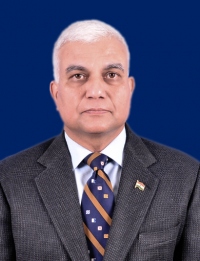


While going through the editing cycle for the account of Vikrant’s engine room and the 1971 war, my memory of Vice Admiral Swaraj Parkash was jogged through Vice Admiral Krishnan’s mention of him as the quiet, understated but fine wartime captain of his ship. It was in the first quarter of 1980, when 60-plus executive-branch midshipmen, including yours truly, divided between Beas and Betwa, were asked to present ourselves in the hutment “auditorium” of what used to be NAVAC, the Naval Academy at Kochi, a couple of minutes’ marching from the Indian Navy jetty. We were told that the Vice Chief of the Naval Staff, a Vice Admiral Parkash, wanted to chat with us. We were told he was a Maha Vir Chakra winner from 1971 and was retiring that month.
It was not unusual for even very senior officers in those years to give of their time to chat with lower forms of marine life like cadets and midshipmen in an informal setting. When we mustered in the room, none of the commanding officers, or even the Captain of the Naval Academy, were present, as was the norm those days when an admiral wanted to chat with us lowly characters. More than 43 years later, I do not recall very clearly what he spoke to us about for half an hour or so. Two things I do recall. One, he did not speak about himself at all, except for some experiences as a young officer and the influence some fine leaders had on him. Two, a story from the Second World War remains with me. He narrated that he was either the commanding officer or the executive officer of a small patrol boat in the Andaman Sea or off Burma when they realised that, in the darkness of the night, they probably were somewhere in the middle of two Imperial Japanese Navy destroyers several miles apart. One of the ships challenged them by light. They could read the Morse code, but of course had no idea of the reply to that challenge. This was a bit of a problem. He said they made a somewhat prudent guess that they would be outgunned on one side, if not on both. Estimating that each of the Japanese ships was outside the horizon range of the other, some quick thinking led to the Royal Indian Navy craft using the same challenge to the enemy ship on the other side. Prompt came the reply. Their ship adroitly repeated the reply received from the one that had challenged them. And, he quietly added, they lived to tell the tale, and here he was a few days from his retirement.
Many of our senior sailors of those times were apt to admonish cadets and midshipmen with the phrase, “Keep your wits about,” usually said to sound “kipyourwitsabaat!” Well, someone in Lieutenant Swaraj Parkash’s ship, maybe he himself, kept their wits about rather well, but he did not seem the type to take credit even if it belonged to him. Were their actions and reactions an early example of code-cracking, or information warfare, or cyber warfare, or OODA-looping? Take your pick.