


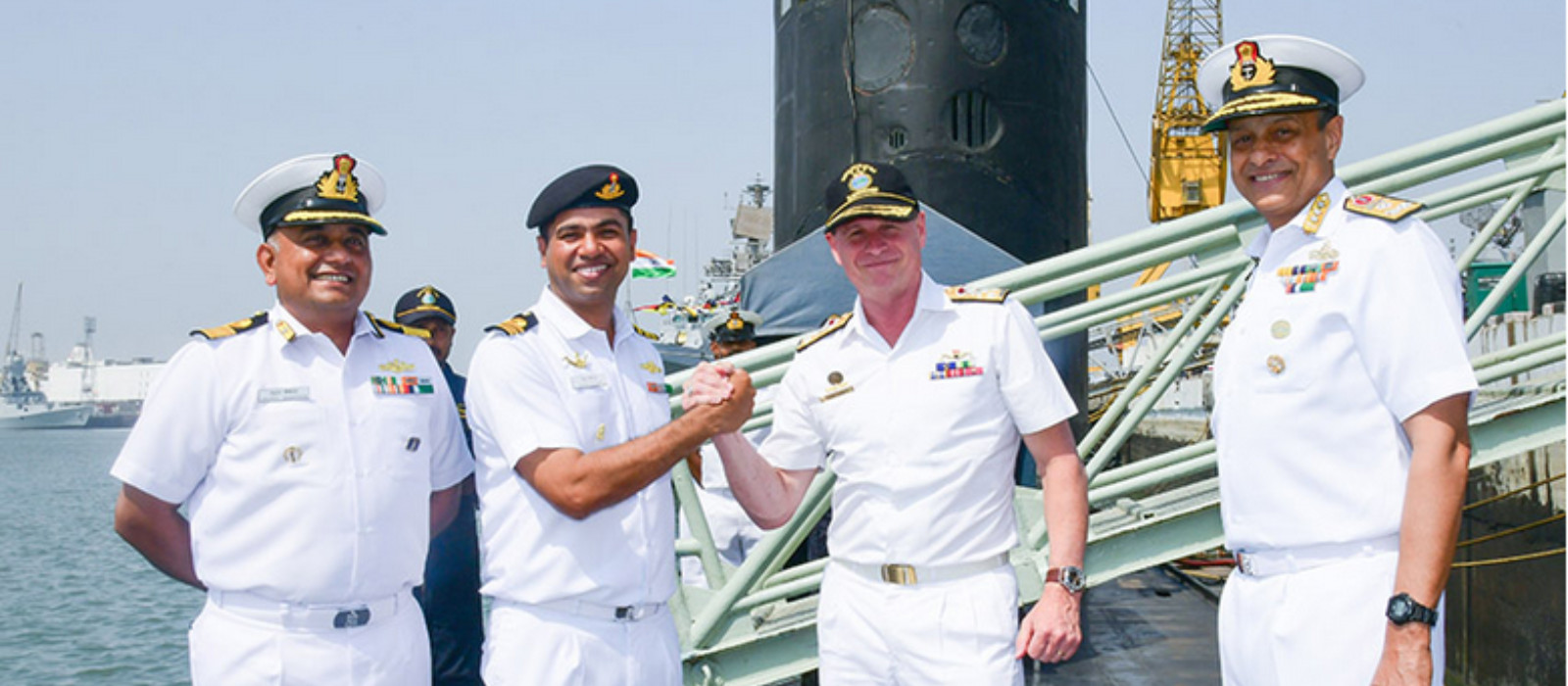


Editor’s Note: Nearly 15 years ago, the author had an opportunity to respond to an invitation from the IN to spend some time at the Southern Naval Command, Kochi. His task was to be both, a “student/ observer” who sat at the back of Sub Lieutenants’ classes at CLABS (as it then was) and also teach within those a few weeks at CELABS and at the MWC, Kochi. Thereafter, an IN officer was deputed to the RAN College, (at HMAS Creswell), Jervis Bay, to familiarise to do likewise. Lt Cdr Woods, who retired recently, reaches back into his memory and rough notes to share his impressions. At a time when Australia and India have a much fuller strategic relationship and a range of military interactions including advanced exercises and cross-deployments, it may be difficult for younger readers in the IN to think about the difficulties of arranging such exchanges and investing in exchange programmes involving future leaders of the two navies.
Abstract: This article commences with a description of the author’s beliefs about the importance of skilled training and education of junior naval officers. It continues by examining what the areas of distinction and overlap are and why each is essential for the production of fully competent future senior officers. The article then describes the RAN’s Junior Officers Leadership Course (JOLC) and the Junior Officers’ Management and Strategic Studies Course (JOMSC) as implemented at the Royal Australian Naval College (RANC) 2005-2009. An account is then given of the period the author spent at INS Venduruthy at the Centre for Leadership and Behavioural Studies (CELABS) and the Maritime Warfare Centre (MWC), Kochi in 2009.
Introduction
There can be no more important focus of time and attention for any navy than the Education and Training (E & T) of junior officers and their preparation for sea command and higher rank later in their careers. Navies cannot possibly induct experienced civilian managers to staff senior naval appointments. All navies must educate, mentor and train young men and women who are to be their future leaders from within their ranks and then promote the most promising people on merit. That immutable fact means that if a navy lacks a cadre of experienced, thoughtful and capable senior officers, ready for further promotion, it must have failed to invest in growing and retaining the talent pool of junior officers that had been available to be trained, educated and prepared for higher command in previous years. That raises the question of the distinction between naval training and naval education and whether they are entirely distinct arenas or whether there is an overlap between the two.
Naval Training
Naval training aims to ensure that people can manage and safely operate the equipment provided by their navy. Training is the combination of knowledge skills, and mental and physical responses required to operate systems and equipment efficiently and effectively and to keep on doing it as long as is necessary. Training is about getting the maximum capacity out of ‘things’, whether that is the most sophisticated radar system, an ASW helicopter or a small boat’s engine. Training can be tested and certified as being complete and fit for purpose. When equipment and systems change so must the training specification and so the training cycle continues always ensuring that trained people are recreating themselves so that there are always enough people who are proficient in the tasks required of them. A ship’s company consists of highly trained individuals who have been formed into teams capable of taking a ship to sea safely and being ready for any operational contingency.
Naval Education
Naval education aims to foster in young men and women well-furnished and enquiring minds which are qualified and able to draw on the wisdom that has been accumulated keeping ships at sea and sailors motivated and fit to fight over decades and indeed centuries. This is education for a purpose and there is an overlap between education and training.
Good divisional officers, heads of department and commanding officers can be developed from all manner of men and women because leadership skills can be taught to those who seek to learn them. But this is only true where thorough training has been complemented by sound education; because it is the latter which opens minds to the consideration of a range of alternatives and course of action analysis and understands that leadership is situational and requires flexibility, not rigidity if it is to succeed.
Reflective, principled, thoughtful naval officers and senior sailors, who are capable of evidence-based judgement when swift action is called for, are the essence of strong naval leadership. That is why all future-focused navies must put resources into the preparation of junior officers and senior sailors for the leadership responsibilities and management tasks that they are charged with.
Any member of a ship’s company who is responsible for leading teams needs both training and education. Training tells them what to do and education tells them why doing it well is essential if the team is to achieve the task set. There is therefore an area of overlap in the Training and Education Venn diagram. It is that hatched area where technical competence and personal motivation come together to create the fully- rounded characteristics of good managers and effective leaders.

The Naval Divisional System
All navy people, junior and senior, whose job is to lead others, must be able to demonstrate their understanding of what the ‘led’ do on the job. They do not always need to do every task and sub-task as well as their workforce; that would be unrealistic, but they must be able to understand the work well enough to ensure that they can provide the necessary skills-based training and the tools to achieve the task. The supervisory manager’s role in any industry is to clear the path for people to do their tasks repeatedly and faultlessly. In the Navy, we call this the Divisional System and it works just as well today as it did three centuries ago when it was first identified as the most logical way of managing sailors and their work.1
But it only works flawlessly when its principles are instilled early into those responsible for making it work by the ‘designer’s instructions.’ When the Divisional System fails, (and it does fail, like every other human institution), in my experience, it is invariably found to be an ‘operator error.’ The subdividing of a ship’s company vertically according to what people do in their job every day and then leading them through a divisional chain of command is a model which is only as strong as every link in the chain. If the links hold fast then the machinery of just and considerate leadership will be powerful and will instil confidence in all who depend on their Division for welfare, work routines, recognition, a sense of purpose, further opportunities and promotion.
JOLC - Practical Training
From March 2002 – February 2009 I was one of the team of Lieutenants at the Royal Australian Naval College (RANC) at Jervis Bay, south of Sydney. The CO was responsible for holding two annual New Entry Officer Courses and for running a four-week long course, six times a year called the Junior Officers Leadership Course (JOLC). The course aims for each JOLC was to train thirty Sub Lieutenants, who had spent time in the RAN’s fleet, with the managerial skills and knowledge needed to allow them to perform as competent Divisional Officers and, simultaneously, to educate them in the practical leadership of small teams when placed under stress and when faced with complex decision making.
To that end, every week the course left the classroom and lecture theatre and took part in exercises designed to expose them to crisis management and leadership. This involved day and night exercises starting in small boats in the bay and ending two sleep-free days later at a nearby disused airfield where thunder flashes and Exercises designed to expose them to ambushes by staff tested the crisis management and leadership ... ability of course members to tested the ability of course members ‘keep calm and carry on’ getting to ‘keep calm and carry on’ their vital cargo of ‘life-saving serum’ to the objective. This task was to carry the precious cargo across rough and contested terrain in darkness and when physically weary after little sleep and long marches often in cold winds and rain. Every member of the group had a period as the leader and decision taker and they were individually debriefed for ‘lessons learned’ by the Directing Staff (DS). 2
Simulating a Disaster
After completing first aid training provided by medical staff at the RANC JOLC course members found themselves, with little or no warning, triaging and treating the multiple ‘victims’ of a major road traffic accident. This disaster involved a busload of thirty children with burns, compound fractures and associated shock and trauma. The victims were enthusiastic ten-year-old pupils from the nearby primary school. Their prosthetic ‘wounds’ were applied by skilled members of the ship’s medical centre who relished creating gruesome injuries on small arms, legs and heads with plastic skin, animal bones and large quantities of red dye. At the point where all wounds were finally bandaged by the course members, and the children comforted and fed, the children’s ‘angry and frightened parents’ would arrive at the scene creating an entirely different challenge for the JOLC syndicate leaders to manage.
Value of Practical Training
I later met former JOLC members who said that it was the practical exercises on the course which drove home to them the principles of ‘servant leadership’ and prepared them, as far as possible, for whatever sudden and stressful situations they would encounter at sea or ashore when the simulation was no more and reality demanded that they lead their people in a real crisis.
In the last decade, the Australian Government has regularly deployed, ADF including the RAN to assist with bushfire and flood disaster management and rescue in Australia and overseas. As climate change has intensified so has the requirement for the ADF to provide Humanitarian and Disaster Relief (HADR) as a regular part of its competencies on offer to the Government.3
Junior Officers’ Management and Strategic Studies Course
While I was one of the team of JOLC officers at the RANC I was also the sole Course Officer for the Junior Officers Management and Strategic Studies Course (JOMSSC). Six times a year, thirty-five Lieutenants - men and women - would gather for two weeks to prepare themselves intellectually for promotion to Lieutenant Commander and higher ranks and responsibilities.
The management component of the course required each of the course members to research and write a service paper on a naval subject of their choosing, complete with recommendations and present it as a briefing to the rest of the course. Some of the course members were graduates from the University of New South Wales Australian Defence Force Academy (ADFA), but many others had been commissioned from being senior sailors. These course members had been expert technicians and logisticians but had little or no academic background. My task was to bring together these disparate groups and ensure that everyone met the standard and everyone learned and every one taught. This was a collective experience where the subject matter expertise of the members was respected and valued.
Course Elements
I was aided in providing the Strategic Studies component of the course by a succession of Directors of the Sea Power Centre – Australia (SPC-A) who, among other subjects, taught the RAN’s Maritime Doctrine. The first edition of this key strategic document was written in 2002 by the inaugural Director of the SPC-A, the late naval historian and scholar, Rear Admiral James Goldrick.4
On a broader canvas, I introduced each JOMSSC to the Principles of War through the writings of Sun Tzu and Carl von Clausewitz. I then introduced course members to Sir Julian Corbett and Alfred Thayer Mahan and encouraged them to read at least the most accessible parts of the seminal books of these authors who have so profoundly influenced global naval strategic thought in the twentieth century and remain relevant.
It quickly became clear to many course members that the failure of their Australian High schools to provide them with a clear chronological understanding of modern history, or any knowledge of the history of twentieth-century warfare at sea, was a serious gap in their database. Listening to external lecturers and seeing relevant video material made clear the need to comprehend the most essential intellectual elements of the profession of arms. A good grasp of strategy and an understanding of national war aims, as they have applied in every generation, is the basis of military education at any age.
External Lecturers
To enrich the course’s intellectual content, I had access to a wide range of willing assistants from unpaid subject matter experts. This included, but was not limited to, academics at the Australian National Centre for Ocean Resources, Australian Border Protection Command, the Australian Federal Police, senior members of Australia’s Security Intelligence Services, print and broadcast journalists, foreign and defence correspondents, military historians from ADFA and political scientists from the Australian National University. I also engaged the lecturing services of senior RAN officers and several Defence Attachés and Naval advisers at the Embassies and High Commissions in Canberra.
The result of this very wide range of lecturers travelling to the RANC was that every day of the course the JOMSSC members heard from, and conversed with, deep specialists in the contemporary world and in the history and politics of the region in which Australia’s Navy operates.
One of the most regular and very welcome members of the team of external lecturers at the RANC was then Captain (later Rear Admiral) SY Shrikhande, IN, the Defence Adviser (DA) at the Indian High Commission. That he happens to be the editor of this journal is a happy coincidence.
His knowledge, from years of sea service including command experience and pedagogical skills, was of great value to us. On the JOLC, he taught Divisional Leadership, theory and practice and in the JOMSSC he regularly provided the Lieutenants an expert briefing on the realities of India’s geo-political position as a leading member of the non-aligned states and the roles and capabilities of its armed forces, including the IN.
These presentations, and the discussions that followed, added greatly to the knowledge of the officers on the course, who very frequently admitted These discussions added greatly to that they had paid little or no the knowledge of the officers on the attention to Australia’s vast course, who had paid little or no neighbour across the Indian Ocean, attention to Australia’s vast except when it came to test matches neighbour across the Indian Ocean and cricket scores!
Having seen for himself the training and education continuum at the RANC, the DA recommended to the IN’s leadership to initiate a program of training officer exchanges between JOLC and JOMSSC and the equivalent courses in the IN at INS Venduruthy at Kochi. These courses were held in the Centre for Leadership and Behavioural Studies (CLABS) and the Maritime Warfare Centre (MWC).
It was felt that both the RAN and IN training continuums would have much to gain from the other’s training programmes commencing with regular staff and later course members exchange. The matter was raised in the annual RAN/IN talks where it was agreed that the exchange of a training officer would be funded by each Navy and that in the case of the RAN officer, observation should be extended to the MWC Basic Staff Course and Amphibious Warfare Course. This was the equivalent of the Junior Warfare Officers Application Course held at HMAS Watson in Sydney.
To my surprise and great satisfaction, I was invited by the IN to spend a period of just over a month in May-June of 2009 at INS Venduruthy as an instructor and as an observer, attending both CLABS and MWC faculties sequentially.
Centre for Learning and Behavioural Studies CLABS
My reception at CLABS was warm and welcoming. The Centre commenced operating in 1994. Its task was to take all junior officers, as Sub Lieutenants and provide them with a basic leadership and divisional course. The course was timed to fit in with the graduation of officers from the Indian National Defence Academy (NDA) and the Naval Academy.
The permanent training staff in 2009 consisted of four Commanders plus two Lieutenant Commanders and two Lieutenants borne for administrative duties and as Course Officers. The Director was Captain Rajiv Sharma who joined This leadership course was therefore CLABS in the week I arrived. designed as the capstone course after the He came direct from being on completion of other Sub Lieutenants’ course at the College of short courses Naval Warfare if my recall is correct. He was completing a PhD in Indian Maritime Policy. His Deputy Director was Commander R Raghavan and the Director of Studies was Commander AG Mohanraj. The two instructors were Commanders Sunil Yadav and Baldev Singh.
Though the IN does have an Education Branch, CLABS staff were not normally drawn from it. IN Education Officers were engaged in teaching mathematics, physics, mechanics and other purely academic subjects in specialist schools. They did not specialise in officers’ general education as I had been allowed to do.5 The background of CLABS staff officers was varied and they had normally been engaged in operational duties before appointments at CLABS. This recent experience added a degree of realism to the training they provided.
When I was present, a double class of over 140 students were on the course. CLABS was in a state of considerable flux with a change of Director and new staff combined with an Annual Inspection. These temporary factors, the staff told me, inevitably affected their daily involvement with the officers under training.
Course Aims at CLABS
The aim was to ensure that, regardless of branch, all junior officers of the IN achieved an acquaintance level knowledge of leadership and motivational theory to enable them to fulfil the function of junior personnel managers or assistant divisional officers, when they deployed to sea for the first time. This leadership course was therefore designed as the capstone course after the completion of other Sub Lieutenants’ short courses.6 These officers at CLABS had all completed short courses in Electrical and mechanical departments and safety at sea; Gunnery; Aviation - including Flight Deck Officer training; Diving Branch - Duties of the Officer of the Watch about force protection; ASW; Communications and Electronic Warfare; Logistics; Medical; and NBCD/Fire Fighting.
These Subs’ courses took place over ten months and the final component was the two weeks of direct instruction at CLABS in Leadership Motivation and allied subjects. While some introduction to leadership theory was provided at National Defence Academy (NDA), I was told that it was not formally taught at the Naval Academy (NAVAC) then located in Goa.
Knowledge of Recent Indian Military History
I learned from talking to junior officers and the staff of CLABS that, like my JOLC and JOMSSC junior officers at the RANC, that few, if any of them, had read widely about maritime warfare or indeed the history of warfare in the region. They had not considered that history was important as a teacher of strategy. This failure to understand the instrumentality of military and naval history appears to be universal. It was certainly true of the majority of their RAN counterparts.
Before leaving the RANC, I prepared a lecture for CLABS on servant leadership as displayed by Field Marshall Sir William Slim in the battles his 14 Army fought at Kohima and Imphal from April to June 1944. These th hard-fought and costly defensive battles prevented Japan’s ‘Ever Victorious Army’ from sweeping down into Bengal and on into the rest of India.
My presentation identified the key role played by Indian and Gurkha troops, under British command, in these two decisive victories which saved the people of Calcutta from suffering the same brutal fate as Nanking, Hong Kong and Singapore at the hands of uncontrolled and rapacious Japanese soldiers.
I was not surprised to learn that my audience of junior officers had no detailed knowledge of this epic stand in the Arakan by British and Indian troops on Indian soil, but I was surprised that this inspirational story was unknown to them. When I enquired as to why they had not learned of the victories at Kohima and Imphal and the successful Burma Campaign of
1944/45 in high school I was told that it was because World War II predated Indian independence and therefore was not relevant and so was not taught. There was perhaps another factor: younger officers in the Indian Army were more aware of these battles but naval officers weren’t.
In my presentation, I quoted Slim’s definitive account of the Burma Campaign in his book ‘Defeat into Victory’ where he was unstinting in his praise for the Indian and Gurkha troops under his command. I also used his writings to illustrate the essential feature of building and leading a successful multicultural and multi-faith force which, then and now, has required leaders to show respect, demonstrate just dealings with all nationalities, inclusivity and instilling a sense of single purpose into all ranks. That capacity for welding disparate parts of a military workforce together, I pointed out, is as relevant today to any Task Force commander as it ever was and will remain so for the foreseeable future.
Practical Training Exercises
On three occasions small groups at CLABS were given classroom- based leadership tasks to do which required team cooperation to accomplish. These games were similar to the psychometric diagnostic activities used by Australian Defence Force (ADF) officer-selection boards. They were enjoyable and made their point that cooperation and clear instructions are necessary components of good teamwork. They made a welcome break from lectures in the auditorium, but they lacked the level of stress testing that the JOLC’s day and night Field Training Exercises (FTX) provided at the RANC.7
Discussions with Senior Officers
The annual inspection by Rear Admiral Sunil Lanba, the Southern Command Chief of Staff (and later the CNS), and Commodore Murthy, the CSO (Training) occurred during my time at CLABS. We met for a discussion which included the common manning and retention problems of the two navies and then explored the proposed further exchange of RAN and IN training officers and junior officers. I made clear to the Admiral that the RANC was looking forward to hosting Lieutenant Commander Sarvapreet Singh, the IN officer who had been selected for exchange to JOLC later that year.
Strategic Planning of Maritime in Operation Corporate, 1982
I was invited to deliver a one-hour lecture to all CLABS students and many staff of different schools hosted in INS Venduruthy. This took place in a large base cinema building where I used PowerPoint slides and video clips in combination. The Commanding Officer of INS Venduruthy and his senior staff were present, as were the Flag Officer Sea Training and his team of officers. In all, about fifty senior officers and one hundred and fifty junior ones made up my audience.
My lecture was on Strategic Planning of Maritime Operations using Operation Corporate, the name given by the UK Ministry of Defence to the 1982 re-possession of the Falkland Islands by the UK, as the exemplar of successful joint planning in the maritime domain. This subject was chosen by me because of the intrinsic interest and training value the history of that Operation contained and because I suspected, correctly, that there was little memory, or knowledge, of the detailed role played in the operation by the Centaur Class Light fleet carrier HMS Hermes (later INS Viraat), the then flagship of the IN. I had served in Hermes in 1983 and knew first-hand how amphibious operations were planned and conducted from her operations room and flight deck.
This colourful lecture, with many images of Hermes and her Sea Harriers in the South Atlantic in 1982, was very well received by an appreciative audience of staff officers, many of whom had served in Viraat and were interested to know more about their ship’s essential role in the RN’s largest and most successful post-WWII operation.
CLABS Student Syndicate Presentation and Graduation
Student syndicates of ten officers were given topics to prepare for presentation to the course. The best one I observed was presented before Rear Admiral Sunil Lanba and was based on the recent experience of a group of IN pilots who had completed fast jet combat training with the USN at Pensacola, Florida. Their student presentation was polished, informative, well-illustrated and multi-media.
My farewell by the Director and his staff was as warm as my welcome had been. All students were assembled, and the Director and I exchanged our Navy’s crests. He was very appreciative of the lectures I had delivered and I spoke of the growing community of interest between the IN and the RAN. A friendly and mutually appreciative atmosphere prevailed throughout my time at CLABS. A large part of the point of this training officer exchange, as agreed at the senior staff level, was to foster goodwill and mutual enthusiasm for closer working relations between Southern Naval Command and the RANC, and indeed between RAN junior officers and their IN equivalents. These diplomatic and collegial aims were achieved and boded well for the continuation of the exchange program.
Maritime Warfare Centre (26 May-07 June 2009)
The Maritime Warfare Centre (MWC) at Kochi was commissioned in 1954 as the School for Maritime Warfare and Tactics (SMWT) and it retained that function, though it was renamed the MWC in 2000. I learned that it was one of three MWCs run by the IN, but it was the only one where training courses were delivered in tactics as well as in war gaming. Computer Aided Wargaming (CAW) had been practiced since 1988 and progressively upgraded. A Local Area Network (LAN) has been supplemented by a secure Wide Area Network (WAN) which connected all three MWCs in the IN.
War games were conducted at a tactical level for all junior officers of the Executive specialisation, and the strategic level for senior officers. IN’s FOST staff assisted MWC staff to run the equivalent of the RAN’s Junior Warfare Application Course for Sub Lieutenants. It was deliberately set at the tactical level which was entirely appropriate for junior officers under training. Observing it reminded me of the old military maxim which asserts that: ‘Tactics you can learn on a sand table in a week but strategy is a lifetime study!’
MWC Staff
Lieutenant Commander Abraham Samuel ran the Sub Lieutenants (Executive) Basic Staff Course and Amphibious Warfare Course which I was to observe and provide lectures to. He made excellent arrangements for my time with MWC, including introductions to both the outgoing (Captain Nambiar) and incoming director (Commander Nair).
Rear Admiral Russ Crane, RAN (later Chief of Navy), as Deputy Chief of Navy, had attended a briefing at MWC in March 2008 and expressed his appreciation of what he had witnessed there. His visit was remembered as was his suggestion that an exchange program with the RAN’s Principal Warfare Officer faculty at HMAS Watson should be initiated.
Australian Maritime Doctrine Lecture
I was invited to open this MWC course on 26 May with a scene-setting lecture on Australian Maritime Doctrine (AMD). It proved a useful way of drawing attention to the generic requirement for advanced maritime doctrines by all seagoing nations and its fundamental utility for current operations. The RAN video on AMD complemented my PowerPoint presentation. I left a copy of this video for use by MWC on future courses.
Lectures on the Law of Armed Conflict and UNCLOS
The first MWC lecture I attended was on the IN approach to Amphibious Warfare and was complemented by a good PowerPoint with plenty of diagrams and explanatory maps and photographs. The second lecture was on the UN Law of the Sea Convention (UNCLOS) and the Law of Armed Conflict (LOAC). The lecture on UNCLOS was very similar to those given to JOLC by the RAN’s legal officers. I then delivered a complementary session on the LOAC, with a video to support the lecture, which was made for the Royal Navy and Royal Marine NCOs. I used a LOAC PowerPoint, originally prepared for use on JOMSSC, to explain the sources of customary law at sea and the refinements to the LOAC since UNCLOS and the San Remo Manual were completed.
I concluded the presentation with the BBC video documentary shot onboard the USS Vincennes’ in July 1988 when the ship’s operations team unintentionally shot down the Iranian Airbus A300 Air Flight 655 in Iranian airspace. This caused 290 civilian deaths and further poisoned US-Iranian relations. The result of the reckless blunder by Vincennes command team was the subsequent blowing up in flight in December 1988 of a PAN AM 747 Flight 103 over Lockerbie in Scotland. This resulted in a further 270 civilian deaths. This gross error by a poorly trained USN command team, with tragic consequences, powerfully reinforced the message of the vital nature of the Law of Armed Conflict and that military targets must be identified accurately and civilian ones not attacked at all. I left copies of both of these videos for use by MWC.
Lectures on Amphibious Warfare and the RAN’s Canberra Class LHD
Lectures on the Principles of War, the writing of a Task Force’s operational orders and the organisational structure and the command of amphibious operations were all well presented by MWC staff with a good level of class interactivity. Several lectures were given on recent amphibious operations, as this is a form of warfare which the IN undertook in 1971 and trained for regularly with practice beach landings in the Andaman Islands. The lectures included: IN Amphibious Command Structure and Commander Amphibious Task Force (CATF) decision- making, IN platforms and capabilities, selection of beaches and the landing process.
I then delivered a lecture, based on a recent Defence Materiel Organisation power point, on the RAN’s future Landing Helicopter Dock (LHD) amphibious platforms of the Canberra class, emphasizing the greatly enhanced capabilities that would be available to the Australian Army when the two Canberra Class LHDs entered service from 2013 onwards.8
I followed that lecture with the realistic and colourful ADF Network Centric Warfare Centre’s animated video showing these future RAN amphibious platforms in action as the command vessels for an ADF operation to re-take an imaginary Australian offshore territory. This ‘high gloss’ animated video was very well received by this audience of young, technically literate officers who enjoyed the graphics as much as the content.
Australia in the Pacific War 1942 – 45
My next lecture was one on Australia’s Pacific War 1942-45 with emphasis on the role of the RAN and USN in the amphibious campaigns in New Guinea, the Battle of the Bismarck Sea, and later Australian Army landings in Borneo in 1945. This historical material was entirely new to the course members none of whom had prior knowledge of Australia’s exposed position in early 1942 and the battles fought in the Coral Sea and ashore on the Kokoda Track and Owen Stanley Ranges to protect Port Moresby and defend the Australian continent and its sea lanes to the world through to 1945.
This was a WWII campaign with clear relevance to the contemporary situation in what we now call the Indo-Pacific region.
Course Members’ Presentations on Naval Campaigns
The ninety-course members were divided into six syndicates of fifteen. The campaigns selected for analysis by them were:
- India’s 1971 War with Pakistan - The Maritime Component
- The Battle of Midway
- The Battle of the Coral Sea Ø The Invasion of Normandy
- The Inchon Landings-1950
- The Falklands War
I debriefed the syndicates after their presentations on each of these campaigns except the first which Commander Nair did. Given the fact that the students had only a week’s notice of the requirement to present, these were generally good. Understandably a great deal of use of internet sources had been made where information on these campaigns was readily available. Inevitably not all members of syndicates were as engaged as those that led the discussion.9
East Timor (Interfet) Operations 1999-2005
My last lecture to MWC students and staff was on the political background of Interfet’s operations to stabilize East Timor (Timor Leste) in the period 1999-2005 before and after independence was declared.
This lecture was originally prepared and presented by me at the United States Naval War College, Newport Rhode Island in 2006 when I was a guest lecturer there. It contained a component on the ADF and NZDF amphibious landings and the beach clearing operations which preceded them. This was particularly relevant given the amphibious syllabus being taught at MWC.
The lecture also served as an introduction to Australia’s contemporary role in South East Asia and the Pacific. Some questions as to why Australia maintains maritime power projection capability in the region had been expressed by course members. This lecture was intended to make clear the rationale for ADF regional capability and the requirement to have the capacity to intervene when called on to do so by the UN Security Council in support of humanitarian objectives as had occurred in 1999 in East Timor.
I complemented this lecture with the Video RAN Ships 2005, which brought students up to date with what the RAN’s surface and sub-surface capabilities consisted of and what each platform was used to achieve.
Country Briefs for War Gaming
The economic and naval capabilities of Pakistan, Bangladesh and Sri Lanka were each well presented by members of the MWC staff. These briefings provided necessary background information from which war gaming scenarios could be developed by students.
Since 2005 war gaming at MWC had employed sophisticated computer software developed to enable realistic real-time scenarios to be presented to students on screen. RED surface, sub-surface and air assets were matched against BLUE equivalents. All the normal constraints of speed, endurance, sensor capability and ordnance were built into the software to ensure that only feasible activities could be undertaken by either side.
The DS had the master control and were able to see the whole plot, whereas BLUE and RED forces had only the information which would be available to a commander of a task group at sea. The result was an absorbing and challenging learning experience for all students. The operation set for the BLUE force course members required them to convoy tankers from the Straits of Hormuz to Mumbai while under attack from RED forces attempting to destroy the tankers. The DS constructed PowerPoint slides of the action as it developed and these were used at the student debrief to explain the errors of omission and commission made by the students during their operation. This was a module in which MWC staff expertise was handed on to the next generation of junior warfare officers with great efficiency.
Exchange of Mementos and Farewell
The Director and I addressed the assembled staff and students of MWC before my departure. Commander Nair, the incoming Director, expressed his pleasure at the opportunity for the interchange of ideas which had occurred and thanked me for my contribution to it through the lectures I had delivered. I presented the RANC’s crest and thanked him and his staff for There are examples of small navies their generosity with their time that have fought with great skill and and resources. I expressed the success due to the tenacity and hope that the decision would be fighting spirit of their commanders made to fund the exchange of Junior Warfare officers under training between the two navies. I was given ten student feedback sheets assessing my performance as an instructor. I had passed muster!
Lessons Learned from Exchanges
Naval history is replete with examples of fleets whose warships and weapons were modern, and their sailors brave, well-intentioned and technically trained, but whose commanders never allowed their navy to be used to its full potential and which failed the test of war at sea. Mussolini’s Navy in the Mediterranean War is one such example. Stalin’s inability to use the Soviet Navy in the Baltic was the result of his paranoid execution of large numbers of its officer corps in the 1930s accused erroneously of disloyalty. Without these key officers, the Soviet fleet was incapable of wartime operations until 1944.
Conversely, there are examples of small navies that have fought with great skill and success due to the tenacity and fighting spirit of their commanders. The USN frigate captains, like John Paul Jones, fighting against the Royal Navy in the War of 1812 were often successful in leading highly motivated ship companies to victory in fierce battles with RN frigates.
The point is that modern ships and high-intensity weapons, efficient supply and logistics are always necessary but never sufficient for success in battle. That is because materiél is only one part of the equation in successful maritime warfare. The rest relates to the education and capability and good judgement of the officers ashore and at sea who are directing and implementing operations.
Without that corps of highly trained and motivated officers, a fleet at sea in wartime can become, at best a blunt instrument, and at worst, a target. What a Navy needs to be is a lethal instrument of national will able to deter aggression when possible, and also able to ‘fight and win at sea’ when necessary. A Navy is in many ways the highest and most challenging expression of a nation’s capacity to provide the technical and human resources needed for the defence of its homeland and its vital sea lanes of communication.
Conclusion
Writing in 2023 with the benefit of nearly 15 years of hindsight I can look back on my month at CLABS and MWC, observing and taking part in the education and training of junior officers, and see that the exchange that took place was mutually beneficial. Later that year Lieutenant Commander Singh spent a month at the RANC and he told me that he had learned from his peers and course members and senior officers, as I had done in India.
The lesson I have retained from my time at Venduruthy in 2009 is that the two navies have much to gain from not only operating together at sea on exercises, as they do ever more regularly but also from exchanging personnel both in training establishments and in our ships, submarines and aircraft.
The hatch between the two Navy training systems was opened nearly 15 years ago by a few individuals with a clear vision for the future of naval education and training. Unfortunately, there has not been as much traffic of this type between our navies since then as there could have been.
Recommendations
Given the significance of the growing bilateral Navy-to-Navy relationship as well as within the QUAD in this decade, it is time to revisit, revive and enlarge the 2009 exchange program and ensure that it is embedded permanently in the normal relationships between our nations and our navies.
Given the shared challenges that in all probability lie ahead for both the IN and the RAN in the next decade, nothing but good would come from far greater people-to-people exchanges and the building of a strong cadre of junior officers with personal knowledge of the capacity of our two regional navies and who have trained together at sea and ashore.
Endnotes
- Arthur Herman, To Rule the Waves: How the British Navy Shaped the Modern World, London, Houder and Stoughton, London: 2004, p 297. Herman mentions that the divisional system as we know today in navies, but especially of commonwealth background, was “pioneered by Vice Admiral Thomas Smith in 1755.” Also, Patrick O’Brien’s books about the RN in the age of sail are an excellent source of further information on how the Divisional System was designed to work.
- The scenarios varied but they all contained the elements of urgency, importance, surprise and exhaustion of resources.
- In the last decade RAN sailors have been ashore providing working ‘cleanup’ parties and medical support in the Philippines, Vanuatu, Papua New Guinea, Samoa, Timor Leste and New Zealand. Cyclones, fire, flood and earthquakes cannot be prevented but must be responded to swiftly. Often this can only be done on an adequate scale by the RAN working with local first responders, In 2022 the Navy evacuated an Australian coastal town of Malacoota in Victoria that was overwhelmed by bushfire. Burns victims were treated on board.
- Australian Maritime Doctrine (Edition 2 2010) can be downloaded as a PDF from the navy.gov.au website. It remains the RAN’s capstone document and guide to understanding the unique nature of the RAN’s contribution to Australia’s national security and how the Navy does its business.
- I should add that Education Branch officers now have an increasingly important role to play, especially at the new Indian Naval Academy. For the annual Seapower and Maritime History Seminar in 2021 under the Dilli series, I was invited to speak virtually about the Australian Navy in the First world War in the Indo-Pacific. It was an opportunity to present on the mishandling of the RAN’s battlecruiser HMAS Australia and to see how Corbett and Mahan reflected on the canvas of naval operations. If a class at CLABS in 2009 seemed large from my RAN perspective, to speak to nearly a 1000 plus cadets and perhaps even more online was quite unusual and very pleasing to me.
- This IN scheme of training was a reminder of the courses introduced by Admiral Jackie Fisher as part of his initiatives under the label of the Selbourne scheme for the RN in the early years of the twentieth century
- This is not intended as a criticism. The numbers at CLABS made the RANC individualised approach to debriefing and training impractical.
- HMAS Canberra and her sister Adelaide have proved to be the key capabilities in the modern RAN’s order of battle for the last decade and have been hard at work on exercises and operations since commissioning.
- Ideally course member syndicates should be no more than eight in number. This was an ideal number. Very large syndicates are problematic as there is no way to discover if the work in preparing the presentation has been equally shared or if some members are in reality just passengers. 78 Indian Naval Despatch Vol. 4 No. 2
