


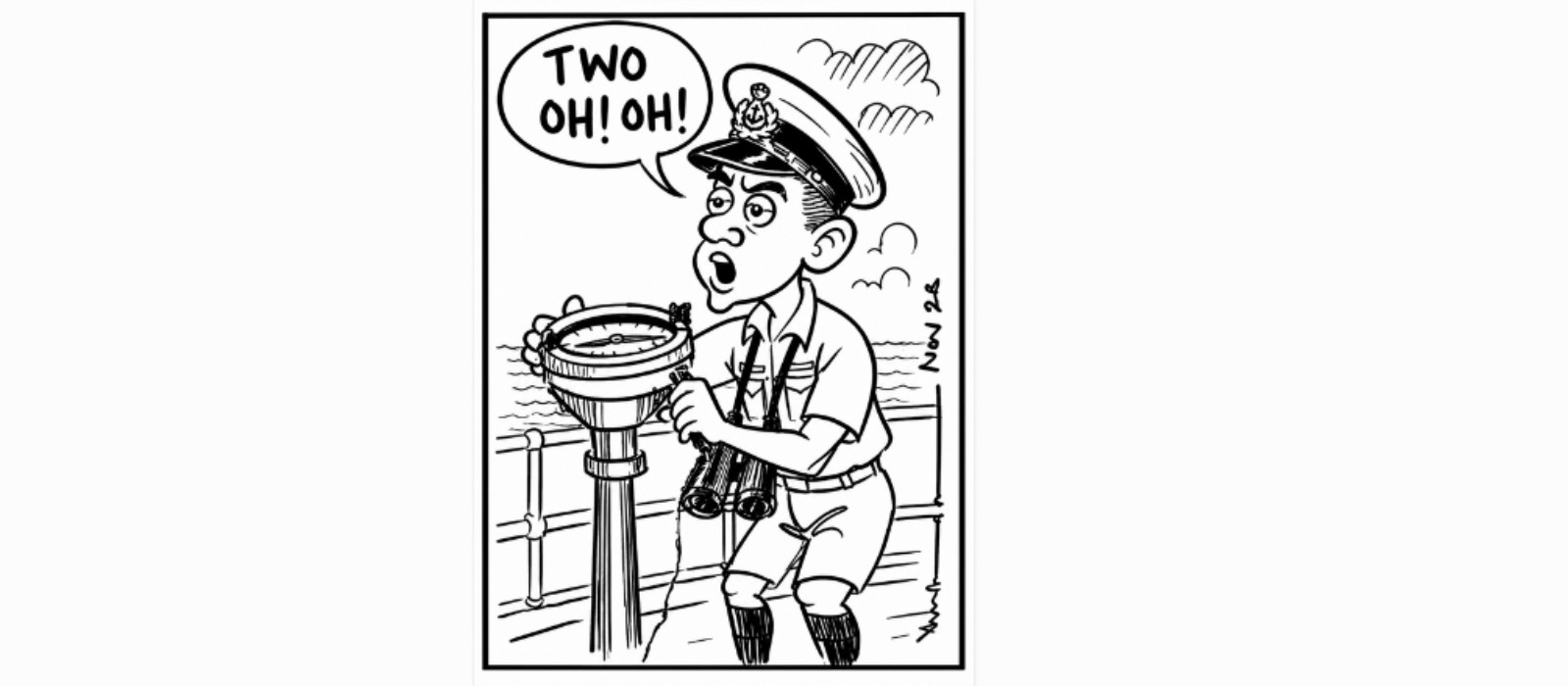


Every naval officer carries a few memories from his training days that refuse to fade, moments that start as embarrassment but get promoted over the years into legend — mostly retold at your expense. One such moment for me took place aboard Tir, somewhere in the Arabian Sea, many years ago.
I had just completed the ab-initio course at INS Mandovi, and like every young cadet, I was brimming with excitement to join the First Training Squadron at Kochi. INS Tir was legendary — our first ship, which we believed would deliver adventure, thrill, long horizons, perhaps even our first overseas deployment. I had watched every Hollywood naval movie I could put my hands on in the run-up.
That morning, the sea was calm, the sky clear, and the ship was scheduled for a navigation exercise called ‘Fixing using a Running Fix’. In simple terms, it’s the method of determining our position at sea by taking bearings of known points at different times — something that sounds elegant until you’re the one holding the pelorus under a blazing sun. In the Cadets’ Dining Hall, I glanced at the watch roster and realised my name sat neatly in the Bridge-Top Lookout column for the morning watch. A fine responsibility — to a cadet, it sounds like second-in-command of the fleet — until you realise it means it's your turn to get baked in the sun. Fuelled by enthusiasm, I resolved not to let heat, sun, or the glare of expectation dampen me. After all, this was what I had signed up for.
The entire course was mustered in the bridge and the exercise began. The Officer of the Watch’s voice crackled sharply through the intercom: “Port lookout, give me bearing — now, now… now!” “Bearing one eight zero degrees, sir!” came the prompt reply. Shortly later, “Bridge-top, your bearing — now, now… now!”. I aligned the pelorus carefully and called out, “Sir, bearing Two Oh Oh!”. There was complete silence. I was hoping that maybe the intercom had failed, but soon the OOW’s voice boomed:
“Bridge-top, you are not Tom Cruise — come to the bridge immediately.” “Aye, sir,” I responded, masking confusion as I made my way down, oblivious that I had just declared linguistic war on naval precision.
By the next hour, I was on the forecastle, a fender perched awkwardly on my back, and an imposition waiting: Write ‘Two Zero Zero, not Two Oh Oh’ — five hundred times. Somewhere between the two-hundredth and three-hundredth line, a form of revelation arrived. The lessons of the sea are seldom gentle - I realised, it’s about precision. Words matter. Bearings matter. Even zeroes matter.
Of course, my course mates found the whole affair hilarious. The next morning, as I entered the Cadets’ Dining Hall, someone called out cheerfully, “Good morning, Two Oh Oh!” and the name stuck for weeks. A few creative souls even scrawled it on the notice board beside my name, while another cadet sketched a crude diagram of a fender balanced on a stick figure’s head. By the end of the week, I was a legend onboard Tir, albeit for the wrong reason.
To this day, that episode brings a chuckle somewhere inside me, and a flash of that fateful Arabian Sea morning — that even a small oh can make a big difference in life. And perhaps that’s why, now when I hear a young enthusiastic officer shout a bearing with an extra “oh,”, I contemplate, that the sea teaches in its own language, and some of its best lessons never make it to the course curriculum.
