


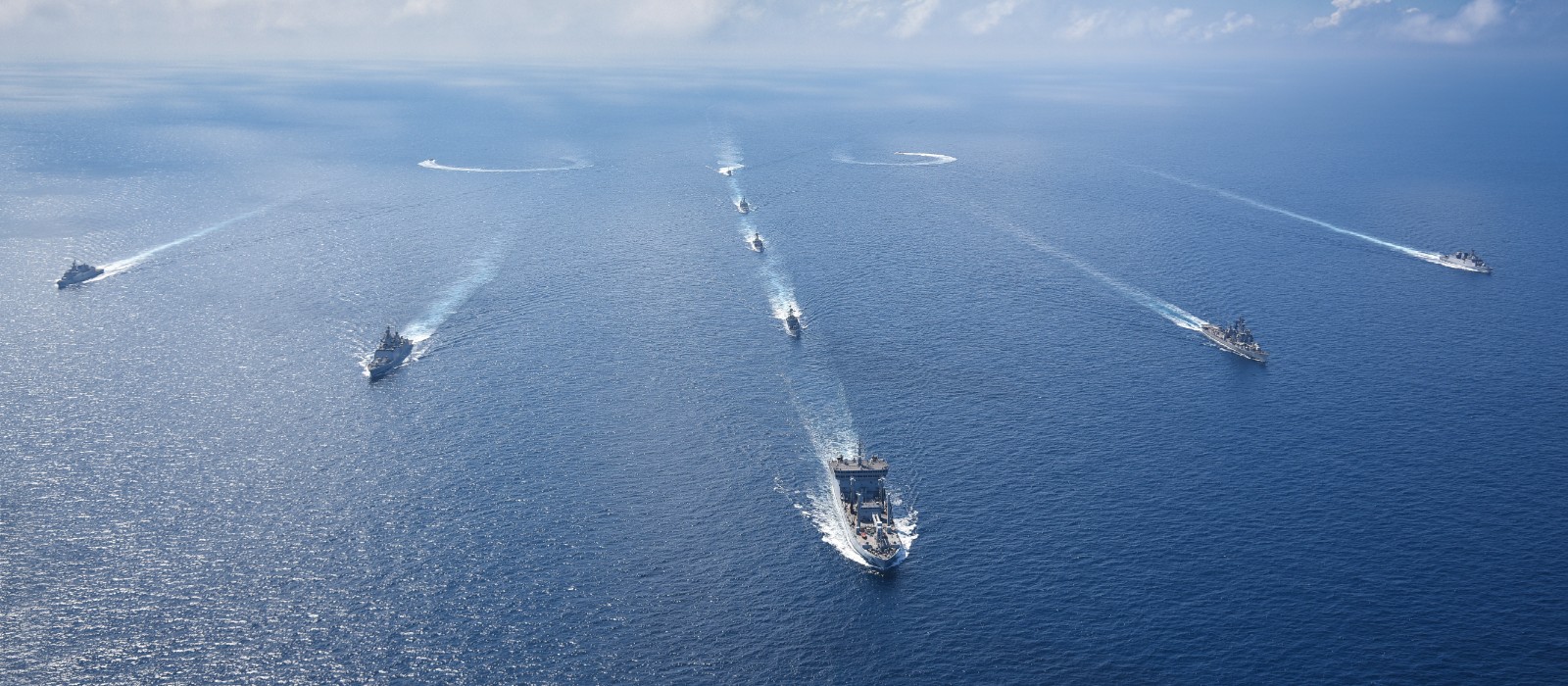


“…India’s ‘mission ready’ naval posture in the Indian Ocean isn’t sustainable”
- Observer Research Foundation1
Cooperation and Synergy – One of the Principles of War
- Indian Maritime Doctrine2
Introduction
The Indian Navy (IN), codification as a Net Security Provider for IOR, or a preferred partner, conducts most of its maritime safety and security operations under Security and Growth for all in the Region (SAGAR). On a similar format, European Naval Forces (EUNAVFOR) and United States Africa Command (USAFRICOM) along with the South West Indian Ocean Region (SWIOR) island nations provide a similar security and safety cover under the European Union’s Maritime Security (MASE) programme, predominantly in SWIOR. However, the modus operandi adopted for SAGAR and MASE are different in more than one way. One of the things which stands out is that MASE is a coordinated joint effort in operations whereas SAGAR is more of an Indian idea for cooperative efforts towards safety and security.
Tools for Maritime Security. Towards enhancing maritime safety and security the Information fusion centres are one of the important tools. Information Fusion Centres (IFCs) are coming up at various levels around the globe towards exchange of white shipping information through International Liaison Officers (ILOs). MASE has upped the ante and have not only established the Regional Information fusion centre but also established the first of the Regional Coordination Operations Centre (RCOC) as well.3 In addition to this are the ‘Mission Based Deployment’ programmes and also the foreign cooperation enablers and other bilateral activities. Much has, of course, been written and debated on the Indo Pacific strategy since 2015. The question we need to ask and answer is how to transform foreign cooperation enablers, whether bilateral, or multilaterals like the Quad, as constituents of an Indo Pacific strategy primarily in the IOR before the initiative is lost to some other nation.4
What the proposed RCOC brings to the table is economy of effort, exchange of information on vessels of interest, grey and black shipping, while coordinating operations by optimum use of assets of partner countries and keeping the initiative. But is the IFC IOR adequate and is relying so much on resource heavy mission-based deployments of the Navy sustainable? The all-important question therefore, becomes - Is there a need to establish an Indian Navy Regional Operation Coordination Centre (INROCC)?
Advent of Regional Operation Centres
Regional Coordination Operations Centre (Seychelles). Consider this scenario. An Intelligence input is received at Seychelles regarding four Pakistani dhows carrying narcotics, 500 NM NE of the islands, likely to pass through Seychelles EEZ.5 As Seychelles does not have Long Range Maritime Reconnaissance (LRMR) capability, the RCOC at Seychelles takes on the task and within a couple of hours the location of four dhows is ascertained by a US LRMR. Subsequently, a Seychelles and EUNAVFOR warship is directed to intercept them. What was seen was a joint coordinated operation with three countries combining their resources. Economy of effort, decisive action enabled by MoUs in place and a successful interception over a relatively vast area were the highlights. Had the diplomatic formalities and approvals not been a part of military cooperation between both nations, the intelligence shared with IN would have yielded in a P8I intercepting the dhows. With RCOC, the MoUs cater for these operations between partner nations.
The above operation was executed for an actual incident in 2020, which proved the feasibility of the first RCOC cooperative operation. The Centre, commissioned in Dec 2019 in Seychelles with equipment and software from the US AFRICOM and also funded by France, is the first of its kind. RCOC undertakes joint operations and maintains a robust Maritime Domain Awareness (MDA) of SWIOR including that of the grey hulls and vessels of interest. The centre takes in the feeds of Regional Maritime Information Fusion Centre at Madagascar and is run by ILOs from nations forming a part of the Indian Ocean commission.
Limited Role of Information Fusion Centre. As mentioned earlier, it has been three years now since the IN set up the IFC, Gurgaon near Delhi. Over the past 3 years IFC IOR has collaborated with several nations and their maritime agencies towards sharing of white shipping information and for positioning of Liaison Officers. However, isn’t it the need of the hour to progress from the initial steps of tracking “white shipping” to include grey hulls, black hulls and other Vessels of Interest (VOI) in the IOR?
There will always be a need to grow and change with the environment. This change is already being set in by USAFRICOM EUNAVFOR in collaboration with smaller island nations. Through collaboration, these initiatives seem to be addressing the gaps to some extent. The following areas however, still need examination:
-
Where are the existing gaps in Mission Based Deployment and IFC IOR?
-
Analyse the architecture of the RCOC and its relationship with Regional Maritime Information Fusion Centre (RMIFC). What are the implications for the countries that are part of it and for India?
-
Where does IN’s Mission Based Deployment and IFC IOR stand with respect to operational philosophy of RCOC and RMIFC?
Existing Gaps – Mission Based Deployment and IFC IOR
Mission Based Deployment (MBD). The idea of a ‘constant watch’ over choke points, while highly desired, is likely to stretch any Navy’s resources and have other opportunity costs. Such deployments at choke points do bring in information, add to MDA and help monitor Chinese presence in IOR; and peace time operations have clearly shown an increase in Chinese presence, be it submarines or research vessels. Effort-intensive as they are, “mission-ready patrols” are unlikely to yield dividends in terms of deterrence in peace time because peacetime presence does not really deter another side’s deployments. Monitoring the vessels beyond the choke points into the IOR calls for further deployments of air and surface assets. Monitoring of Chinese platforms in IOR can be done best through coordinated operations by regional centres exchanging information about Vessels of Interest and the instruments need not be only, or even primarily, deployed ships.
The IOR also includes littoral island nations which have maritime vulnerabilities and frequently need cooperative assistance for safety and security needs. The ‘Vanilla’ islands, for example, were initially impacted with piracy incidents and EUNAVFOR played a major role in countermeasures. In present times, narcotics and illegal fishing are major worries for these nations. Towards this USAFRICOM and EUNAVFOR have combined their assets and capabilities to provide safety and security cover through their major programme MASE already mentioned. This has allowed USAFRICOM and EUNAVFOR to base their assets in these island nations.
Other Problems of MBD. IN ships under MBD were being mainly deployed to focus on entry and exit points of IOR. In addition, Exclusive Economic Zone (EEZ) patrols to assist a few other countries also are planned with overall naval deployments in mind and not necessarily with specific incidents or violations of an IOR neighbour’s interests within their EEZ. Such requirements, of course can be numerous and recurring. While the IN has the capability to deploy more often, it still stretches resources available especially when seen in the context of India’s overall maritime imperatives. Nonetheless, this could leave IOR littoral and island nations with some security gaps.
MV Wakashio Incident. Let us look at the grounding scenario of a tanker, MV Wakashio, at Mauritius on 25 Jul 2020, which led to a severe oil spill.6 The first responders were the French deployed through RCOC, who were later joined by other littoral as well as some EUNAVFOR and USAFRICOM assets. Indian Naval divers also joined the effort albeit couple of days later than the first responders. This would have been mainly due to the diplomatic channel and approval and processes at government level.
Information Fusion Centre (IFC IOR). Information Fusion Centre Indian Ocean Region (IFC IOR) has been a great success towards furthering shared MDA in the IOR. While IFC IOR has signed various white shipping MOUs with partner countries, US AFRICOM and EUNAVFOR are signing MoUs with on white shipping as well as vessels of interest. The Indian IFC also provides pictures of respective EEZ to island nations in SW IOR like Seychelles and Mauritius. These pictures contain only AIS contacts transiting or operating within the EEZ. However, this information is already available to island nations through RCOC. In addition, RCOC also provides information on non AIS contacts and grey hulls operating within the EEZ through various means explained subsequently.
Permission Grants - IFC IOR. The IFC at present, collaborates directly with other countries over exchange of information on white shipping enabling quicker interactions. This is augmented by seminars and workshops from time to time. Any discussions on joint EEZ patrols or actions towards maritime safety cannot be discussed without prior permissions. Within the IN, such steps would involve several Directorates looking after Naval Operations, Foreign Cooperation, Communications and Networks and Naval Intelligence. Further, it would have to be processed through diplomatic channels of MEA as well as MoD. Thus, even if an IN warship is on EEZ patrol for another country, it would not be easy to for host country to share intelligence inputs for that area due to diplomatic complications and fuzzy aspects on what to share and then do about vessels of interest.
Chinese Fishing Fleet Incident.7 Operational philosophy is changing with the increasing complexity of white and grey hulled traffic and illegals operating in the IOR, an example being the illegal Chinese fleet operating in Seychelles EEZ. The weekly IFC picture available for Seychelles EEZ could not have located them as they all were non-AIS contacts. However, RCOC informed the presence of Chinese fishing boats to Govt of Seychelles as well as more detailed inputs bringing out the erstwhile blacklisting of these boats by some Western African countries.8
Architecture of Regional Coordination Operations Centre
IOC (Indian Ocean Commission). Under the overall umbrella of the MASE programme, a regional group called the Indian Ocean Commission (IOC) was formed, comprising the 5 island states of Mauritius, Seychelles, Comoros, Madagascar and Reunion (France). Interestingly, under the garb of Forum on China Africa Cooperation (FOCAC), China has recently registered itself as an observer state for the IOC. Its member countries now work together to increase information sharing as also resource sharing towards maximising resource effectiveness. Two arms of the IOC are Regional Coordination and Operations Centre (RCOC) and the Regional Maritime Information Fusion Centre (RMIFC). Most importantly, IOC has built RCOC and RMIFC to give full MDA of the Western IOR region. This is being supported by USA and the EU in a big way in terms of assets and finances.

Fig 1: Swath of IOC (RCOC & RMIFC)
RMFIC & RCOC Cross Linkages. The RCOC’s main function is to conduct joint actions at sea and work alongside the Madagascar based RMIFC. It is responsible for exchanging and sharing maritime information and alert the RCOC of any Safety and Security breach at sea.9 Thus, RMIFC gets the raw data, processes and sends the combined picture to RCOC. RCOC will then set in motion an operational response at sea jointly with the Regional States of the Eastern States of Africa and Indian Ocean (ESA-IO). Its goal will be of preventing actions or situations affecting maritime security in the ESA-IO region.10 Thus, the Information Fusion Centre is a feeder institution to the Operations centre.
US Support to RCOC. While USA is not a part of MASE program, it has got actively involved in the programme under its Africa Command (AFRICOM) cooperation. For the past 2 years the US has deployed a military surveillance aircraft in Seychelles for durations of 6-8 months to boost MDA in the region and aid RCOC.11 The purpose of the aircraft deployment is to build up surface picture for the CTFs operating in the region and undertake flying for EEZ surveillance for the region. Inputs received from the sorties will be provided to the RCOC and RMIFC.
EUNAVFOR - Mercury Net. EUNAVFOR presently operates with Mercury net, which is a web-based program for sharing of white and grey shipping data. RCOC maintains a continuous watch on Mercury net to maintain a networked picture of the Western IOR. In addition, EUNAVFOR assets deployed in SWIOR and Eastern African region are frequently directed by RCOC towards ‘Scene of Action.’
International Liaison Officers. At present, a representative from each of the five-member countries of IOC forms a part of the RCOC. The background of these members is generally from the operations sphere from each member country posted together to form a good, working team.12 In addition, ILOs from observer nation such as Kenya are also joining the centre. A case for deputing an Indian Naval ILO was taken up in 2019 by the Indian mission at Seychelles and is still under process.
Sea Vision, Mecury Net &SkyLite Programme. At the heart of RCOC is the MDA received through the Sea Vision software established by the Americans. The Operations centre runs on ILOs monitoring respective sea vision run panels as well as information on mercury net. IORIS has been set up by EUNAVFOR which has been made compatible with Sea vision to receive a combined Command Operational Plot.
Intelligence Inputs. The main source of intelligence received on suspicious vessels and grey hulls received at RCOC is through the USAFRICOM IMINT inputs as well as ‘SKYLITE Programme.’ This is a satellite-based programme which monitors a certain area like the Seychelles EEZ and alerts the ILO based on algorithms of proximity and time. For example, if two vessels come in contact with each other for more than a certain set period of time it might label the vessels as engaged in suspicious activities and thus, initiate an investigation.
Conduct of Operations. RMIFC is based on information towards maritime safety alerts, information collected on white shipping and information based on internet. RCOC collects the processed information from RMIFC on a particular area of operation. RCOC receives IMINT and intelligence on vessels of interest. Once an AOO is designated, an air sortie is undertaken (US deployed aircraft within the island nations or through French operated aircraft based at Reunion). Thereafter, the closest platform to that area is checked on the grid. This information on deployed asset is available through Mercury net and Sea Vision. The surface asset could then be directed to intercept. If required, media coverage is carried out by RCOC under the aegis of ‘MASE’ programme.
An Indian Regional Operations Coordination Centre (INROCC) Initial Structure
ILOs. The INROCC ILO structure can be maintained with the ILOs of IFC IOR wherein the ILOs continue to be deputed to the IFC but with additional roles as part of INROCC as well.
MOUs. Additional MoUs for coordinated operations by partner countries’ available assets would be necessary with clauses for information exchange on Vessels of Interest. For overall effectiveness, INROCC should be networked with other similar Centres mentioned earlier.”
Operational Set Up. Operational Set up for INROCC can continue to be maintained at IHQ MoD/ DNO. The following is recommended: -
-
The INROCC operational picture could be maintained through inputs received from IFC IOR, Mercury net and Sea Vision. This would include sharing of actionable intelligence from these web-based applications.
-
Additionally, operational picture of the Indo Pacific Regional Information Sharing Platform (IORIS) can be looked into. IORIS has been an upcoming Maritime Coordination and Communication secure platform which is being jointly operated by EUNAVFOR and US Navy. RCOC, Seychelles has proven the interoperability of these two platforms.
-
Interoperability of Sea Vision, IORIS with IMSAS needs to be worked upon at the operational level. Alternatively, IMSAS can be maintained separately from IORIS and Sea Vision.
-
MoUs towards intelligence sharing as well as coordination of operations involving respective assets in IOR need to be signed. This will provide the freedom to deploy assets of partner nations in area of operation or closest to vessel in distress while keeping the initiative.
-
Positioning of additional ILOs other than IFC IOR could be looked into once INROCC is functional.
-
IMSIS data exchange to be carried out through web-based applications till such time the compatibility with other application is not achieved.
Conclusion
All these steps would be a logical furtherance of the decades long initiatives that have led to several regular Bilateral and Multi-lateral exercises, coordinated patrols and other avenues for interactions with several navies and coast guards.13 Building up on these time-tested partnerships and the progress made to setting up the IFC itself could make the transition to the next steps feasible and acceptable.
The concept of RCOC and RMIFC functioning together has already been “tested and found correct” in SWIOR. Major multination exercises in the region such as ‘Cutlass Express’ are being conducted through RCOC. Expanding the network across the Indo-Pacific INROCC is going to be the future and the earlier the inroads towards the centre are made the better it is.
Endnotes
-
Abhijit Singh, “India’s ‘Mission Ready’ Naval Posture in the Indian Ocean isn’t Sustainable,” Observer Research Foundation, 05 April 2018. https://www.orfonline.org/expert-speak/indias-mission-ready-naval-posture-in-the-indian-ocean-isnt-sustainable/, accessed 29 June 2022.
-
Integrated Headquarter, Ministry of Defence (Navy), Government of India, Indian Maritime Doctrine INBR 8, 2009, 43.
-
https://www.commissionoceanindien.org/wp-content/uploads/2019/10/Final-communiqu%C3%A9CRCO_H24_7j_Eng.pdf, 30 September 2019.
-
Louis Bergeron, Nick Iorio and Jeff Payne, “The US Need a New Indian Ocean Strategy, Now: Its Time to Prioritize the Indo in Indo-Pacific,” The Diplomat, 11 February 2021. https://thediplomat.com/2021/02/the-us-needs-a-new-indian-ocean-strategy-now/. accessed 28January 22.
-
Interlocutors at Seychelles.
-
“France Send Help to Mauritius to Deal with Wakashio Oil Spill,” Africa Times, 08 August 2020. https://africatimes.com/2020/08/08/france-sends-help-to-mauritius-to-deal-with-wakashio-oil-spill/, accessed 07 January 2022.
-
Christophe Zialor, “Eight Chinese Fishing Vessels Grounded in Port Victoria,” Nation, 20 May 2021. https://www.nation.sc/articles/9041/eight-chinese-fishing-vessels-grounded-in-port-victoria, accessed 25 January 2022.
-
Interlocutors at Seychelles.
-
Op Cit., n.3.
-
http://blueeconomyseychelles.org/item/159-press-release-indian-ocean-commission-the-seychelles-regional-centre-for-operational-coordination-rcoc-operating-24-7, 08 October 2019.
-
Interlocutors from MSA Seychelles. Report at IHQ MoD/ DNCO
-
https://mfa.gov.sc/news/1898/usafricom-to-provide-support-to-seychelles-coast-guard-and-seychelles-maritime-law-enforcement-agencies
-
Anurag Bisen, “India-Russia Cooperation in Indian Ocean Region, Arctic and Russian Far East,” IDSA, 06 December 2021. https://www.idsa.in/policybrief/india%E2%80%93russia-cooperation-in-indian-ocean-region-arctic-anuragbisen-061221, accessed 07 February 2022.
