


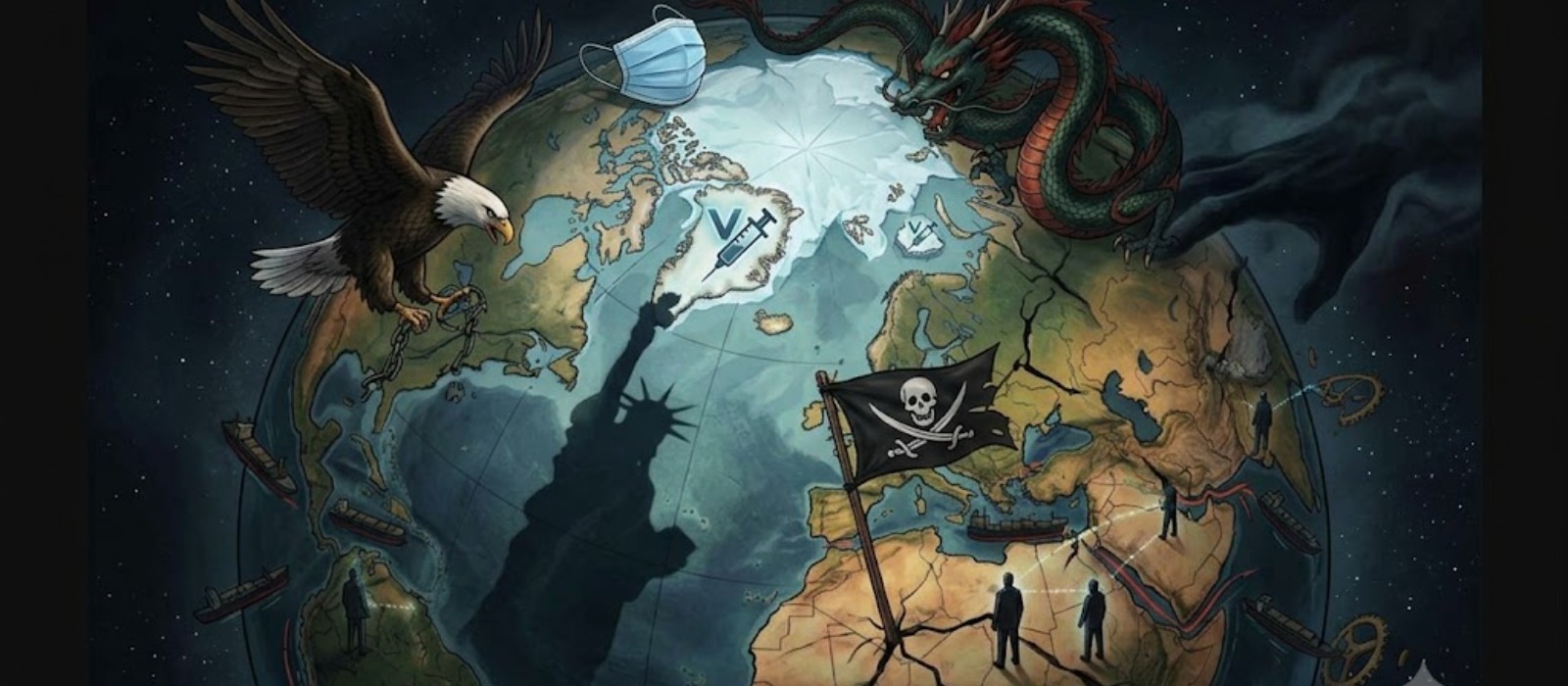


Introduction
Nobody, not even the best-known scientists and epidemiologists of the world, seems to know when the Covid-19 pandemic will end, or at least, become an endemic, like the common flu or
viral fever.1 It will end though, sooner or later, just like the similar 1918 pandemic faded away to become an endemic. What thinking people across the world in 2022 are more worried about are the other challenges that confront humanity; challenges whose looming danger was submerged in the hysteria over Covid-19.2 Some of the best strategic minds in the world are brainstorming the myriad security challenges that will confront a multi-polar world in the aftermath of the pandemic. As usual, there have been fierce debates and disagreements. But this writer found three that seemed the most talked and argued over. This article is an attempt to summarise these three challenges: -
-
-
Thucydides’Trap: Will America and China Go to War?
-
Ever-Shifting Contours of Terrorism
-
Are We Facing a Climate Crisis or A Crisis of Climate Inequality?3
-
The three subsequent sections provide a bird’s eye view of the threeselected challenges, and reference India where necessary. It may be a drop in the ocean since millions of words have been written, and are still being written, on each security threat identified. While the paper is addressing ‘Humanity’ of the Global Village; all three concerns are directly linked to India.
Thucydides’Trap: Will America and China Go to War?
In August, 2012, American scholar Graham Allison created at least a small storm of a controversy by writing a column in the London based newspaper Financial Times with a headline: “Thucydides’ trap has been sprung in the Pacific,” suggesting that a military confrontation between the sole global superpower, the United States of America, and the rising global superpower, China, was becoming inevitable.4 He followed it up with many more articles and papers in journals, and even a book titled: Destined for War: Can America and China Escape Thucydides’ Trap?5 For those not familiar, the term derives from Thucydides’ contemporary account of the Peloponnesian war in Ancient Greece, where the rising Sparta and the established - Athens went to war. Allison’s hypothesis is that war becomes inevitable when a rising power strives to outdo and overtake the existing dominant power.6 Many scholars have, however, vehemently disagreed with Allison. But this is not the place for taking further this argument because the future of India is inextricably linked with what happens between America and China. Rajesh Rajagopalan, a Professor of International Politics at the Jawaharlal Nehru University, argues that India will find it much more complex and difficult to handle the looming America-China confrontation than the Cold War between the United States and the erstwhile Soviet Union.7
Thucydides’ Trap or not, there can be no argument that differences, disagreements, tensions and even provocations between America and China have been growing in this century. What was initially trade and economy related, has now mutated into a Cold War where China and America - two sharply different models of governance - are on opposite sides of a potential conflict. There are also no guarantees that America is destined to win this Cold War. It all started brewing around 1990 when the Chinese economy started growing rapidly, led by manufacturing and exports. Interestingly, the then per capita income of India was slightly higher than China’s (US$368 versus US$318 per year). An explosive growth in exports and trade surpluses led to a situation by 2019 when the per capita income of China crossed US$ 10,000 a year, five times that of India.8 After China joined the World Trade Organisation in 2000, it became the manufacturing hub of the world and became deeply integrated with global supply chains. The massive trade surpluses wrapped up by China created both disquiet and friction. In 2021, exports from China crossed US$ 3.3 trillion (India’s total GDP will touch US$ 3 trillion this year), its total trade surplus was US$ 676.4 billion, and surplus with the US alone was US$ 396.6 billion.9
Globalisation and the creation of interlinked global supply chains were two developments China used very successfully to its advantage. Trade and currency-value related friction marked growing tensions between America and China in the first decade of the 21st Century.10 Yet trade friction between America and other countries like Japan and South Korea had been navigated in the past. Optimists expected the same to happen with China. But something fundamentally shifted in 2012, when Xi Jinping became the leader of China. He has ruthlessly consolidated personal power, and is now veritably the leader of China for life, much like Mao Zedong was in the first decades of Communist China. He has adopted an aggressive posture in the South China Sea and has triggered small and potentially big military confrontations with Asian countries ranging from Japan to Vietnam to Philippines to India. America has, in the meanwhile, articulated an Indo-Pacific Strategy, issued standard diplomatic missives and undertaken occasional naval forays in the region.11 Today, America confronts an increasingly expansionist, aggressive and ambitious China, which now has an estimated annual military budget of US$ 209.16 billion.12 This has in turn, allowed China to launch ambitious projects like the Belt and Road Initiative across the world to increase its influence.
Today, Xi Jinping and Chinese diplomats openly talk of realising the “Chinese Dream,” a throwback to an era where China was the largest economy and most powerful country of the world known as the Middle Kingdom. Chinese diplomats in foreign countries now increasingly engage in what has become infamous as “wolf war diplomacy.”13 In practising so, China’s efforts to blunt criticism of its crackdown in Hong Kong have largely relied on counterattacks and claims of hypocrisy, while its response to international condemnation of its repression of Uighurs in Xinjiang frequently endeavours to change the conversation instead.14 What baffles many strategic experts in the West is how and why Western democracies are not treating an increasingly hostile China the way they treated the Soviet Union, in a united, cohesive and determined manner.15 This has encouraged China to spread propaganda that the seemingly stable authoritarian model of governance it follows is superior to the chaotic and wasteful democratic model propagated by America. The authoritarians seem to have the edge right now.
So, will Thucydides’ Trap become a self-fulfilling prophecy? At the moment, chances of a direct military conflict with China are very high only in two countries - India and Taiwan. In 2020, India was already engaged in a limited military conflict with China in Ladakh, where Galwan Valley has become famous and a sign of things to come.16 In the eventuality of aconflict between India and China, the US would in all likelihood restrict itself to indirect support to India, through supply of material and information - akin to what we are witnessing in the ongoing Ukraine - Russia conflict. However, the publicly announced interpretations of the Taiwan Relations Act by President Biden since Aug 21, with the latest clarification during the press conference after the Quad Summit held in Tokyo in May 22 lends a formal obligation to US to defend Taiwan, if China invades it to restore what is claimed to be Chinese territory.17 That would mean the supreme leader of China Xi Jinping might have overplayed his cards, as many authoritarian leaders before him have done not only in history, but also in contemporary times. Unless of course, comprehensive lessons are drawn by Xi from the ongoing Russian invasion of Ukraine.
There is another interesting insight. Many critics of Graham Allison who started this whole debate in 2012 are convinced that China is overrated as both a military and economic superpower. The demographic dividend has come to an end for China as it has an increasingly ageing population. Ruthless controls over internet and companies based on it means that China is in danger of losing its technological power. Moreover, her GDP growth rates have already started slowing down, as was inevitable. The counterintuitive argument by Hal Brands, the Henry Kissinger distinguished professor of global affairs at Johns Hopkins University’s School of Advanced International Studies, and Michael Beckley in a 2021 piece in Foreign Policy magazine argue: “China is a Declining Power-And that’s the Problem.”18 To tweak a Chinese proverb: We seem destined to live in interesting times.
Ever-Shifting Contours of Terrorism
Before and after the Soviet Union disintegrated in 1991-92, two scholars made seemingly conflicting predictions about the world. The first was “End of History” by Francis Fukuyama in 1989 in the journal National Interest.19 The gist of his argument was that America and her allies had won the decisive ideological war, and that the future belonged to Democracy and Capitalism. Another scholar, Samuel P Huntington, wrote an even more controversial treatise for the journal Foreign Affairs in 1993 titled, “The Clash of Civilisations.”20 The gist of his argument was that there could be a civilisational war between an alliance led by America and her allies (he included India in this list), and another alliance led by a clutch of Islamic states along with China. Both turned out to be right, and wrong. Where both were wrong is in missing out on the by then looming danger of terrorism on a global scale. Former allies who partnered with the United States to throw the Soviet Army out of Afghanistan became implacable foes as they declared America as the evil that needed to be destroyed. Why just Fukuyama and Huntington (though he did refer to the threat of radical Islam), even cynical journalists missed the emerging signals. In 1993, a newspaper, The Independent, featured a profile cum interview of Osama Bin Laden, and all but glorified him in a piece with the headline, “Anti-Soviet Warrior Puts His Army on the Road to Peace.”21 By then, Bin Laden was ensconced in Sudan and a serious attempt to bring down the Twin Towers in New York had already been made.
For the Indian security establishment, this delusional detachment from reality - deliberate or not - was not new. The country had been facing a serious threat of terrorism in Punjab since the early 1980s and the withdrawal of Soviet forces from Afghanistan coincided with a massive escalation of terrorism in Jammu & Kashmir. The global community largely ignored India’s warnings. Many did not even punish heinous crimes of terrorism. The manner in which security and law enforcement officials in Canada failed to successfully prosecute those responsible for the mid-air explosion of Air India Kanishka that killed 329 people in 1985, is perhaps a classic example of turning a blind eye.22 Till the early 1990s, several strategic experts, except for a few prescient ones, considered terrorism to be a manifestation of territorial, and not ideological ambitions and animosities. The IRA in Ireland, the Basques in Spain and the LTTE in Sri Lanka were cited as examples.23 Left wing terrorist outfits like the Red Brigade in Italy (which killed a prime minister) and the Baider Meinhof in Germany were dismissed as Soviet sponsored lunatics who quickly faded away.
It was only after the launch of the Al-Qaeda was formally announced and American naval assets, apart from other things, started getting bombed regularly, that the West sat up and took notice of the global spread of terrorism. By then, Global Jihad had been well and truly declared against the “Satan” America, which became concerned and yet remained complacent. In a way, and under those circumstances, “9/11” became inevitable. While the West had faced sporadic acts of terrorism in the form of hijacks and killings, rooted in anti - Israel sentiments, anti-semitism, left wing anti-government acts, etc; it was the Twin Towers collapse, that brought terrorism into everyday lexicon at a global level . Americans realised that no one was immune to this kind of ideological terrorism where the terrorist welcomes and literally embraces death. Dying to Kill: The Allure of Suicide Terror by Mia Bloom suddenly became the book to read.24 In any case, soon after 9/11, President George W Bush Jr declared a Global War on Terror, invaded Afghanistan and ousted the Taliban regime that was a gracious host to Osama Bin Laden. It was his successor Barrack Obama, under whom the American Special Forces hunted down and killed Osama Bin Laden in Abbottabad, a military town in Pakistan. The hunt and the kill is in itself a fascinating story. 25
But that brought no respite from terrorism. Bombings and killings continued throughout the world, with the ones in developed countries getting a lot of media attention. According to a French Think Tank Foundation, Pour L’Innovation Politique, “…we can establish that between 1979 and 2019, at least 33,769 Islamist terrorist attacks took place worldwide. They caused the deaths of at least 167,096 people.”26 It is a fact that an extremely tiny section of followers of Islam do this; it is also a fact that they invoke Islam while killing and dying. Numerous studies and reports by dozens of Think Tanks and security agencies have made an attempt to examine the real causes behind this “Dying to Kill” phenomenon. But terrorism continues unabated. There were a few years, beginning 2014, when the ISIS actually carved out a State from bits of Iraq and Syria and made it a habit of releasing gruesome videos of people being beheaded or burnt alive.27 The ISIS leaders too have been killed. But this terror is a hydra headed monster. Lone wolfs literally lurk in all corners of the world, happy to kill even a few and die for the sake of jihad. Internet and social media revolutions have multiplied the threat many fold. After September 11, Paul Eedle observed in the Jane’s Intelligence Review, the effective use of internet to spread the message of Jihad, to win over the hearts and the minds of the Islamic world and to propagate complete war with the West; with online videos bringing the Jihadi message of violence with terrible vividness.28 One big challenge facing the world is the lack of consensus on how to deal with this kind of terrorism.29
Some sanguine people reckon that till after the medieval ages, even Christians held extremist views and killed, tortured and maimed in the name of the Lord. They think that sooner or later, internal forces within Islam will put an end to this savagery. Can the world afford to wait till then?
Are We Facing A Climate Crisis or A Crisis of Climate Inequality?
A Twitter spat between climate activist Greta Thunberg and a German Railways Service DB prior to Christmas in 2019 sums up the irony, the cruelty, the reality and the inequality of the climate crisis. Thunberg seemed to complain about overcrowded trains. DB responded by telling her she forgot to tell how she was given a First Class seat.30 The 18 years old activist has been repeatedly nominated for the Nobel Peace Prize. Will that noble gesture help fight the climate crisis more effectively? Actually, are we not facing a crisis of climate inequality?
What is the climate crisis and are we being overly alarmist over it?31 Shorn of technical jargon, the climate crisis is a result of irresponsible excessive use of energy, especially fossil fuels like coal, oil and gas. This has led to massive emissions of harmful carbon that lead to rising temperatures worldwide and to widespread environmental damage to fragile ecosystems. In short, the world is living beyond its means and could face permanent damage during this century itself, if urgent measures are not taken right now to address this crisis. The potential damage ranges from ever increasing natural calamities to a permanent damage to soil fertility which could threaten food supply in the long run. According to climate activists, the biggest losers would be poor countries and poor people.
What, according to climate activists like Greta Thunberg, is the solution? Simple: immediately cut back and eventually eliminate the use of fossil fuels and switch to clean green renewable energy that relies on everlasting wind and sun. To use a cliché, that’s easier said than done. To use another cliché, the road to hell is paved with good intentions. The article mentioned in the introduction by Sunita Narain, an environmental activist herself of some repute, is relevant in this regard.32 She cogently argues how imposing arbitrary curbs on energy usage will destroy the lives and livelihoods of the poor. She argues how 800 million Indians would hopefully earn higher incomes in the future that will enable them to buy fans, coolers, refrigerators, two wheelers, mobile phones and much more. All of that needs energy. Are we going to deny them access to energy because of a climate crisis that is no fault of theirs? In any case, the use of fossil fuels in the global energy consumption mix still remains extremely high despite the growing availability of renewable energy in developed economies. Some studies suggest that fossil fuel usage is as high as 80% of total energy consumption.33
That brings us to the real crisis of climate inequality. Rhetorical though it sounds, developed nations have been using more and more fossil fuels since the beginning of the Industrial Revolution more than 250 years ago. They continue to do so. Expecting poor Third World countries and their citizens to suddenly invest in green energy to “save the world” is either naïve or arrogantly audacious, or both. There is clear empirical evidence to show the extent of this inequality. According to a report in Down to Earth magazine by Chandra Bhushan in 2018, “In MER terms, the average per capita consumption expenditure in the US is 37 times higher than India’s (US $33,469 as compared to US $900). The richest Indians consume less than even the poorest 20 per cent Americans. If we consider the consumption expenditure in terms of MER, the richest Indians consume less than one third of the poorest 20 per cent Americans.”34 Clearly, most sensible people will agree that climate crisis cannot be addressed till we address the crisis of climate inequality.
Conclusion
The first issue of a potential Thucydides’ Trap falls in the domain of international geo-political, strategic and great power competition; with India in the direct fringes of any such entrapment. The second issue of Terrorism, though a jurisdiction of internal security apparatus of affected nation states, has trans-national religious linkages and the mostly unrestricted /unregulated access to internet has given it a global dimension, forcing nations to collaborate. The last issue, largely pertains to climate, in a sense one of the key global commons, which necessitates accommodative and cooperative synergy and strategy by developed and developing countries alike.
Technology, better sense and fairness have the potential to find meaningful answers and solutions to these three security threats confronting our multi-polar world. But while we can all be confident of technology helping out, can we be similarly confident about better sense and fairness amongst humans? There are no easy answers and one doesn’t see these threats going away in the near and medium term. What about the long term? As the legendary economist John Maynard Keynes once said: “In the long term, we are all dead.”35
Endnotes
-
Sarun Charumilind et al., “When will the Covid 19 Pandemic End?” McKinsey & Company, 01 March 2022. https://www.mckinsey.com/industries/healthcare-systems-and-services/our-insights/when-will-the-covid-19-pandemic-end, accessed 21 March 2022.
-
Ngaire Woods, “Challenges and Opportunities in the Post Covid 19 World,” We Forum, May 2020. https://es.weforum.org/reports/post-covid-19-challenges-and-opportunities/, accessed 21 March 2022.
-
Sunita Narain, “Why We Cannot Ignore the Poor?” Down to Earth, 15 April 2016. https://www.downtoearth.org.in/blog/climate-change/why-we-cannot-ignore-the-poor-53321, accessed 21 January 2022.
-
Graham Allison, “Thucydides's Trap has been Sprung in the Pacific,” The Financial Times, 21 August 2012. https://www.ft.com/content/5d695b5a-ead3-11e1-984b-00144feab49a, accessed 21 January 2022.
-
Graham Allison, Destined for War: Can America & China Escape Thucydides’ Trap? (Houghton: Mifflin Harcourt, 2017), 23.
-
Thucydides, “The History of Peloponnesian War," 431 B.C.E. https://web.archive.org/web/20200407122012/http://classics.mit.edu/Thucydides/pelopwar.1.fir st.html, accessed 24 January 2022.
-
Rajesh Rajagopalan, “India and US Must Know the New Cold War is a Different Beast: China isn’t USSR,” The Print, 16 February 2021. https://theprint.in/opinion/india-and-us-must-know-the-new-cold-war-is-a-different-beast-china-isnt-ussr/605415/, accessed 24 January 2022.
-
Vivek Kaul, “The Tale of Two Economies: What Changed in 30 years,” The Mint, 23 June 2020. https://www.livemint.com/news/india/the-tale-of-two-economies-what-changed-in-30-years-11592930762996, 23 February 2022.
-
Joe McDonald, “China’s Trade Surplus Hit Record in 2021: With Exports Jumping 30% Amid Pandemic Demand,” The Time, 13 January 2022. https://time.com/6139334/china-record-trade-surplus-2021/, accessed 24 February 2022.
-
Nicholas R Lardy, “US-China Economic Relations: Implications for US Policy,” Brookings, 25 April 2001. https://www.brookings.edu/testimonies/u-s-china-economic-relations-implications-for-u-s-policy/, accessed 24 February 2022.
-
Boney S Glaser and Gregory Poling, “China’s Power Grab in the South China Sea,” The Foreign Affairs, 20 August 2021. https://www.foreignaffairs.com/articles/china/2021-08-20/chinas-power-grab-south-china-sea, accessed 21 February 2022.
-
Mathew P. Funaiole, “Understanding China’s 2021 Defence Budget,” Center for Strategic & International Studies, 05 March 2021. https://www.csis.org/analysis/understanding-chinas-2021-defense-budget, accessed 24 February 2022.
-
Zhikun Zhu, “Interpreting China’s Wolf Warrior Diplomacy,” The Diplomat, 15 May 2020. https://thediplomat.com/2020/05/interpreting-chinas-wolf-warrior-diplomacy/, accessed 21February 2022.
-
Jessica Brandt and Bret Schafer, “How China’s ‘Wolf Warrior’ Diplomats Use and Abuse Twitter,” The Brookings, 28 October 2020. https://www.brookings.edu/techstream/how-chinas-wolf-warrior-diplomats-use-and-abuse-twitter/, accessed 24 February 2022.
-
Rana Mitter and Elsbeth Johnson, “What the West Gets Wrong About China?” The Harvard Business Review (2021, May-June). https://hbr.org/2021/05/what-the-west-gets-wrong-about-china, accessed 24 February 2022.
-
Shruti Pandalai, “Lessons for India after Galwan Valley Clash,” The Diplomat, 31 July 2020. https://thediplomat.com/2020/07/lessons-for-india-after-the-galwan-valley-clash/, accessed 24February 2022.
-
Zolan Kanno Youngs and Peter Baker, “Biden Pledges to Defend Taiwan, If It Faces Chinese Attack,” The New York Times, 23 May 2022. https://www.nytimes.com/2022/05/23/world/asia/biden-taiwan-china.html, accessed 05 June 2022.
-
Hal Brands and Michael Beckley, “China is a Declining Power: and that is the Problem,” The Foreign Policy, 24 September 2021. https://foreignpolicy.com/2021/09/24/china-great-power-united-states/, accessed 21 February 2022.
-
Francis Fukuyama, “ The End of History?” The National Interest , 1989 . https://www.taylorfrancis.com/chapters/mono/10.4324/9781315255156-18/francis-fukuyama-1989-end-history-national-interest-16-pp-3-18-173-89-robert-lieber, accessed 24 February 2022.
-
20 Samuel P. Huntington, “The Clash of Civilisations?” The Foreign Affairs (Summer 1993). https://www.foreignaffairs.com/articles/united-states/1993-06-01/clash-civilizations, accessed 24 February 2022.
-
Robert Fisk, “06 Dec 1993: Anti-Soviet Warrior Puts His Army on the Road to Peace,” The Independent, 04 November 2020. https://www.independent.co.uk/news/long_reads/robert-fisk-osama-bin-laden-interview-sudan-1993-b1562374.html, accessed 23 February 2022.
-
Gurpreet Singh, “AI Kanishka Bombing: Reyat’s Release Stuns Victims’ Kin,” The Hindustan Times, 29 January 2016. https://www.hindustantimes.com/world/ai-kanishka-bombing-reyat-s-release-stuns-victims-kin/story-J9SNOItJqCsFTZj6vJLZKJ.html, accessed 24 February 2022. 23 John Bew, Martin Frampton and Inigo Gurruchaga, Talking to Terrorists: Making Peace in North Ireland and Basque Country (London: Hurst & Co., 2009).
-
Mia Bloom, Dying to Kill: the Allure of Suicide Terror (Columbia: Columbia University Press, 2007).
-
Mark Yoshimitsu Nemcoff, The Killing of Osama Bin Laden: How the Mission to Hunt Down a Terrorist Mastermind was Accomplished (UK: Glenyyre Press, 2011).
-
Dominique Reynie, “Islamist Terrorist Attacks in the World: 1979-2019,” Foundation for L’Innovation Politique, November 2019. https://www.fondapol.org/en/study/islamist-terrorist-attacks-in-the-world-1979-2019/, accessed 24 February 2022.
-
“Timeline: the Rise, Spread and the Fall of the Islamic State,” Wilson Center, 28 October 2019. https://www.wilsoncenter.org/article/timeline-the-rise-spread-and-fall-the-islamic-state, accessed 24 February 2022.
-
“Dot-Com Terrorism: How Radical Islam Uses the Internet to Fight the West,” The New Atlantis no. 5 (Spring 2004), 91-93. http://www.jstor.org/stable/43152106 accessed 24 February 2022.
-
Alex Schimid, “Terrorism: The Definitional Problem,” Case Western Reserve University vol. 36, no. 2 (2004).https://scholarlycommons.law.case.edu/cgi/viewcontent.cgi?referer=&httpsredir=1&article=14 00&cont ext=jil, accessed 21 February 2022.
-
Kate Conolly, “Greta Thunberg in Twitter Spat with German Rail,” The Guardian, 15 December 2019. https://www.theguardian.com/environment/2019/dec/15/greta-thunberg-in-twitter-spat-with-german-rail-firm#:~:text=Swedish%20climate%20activist%20Greta%20Thunberg,seat%20on%20an%20overcro wded%20train, accessed 24 February 2022.
-
Michael Shellenberger, “Why Climate Alarmism Hurts Us All?” The Forbes, 04 December 2019. https://www.forbes.com/sites/michaelshellenberger/2019/12/04/why-climate-alarmism-hurts-us-all/?sh=73e93c 9936d8, accessed 21 February 2022.
-
Sunita Narain, “We Cannot Ignore the Poor,” Down to Earth, 15 April 2016. https://www.downtoearth.org.in/blog/climate-change/why-we-cannot-ignore-the-poor-53321, accessed 24 February 2022.
-
Nina Chestney, “Global Fossil Fuel Use Similar to Decade Ago in Energy Mix, Report says,” Reuters, 15 June 2021. https://www.reuters.com/business/environment/global-fossil-fuel-use-similar-decade-ago-energy-mix-report-says-2021-06-14/, accessed 24 February 2022.
-
Chandra Bhusan, “Consumptions and Emissions: Rich Indians v/s Rich (and Poor) Americans,” Down to Earth, 05 October 2018, https://www.downtoearth.org.in/news/climate-change/consumption-and-emissions-rich-indians-v-s-rich-and-poor-americans-61805, accessed 23 February 2022.
-
William Beranel and David R. Kamerschen, “Examining Two of Keynes’s Most Popular Statements-Wasteful Public Spending Can Be Acceptable, and, In The Long Run We Are All Dead-Yields Some Surprising Implications,” The American Economist vol. 61, no. 2 (2016, October). https://www.jstor.org/stable/26725784?read-now=1&seq=1, accessed 15 June 2022.
