


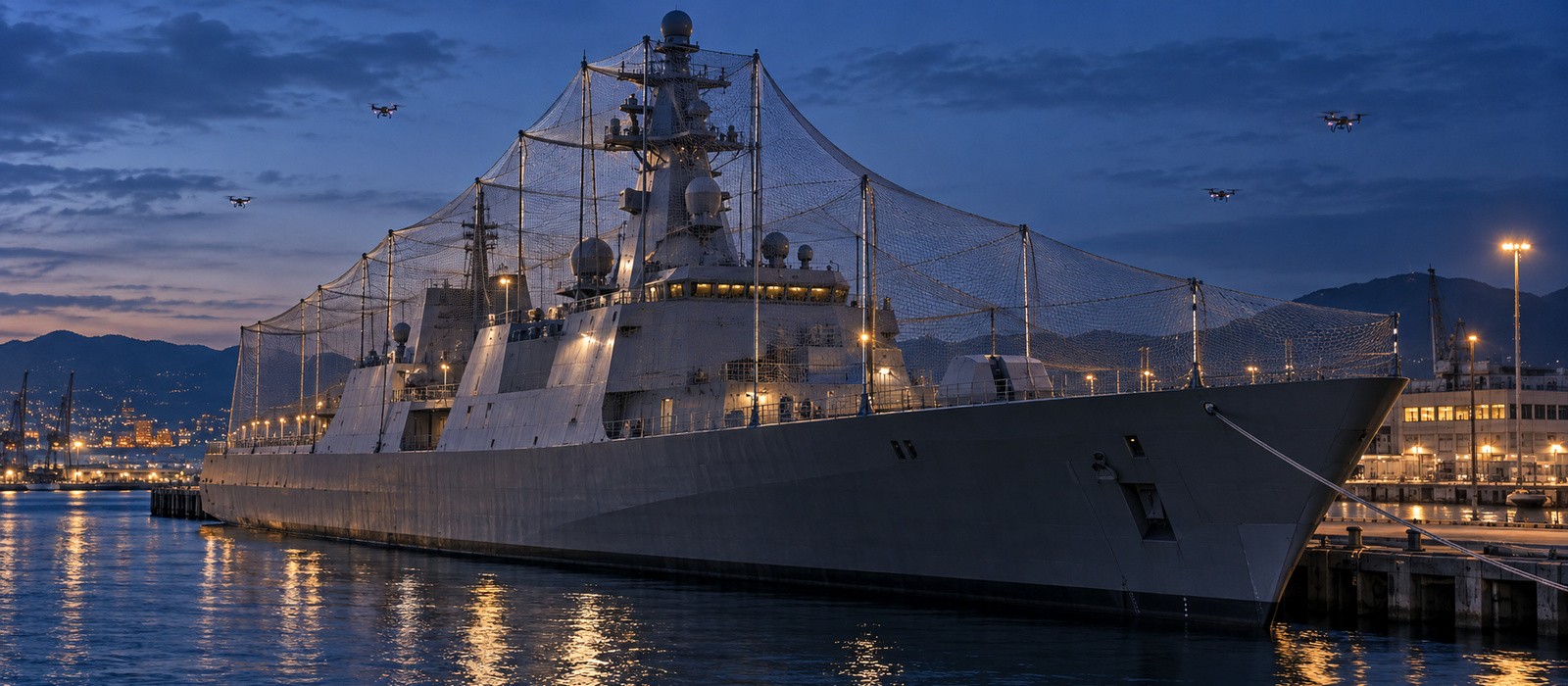


Abstract: The ongoing conflict in Ukraine has highlighted the vulnerability of high-value naval assets and critical infrastructure to low-cost, smallscale unmanned aerial systems (UAS), where the widening disparity between target value and weapon cost enables effective swarm and saturation attacks using commercially available platforms. This article examines the strategic and economic viability of employing anti-drone mesh netting, cages, and similar physical barriers as a simple, passive countermeasure. Drawing on adaptations used to protect ground installations, including Russian airfields, it argues that such lowtechnology solutions provide a rapid, cost-effective, and resource-efficient layer of defence against kinetic drone strikes, as demonstrated during Operation Spiderweb. Operationally, these barriers create a physical standoff that can prematurely detonate or disable incoming drones, while economically they offer a significantly lower-cost alternative to electronic warfare systems or interceptor missiles, delivering strong returns in asset protection. The analysis also acknowledges operational limitations, including potential impacts on ship handling, environmental resistance, radar interference, and deployment constraints. Nevertheless, in the context of proliferating low-cost threats, passive physical barriers represent an increasingly necessary and economically prudent first line of defence for high-value naval platforms.
Introduction
For decades, naval warfare has been defined by the pursuit of technological superiority in niche areas like as multi-milliondollar missiles, advanced radar, and sophisticated electronic warfare (EW) suites. These systems were designed to counter equally expensive threats such as submarines, fighter jets, and cruise missiles. Yet, the current geopolitical landscape, vividly illustrated by the conflicts in Ukraine, Palestine, Red Sea, Armenia, Iran, Israel and India has exposed a devastating vulnerability in this high-tech defence posture, which is the rise of the ubiquitous, low-cost Unmanned Aerial System (UAS), or drones.
The last decade has witnessed the rapid weaponisation of Unmanned Aerial Systems (UAS). The proliferation of commercial-off-the-shelf (COTS) quadcopters, First-Person-View (FPV) drones, and readily available explosive payloads has created a formidable asymmetric threat capability. What was once a battlefield novelty is now a strategic vector being employed en masse or through coordinated covert targeting.1 Lowcost drones generate disproportionately expensive effects against highvalue assets shielded by traditional, layered defence structures. Operation Spiderweb—a coordinated, deep-strike attack by Ukrainian special forces - perfectly demonstrated this risk.2 By launching dozens of explosive FPV drones against bomber airfields deep within Russia, the operation inflicted significant damage on multiple aircraft and dramatically illustrated how low-cost UAS can bypass detection and create high-cost, outsized operational disruption.
A broader pattern is also evident beyond the Black Sea theatre. In the Middle East, the employment of Iranian Shahed-type one-way attack drones has demonstrated how relatively inexpensive loitering munitions can be produced in large numbers and used to impose disproportionate pressure on sophisticated air-defence networks. Their significance lies not merely in their individual performance, but in the operational logic they embody of volume, affordability, and expendability which are increasingly being used to offset the defender’s technological advantage. This trend is no longer confined to regional actors. The emergence of the United States’ Low-Cost Uncrewed Combat Attack System (LUCAS), reportedly developed along broadly similar lines and fielded on an accelerated timeline, suggests that major powers too now recognise the growing military utility of low-cost, mass-producible, one-way attack systems. For planners, the consequence is clear. The challenge posed by inexpensive drones is not episodic or theatre-specific, but part of a wider transformation in warfare in which numerical scale and low unit cost are becoming strategically consequential.
For navies, the implications are particularly sharp. Warships at sea retain some freedom to manoeuvre, disperse, conceal, and defend themselves in depth. Ships in harbour, by contrast, are tactically constrained. Ships under refit, alongside jetties, near fuelling installations, or berthed close to other units are often more cluttered, and more exposed. The problem is therefore not only one of ship self-defence, but also of harbour defence, infrastructure resilience, and the protection of naval combat power while static.
In this context, anti-drone mesh deserves renewed examination. At first glance, such barriers appear crude and inelegant, especially when contrasted with the technological sophistication associated with modern fleets. Yet warfare has never rewarded elegance for its own sake. What matters is whether a defensive measure preserves combat capability, raises the attacker’s cost, and reduces the likelihood of successful strikes. In precisely those terms, passive barriers may be more relevant than they first appear.
Historical Precedent
The history of naval warfare is a cyclical narrative of technological advantage quickly met by ingenious, often low-cost, defensive countermeasures. No episode better illustrates this than the evolution of protection against the torpedo, a historical precedent that provides the precise operational and economic blueprint for deploying anti-drone mesh today. The introduction of the self-propelled torpedo in the late 19th century fundamentally redefined naval strategy. Suddenly, a massive, multimillion-dollar capital ship, once impervious to all but the heaviest artillery, could be instantaneously sunk by a small, relatively inexpensive submersible weapon.
This created the first great asymmetric threat of the modern era, forcing navies, particularly Britain’s Royal Navy, to seek a defensive solution that did not rely on disproportionately expensive weaponry.3 Their answer was the anti-torpedo net (or boom defence): a simple, robust physical barrier composed of heavy steel mesh suspended from booms extended outwards from the ship's hull while at anchor or proceeding at very slow speeds.4 This defence was designed not to destroy the torpedo electronically or kinetically with a missile, but purely to defeat its purpose by causing a physical standoff detonation or fouling its trajectory before it could impact the vulnerable hull.
The nets proved remarkably successful within their operational parameters, notably protecting battleships and cruisers in harbours and major fleet anchorages throughout the First World War and into the Second, forcing early, unsophisticated torpedoes to prematurely expend their energy or detonate harmlessly outside the critical zone.5 This passive, mechanical defence accepted the attacker's weapon but denied its effective delivery, reversing the cost-exchange ratio (CER) by protecting massive assets with mere tons of steel netting and rigging.

Fig 1: Anti-torpedo nets deployed from HMS Hotspur during harbour defence operations (Royal Navy archival photograph)6
Anti-Drone Mesh and Use in Russia – Ukraine War
Anti-drone mesh, netting, and caging represent a family of physical, non-electronic barriers designed to counter small UAS threats. These systems work by exploiting the fundamental mechanical weakness of the drone: its propellers. The design goal of the mesh is twofold: fouling and standoff.
- Propeller Fouling: The primary mechanism involves catching the drone in the netting. Small multi-rotor drones rely on fine, rapidly spinning propellers for flight stability and lift. Even a light, fibrous strand of nylon or high-tensile polyethylene mesh, when entangled in a propeller blade, will instantly destabilize the drone and cause a complete loss of flight control. The drone tumbles, unable to complete its mission or deliver its payload accurately.
- Standoff and Detonation: For drones carrying contact-fuzed explosive payloads (e.g., Rocket Propelled Grenade warheads or improvised explosives), the mesh serves as a standoff shield. The mesh and supporting frame are designed to be strong enough to hold the explosive charge away from the ship’s hull or critical components. The drone strikes the cage/net, triggers its charge, and the resulting blast is dissipated in the air at a safer distance from the primary target. This mitigation prevents or significantly reduces structural damage.
Ships at Harbour
A warship alongside is not merely a vessel at rest. It is a dense concentration of vulnerable systems, personnel activity, and maintenance exposure. Antennas, bridge spaces, upper-deck equipment, replenishment points, and localised mission-critical fittings may all be more exposed in harbour than during deployed operations. Readiness states may be lower, work may be underway, and the tactical geometry of the berth may be highly predictable.
- In such circumstances, anti-drone mesh can provide a useful degree of stand-off protection. Its value lies not in turning a berth into an impermeable enclosure, but in making direct impact on critical areas more difficult. A passive barrier over selected exposed sections, or integrated into sheltered berth protection, may force an attacking drone to detonate early, lose control, or miss a desired point of impact. This does not render the ship invulnerable. It does, however, reduce the attacker’s margin for success.
- The concept is especially relevant for ships in refit, vessels berthed in clusters, and high-value units whose temporary loss would carry disproportionate operational cost. For the Navy, this concern extends to major western and eastern seaboard hubs, submarine support locations, and maintenance-heavy dockyard environments, where combat power and infrastructure may be concentrated in ways that reward adversary reconnaissance and low-cost strike planning.
Naval Bases and Infrastructure
If the drone age is transforming naval warfare, it is also transforming the meaning of naval vulnerability. A navy is not only its ships. It is also its dockyards, cranes, dry docks, communications centres, fuelling systems, repair workshops, ammunition facilities, and command nodes. Damage to these may not generate the same public imagery as a strike on a front-line warship, but it can impose cumulative operational penalties.
For this reason, the strongest case for anti-drone mesh system may lie ashore. Fixed infrastructure is easier to shield than mobile platforms, and passive protection can be more systematically integrated into the defence layout of a base. Overhead screening, selective canopying, shielded approaches, and protection of critical nodes can all contribute to resilience. The aim need not be to cover every surface. Rather, it is to identify those locations whose disruption would have disproportionate operational effect and to provide affordable passive hardening against low-cost aerial attack.

Fig 2: Anti-drone nets protecting a Russian oil depot at Stavropol7
This issue has relevance for Indian Naval infrastructure as it spans major metropolitan ports, specialised bases, island territories, training and logistics establishments, and a wide coastal ecosystem that supports sustained maritime operations. Some facilities are embedded in dense commercial or urban environments, while others occupy strategically exposed littoral or island geographies. In both cases, the vertical dimension of the threat can no longer be ignored. A drone launched from outside a perimeter may not destroy a naval base, but it may still create disruption, publicity, intelligence gain, or local damage out of all proportion to its cost.
The Harbour Edge and Restricted Movement Spaces
There is also a transitional zone that deserves attention: harbour entry and exit, chokepoints, littoral waters, and other environments in which a ship’s ability to manoeuvre is restricted by geography, traffic, or navigational rules. Contemporary counter-unmanned aerial systems commentary has noted that vessels in such conditions may be especially vulnerable to drone threats because their ability to take evasive action is limited. This does not mean mesh is appropriate for all movement phases. Passive barriers can impede access, create drag, and complicate handling if applied indiscriminately. But it does suggest the importance of procedures governing transition states. When should passive systems be fitted, removed, or reconfigured? Which categories of vessel and which threat conditions justify them? These are operational questions that deserve to be addressed within harbour defence and base operating procedures rather than left to ad hoc improvisation.

Fig 3: AI generated author’s representation of anti-drone mesh
The Economic Imperative
The proliferation of low-cost drones in modern conflicts, as starkly demonstrated in the Russia-Ukraine war, has exposed a critical vulnerability in naval defence economics. Small, inexpensive drones costing as little as ₹4-20 lakh can inflict debilitating damage on multibillion-rupee warships.8 This presents an urgent strategic and financial challenge, making the adoption of anti-drone mesh systems an economic imperative for the Indian Navy. The core issue lies in a cripplingly unfavourable cost-exchange ratio (CER) for traditional defence systems as below:
- High-Cost Interceptors. A single Barak missile, the standard interceptor on Indian Navy warships, costs between ₹5 crore and ₹15 crore.9 Using such a sophisticated weapon to neutralize a ₹4 - 20 lakh commercial drone results in a disastrous CER of up to 400:1 against the defender. A sustained defence against a drone swarm under these terms is financially and tactically untenable.
- Limited Return on Advanced Systems. High-tech solutions like electronic warfare (EW) suites or directed-energy weapons carry immense capital and operational costs. A naval EW suite can exceed ₹100–150 crore in initial investment, requires significant power, continuous software updates, and specialized personnel. Critically, these systems are often ineffective against drones on pre-programmed, radio-silent GPS routes, delivering a poor return on investment against this asymmetric threat.
In stark contrast, the anti-drone mesh system offers a leap in costefficiency and resilience. Constructed from high-tensile material or advanced polymer netting, the mesh acts as a physical barrier around vital ship sections like the bridge, radar arrays, and missile silos. Its economic advantages are profound:
- Exceptional Return on Investment (ROI). A complete, customized mesh installation for a major warship, such as a ₹12,000 crore P-15B destroyer or a P-17A frigate, will cost between ₹45 lakh and ₹50 lakh.10
- Negligible Operational Costs. The mesh is a passive, one-time installation. It requires no power, no operator, and virtually no maintenance beyond periodic visual inspection. It provides a persistent, 24/7 defence that cannot be jammed, spoofed, or exhausted.
- Maximizing Asset Readiness. By preventing damage from lowcost threats, the mesh system directly mitigates the risk of unscheduled dry-docking and lengthy repairs. This is a significant saving, as the opportunity cost of a capital ship being out of service can amount to ₹2–3 crore per day.
Doctrinal Implications:
- Conceptual Clarity. Passive barriers should be integrated into harbour defence and infrastructure protection plans as one available layer, with clearly defined use cases rather than a universal mandate.
- Prioritisation. Not every platform and facility requires identical protection. A sensible approach would focus on those assets whose damage or temporary disablement would have disproportionate operational effect. This includes high-value combatants in refit or alongside periods, specialised maintenance infrastructure, selected fuel and ammunition nodes, and communications or command facilities whose disruption would ripple through wider operations.
- Readiness Procedure. Passive protection is only useful if it can be fitted, maintained, and integrated with normal activity without paralysing operations. This points towards modular kits, standard operating procedures, crew drills, engineering validation, and regular inspection regimes. The issue is not simply whether mesh exists. It is whether it can be made usable.
- Procurement. In an era of increasing budgetary pressure, the most strategically useful defence investment is not always the most technologically advanced. Some resilience can be bought relatively cheaply if procurement logic is willing to recognise the value of lowcost passive systems. The purpose of military spending is not technological prestige, it is combat credibility and force preservation.
Conclusion
Operation Spiderweb illustrated a legal and operational reality of modern conflict i.e. low-cost UAS, used with ingenuity and massed effect, can impose strategic damage. For naval forces and ports, the takeaway is that physical nets and anti-drone mesh are inexpensive, practical, and underused tools that materially raise the cost to attackers using rotorcraft UAS. They won’t stop every threat but when combined with sensors, softkill measures and procedural controls, mesh can blunt many of the attacks that are likely to be attempted first in a future conflict. Meshes shouldn’t be an afterthought or a last-minute improvisation once the attack has been suffered. It should be a budgeted capability with a logistics chain and trained crews. That way, when adversaries attempt their next drone strike against a fleet or port, physical measures will be part of a layered answer, saving ships, infrastructure, and lives at a fraction of the cost of replacing high-end systems or strategic assets.11
Endnotes
- Aosheng Pusztaszeri and Emily Harding, “Technological Evolution on the Battlefield,” Center for Strategic and International Studies (CSIS), September 16, 2025, https://www.csis.org/ analysis/chapter-9-technological-evolution-battlefield.
- “Significance and Implications of Ukraine’s Operation Spiderweb,” Trends Research and Advisory, June 03, 2025, https://trendsresearch.org/insight/significance-and-implications-ofukraines-operation-spiderweb/.
- “Net and Boom Defenses,” Maritime.org, https://www.maritime.org/doc/netsandbooms/ index.php.
- “William Munton Bullivant,” Grace’s Guide, https://www.gracesguide.co.uk/ William_Munton_Bullivant.
- “Torpedo Net,” Wikipedia, https://en.wikipedia.org/w/index.php?title=Torpedo_ net&oldid=1309915296.
- Tony_Tanna78, “HMS Hotspur (1870) with Torpedo Booms and Nets Out, 1887,” Reddit, April 29, 2024, https://www.reddit.com/r/WarshipPorn/comments/1cftqyy/hms_hotspur_1870_ with_torpedo_booms_and_nets_out/.
- “Anti-Drone Nets Saved Russian Oil Depot,” Militarnyi, November 01, 2024, https://militarnyi.com/en/ news/anti-drone-nets-saved-russian-oil-depot/.
- “The Drone Defense Economics Crisis: When $3M Missiles Target $38K Drones,” Norsk Luftvern, June 26, 2025, https://norskluftvern.com/2025/06/26/the-drone-defense-economicscrisis-when-3m-missiles-target-38k-drones/.
- “Missile Interceptors by Cost,” Missile Defense Advocacy Alliance, https://missiledefenseadvocacy.org/missile-defense-systems-2/missile-defense-systems/missileinterceptors-by-cost/.
- “India Gets 4th P-15B Missile Destroyer: 2x8-Cell VLS BrahMos AShMs,” Bulgarian Military, May 18, 2022, https://bulgarianmilitary.com/2022/05/18/india-gets-4th-p-15b-missiledestroyer-2x8-cell-vls-brahmos-ashms/.
- “Anti-Drone Response,” Bundesagentur für Sprunginnovationen (SPRIND), https://www.sprind.org/en/actions/chal lenges/funke-anti-drone-response.
