




Editor’s Note: This article is an adaptation by the author of a piece posted on his blog on 03 March 2017. Published here with permission of the author.
To invent, you need a good imagination and a pile of junk.
-Thomas Alva Edison
Periodically, I launch myself into one of those spring-cleaning campaigns that I undertake. Bordering on Obsessive Compulsive Disorder (OCD), the urge to clean up by wantonly throwing out stuff every now and then has been a malady I have been afflicted with for many years. I am reminded of an incident from long ago when I was at the receiving end of one such cleanship overdrive. I believe it has lessons for our homes, the Navy and workplaces as well.
For the Executive Officer (XO) of a small ship, storage space for tens of thousands of articles that go into keeping a warship “shipshape” is always at a premium. Every department has a tendency to hoard things onboard ‘just in case.’ Then there is the bureaucratic challenge of returning defunct or life-expired items back to the depot - a tedium euphemistically called ‘survey.’ Both these factors combine to ensure ships are stuffed year-on-year with more than a fair share of junk - a serious fire hazard and a constant source of worry for the XO and CO.
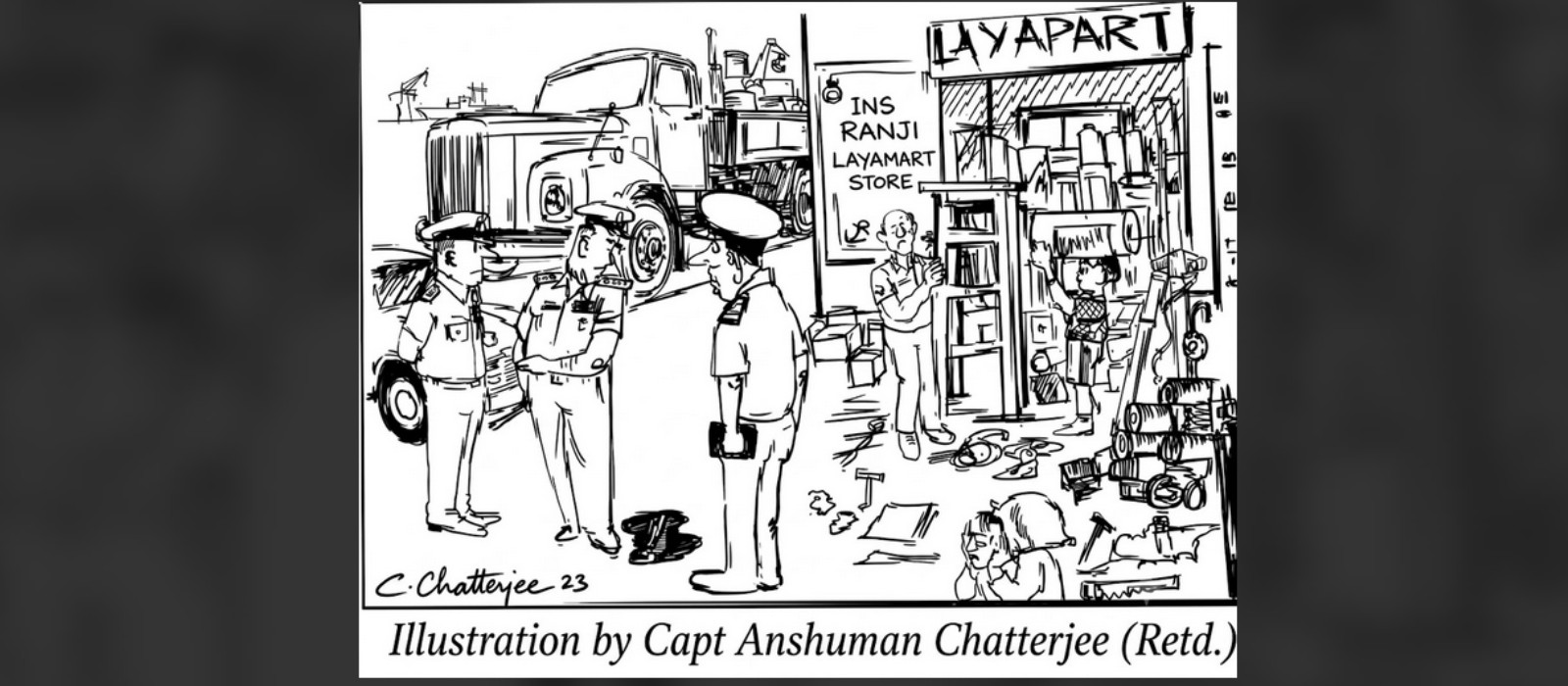
To tackle this menace, the navy came up with a novel concept called Lay Apart Store - a small space ashore (equivalent to a garage) allotted to each ship where such items can find short-term storage before they are returned to the depot. A noble intention indeed but with a small hitch. A survey is a cumbersome procedure and there are always more items to survey than can possibly be surveyed in the ever-shrinking time that operational ships spend in the home port. Consequently, Lay Apart stores are always overflowing with items, particularly in the days preceding important events such as an Annual Inspection when the ship has to be stripped of all junk. Part laziness, part systemic, the hoarding syndrome keeps festering till some senior officer cracks the whip and calls for ‘Rounds’ (inspection) of the Lay Apart Store - a nightmare for XOs, especially if it comes as a surprise.
Soon after taking over the reins of Eastern Fleet, our Fleet Commander had included Lay Apart Stores among his priorities. To further aggravate matters, he had announced the creation of an additional shore-based facility called ‘Paint Store’ where the copious amount of paint allotted to ships would have to be stored - again with the noble intention of reducing fire hazard on ships. However, under the regime of the day, an overriding requirement of both these stores was to look as austere and empty as possible (falsely indicative of promptness on the ships’ part to survey old items). Anything more than a few neatly labelled paint cans, the odd block & tackle or a reel of extra berthing hawser was frowned upon - clearly, an uphill task for the XO unless matters improved at the depot, or innovative window dressing measures were employed.
So, when sadistic opportunists sitting in Fleet HQ announced surprise rounds of Lay Apart Store and Paint Store a week before our ship’s annual inspection, I knew we were headed for an unmitigated disaster. With just two hours for rounds to commence, the Commanding Officer and his able deputy suddenly had a two-front war thrust on them. We quickly mobilised the ship’s company into two teams to “attack” both stores and empty them of the very things they were designed to hold in the first place.
Strange are the ways of the Navy, but who had the time or cheek to question them? It was an “all hands on deck” situation. Our resourceful Gunnery Officer quickly arranged a 3-tonner (a large military-grade truck) to hold the contents of both stores till such time the storm passed. With other ships in the harbour also scurrying to hide away skeletons from their LA Store, large trucks were suddenly in hot demand.
Within the next few hours, several vehicles, small and large, started plying around the dockyard hiding the contents of their respective LA stores. On our part, we had a shambolic truckload of stuff that included old Remington typewriters, obsolete signalling devices, 486-era computers, Motorola radio sets, steel wire ropes, tons of cleaning material etc. The last of the junk was being feverishly tossed onto the truck when the Admiral’s flag car pulled up in front of our LA store with the nearest bugler sounding the “Alert.” Almost on key, a discarded steel vessel from the ship’s galley rolled over from our truck to the pavement below; the metallic sound shattering the pin-drop silence created by the admiral’s arrival. The bizarre & frenetic activity came to an abrupt halt.
What happened next is best left to your imagination. I think the admiral had his first and genuine ‘SNAFU’ moment in many years! It certainly was for us!
Within a few hours of the Admiral’s rounds, the fleet of trucks hiding many ships’ junk returned to disgorge their illicit cargo back into the stores. To cut a long story short, everybody passed muster except us - all because of a few minutes delay in doing the Houdini.
The sheer impracticality of keeping a Lay Apart store in ‘window dressed’ condition while doing little to facilitate or simplify the survey process at both ends, in this case, is symptomatic of the importance we sometimes attach to “good order & naval discipline” (a phrase borrowed from naval lexicon that can be very flexibly interpreted) without investing in sound processes. Noble intentions that are not backed up with mechanisms that encourage end-users to adopt best practices can remain, well, just noble intentions. Well-meaning initiatives intended to improve people’s lives or enhance operational efficiency sometimes end up becoming an albatross around our necks.
At home, I used to insist that the guitar is always put back inside its case after use and kept in the designated corner (where it would look nice & orderly) till we realised that the boys were now shunning the guitar altogether to avoid the extra work of securing it after use. Ditto with my OCD-driven insistence that books be always arranged in that particular order in this particular corner of that particular bookshelf. Once freed of these shackles, the reading habit flourished, books lying almost always within an extended arm’s reach in our house. I also remember incidents of ships preserving their labour-saving devices for the Admiral’s inspection while chipping away with the same old chipping hammers that were to be replaced by labour-saving devices. Thankfully, even this syndrome is behind us I am told.
Recently, I learnt of an HR initiative in an aviation company which mandated annual appraisals among their company pilots. This required pilots to have short-term and long-term goals, along with a host of other appraisal jargon borrowed from a completely non-aviation setup. Needless to state, pilots were seething at being measured with the wrong tape. Why complicate matters when successful and timely completion of revenue sorties, flying hours, safety records, biannual check rides etc. more than suffice as performance metrics? Another well-intentioned initiative with a misplaced application?
By shifting the focus to the upkeep of the Lay Apart store rather than its pure utility, both the ship and HQ lost the plot and people had to resort to all kinds of deceit to measure up to the wrong benchmark. What if the processes of surveying equipment, and reducing the excessive amounts of cleaning gear and paint that used to be delivered to ships periodically were areas where fleet and Command HQs had paid more attention to than in wanting to see Lay apart stores clean and empty but at the cost of “creative measures” that were then resorted to passing “one test at a time?” Get the drift?
Sometimes a little disorder is required to break new ground. Creativity and good order may not be the best of friends.
Do you agree?
Note: The accompanying illustration has been prepared by Capt Anshuman Chatterjee (Retd.), a naval veteran, who bid adieu to the IN in 2017. Capt Chatterjee, a former naval aviator, is an accomplished artist, illustrator, cartoonist, and caricaturist.
