


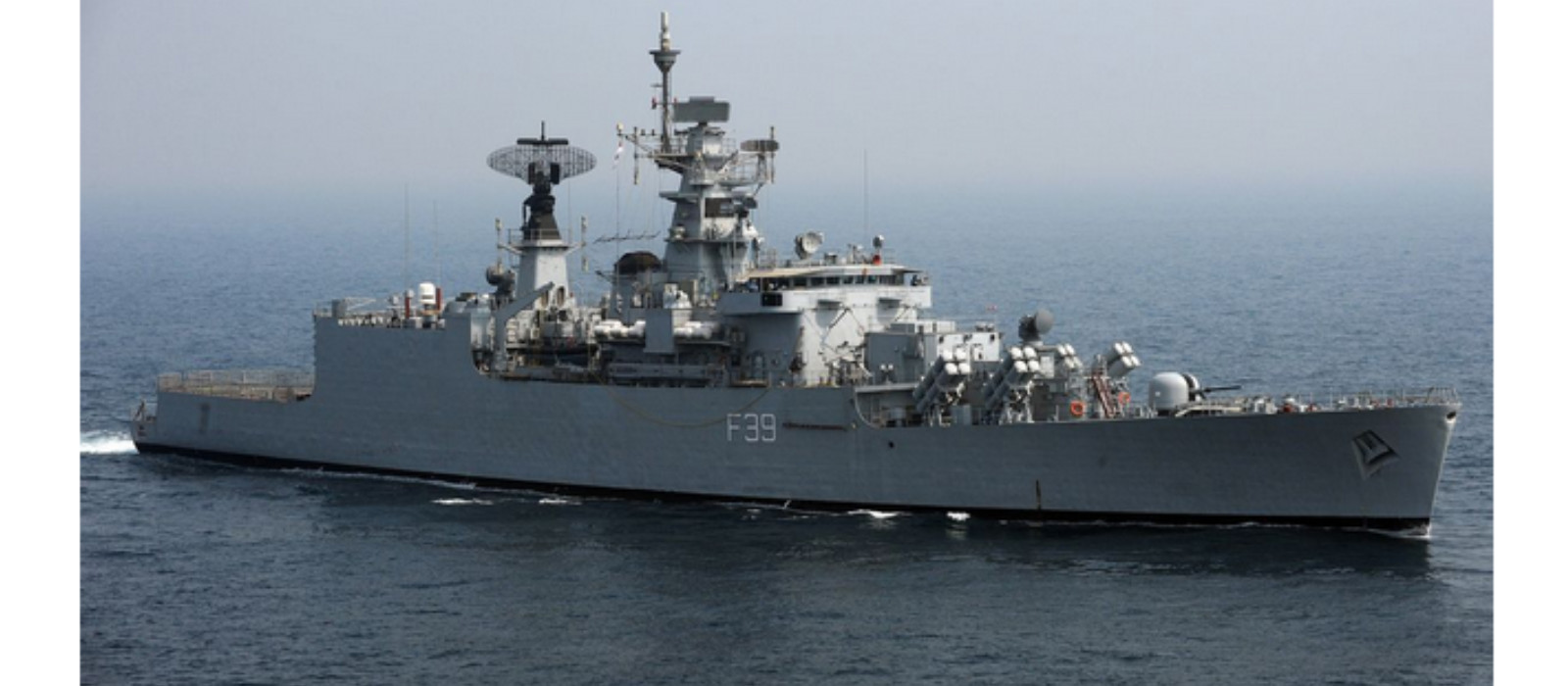


INS Betwa (F39) is an indigenously designed and built, steam propelled, guided missile frigate of the Indian Navy named after the river Betwa. With a motto ‘The Tenacious Torrent’ signifying it unstoppable spirit, the predecessor to the current Betwa was commissioned as a Leopard-class Type 41 anti-aircraft frigate (F139) in December 1960 and played a pivotal role in ‘Op Vijay,’ towards liberation of Goa in December 1961. The new Betwa was commissioned on 07 July 2004, and was the first Indian warship to have an indigenously designed and manufactured Combat Management System (EMCCA), which had been successfully integrated with a wide array of weapons and sensors.1 Soon after joining the Western Fleet, she played a major role in the evacuation of Indian citizens from Lebanon in the year 2006 as part of ‘Op Sukoon’ winning laurels from all quarters.
In the ensuing years, she participated in numerous Fleet exercises, HADR operations, multi-lateral naval exercises, etc., and underwent scheduled refits to keep her fighting fit. The ship commenced her maiden Medium Refit and Mid-Life Upgrade (MR-MLU) on 15 April 2016 and was poised to become even more potent and lethal on completion. However, while undocking on the fateful day of 05 December 2016, the ship keeled over in the Cruiser Graving Dry Dock at Naval Dockyard, Mumbai {ND(Mb)}. This was probably a rarest of rare kind of incident wherein a major warship had suffered damage of humungous proportions, akin to action damage in combat, in a dry dock, during peace time! As the 3,750 Ton ship keeled-over on the Port side in the dry dock, it did not take long for the major machinery spaces like the Boiler Room, Engine Room, Machinery Control Room, Main and Auxiliary Switchboards, AC and Diesel Alternator Compartments to be submerged in water. Seawater ingress left the installed machinery, electrical cabling, a large number of weapons and sensors unserviceable. Since most of the equipment and systems onboard warships are tightly integrated/ inter-connected, it seemed a foregone conclusion that salvaging equipment and machinery would be impossible. Apart from ship’s internal machinery, the main mast too had been damaged as was the hull at many locations. Preliminary time estimate towards restoration of the ship was estimated to be about two years. But based on the ship’s visible condition, many were pessimistic and suggested, ‘this ship could never revert to the state to be made to sail again.’2 Whatever may have been the state of Betwa, it was imperative for the Indian Navy to resurrect her and get her to a fully operational status.
In this freak accident, the ship unfortunately lost two sailors and 15 others, including personnel from the ND(Mb), suffered injuries. The morale of the ship’s crew was certainly impacted. After all, they had lost two shipmates, several were injured, many had lost personal belongings besides feeling stigmatised by the loss of their ship in such uncommon circumstances. Despite this, the indomitable spirit of Betwa was very soon on full display when the crew quickly got their act together and commenced salvaging equipment, records and whatever else that could be recovered from the now keeled-over ship which was filled with seawater. Entering any space or compartment in a ship resting at 90 degrees to one side was a challenge as anyone can well imagine. It was not easy to walk on what once were bulkheads and not decks, and in a state where the ship was without lighting and ventilation. To say that the ship was disoriented would be the mildest way of putting it.
ND(Mb) with 285 years of history to lean-on, put together its action plan towards restoration of the ship on a war-footing. A US based salvage firm, the Resolve Marine Group, which had prior experience of salvaging ex-Sindhurakshak, was given an emergency contract to get the ship upright. The firm quite promptly carried out extensive diving surveys and hull repairs to achieve stabilisation of the vessel in order to proceed with dewatering of the dry dock. Following this, necessary repairs to the internal tanks, tank-tops, shell-plating and superstructure, ballasting arrangements/preparations, debris removal, etc., was undertaken to restore ship’s buoyancy. Finally, the complex salvage operation for righting the ship based on sequential ballasting of various internal tanks and utilising buoyancy balloons; a procedure that avoided the use of any external lifting forces, commenced on 20 February 2017 and got completed on the landmark day of 23 February 2017 bringing Betwa to even-keel in the dry dock itself.3
Thereafter, the ship’s crew undertook washing down of the affected compartments so as to minimise rust formation caused by the seawater. This too was a carefully calibrated process, intensive on time and in manhours. The next challenge was to operationalise the ship to achieve her full combat potential, an uphill task indeed, on a path full of uncertainties!
As a precedent for the Indian Navy, the US Navy had successfully restored USS Cole to her full capacity after suffering major damages consequent to a terrorist attack at the port of Aden, Yemen on 12 October 2000. The Cole’s refit work package was completed at Litton Ingalls Shipyard, Pascagoula, Mississippi and the major works involved Mreplacement of two gas turbine main engines, the starboard gear box, three gas turbine generators in the machinery compartment, which had all been gutted due to ingress of seawater.4 ND(Mb) and the crew of Betwa drew inspiration from the restoration of Cole. For some key restoration work, ND(Mb) had to co-opt agencies outside the yard while leveraging its own diverse capability and work-force.
As naturally happens in a free, democratic country, the accident had attracted bad press and public condemnation and the scope and cost of repairs also received more attention than in other cases. Investigation into the occurrence of the unfortunate incident had already commenced in order to ascertain the events that led to the same and fix responsibility. In the process, decision-making suffered to a degree because several officers, especially the CO and HODs were occupied with the formal investigation. Nonetheless, the crew and all naval agencies continued to go about the salvage and operationalising of the ship with a doggedness that merits more admiration than it may have got at that time.
Here, it is pertinent to mention that Betwa was in a mid-life upgrade and several weapons, sensors and other equipment were to be upgraded and modernised. The keeling-over incident during the ongoing MR-MLU greatly increased the work package and execution of this enhanced scope work package demanded greater degree of proficiency and higher level of expertise from all involved. Accordingly, in 2018, a new team of officers comprising the Commanding Officer and the Heads of Departments were identified and appointed with a mission to take Betwa back to sea. Simply stated, the new team of Betwa was tasked to transcend all odds and make her combat ready. However, the going was never easy while implementing the revised refit plan.
There were many unique challenges faced in restoration of Betwa. The foremost was pertaining to shaft alignment as both main gear boxes, which serve as the datum or reference point in shafting, were removed for overhauling at OEM premises and it was perceived that hull-distortion had affected the existing shaft line. As anticipated, upon re-laying the shaft post-installation of gear boxes, considerable mismatch between the earlier and fresh readings was observed. This was resolved by machining the gear box chock plates and undertaking necessary modification to stern gland bush, in an iterative manner. In order to ratify the work undertaken, shaft alignment readings were continuously taken utilising established telescopic sighting and contemporary laser sighting techniques, usually during the middle-watch for over two months during ship’s final dry-docking phase.
Apart from this, maiden Air Pressure Test (APT) of the inner gas casing of ship’s boilers, was successfully undertaken in order to comply with the mandate of the Central Boiler Inspecting Unit (CBIU). While the broad procedure for conduct of APT was mentioned in the reference documents, no agency had any details pertaining to the experimental set-up that was required to proceed with this activity. Therefore, ND(Mb) had to rely on the ‘hit and trial’ method to achieve acceptable APT standards by utilising an inhouse fabricated jig. This however, consumed over four months of the refit time.
A steam ship has myriad pipelines running across its length and breadth connecting various systems and Betwa was no exception. During the incident, many of the pipes, valves and other components held onboard either got lost or damaged or deformed, necessitating renewal or replacement to achieve integrity of the associated systems. This posed a huge logistic and engineering challenge which caused further time and cost overruns. However, it was overcome with optimum resource management. The ex-Ganga awaiting disposal after her decommissioning on 22 Mar 2018 was a source for re-appropriation of similar pipes, end-fittings, valves, etc., thereby expediting refit progress and aiding cost savings. The ship also served as a ready reckoner for tracing of various systems. Over 2500 new pipes were manufactured; and similar numbers of valves were removed and refitted to operationalise systems on Betwa. Thus, proactive approach and dovetailing of various activities helped in curtailing refit timelines and mitigating bottlenecks.
In pursuing this challenging task of restoring Betwa - now a brown-field turnkey project, about 250 tons of steel was renewed and 52 tons of solid ballast was added to meet the ship’s revised stability criterion. In addition, habitability upgrade of 64 compartments, retubing of both main boilers, upgraded feed water and fuel systems hygiene (so vital in a steam ship), major overhaul of both main gear boxes and other motor driven and steam driven auxiliaries, renewal of piping, overhaul of 194 motors, installation of a new switchboard, weapon-convertors, electrical control panels, replacement of transformers, radars, APT of 36/37 compartments, etc., was also achieved prior refit completion. The list seems just a couple of sentences worth, but most readers would be able to visualise the complexity and quantum of work involved that would classify the extant refit as ‘no ordinary refit.’
The ship’s Refit Coordination Team had to revisit the entire scope of work repeatedly, formulate corresponding action-plans and execute them professionally. Consequently, astute planning with short-term and long-term objectives resulted in the revival of all critical compartments towards enabling the ship to “Float” and “Move,” from the state it was in February 2017, wherein over 600 tons of water had to be filled in her fuel tanks in order to maintain buoyancy to keep her afloat and upright.
Timely achievements of critical refit milestones like restoration of ship’s fire-main, fresh water, feed water, pneumatic and fuel systems, air conditioning, operationalisation of compressors, power generation employing installed alternators, flashing up of boilers, etc., enthused the crew and yard teams and gave much needed boost in the ongoing refit. The journey of the ship from lighting up of the starboard boiler on 05 December 2018 to the turning of the propellers for Basin Trials on 12 February 2020 seemed to happen in a blur. The ship sailed for her maiden sortie on 17 February 2020, about three years after she was made “right side up.” Betwa’s crew worked zealously and passionately to ensure this critical stage.
However, there was more work to be done especially towards achieving ship’s “fight” attributes when the unforeseen COVID-19 pandemic, with subsequent lockdowns emerged and became an impediment in ship’s refit progress. Despite this, in the ensuing “COVID” months, all stakeholders continued with work under trying situations, acknowledging the restrictions imposed. This ensured completion of the Harbour Trials of the weapon suite and balance sea trials/ checks including Full Power Trials to obtain all the necessary certifications required for the ship to become fully operational, and she was equipped to deliver ordnance on target whenever the occasion demanded.
Betwa underwent rigorous trials, checks, inclining experiments and operational inspections prior to achieving her refit completion on 21 September 2020. From the situation the ship was in December 2016, to where she reached in September 2020 is a story of technical competence, crew resilience, multi-agency participation and detailed planning with determined execution. What the IN and the ship had demonstrated was unique, unprecedented and incomparable by any yardstick.
For several months, Betwa did well as a fully operational frigate of the Western Fleet. In May 2021, she came out with flying colours with her participation in Search and Rescue (SAR) operations in recovering the crew of ONGC’s P-305 barge wherein both men and machinery were put to test in extreme sea state 6/7. This SAR also involved recovering the bodies of those who had not survived the ravages of cyclone Tauktae. The ship did very well in reaffirming INs’ faith in her abilities. Her performance matched to the likes of Kochi, Kolkata and Talwar. The ship persevered and coordinated SAR for seven days and returned from her task only when she needed replenishment.5
Betwa, ‘The Tenacious Torrent,’ has risen from the ashes like the proverbial phoenix and has emerged victorious casting away questions that anyone may have harboured. The story of restoration of Betwa is one of grit and steely resolve of the men who sail with her and the tireless efforts of ND(Mb), conforming to INs’ mission statement of being “Combat Ready, Credible and Cohesive”.
Endnotes
-
“INS Betwa is India’s First Warship with Combat Data System,” The Times of India. https://timesofindia.indiatimes.com/india/ins-betwa-is-indias-first-warship-with-combat-data-systems/articleshow/1223686.cms, accessed 14 December 2021.
-
“ After Accident, INS Betwa May not Set Sail Again,” Mumbai Mirror . https://mumbaimirror.indiatimes.com/mumbai/other/after-accident-ins-betwa-may-not-set-sail-again/articleshow/55825553.cms, accessed 14 December 2021.
-
“Resolve Marine Completed Salvage of Indian Navy Warship INS Betwa,” Defense News. http://defensenews-alert.blogspot.com/2017/03/resolve-marine-completes-salvage-of.html, accessed 14 December 2021.
-
“USS Cole Returns to U.S. Navy Fleet Following Restoration by Northrop Grumman,” Huntington Ingalls Industries. https://newsroom.huntingtoningalls.com/releases/uss-cole-returns-to-u-s-navy-fleet-following-restoration-by-northrop-grumman, accessed 14 December 2021.
-
“Indian Navy SAR-Tauktae,” YouTube. https://www.youtube.com/watch?v=fP9BrLiWKz8, accessed 20 February 2022.
