


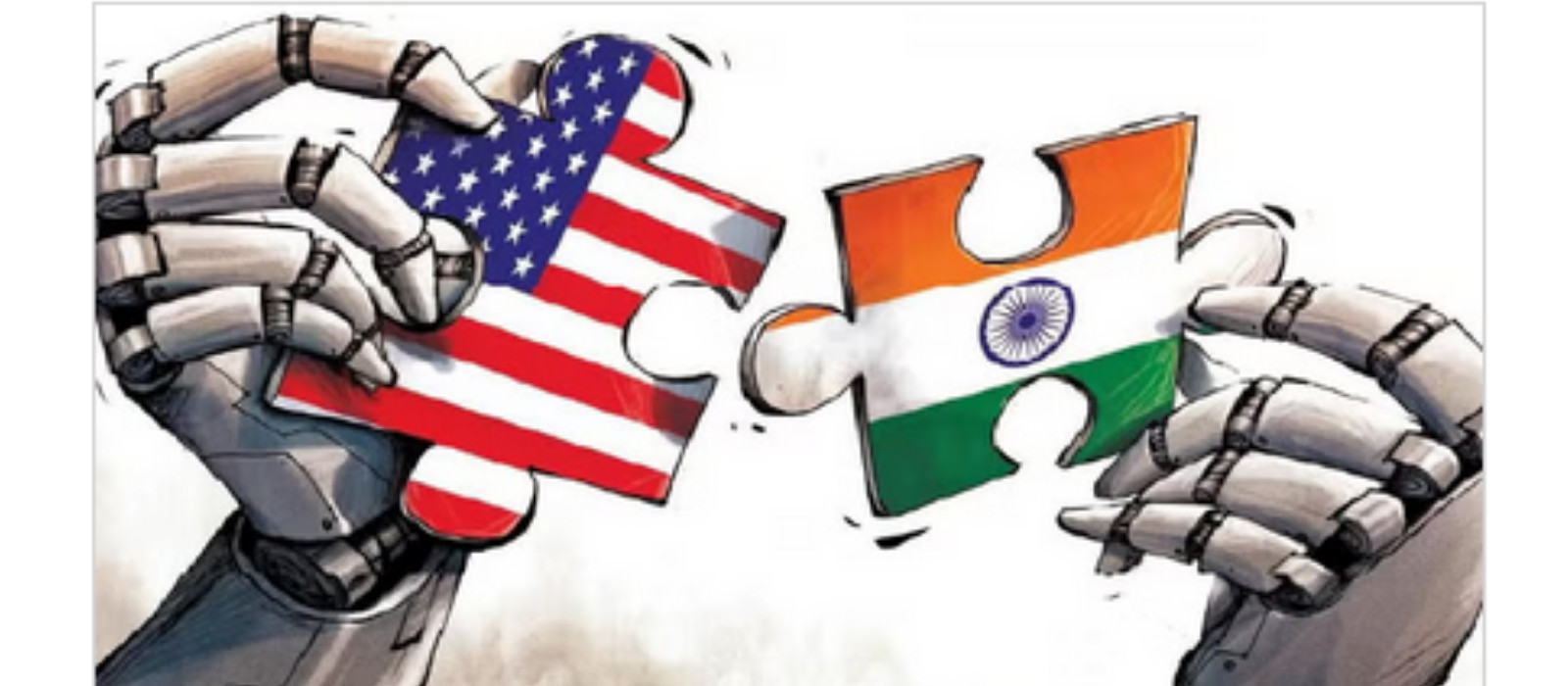


Abstract: India–US relations have been on an upswing in the recent past. This essay argues that the bilateral relationship between the oldest and the largest democracies transcends geopolitical imperatives, such as containing the rise of China. This essay highlights the evolving trade and economic interactions, technological cooperation, shared aspirations of building resilient global supply chains, and people-to-people engagement between the two countries to demonstrate the strengthening of the relationship in diverse areas. In the coming years, as in all relationships, there will be a few areas of disagreement. Nonetheless, the economic, social and technological components of the bilateral relationship will get further consolidated.
Introduction
United States President Joe Biden travelled to India for the G20 Leaders’ Summit on 8–9 September 2023. On the sidelines of the Summit, President Biden held a bilateral meeting with Indian Prime Minister Narendra Modi on 8 September. The joint statement of the meeting reiterated the consolidation of India–US relations and the growing strategic convergence between the two countries. President Biden also praised India’s G20 Presidency for “delivering important outcomes.”1 India was able to find common ground with the G20 countries and adopt the New Delhi Leaders’ Declaration, which seemed unlikely before the Summit.
The Biden visit to India was preceded by Prime Minister Modi’s successful state visit to the United States from 21–23 June 2023. In addition to interacting with President Biden and his team, the Indian premier addressed a joint session of the United States Congress. There were some important gains from the state visit. The two leaders affirmed that both countries were among the closest partners in the world. Referring to the outcomes of the visit, Prime Minister Modi noted that “together India and the US are not just forming policies and agreements, we are shaping lives, dreams and destinies.”2
India–US relations have been on an upward trajectory for over two decades. There have been numerous high-level interactions, such as during US Defence Secretary Lloyd Austin’s and US National Security Advisor Jake Sullivan’s visits to India. Earlier that year, US Secretary of State Antony Blinken also travelled to New Delhi for the G20 Foreign Ministers’ meeting and the Quad ministerial meeting in March 2023. The Quad Leaders’ Summit was held subsequently in May 2023.
Transcending Scepticism
It should be noted that India–US relations had to overcome years of neglect and episodes of discord. During the Cold War, the United States and Pakistan were allies. As a consequence, Pakistan received considerable defence equipment from the United States, which was often used against India. Further, in 1971, the United States moved its nuclear-powered aircraft carrier into the Bay of Bengal, threatening to undermine Indian operations against Pakistan during the Bangladesh Liberation War. The Soviet intervention in Afghanistan ensured that Pakistan emerged as a frontline state. The US dependence on Pakistan to pursue its Afghan strategy meant that it turned a blind eye to Pakistan’s nuclear weapons programme.
The end of the Cold War did not automatically result in improved India–US relations. On the contrary, the bilateral relationship had many friction points. American policymakers’ statements on Kashmir and the human-rights situation in India did not go down well in Delhi. India’s perception was that the United States continued to lean towards, or privilege, Pakistan over India despite the end of the Cold War dynamic.
Immediately after India’s nuclear tests in 1998, the bilateral relationship had deteriorated considerably. However, the rapid growth of the Indian economy, its ability to project power in the Indian Ocean and its growing engagement in the larger East Asia region prompted the United States to look at India with a new lens. India’s emergence as a nuclear-weapon state with significant economic prowess meant that the United States started seeing India as a strategic player in the region.
Robust Trade and Investment
The US and Indian economies operate on liberal market principles, although with differing levels of emphasis. Such adherence to liberal market principles has provided opportunities for increased economic engagement between the two countries. In 2022, bilateral trade between the two countries amounted to US$191 billion, making the United States the largest trade partner of India. Since the turn of the century, the United States has been the third-largest investor in India, with foreign direct investment standing at about US$60.19 billion.3 In the recent past, India, through various initiatives such as Make in India and the Production Linked Incentive scheme, has attracted investment from various developed countries, including the United States.4 Indian companies have also invested in the United States, creating substantive job opportunities. The argument that some in the United States make, that Indians are taking away jobs, is not true, as Indian firms are creating significant employment opportunities there. For instance, according to a survey conducted that year by the Confederation of Indian Industry, 163 Indian companies have invested over US$40 billion in the United States, which has created approximately 425,000 jobs in the country.5
India has a diversified export basket to the United States. India’s largest exports to the United States comprise precious stones and jewellery (HS 71), which accounted for over US$12.5 billion in 2022–23. The year before, the figure stood at US$14.6 billion.6 India’s pharmaceutical exports have also registered significant growth since 2013–14, from INR 904 billion (US$10.9 billion) to INR 1,834 billion (US$22.13 billion) in 2021–22.7 Pharma exports maintained their upward trend in 2022–23, reaching US$25.3 billion.8 Other important sectors of Indian exports to the United States include organic chemicals, textiles, and electrical machinery and appliances, among others. The biggest success story, however, has been India’s software exports to the United States. Overall, India’s software exports to the world reached a record high of US$326 billion in financial year 2022–23.9 The information technology and business-process-management sector registered a year-on-year growth of 15.5 per cent during financial year 2022. The United States is a major market in this sector and accounts for 62 per cent of those exports, excluding hardware.10 India will look to further deepen its financial-technology cooperation with the United States. The recent interactions have provided an opportunity for the Indian leadership to brief their American counterparts on the significant progress that India has made in the fintech sector. Specifically, Indian leaders have reiterated India’s success in financial inclusion by integrating Jan Dhan bank accounts, Aadhaar and mobile-based financial services.
Technology Transfers and Defence Trade
The two countries signed a memorandum of understanding in March 2023 on establishing a semiconductor supply-chain and innovation partnership under the framework of the India–US Commercial Dialogue.11 In December 2021, India formulated a US$10 billion incentive plan to attract semiconductor manufacturing in the country, to establish itself as a global electronics-production hub.12 Under the plan, India will cover fiscal support of up to 50 per cent of a project’s cost to eligible display and semiconductor fabricators. An American firm, Micron Technology Inc., announced that it would soon invest up to US$825 million in India in the semiconductor segment, including setting up an assembly and testing facility in Gujarat.13 After Micron, AMD announced that it would invest US$400 million in India over the next five years, including setting up a campus in Bengaluru that will be the company’s largest design centre.14 In June that year, US-based Applied Materials said that it would also invest US$400 million over the next four years in a new engineering centre in India.15 Similarly, Microchip Technology will invest US$300 million to expand its operations in India. It already has facilities in Hyderabad, Bengaluru and Chennai.16 Another US-based company, Lam Research, plans to train 60,000 engineers in India over the next decade to boost the country’s semiconductor education and workforce development.17 There is growing anticipation that there will be more collaboration, investment and capacity-building involving Indian and US companies in the semiconductor segment. Both countries also agreed on scaling up cooperation in quantum technologies and artificial intelligence.
An important dimension of India–US relations has been increased cooperation in high-end technologies. In January 2023, the US–India Initiative on Critical and Emerging Technology (iCET) was inaugurated to strengthen defence-industrial cooperation.18 During President Biden’s visit, the two countries decided to undertake a mid-term review of iCET ahead of the next annual meeting, scheduled for early 2024.19 The two countries also agreed on the need to develop an “open, accessible, and secure technology ecosystem” for mutual benefit. The most significant development has been the decision to facilitate cooperation between NASA and ISRO on human spaceflight. In the near future, the two space agencies will work on projects involving the International Space Station and enhance commercial collaboration between private-sector companies from both countries in the space economy. In the telecommunications sector, the US Next G Alliance and India’s Bharat 6G Alliance signed a memorandum of understanding on 9 September 2023, to explore collaboration on 6G wireless technology.20 Prime Minister Modi’s visit and the subsequent cooperative efforts have laid the foundation for an unprecedented integration of the science and technology ecosystems of the two countries.
There has been a remarkable improvement in the India–US defence partnership in recent years. There have been significant interactions between Indian and US defence forces through bilateral and multinational exercises such as the Malabar exercises. India has one of the most intense military-exercise programmes, both in quantity and quality, with the United States. These exercises have provided an opportunity for the Indian defence forces to get acquainted with US operating procedures, and vice versa. Whilst maintaining arms imports from Russia and France, India’s imports of US defence equipment may soon reach US$25 billion.21 In an important development, India’s Defence Acquisition Council has approved the acquisition of armed Predator unmanned aerial vehicles from the United States.22 Specifically, India will be procuring MQ-9B high-altitude long-endurance unmanned aerial vehicles from General Atomics. These aircraft will help India increase surveillance capabilities in both the continental and maritime domains. Further, the essay notes that they will also help carry out strikes from very high altitudes, giving Indian ground forces a significant advantage in the event of a conflict.
Delhi and Washington have adopted the Roadmap for Defence Industrial Cooperation. There are ongoing efforts to integrate the defence-industrial ecosystems of both countries by ensuring increased supply-chain engagement. In July that year, Larsen & Toubro signed the Master Shipyard Repair Agreement with the US Navy, through which the United States will utilise repair facilities regularly at the L&T shipyard in Tamil Nadu.23 Further, a commercial agreement between GE Aerospace and Hindustan Aeronautics Limited will lead to the manufacturing of GE F414 jet engines in India.24 This agreement is significant as it enables technology transfer to the Indian firm. Only select countries in the world can manufacture fighter-jet engines, and through such an agreement India will join this group. Delhi and Washington have also established a defence acceleration ecosystem, INDUS-X, which will be instrumental in operationalising the “defence innovation bridge” under iCET.25 India has always been a net importer of defence equipment, with a large number of weapon systems arriving from Russia. However, in recent years, India has been making persistent efforts to kick-start domestic defence production. This would ensure greater strategic autonomy and increased employment opportunities in India. After the recent summit meetings, Washington seems to be shedding its inhibitions on technology transfer to India and is keen to partner with Indian companies in defence production.
Diversifying Supply Chains through Multilateral Frameworks
In terms of regional frameworks, through platforms like the Quad, India and the United States are attempting to shape the Indo-Pacific security and economic architecture. Further, they are negotiating with like-minded countries to operationalise an Indo-Pacific Economic Framework supply-chain agreement. The two countries have emphasised that they will work for the global good through various groupings, particularly through the Quad, to contribute to a “free, open, inclusive and resilient Indo-Pacific.” In addition to the wider Indo-Pacific, during the Indian premier’s visit to the United States, the need for a coordinated foreign-policy approach in India’s immediate eastern neighbourhood received some attention. There is a concern in both countries with Myanmar’s evolving political and security situation.26 The United States is also concerned about the elections then expected in Bangladesh in January 2024, and has announced punitive measures in the form of threatening to impose visa restrictions against election-rigging, as well as sanctions on Rapid Action Battalion members.27 There were concerns in India that the United States “pressuring the Bangladesh government over the country’s upcoming general elections could end up strengthening the hand of extremist forces and affecting regional stability.”28 The Bangladesh government has “accused the United States of seeking a regime change in the country.”29 However, the US President met Bangladesh Prime Minister Sheikh Hasina briefly on the sidelines of the G20 Leaders’ Summit in India, raising hopes of an improved bilateral relationship.30
There are new multilateral initiatives involving India and the United States which merit mention. In July 2022, the heads of state of India, Israel, the United Arab Emirates and the United States convened for a leaders’ meeting of the I2U2 group. This grouping of countries has a “focus on joint investments and new initiatives in water, energy, transportation, space, health, and food security.”31 Another important initiative has been the India–Middle East–Europe Economic Corridor, “aimed at unlocking greater investment for infrastructure development and strengthening connectivity in its various dimensions between India, the Middle East and Europe.”32 The corridor comprises an eastern corridor connecting India to the Gulf and a northern corridor connecting the Gulf to Europe via railway, a ship-to-rail transit network and road transport routes. The emergence of I2U2 and the corridor will contribute to forming resilient supply chains among member countries.
Over the past few years, India and the United States have been discussing measures to ensure not merely diversification of supply chains but also the need to build resilient ones. At a broader level, India will examine whether the developed West is working to ensure greater synchronisation between geopolitical strategies and geoeconomic policies. In 2021, a summit on strengthening global supply chains was convened by the United States with a three-dimensional approach of “trusted source, transparency and time-frame for improving the supply chains.”33 During Prime Minister Modi’s visit to the United States, the two countries referred to resilient and diversified supply chains in various domains such as pharmaceuticals, critical minerals and emerging technologies. The second Indo-Pacific Economic Framework ministerial meeting was held in the United States in May 2023, during which negotiations for the supply-chains agreement, Pillar II, were substantially concluded.34 The G20 summit joint declaration also referenced support for “reliable, diversified, sustainable and responsible supply chains.”35
Other areas where India and the United States need to hasten cooperation are health care using digital technologies, artificial-intelligence platforms, and strengthening pharmaceutical supply chains. As part of efforts to combat climate change, both countries will work to deploy 10,000 made-in-India electric buses. While pointing out that India has met its Paris climate commitments, Indian leadership has been nudging American counterparts to fulfil commitments on climate change and related issues.
Given the global power shift, India, over the years, has been calling for the reform of the United Nations Security Council. An emphatic statement from the United States strongly endorsing India’s candidature for a permanent seat, and articulating the need for reforms of the Council in a time-bound manner, would have been much appreciated in India. The United States has also expressed support for India’s candidature as a non-permanent member of the Council for the 2028–29 term.
As Indian and US leaders discussed emerging geopolitical trends, the aggressive territorial assertions of China in various regions were a point of conversation. However, to assume that the evolving India–US relationship is only a consequence of shared concerns regarding the rise of China would be erroneous. The enhanced economic engagement, people-to-people interactions, growing technological collaboration, the presence of a large Indian diaspora and value congruence are what drive the India–US relationship.
Indian Diaspora and People-to-People Engagement
Indians represent the second-largest immigrant group in the United States, after Mexicans.36 Roughly 4.4 million people make up the Indian-American diaspora.37 This includes over three million persons of Indian origin and over a million non-resident Indians. According to the Open Doors report of 2022, Indian students made up 21 per cent of all international students in the United States in the academic year 2021–22.38 The United States issued 199,182 visas to students from India in 2021–22, second only to China.39 Since the turn of the century, the United States has issued over 2.6 million visas to Indian students.
However, in recent times, there have been challenges for Indians in securing visas to the United States. There have been long waiting periods for Indian visa applicants, especially those applying under the B1 (business) and B2 (tourist) categories.40 To alleviate some concerns, the US State Department has initiated a pilot programme to process domestic renewals of selected petition-based temporary work visas.41 The United States will open new consulates in Bengaluru and Ahmedabad. In May that year, the United States opened a new campus of its consulate in Hyderabad, which is the biggest in South Asia and can process up to 3,500 visa applications a day.42 Other measures need to be taken to reduce wait times for visa applicants.
A majority of students study STEM subjects, which also leads to an increase in collaboration via investment among software start-ups in both countries. According to 2019 reports, Indian Americans have a median household income of US$126,705, compared with an average Asian-American household income of US$87,243.43 The US national median household income, per survey data for 2021, is US$70,784.44 Indian-origin entrepreneurs occupy key positions in several US multinational companies. Some of the prominent ones are Sundar Pichai (Google), Satya Nadella (Microsoft), Jay Chaudhry (Zscaler), Anirudh Devgan (Cadence Design Systems) and Shantanu Narayen (Adobe), among others. As a result, American companies may have a slight edge in selling their services and products because of the leadership positions that Indian-origin persons occupy in such companies.
Indian Americans have also made their mark in American politics. While the then US Vice President, Kamala Harris, is of Indian origin, the 2024 US presidential contest was set to feature Indian-American candidates, including Vivek Ramaswamy, Nikki Haley and Hirsh Vardhan Singh.45 In 2013, the House of Representatives had only one Indian-American member, while fewer than ten were serving in state legislatures.46 That year, the Congress included five Indian Americans, while nearly 50 were in state legislatures. More importantly, Indian Americans occupy important positions across the political spectrum in the United States. The Indian diaspora does not have a rigid political ideology within American politics and has instead smoothly adapted to its diverse narrative frameworks.
Conclusion
There is no denying that the emerging geopolitical dynamic in the larger Indo-Pacific region is propelling India and the United States to move closer to each other. More specifically, the rise of China and its aggressive territorial assertions against US allies in the Pacific and Southeast Asia have also prompted the United States to rethink its policy towards countries such as India. However, as demonstrated above, India–US relations are not defined by the China factor alone. The economic interactions between the two countries have been registering steady progress over the past few decades. Given the openness of the Indian economy, there is increased interaction between Indian and US business entities. The movement of people between the two countries for education, commerce and tourism has risen rapidly over the past few decades. These interactions are bound to grow in the coming years.
India’s economic growth will not happen in isolation. In addition to robust domestic economic, infrastructure and welfare policies, India will have to engage with major powers for trade, investment and technology transfers. Amid rapid geopolitical flux and growing uncertainties in the global economy, India must use all available global opportunities to make its economy more resilient. The recent interactions of Indian and US leaders are part of a larger effort to ensure the Indian economy has higher growth rates, strengthen the country’s trade with resilient supply chains, enable access to the latest technologies for Indians, including defence hardware, and give India a greater voice on global platforms.
Endnotes
- “Joint Statement from India and the United States,” The White House, 8 September 2023.
- Divya A., “PM Modi Wraps Up US Visit: Together, Shaping Dreams,” The Indian Express, 25 June 2023.
- “Factsheet on FDI Inflow,” Department for Promotion of Industry and Internal Trade, March 2023.
- “Production Linked Incentive Scheme (PLI) for Large Scale Electronics Manufacturing,” Ministry of Electronics and Information Technology, https://www.meity.gov.in/esdm/pli, accessed 11 September 2023.
- “A Total of 163 Indian Companies Invested $40bn in U.S.; Created 425,000 Jobs: CII Survey,” The Hindu, 4 May 2023.
- “Export-Import Bank,” Ministry of Commerce and Industry, accessed 12 September 2023.
- “India’s Pharma Exports Grow by 103% Since 2013–14,” Press Information Bureau, 1 May 2022.
- B. Krishna Mohan, “India’s Pharma Exports Cross $25.3 Billion,” Deccan Chronicle, 17 May 2023.
- “India Achieves its Highest Ever Overall Exports of USD 776 Billion,” Press Information Bureau, 2 June 2023.
- “Services: Source of Strength,” Economic Survey, India Budget, accessed 10 September 2023.
- “MoU on Semiconductor Supply Chain and Innovation Partnership Between India and US Signed Following the Commercial Dialogue 2023,” Press Information Bureau, 10 March 2023.
- Sankalp Phartiyal, “India Outlines $10 Billion Plan to Woo Global Chip Makers,” Reuters, 15 December 2021.
- Arjun Kharpal, “India Woos U.S. Chip Giants as it Looks to Become a Semiconductor Superpower,” CNBC, 28 July 2023.
- Kharpal, “India Woos U.S. Chip Giants.”
- “Applied Materials to Invest $400 Million in India for New Engineering Center,” Reuters, 22 June 2023.
- Sohini Bagchi, “US-based Microchip to Invest $300 mn in India; Opens R&D Centre in Hyderabad,” Mint, 4 July 2023.
- The printed note 17 repeats the Microchip citation in note 16. The sentence it marks concerns Lam Research’s plan to train 60,000 engineers.
- “Fact Sheet: United States and India Elevate Strategic Partnership with the Initiative on Critical and Emerging Technology (iCET),” The White House, 31 January 2023.
- S. Ronendra Singh, “India, US to Undertake Mid-Term Review on Critical, Emerging Technology Partnerships,” The Hindu Business Line, 8 September 2023.
- “Bharat 6G Alliance Inks Pact with Next G Alliance,” Mint, 9 September 2023.
- Huma Siddiqui, “India–US Military Trade to Touch $25 Billion,” Financial Express, 2 June 2023.
- “What are the MQ-9 Reaper Drones and Why Does India Want to Buy Them From the US?” Firstpost, 17 June 2023. The body prints “MU-9B”; the note and the aircraft designation are MQ-9B.
- “L&T Signs Master Ship Repair Agreement with US Navy,” The Hindu Business Line, 12 July 2023.
- Dinakar Peri, “PM Modi, President Biden Welcome Progress in Defence Ties,” The Hindu, 8 September 2023.
- “India–United States Defence Acceleration Ecosystem (INDUS-X) Launched in Washington, DC,” Press Information Bureau, 22 June 2023.
- “India–USA Joint Statement during the Official State Visit of Prime Minister Shri Narendra Modi to USA,” Ministry of External Affairs, 23 June 2023.
- “Free, Fair Polls: US Rights Bodies Urge Sanctions, Other Steps,” The Daily Star, 17 August 2023.
- Rezaul H. Laskar, “Pushing Bangladesh May Aid Extremist Forces, India Indicates to US,” Hindustan Times, 29 August 2023.
- “Sheikh Hasina Accuses US of Seeking Regime Change in Bangladesh,” Scroll, 11 April 2023.
- ANI post, 9 September 2023.
- “Joint Statement of the Leaders of India, Israel, the United Arab Emirates, and the United States (I2U2),” The White House, 14 July 2022.
- “Partnership for Global Infrastructure and Investment and India–Middle East–Europe Economic Corridor,” Ministry of External Affairs, 9 September 2023.
- “PM Modi Underlined Trusted Source, Transparency, Time-Frame for Improving Supply Chains,” The Hindu Business Line, 1 November 2021.
- “Negotiations for the Supply Chains (Pillar II) Agreement Substantially Concluded during 2nd IPEF Ministerial Meeting,” Press Information Bureau, 1 June 2023. The body prints “Pilar II.”
- “G20 New Delhi Leaders’ Declaration,” G20, 9 September 2023.
- Mary Hanna and Jeanne Batalova, “Indian Immigrants in the United States,” Migration Policy Institute, 16 October 2020.
- “Population of Overseas Indians,” Ministry of External Affairs, accessed 12 September 2023.
- “Leading Places of Origin,” Open Doors, accessed 10 September 2023.
- “Leading Places of Origin,” Open Doors.
- “US to Prioritize Indian Student and Work Visas Over the Summer,” The Economic Times, 22 April 2023.
- Sanchari Ghosh, ed., “H-1B Visa Renewal in US,” Mint, 5 July 2023.
- “Department of State Dedicates New U.S. Consulate General in Hyderabad, India,” US Department of State, 2 June 2023.
- Sounak Mukhopadhyay, “Indians are Highest-Earning Ethnic Group in USA: Harsh Goenka Explains Why,” Mint, 15 January 2023.
- Anna Helhoski, “What Is the Median Household Income?” NerdWallet, 12 September 2023.
- “List of All Indian-American Candidates Running for US Presidential Elections,” NDTV, 18 August 2023.
- Maggie Astor and Jill Cowan, “Indian Americans Rapidly Climbing Political Ranks,” The New York Times, 27 February 2023.
