




Abstract: This essay examines the evolution of the cross-strait fishers dispute in the Palk Bay, a shallow, ecologically fragile semi-enclosed water body between India and Sri Lanka, linked to the Bay of Bengal by the Palk Strait. Tracing the colonial-era understanding reached in 1921 between authorities of India and Ceylon (now Sri Lanka) regarding demarcation of fisheries in the Bay, the article highlights how subsequent postindependence developments like state-supported mechanisation of fishing vessels in India, maritime boundary settlement by India and Sri Lanka in the mid-1970s, and the Sri Lankan civil war turned a maritime space of open, kinship-based usage steadily into a fishers’ dispute over resource, marked by overfishing, ecological degradation, and recurring cross-border arrests of Indian fishermen in Sri Lanka. The article reviews the dense but fragmented landscape of responses, including the fishermen level talks, regulatory framework at the state level, central subsidy schemes for diversification of trawling fishers, and the mechanism of India–Sri Lanka Joint Working Group on Fisheries. It brings out that uneven implementation, entrenched trawling interests, and unreconciled political narratives have eroded the impact of remedial measures. Against this backdrop, the article contends that pathways for resolution can be opened by formulating a calibrated mix of state-backed initiatives covering fisheries management reform, developmental schemes, stricter regulation and bilateral fisheries diplomacy. While bringing out the scope for progressing various lines of effort, the article highlights the potential of closer cooperation between India and Sri Lanka to recast Palk Bay as a shared ecological and civilisational heritage rather than a theatre of narrow resource competition.
Introduction
The Palk Bay is a semi-enclosed shallow bay surrounded by coasts of India and Sri Lanka to the northwest and southeast Trespectively. It is connected to the Bay of Bengal in the northeast by the Palk Strait, and to the southwest, a chain of shoals called the Adam's Bridge (also known colloquially as Ram Sethu, in India). It separates Palk Bay from the Gulf of Mannar. The Palk Bay derives its name from Robert Palk, a Governor of Madras Presidency in the mid-18th century, when India was under British colonial rule.1 A complex dispute over fisheries resources in the Palk Bay has festered over the years between fishers on either side of the Palk Strait, gathering significant political dimensions. The genesis of the resource conflict is to be found in the backdrop of the historical background and the political understanding reached between India and Sri Lanka over the maritime boundary.

Fig 1. Illustrative Map showing the Palk Bay and the International Maritime Boundary Line (for representative purpose only).
Source: Scholtens, Joeri. (2016). Fishing in the Margins: North Sri Lankan fishers'struggle for access in transboundary waters.
Distinctive Features of Palk Bay that Enhance its Strategic Importance
On the Indian side, the Bay has a coastline of around 250 kilometres covering five districts in the state of Tamil Nadu: Nagapattinam, Thiruvarur, Thanjavur, Pudukkottai and Ramanathapuram. On the Sri Lankan side, the coastline along Jaffna peninsula, Kilinochchi and Mannar districts of the Northern Province circumscribe the Palk Bay. The width of the Palk Bay ranges from 64 to 137 km (or 34.5 to 74 NM).
The distinctive features of Palk Bay make the water body somewhat unique and strategically important for India as well as Sri Lanka. The Bay has significant geographical, ecological, political, economic and security attributes. It has average depths of about 9 to 15 m, with extensive seagrass beds, coral patches, and mangroves. The predominantly marine geomorphology and weak ocean currents create nursery grounds for shrimp and demersal species, making the area one of the most fertile nearshore fishing zones in the Northern Indian Ocean. An ecological paradise, it hosts hundreds of species of marine life, with a variety of algal species, seagrass species, marine turtles, dugongs (sea cows), and diverse invertebrates.2 This unique ecosystem, coupled with calmer waters sheltered from the open seas, serves to attract artisanal and mechanised fishers, the latter particularly in large numbers from the Indian side.
The Palk Bay opens to the Bay of Bengal in the northeast and the Gulf of Mannar in the south. The Bay links with the Gulf of Mannar through a 1.2 km wide but shallow passage called Pamban Pass. The Palk Strait, about 35 km long, separates the Northern coast of Sri Lanka and southeast coast of India. Both India and Sri Lanka have declared the waters of Palk Bay as “historic waters,” thereby enhancing their respective entitlements to the waters of the Bay as per international maritime law including the United Nations Convention on the Law of the Sea. The International Maritime Boundary Line (IMBL) passes through the Palk Strait and Adams Bridge, effectively dividing the waters of the Palk Bay as per a bilateral agreement between India and Sri Lanka concluded in 1974. The IMBL passes close to the shore from either side (at some points less than 10 km). For e.g., from the Indian side, the IMBL is only 6.9 km away from Dhanushkodi, 11.5 km away from Rameswaram and 24.5 km away from Thondi, a major coastal township and business centre in the area.3 The geographic proximity of fishing centres to IMBL has implications for fisheries management especially due to the spatial limitations imposed by the enclosed nature of the Bay. The Bay’s littoral districts, five in Tamil Nadu, three in Northern Sri Lanka as mentioned earlier, are among the poorest in livelihood terms, making fisheries or fishing based vocations the primary or only financially viable activity. Fishing and fishers are thus a focus of human security and political attention in their respective countries.4
The Genesis and Growth of the Fishers’ Conflict
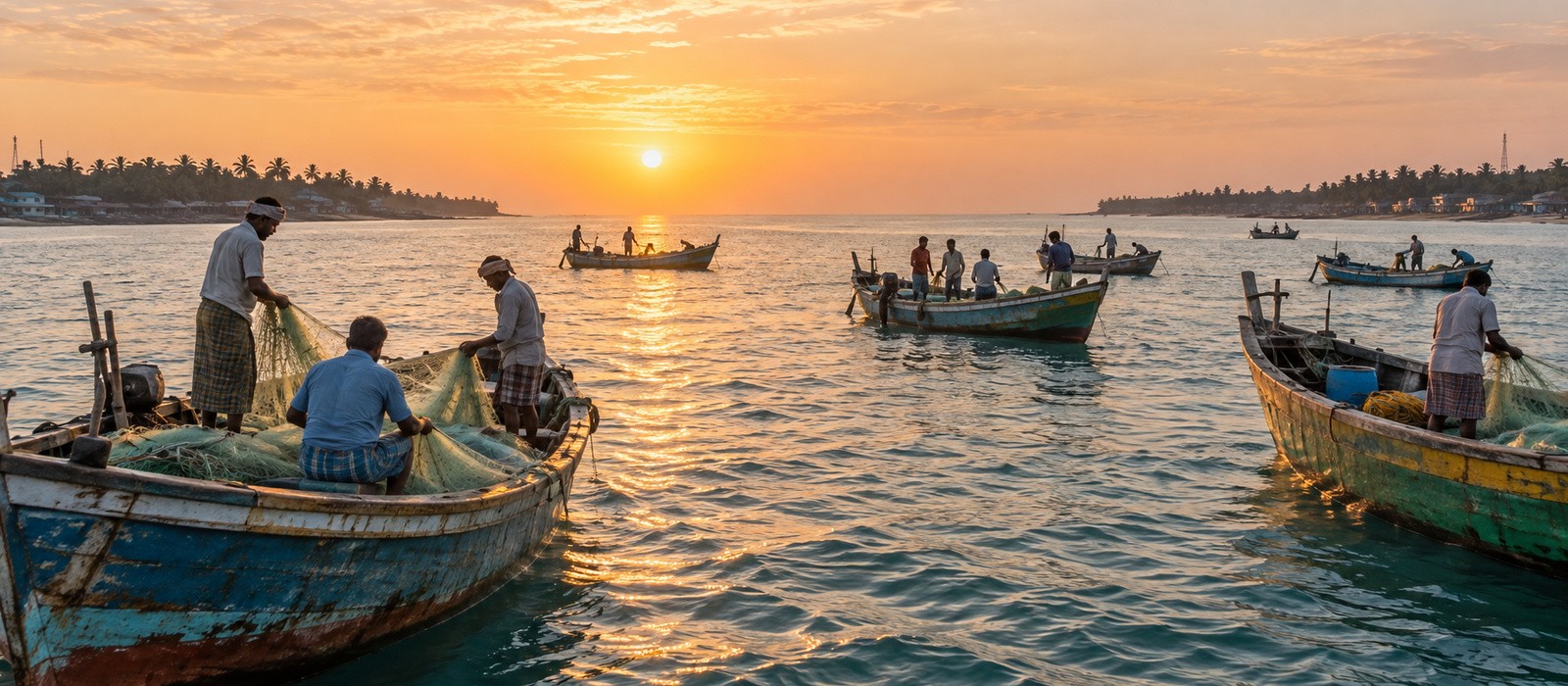
Historically, the Palk Bay functioned as an unhindered maritime space, providing a medium for trade and travel to communities across India (mainly Tamil Nadu) and Northern Sri Lanka. Since ancient times there was intensive two-way movement of people for trade, fishing, and religious pilgrimage. During the colonial period, both India and Sri Lanka (then Ceylon) came under British rule. Exploitation of fisheries in the Palk Bay was an issue of concern as far back as in 1921, when discussions on the ‘Fisheries Line’ were held between the colonial government delegations representing Ceylon and India.5 Following the talks, a ‘Fisheries Line’ was agreed upon between the two sides, though it did not have any sovereign character and was not ratified by the British Colonial Office.6 After India and Sri Lanka became independent nations, fishing in the Bay was mostly undertaken by artisanal fishers using sail boats; and fisheries were of small scale. Conflicts between fishers were limited and managed through customary forums of resolution and kinship ties between ethnic Tamil communities across the Bay. The first structural challenge came with India’s state supported push to development of fisheries resources in the late 1960s through the 1970s, to provide higher incomes to fishers. The ‘IndoNorwegian Project’ was launched with the assistance of Norwegian government in Tamil Nadu, Kerala and Karnataka, which included subsidies and training to fishers for introduction of mechanised ‘bottom trawlers’ in the Palk Bay.7 This proved to be a popular move in the targeted communities that promoted exportoriented shrimp fishing and consequently transformed the traditional fishing in Palk Bay into a resource competition. However, mechanised trawling promoted extraction of undifferentiated catch, employing gear and techniques that cause damage to the seabed, and also on many occasions, accidentally destroying traditional fishing nets deployed by smaller boats.
As the mechanised trawlers proliferated on the Indian side, increasing from around 1,500 to over 3,300 in the Palk Bay districts between the mid 1980s and 2000, inshore fish stocks on the Indian side were overexploited, compelling Tamil Nadu based trawler operators to expand effort spatially across the Palk Bay, including on the Sri Lankan side of the Bay.8 The onset of the Sri Lankan civil war from 1983 produced a second disruptive development in the fishers’ saga in the Bay. Tamil fishers in Sri Lanka’s North and East were adversely affected by the conflict and fishing remained restricted by security measures enforced by authorities. Over the years many fishers fled across the Bay, to India. This “conflict- induced vacuum” allowed Indian trawlers and other fishing vessels to venture deeper into themPalk Bay with virtually unhindered open access.9 The re-entry of Sri Lankan Tamil fishers into the Bay in the postwar period from 2009, thus brought them in direct resource conflict with Indian mechanised and other fishing vessels that had by then become habituated to fishing expansively in the Bay.10
A third disruptive factor was the steady “motorisation” of artisanal craft (locally called ‘vallams’ or “vattais”) in Tamil Nadu, which blurred the boundary between traditional and mechanised boats.11 The wooden boats were replaced by fibre reinforced plastic boats with outboard engines, mini trawls and ringseines. This trend was resented by not only the Sri Lankan Tamil fishers but also the traditional Tamil fishers on the Indian side, who prefer to use artisanal methods for fishing (netting, traps). Small scale fishers in the region frequently complain that mechanisation of boats has severely depleted their traditional fishing grounds by overexploitation of limited resources.
Fishing communities form large population groups in coastal areas on both sides and are an important electoral consideration. Therefore, political responses to the fisheries conflict have been intense and vocal on both sides. Tamil fishing communities in North Sri Lanka have been vociferous in their demand on their government to act decisively to end Indian “poaching” in their waters, especially the destructive bottom trawling, which is practised by Indian fishers but is legally banned in Sri Lanka, since 2017.12 Particularly after the end of the civil war in Sri Lanka, there have been frequent incidents of interception and arrest of Indian fishing vessels by SriLanka Navy in the Palk Bay.13 This serves to create local tensions in Tamil Nadu and Karaikal (a coastal enclave of the Union Territory of Puducherry surrounded by Tamil Nadu's Nagapattinam and Tiruvarur districts), where the fishers’ issue is widely perceived as an emotive, livelihood related issue. It is pertinent to bring out here that occasionally, Sri Lankan fishing vessels, too, are intercepted by Indian law enforcement authorities for indulging in illegal fishing in the Exclusive Economic Zone (EEZ) of India. The incidence is lower in Palk Bay but there have been many instances of arrests of Sri Lankan fishermen near the East and Southeast coast of India and off Kanyakumari (southern tip of peninsular India).14
The Settlement of Maritime Borders between India and Sri Lanka and its Effect on Fishers in Palk Bay
The mid-1970s marked a remarkable period when India sought to settle its maritime boundaries with many of its neighbours. The then Indian Prime Minister, Mrs. Indira Gandhi enjoyed a good personal friendship with Mrs. Sirimavo Bandaranaike, her Sri Lankan counterpart. This factor is perceived to have played a key role in the understanding reached between India and Sri Lanka in mutually declaring the Palk Bay as historic waters and agreeing upon the delimitation of a boundary through it.15 The ‘Agreement Between India and Sri Lanka on the Boundary in Historic Waters Between the Two Countries and Related Matters’ of 1974 also effectively acknowledged the island of Kachchateevu in Palk Bay as a territory of Sri Lanka16 The agreement provided that “Indian fishermen and pilgrims will enjoy access to visit Kachchateevu as hitherto and will not be required by Sri Lanka to obtain travel documents or visas for these purposes”. Further, it provided that “vessels of India and Sri Lanka will enjoy in each other's waters such rights as they have traditionally enjoyed therein”. This ‘settlement’ between the two sides regarding Kachchateevu did not prove to be a lasting solution to the fishers’ issue. In 1976, the two sides concluded an agreement on the maritime boundary in the Gulf of Mannar and the Bay of Bengal. This agreement extended the IMBL in the Palk Strait to the Bay of Bengal and Gulf of Mannar and marked the trijunction between India, Sri Lanka and the Maldives.17 The 1976 agreement provided for sovereign rights in respective territorial seas, historic waters and EEZ. This also includes exclusive jurisdiction over resources, living or non-living. Cumulatively, the provisions of 1976 agreement, with the earlier understanding reached over Kachchateevu with Sri Lanka created a disadvantageous situation for the fishers on the Indian side, especially those operating from Rameshwaram, Mandapam, Thondi etc., and habituated to fishing in proximity of the IMBL and Kachchateevu. The relative short distances meant that fishers in search of better catches would tend to cross the IMBL and in the process, often run afoul of law enforcement agencies of Sri Lanka, leading to interception, detention and arrests. The saga of Indian fishers’ arrests by Sri Lankan authorities in the Palk Bay continues year after year. In 2025 alone, as per media reports, the Sri Lankan Navy apprehended 346 Indian fishermen and seized 44 trawlers.18 Most of the incidents of fishers’ arrests across the IMBL take place when trawlers from Tamil Nadu (and Karaikal) sail out on overnight expeditions.
The Kachchateevu issue is frequently raised in Tamil Nadu by fishers’ groups and political parties with the demand that Indian fishers be permitted to fish around the island in an unhindered manner. It is roundly alleged that the island was “ceded by India” to Sri Lanka without consultation of local fishermen. Political demands have also sought retrieval of the island from Sri Lanka.19 However, India’s official position on this issue maintains that the question of retrieval does not arise as it was historically an unsettled territory between British India and Ceylon (now Sri Lanka), and the matter was diplomatically settled between India and Sri Lanka through bilateral agreements in 1974 and 1976.20
Notable Efforts Undertaken Towards Reconciliation and Resolution
The need to address the fisheries conflict in the Bay has been felt at the political level for at least the past three decades, especially due to the frequent voicing of concerns by artisanal, small-scale fishers against mechanised trawlers from both sides of the IMBL. In 2016, noted scholar V. Suryanarayanan recollected in an article entitled ‘The India-Sri Lanka Fisheries Dispute: Creating a Win-Win in the Palk Bay’ that after the Norway brokered ceasefire between Sri Lankan government and Liberation Tigers of Tamil Eelam (LTTE) in 2002, India’s Alliance for Release of Innocent Fishermen (ARIF) took the initiative to directly work upon a solution between fisher communities.21 In May 2004, a goodwill mission comprising 21 Indian fishermen held discussions with their Sri Lankan counterparts in Sri Lanka. The two sides agreed to certain mitigation measures, particularly focused on checking bottom-trawling from the
Indian side. However, the fishers level agreement was not followed in letter and spirit. In August 2010, a reciprocal visit by Sri Lankan fishermen took place, and negotiations resumed in Chennai, indirectly facilitated by politicians from both sides. The options for “buy back” of trawlers were discussed for the first time on the Indian side, as a line of effort towards mitigation of the problem.22 However, it has not been since seriously pursued as a policy measure. This aspect is explained later in the essay. Leaders of fishing communities on either side of the Palk Strait met six times between 2010 and 2015 but then gave up on further talks due to lack of consensus.23 There were more talks in 2016 between community leaders, again with no concrete outcomes.
In 2016, India and Sri Lanka agreed on setting up of a Joint Working Group (JWG) on Fisheries, led by the Ministry of Fisheries, Animal Husbandry and Dairying of India and Ministry of Fisheries and Aquatic Resources Development of Sri Lanka, as the mechanism to help find a permanent solution to the fishermen issue. The JWG has representatives from the ministries of external (foreign) affairs, coast guards, and navies of both countries. At its inception, the Terms of Reference of the JWG included expediting the transition towards ending the practice of bottom trawling at the earliest, working out the modalities for the Standard Operating Procedures for handing over of apprehended fishermen, and ascertaining possibilities for cooperation on patrolling.24 The JWG on Fisheries has met six times so far, the last meeting having been held in October 2024, in Colombo. The focus of the last meeting was on humanitarian and livelihood considerations pertaining to fishermen.25 Reportedly, the Indian side reiterated its request to schedule the meeting of Fishermen Associations between the two countries at the earliest to further discuss the issues related to fishermen. Clearly, over the years, the JWG mechanism has not been able to satisfactorily address the issues of fishers’ trespass and bottom trawling that were focal to the genesis of the mechanism.
In addition to the JWG mechanism, senior political personalities have made efforts to prioritise and find solutions to the fishers’ dispute. In February 2020, when the then Sri Lankan Prime Minister Mahinda Rajapaksa arrived in Delhi for his first official visit abroad, his cabinet colleague, the then Minister of Fisheries and Aquatics of Sri Lanka, Douglas Devananda, accompanied him. News reports quoted the Minister saying that “he was going to propose that the two countries set up a joint marine resources management authority. “We should have seven members from either side, including bureaucrats, researchers, fishermen’s association representatives, and find a lasting solution to the Palk Bay fisheries conflict”.26 In January 2021, the Minister appointed a Committee of Senior Officials to find a permanent solution to the issue of fishers’ trespass. However, not much came of it. The need to find a permanent solution to the issue also found mention in the “Integrated Country Strategy for Sri Lanka Diplomatic Missions in India 2021-2023” published by the Sri Lankan High Commission in New Delhi which listed the objective to “Engage with Indian authorities (Central government, relevant State governments and other stakeholders) for a mechanism acceptable to all sides for the resolution of fisheries-related issues”.27
There is bipartisan support in Tamil Nadu for upholding Indian fishers “traditional rights” in the Palk Bay, which is reflected in frequent appeals made by politicians in Tamil Nadu to the Centre to intervene for release of arrested Indian fishers (and their boats) from Sri Lanka and find a “lasting solution” to the fishers’ conflict.28 After the current State administration in Tamil Nadu took over in 2021, the state minister for Fisheries and Animal Husbandry, Anitha R. Radhakrishnan was quoted in the media stating that “The CM is of the opinion that both countries should conduct high-level talks and find a permanent solution to this issue, which will happen soon”.29 More recently, the issue was raised during the maiden visit of Sri Lankan President Aruna Kumara Dissanayake to India after assuming office, in December 2024. He called on India to “curtail the use of bottom trawlers that deplete marine resources”.30 The broader trend indicates a desire on both sides to find a lasting solution to the fisheries problem in the Palk Bay but clearly, various interest groups and stakeholders see the issue from their perspective which does not necessarily place them on a common ground.
Policy Measures taken by India to address the Fishers’ Issue
India’s policy responses to the fisheries resource conflict in the Palk Bay have seen a combination of regulatory measures, state sponsored subsidies to fisher communities, diplomatic crisis management after arrests of fishermen, and uncoordinated approaches towards mitigation of the problem of “bottom trawling”, including advent of fisheries developmental schemes towards structural transition.
It is estimated that over 2,500 mechanised trawlers, 6,000 motorised craft and 1,000 non-motorised craft operate in the Palk Bay.31 The Tamil Nadu Marine Fisheries Regulation Act (MFRA),1983, reserves an inshore belt of up to three nautical miles seawards along the coast for “traditional” craft, in which trawling is prohibited. The MFRA provides for seasonal bans (annually 45 days ban is imposed on mechanised fishing by the state). Further, there is the “3-4 days rule” in Palk Bay, in which three days per week are reserved/permitted for mechanised trawlers, and four days for smaller (artisanal) craft. However, in practice, the enforcement has been weak and often subject to compromises made with entrenched interest groups, including trawling syndicates. Monitoring and control of various fishing vessels by the fisheries department is not particularly effective. It is observed that artisanal fisherfolk fish throughout the week, while trawlers commonly violate spatial and/or temporal limits.32
Given the proximity of the IMBL to the coast, both, the Indian Navy and Coast Guard have presence in the Palk Bay region.33 While the fishers trespass issue is well known, there are other maritime security challenges in the region like illegal immigration, smuggling and narcotics trafficking. Wildlife protection is also an active focus area. The Coast Guard assists the state forest department in supporting conservation efforts in the Gulf of Mannar Biosphere Reserve and Dugong Conservation Reserve in Palk Bay.35 At the institutional level, the key maritime security agencies on either side of the Palk Strait maintain working level contacts and have formal periodic interactions. To that end, International Maritime Boundary Line Meetings have been regularly held between the navies and coast guards of India and Sri Lanka to discuss common security challenges.36
Diversification of fishers habituated to bottom trawling is recognised in professional fisheries management circles as a policy imperative. In the past decade, the Central government has made concerted efforts to support the State in introducing alternative income options and developmental schemes aimed at weaning away the Palk Bay fisher folk from bottom trawling. Various schemes have been designed over the years to diversify fisherfolk into alternative fisheries vocations. These include Blue Revolution Scheme, Fisheries and Aquaculture Infrastructure Development Fund (FIDF), Pradhan Mantri Matsya Sampada Yojana (PMMSY) and Pradhan Mantri Matsya Kisan Samridhi Sah-Yojana (PM-MKSSY).37
Particularly for the Palk Bay region, a scheme titled “Diversification of trawl fishing boats from Palk Bay into deep sea fishing” was approved under Central assistance in 2017-18. Under the scheme, 750 trawler boats were to be replaced by tuna long-liner vessels for deep sea fishing. Rs 1500 crores was earmarked for the scheme, in phases.38 However, the scheme has not been a success due to a variety of reasons, including the reluctance of fishers habituated to short overnight fishing expeditions to switch to multiday fishing voyages.39 Information suggests that only 61 long liner boats could be completed under the scheme until end-2024.40 More recently, in November 2025, the Centre notified rules for “Sustainable Harnessing of Fisheries in the Exclusive Economic Zone (EEZ)”, which are designed to provide a boost to deep sea fishing in the Indian EEZ.41 Ultimately, the issue boils down to the willingness on the part of the cliques habituated to the status quo to take the risks to diversify into more profitable and sustainable methods of fishing.
Possible Pathways to Resolution
The fisheries issue in Palk Bay may seem intractable but it is not unsurmountable. Decisive steps, including a combination of incentives and disincentives, are needed to reduce and eliminate bottom trawling while ensuring economic stability for affected fishing communities. The pathways for resolution of the issue can be created by taking initiatives and measures that address fisheries management reform, adoption of developmental schemes, effective fisheries regulation and bilateral fisheries diplomacy. Some possible measures are discussed as follows:
Trawler Buy-Back and Scrapping Scheme
- The buy-back of fishing vessels, licenses or access rights, and fishing gear can serve as important management instruments for addressing problems of vessel overcapacity, overexploitation of fish stocks, and inequitable resource distribution. Buy-back schemes to address issues concerning fisheries have been tried in many parts of the world, with varying success. This includes Australia, Canada, Mexico, USA, and other European countries.42
- The Centre, in coordination with Tamil Nadu (T.N.) and Puducherry governments, could introduce an amnesty program to gradually phase out bottom trawlers over a grace period of 2-3 years. The amnesty scheme should focus upon incentivising the trawler owners to sell their bottom trawlers for a reasonable compensation to be paid by the government (“buy-back scheme”).
- The buy-back scheme should be initiated under Centre’s financial assistance, offering compensation to trawler owners who voluntarily offer to sell their boats (bottom trawlers) for scrapping.
- Fishers selling their vessels under the buy-back scheme should be obliged not to reinvest in bottom trawling vessels and refrain from indulging in environmentally destructive methods of fishing.
- A joint monitoring mechanism comprising representatives of Central and State fisheries departments, State Police and Coast Guard could be formed to oversee the certification process of the buy-back and scrapping.
- Under a Centre-State collaborative approach, consultancy services of an experienced Fisheries Expert of the Food and Agricultural Organisation (FAO) of the UN could be availed to craft an appropriate buy-back scheme for Palk Bay trawlers. A special financial package under PMMSY outlay could be offered by the Centre to support the implementation of the scheme in T.N. and Puducherry.
Alternative Income and Livelihood Options for Fisherfolk and Workers employed in Trawling
- Affected trawler workers could be provided with a subsistence allowance for up to two years to ease the transition from trawling to other fishing related vocations.
- Large-scale skill development programs could be offered to train trawler fishermen in deep-sea fishing, aquaculture, cage culture, ornamental fisheries, traditional fishing (with vallams) and development of cottage industries focused on fishing related products. Cage fish farming could be encouraged as an alternative to bottom trawling. There is a wealth of traditional fishing knowledge in the coastal communities of Palk Bay that can help in reducing the dependence on trawling for earning livelihoods.
- The Central Marine Fisheries Research Institute (CMFRI), Central Institute of Fisheries Nautical and Engineering Training (CIFNET), Indian Council of Agricultural Research (ICAR), Fisheries Survey of India (FSI), Marine Products Export Development Authority (MPEDA), Central Institute for Brackish Water Agriculture (CIBA), Indian National Centre for Ocean Information Services (INCOIS), National Skill Development Corporation (NSDC), National Institute of Ocean Technology (NIOT), Rajiv Gandhi Centre for Aquaculture (RGCA) and other expert bodies (including NGOs working on fishers related issues) could be involved in upskilling programs funded by Central and State governments.
Promotion of Sustainable Fisheries in the Bay of Bengal and Gulf of Mannar
- Owners of bottom trawlers in the Palk Bay districts of T.N. and Karaikal could be encouraged by respective fisheries departments to switch to purse seine fishing in deeper seas of the Bay of Bengal. This has become legally permissible following the lifting on ban by the Supreme Court on purse seiner fishing vessels in the Exclusive Economic Zone of Tamil Nadu, in January 2023.43 Accordingly, parts of EEZ in the Bay of Bengal and the Gulf of Mannar (outside the core zone of marine biosphere reserve) can be explored for purse seine fisheries.
- Fishers in Rameshwaram and Mandapam (part of Ramanathapuram district) who are accustomed to trawling in Palk Bay need to reorient themselves towards tuna fishing and explore other deep-sea fishing methods in the Gulf of Mannar and Wadge Bank (off Kanyakumari) within the Indian EEZ. Dedicated awareness campaigns could be conducted to encourage them to utilise government schemes like Blue Revolution, PMMSY and PM-MKSSY for adoption of alternative options substitute to bottom trawling. Lessons from the deficient implementation of the earlier “Diversification of trawl fishing boats from Palk Bay into deep sea fishing” scheme need to be incorporated in this effort. With the New Pamban Railway bridge connecting Mandapam with Rameshwaram becoming operational, it will become easier for fishing vessels from Palk Bay to cross over to the Gulf of Mannar by taking advantage of higher height clearances beneath the vertical lift of the bridge.
- To help in the diversification of fishers in Ramanathapuram district who operate in Palk Bay to alternative fishing grounds in the Gulf of Mannar, modern infrastructure, including dedicated fish landing centres, cold chain, subsidised transportation facilities, and marketing assistance could be provided by the T.N. State government with the Centre’s support, where necessary. To facilitate deep sea fisheries, introduction of “reefer” vessels to store fish for longer durations at sea while fishing in the Gulf of Mannar or the Indian Ocean should also be considered by the State. In 2025, the State government announced construction of a fishing harbour in Thangachimadam area near Rameshwaram to facilitate fishermen to go on long duration deep sea fishing expeditions in the Indian Ocean.44 Further, there are plans for construction of fishing harbours in Pamban and Kunthukal to facilitate fishers who wish to operate in the Gulf of Mannar. These initiatives hold promise for the strategy of diversification.
- Experienced fishermen from Kanyakumari and Thoothukudi districts, who are renowned for their expertise in deep-sea fishing, could be called upon by the T.N. State fisheries department and community leaders to assist their counterparts from areas around Rameshwaram (and other fishing villages in Palk Bay) in learning the art and skill of deep-sea fishing.
- Central organisations like MPEDA (which functions under the Ministry of Commerce) have the necessary wherewithal to train fishers in deep sea fishing and processing of the catch. Their expertise could be harnessed by the State in diversification of fishers away from bottom trawling.
Stronger Regulatory Measures to Discourage Bottom Trawling
- Seafood processing companies that create demand for shrimp, prawns and other high-value marine species targeted by trawlers in Palk Bay could be subjected to greater scrutiny for compliance with sourcing rules by MPEDA, which issues export certifications to exporters (e.g. Catch certificates, Certificate of Origin and DS 2031 certificate).45 Seafood that is obtained by Illegal, Unreported and Unregulated fishing practices is not eligible for export certification. MPEDA could utilise its outreach among fisher communities of the Bay to discourage unsustainable fishing practices contributing to seafood processing business. The Indian Coast Guard could also be co-opted in the process of identification of vessels indulging in frequent crossing of IMBL and indulging in bottom trawling. Disincentives in the form of denial of fuel subsidies or suspension of fishing license should be considered by the concerned district administrations to penalise errant vessel owners.46
- A Vessel Monitoring System supported by Global Positioning System (GPS) enabled “geofencing” with the coordinates of IMBL preset can be introduced as a mandatory requirement for all mechanised fishing vessels. Tamper-proof mechanisms are available commercially and can be implemented by the fisheries departments in T.N and Puducherry in association with Indian Coast Guard. The installation of Indian Space Research Organisation (ISRO) developed position transponders should be completed for all fishing vessels in the region.47 These measures can serve to provide vessel position information to authorities and dissuade vessels from crossing permitted fishing limits.
Bilateral Fisheries Diplomacy
- Experts have strongly advocated a joint, collaborative approach by India and Sri Lanka to find a solution to the fishers’ dispute and sustainable management of fisheries in the Bay.48 In this regard, it bears recall that in the 5 Meeting of the India-Sri Lanka Joint Working Group th on Fisheries (held through virtual mode), the Indian side expressed its readiness to work together with Sri Lanka for joint research to enhance the productivity of Palk Bay fisheries. On its part, the Sri Lankan side proposed a faster transition to sustainable fishing in the Palk Bay fisheries and suggested that India can help them develop the aquaculture sector and the associated infrastructure in Northern Sri Lanka.49 This convergence of intent can be earnestly pursued by the two sides by fostering professional exchanges between fisheries scientists and aquaculture entrepreneurs. India could aid Sri Lanka towards further development of its fisheries for supporting the livelihoods of fisher communities, especially in Northern Sri Lanka.
- Talks between fishermen from both sides have not yielded any tangible outcomes in the past towards reduction of bottom trawling. However, this option should remain open because such meetings function as a “safety fuse” by offering dialogue between affected communities that share centuries old kinship. By promoting structured conversations between them, the scope for rational views to find salience remains alive. The annual gathering of Sri Lankan and Indian pilgrims for the Saint Anthony’s fest held on Kachchateevu Island could provide a setting for an informal dialogue in amicable setting between fisher community leaders.50 Here it is important to note that there is a large segment of small-scale (artisanal) fishers on the Indian side who are opposed to bottom trawling and resent the material and ecological destruction caused by mechanised craft in the Bay. The concerns of such fishers’ need to be given prominence in internal debates between stakeholders in Tamil Nadu.
- The idea of permitting “licensed fishing” by Indian fishers in Sri Lankan waters (provided they don’t indulge in bottom trawling), has been advocated by scholars like Prof. V Suryanarayan at different times, who has suggested permitting licensed Indian fishermen to fish within a designated area of Sri Lankan waters and vice versa.51 The suggestion has found few takers but his broad thrust to view the Palk Bay as a ‘shared heritage’ between the two countries is valid for future diplomatic efforts. There is a need for India and Sri Lanka to continue various cooperative efforts and evolve a mechanism for joint fisheries management and environmental conservation in the Bay.52
- In the diplomatic context, it must be kept in mind bears note that the proposed Sethusamudram Shipping Canal Project, entailing creation of a dredged navigation canal for shipping through the Adam’s Bridge, connecting Gulf of Mannar and Palk Bay is likely to have severe ecological impact on fisheries in the region.53 After its inception in 2005, the project was challenged through litigation, following which the Supreme Court of India passed an Interim Order in September 2007 to suspend the dredging works at Adams Bridge / Ram Sethu.54 As a result, the entire dredging work of the project was eventually suspended and the project remains stalled. Considering that the Palk Bay and Gulf of Mannar bear fisheries of common interest to India and Sri Lanka, it would be advisable for both sides to maintain communication through established channels to consider the potential impact of large offshore developmental projects in the region on sustenance of fisheries.
Conclusion
The fishers’ dispute in Palk Bay, though complicated, can be addressed through a combination of steps involving diversification of fisheries, strengthening regulatory mechanisms, community sensitisation, vocational support, promotion of greater political understanding between divergent interest groups and unstinted diplomatic efforts. India and Sri Lanka stand to gain by joining hands to becalm the frayed sentiments among Palk Bay fisher communities and treating the water body as their ‘shared heritage’. Globally, there are notable examples of cooperation between neighbouring maritime states in fisheries and marine resources matters. For e.g. in 2000, China and Vietnam concluded an agreement over fishery cooperation in the Beibu Gulf (Gulf of Tonkin), which has endured. Japan and Taiwan signed a fisheries agreement in 2013 to end controversies overfishing in waters surrounding the contested Diaoyutai Islands. The Palk Bay constitutes a unique and pristine ecosystem that not only serves as a habitat for a multitude of flora and fauna, but also as a space that sustains humanity by offering a medium for connectivity and nutrition for different communities. The resource conflict deserves greater attention from all those who cherish the Bay’s attributes as an ecological paradise and a maritime space that supports civilisational intercourse.
Endnotes
- V. Salagrama, A Livelihood-Based Analysis of Palk Bay. CMPA Technical Series No. 1 (New Delhi: Indo-German Biodiversity Programme, GIZ India, 2014), https://2023.snrd-asia.org/wpcontent/uploads/2018/0 4/CMPA-Technical-Report-Series-No.-01.-A-Livelihood-basedAnalysis-of-Palk-Bay.pdf. The Cross-Strait Fishers’ Dispute in Palk Bay and Possible Pathways for Resolution
- P. A. Azeez et al., The Ecological Baseline Study of Palk Bay. CMPA Technical Series No. 06 (New Delhi: Indo-German Biodiversity Programme, GIZ India, 2016), https://indogermanbiodiversity.com/pdf/publi cation/publication09-12-2017-1512808315.pdf.
- P. A. Azeez et al., The Ecological Baseline Study of Palk Bay.
- Kosala Wijesooriya, Churning “Historic Waters”: Maritime and National Security in the Palk Bay and Sri Lanka (master’s thesis, U.S. Naval Postgraduate School, December 2017), https://apps.dtic.mil/sti/pdfs/AD1053524.pdf
- Rajni Gamage and Isha Gupta, “Resolution of the India-Sri Lanka Maritime Border Conflict and Fisheries Dispute,” Institute of South Asian Studies Working Paper no. 369 (National University of Singapore, August 23, 2023), https://www.isas.nus.edu.sg/papers/resolution-ofthe-india-sri-lanka-maritime-border-conflict-and-fisheries-dispute/.
- Rajni Gamage and Isha Gupta, “Resolution of the India-Sri Lanka Maritime Border Conflict and Fisheries Dispute.”
- A. Gandimathi et al., The Blue Economy in Tamil Nadu: Exploring the Socio-Economic, Political and Ecological Implications on the Coastal Communities (National Fishworkers Forum and SNEHA, India, http://blueeconomytribunal.org/wp-content/uploads/BE_StudyReport_IND_East-Coast_Tamil-Nadu.pdf. Kerala Museum, “The Indo-Norwegian Project,” Mechanised Fishing Part 1, https://keralamuseum.org /article/mechanised-fishing-part-1-theindo-norwegian-project/#:~:text=The%20Indo%2DNorwegian%20Project% 20transformed,the%20net%20behind%20the%20cabin.
- Gamage and Gupta, “Resolution of the India-Sri Lanka Maritime Border Conflict and Fisheries Dispute.”
- V. Suryanarayan, “The India–Sri Lanka Fisheries Dispute: Creating a Win-Win in the Palk Bay,” Carnegie India, 2016, https://carnegieendowment.org/russia-eurasia/research/2016/09/theindia-sri-lanka-fisheries-dispute-creating-a-win-win-in-the-palk-bay.
- V. Salagrama, A Livelihood-Based Analysis of Palk Bay. CMPA Technical Series No. 1: “2000s – Tsunami of Boats” (New Delhi: Indo-German Biodiversity Programme, GIZ India, 2014), 12, https://2 023.snrd-asia.org/wp-content/up loads/2018/04/CMPA-Technical-Report-Series-No.- 01.-A-Livelihood-based-Analysis-of-Palk-Bay.pdf.
- V. Salagrama, A Livelihood-Based Analysis of Palk Bay. CMPA Technical Series No. 1: “2000s – Tsunami of Boats”.
- Malaka Rodrigo, “Indian Trawlers Leave Sri Lankan Small-Scale Fishers a Ravaged, Bereft Sea,” Mongabay, April 23, 2025, https://news.mongabay.com/2025/04/indian-trawlers-leave-srilankan-small-scale-fishers-a-ravaged-bereft-sea/.
- “Sri Lankan Navy Arrests 25 Indian Fishermen from Tamil Nadu, Puducherry,” The Hindu, February 17, 2026, https://www.thehindu.com/news/national/tamil-nadu/sri-lankan-navyarrests-25-fishermen-from-tn-karaikal/article7 0637458.ece.
- The Hindu Bureau, “14 Sri Lankan Fishermen Arrested by Indian Coast Guard at Nagapattinam,” The Hindu, May 17, 2024, https://www.thehindu.com/news/cities/ Tiruchirapalli/14-sri-lankan-fishermen-arrested-by-indian-navy/article68183808.ece and Times News Network, “Five Sri Lankan Fishermen Arrested in Indian Waters,” The Times of India, June 11, 2012, https://timesofindia.indiatimes.com/city/madurai/Five-Sri-Lankan-fishermen-arrestedin-Indian-waters/articleshow/14010790.cms
- V. Suryanarayan, “India-Sri Lanka: 1921 Conference on Fisheries and Ceding of Kachchatheevu – Analysis,” Eurasia Review, August 22, 2011, https://www.eurasiareview.com/ 22082011-india-sri-lanka-1921-conference-on-fisheries-and-ceding-of-kachchatheevuanalysis/.
- India and Sri Lanka, “Agreement Between India and Sri Lanka on the Boundary in Historic Waters Between the Two Countries and Related Matters,” June 26 and 28, 1974, United Nations Treaty Series, https://www.un.org/depts/los/LEGISLATIONANDTREATIES/PDFFILES/TREATIES/LKA-IND1974BW.PDF.
- Ministry of External Affairs, Government of India, Agreement between the Government of India and the Government of Sri Lanka on the Maritime Boundary in the Gulf of Mannar and the Bay of Bengal, March 23, 1976, https://www.mea.gov.in/portal/legaltreatiesdoc/lk76b1690.pdf.
- Bavana Guntha, “Sri Lanka Navy Detains Seven Indian Fishermen, Seizes Two Trawlers,” The Morning Voice, January 24, 2026, https://tmv.in/article/sri-lanka-navy-detains-seven-indianfishermen-seizes-two-trawlers.
- Press Trust of India, “Jayalalithaa Renews Demand for Retrieval of Kachatheevu Islet from Sri Lanka,” India Today, May 21, 2013 https://www.ndtv.com/south/jayalalithaa-renews-demandfor-retrieval-of-kachatheevu-islet-from-sri-lanka-522906.
- J. Venkatesan, “Kachchatheevu Was Not Ceded to Sri Lanka, Centre Tells Court,” The Hindu, November 16, 2021, https://www.thehindu.com/news/national/kachchatheevu-was-not-cededto-sri-lanka-centre-tells-court/article5 076961.ece.
- V. Suryanarayan, “The India–Sri Lanka Fisheries Dispute: Creating a Win-Win in the Palk Bay,” Carnegie India, 2016, https://carnegieendowment.org/russia-eurasia/research/2016/09/theindia-sri-lanka-fisheries-dispute-creating-a-win-win-in-the-palk-bay.
- V. Suryanarayan, “The India–Sri Lanka Fisheries Dispute: Creating a Win-Win in the Palk Bay.”
- Meera Srinivasan, “Fighting for Fish: The Tangled Battle to Rein in Tamil Nadu Trawlers in the Palk Strait,” The Caravan, November 01, 2016, https://caravanmagazine.in/reportage/ fighting-for-fish-tangled-battle-to-rein-in-tamil-nadu-trawlers-in-palk-strait.
- Ministry of External Affairs, Government of India, “Question No. 965: Indo-Sri Lanka Joint Working Group on Fisheries,” Rajya Sabha Unstarred Question, November 24, 2016, https://www.mea.gov.in/rajya-sabha.htm?dtl/27680/QUESTION+NO965+INDOSRI+ LANKA+JOINT+WORKING+GROUP+ON+FISHERIES.
- High Commission of India, Colombo, “6th Meeting of the Joint Working Group on Fisheries,” Press Release, October 29, 2024, https://www.hcicolombo.gov.in/section/press-releases/6thmeeting-of-the-joint-working-group-on-fisheries/.
- Meera Srinivasan, “Sri Lankan Prime Minister Mahinda Rajapaksa Arrives in New Delhi,” The Hindu, February 07, 2020, https://www.thehindu.com/news/international/sri-lanka-primeminister-mahinda-rajapaksa-on-a-four-day-visit-to-india/article30762249.ece.
- High Commission of Sri Lanka in India, Integrated Country Strategy, https://share.google/ toqCwRx hvPlA4srxT.
- The Hindu Bureau, “CM Stalin Writes to External Affairs Minister for Release of T.N. Fishermen from Sri Lankan Custody,” The Hindu, January 21, 2026, https://www.thehindu.com/ news/national/tamil-nadu/cm-stalin-writes-to-external-affairs-minister-for-release-of-tnfishermen-from-sri-lankan-custody/article70532644.ece and Press Trust of India, “Find Permanent Solution to Fishermen Issues: Tamil Nadu Chief Minister to Centre,” NDTV, February 01, 2022, https://www.ndtv.com/india-news/find-permanent-solution-to-fishermen-woes-tn-cmtells-centre-2743135.
- The News Minute, “Talks between India and Sri Lanka Needed to Resolve Attacks on Tamil Fishermen: TN Min,” July 2, 2021, https://www.thenewsminute.com/tamil-nadu/talks-betweenindia-and-sri-lanka-needed-resolve-attacks-tamil-fishermen-tn-min-151606#.
- Suhasini Haidar, “Won’t Allow Sri Lankan Territory to Be Used Against India: President Dissanayake,” The Hindu, December 17, 2024, https://www.thehindu.com/news/national/ president-dissanayake-will-not-allow-sri-lankan-territory-to-be-used-against-india/ article68993085.ece.
- M. Rajkumar et al., “Diversity of Flora and Fauna in Low-Value Bycatch from Bottom Trawls in Palk Bay, South-East Coast of India,” Indian Journal of Fisheries 72, no. 2 (2025): 45–59, https://eprints.Cmf ri.org.in/18912/1/Indian%20Journal%20of%20Fisheries_2025_ Rajkumar%20M.pdf.
- V. Salagrama, A Livelihood-Based Analysis of Palk Bay: CMPA Technical Series No. 1: The Cross-Strait Fishers’ Dispute in Palk Bay and Possible Pathways for Resolution Institutional Stakeholders in the Bay (Indo-German Biodiversity Programme, GIZ India, New Delhi, 2014), 24–25 https://2023.snrd-asia.org/wp-content/uploads/2018/04/CMPA-TechnicalReport-Series-No.-01.-A-Livelihood-based-Analysis-of-Palk-Bay.pdf.
- Indian Navy, Tamil Nadu and Puducherry Naval Area. “#321ALHParunduFlight ‘Knight Hawks’ Proudly Celebrated Her Second Anniversary on 23 Mar 24. Maintaining Tight Vigil over Gulf of Mannar and Palk Bay Region, the Flight Operates State-of-the-Art Helicopter ALH Mk III Helicopters.” X (Twitter), March 26, 2024, https://x.com/IN_HQTNP/status/ 1772489039733461373?s=20 and Indian Coast Guard. “Indian Coast Guard Station Mandapam Intercepts 145 Kg Illegal Sea Cucumber Shipment.” Press Information Bureau, April 14, 2025, https://www.pib.gov.in/PressReleseDetail.aspx?PRID=2121696®=6&lang=1.
- Pramod Madhav, “Coast Guard Arrests 3 Sri Lankans with Criminal Records Infiltrating Tamil Nadu,” India Today, June 29, 2025, https://www.indiatoday.in/india/south/story/three-sri-lankannationals-arrested-indian-coast-guard-sinhalese-tamil-nadu-dhanushkodi-2747793-2025-06-29 and Ministry of Defence, Government of India, “ICG Seizes 53.6 Kg of Ganja Worth Rs 60 Lakhs near Indo-Sri Lankan IMBL,” Press Information Bureau, January 29, 2025, https://www.pib.gov.in/PressReleasePage.aspx?PRID=2097439®=3&lang=2.
- Geetha Srimathi, “Tamil Nadu Forest Department to Strengthen Coastal Patrolling as Olive Ridley Carcasses Begin Washing Ashore,” The Hindu, December 28, 2025, https://www.thehindu.com/news/cities/chennai/tamil-nadu-forest-department-to-strengthencoastal-patrolling-as-olive-ridley-carcasses-begin-washing-ashore/article70445996.ece.
- Sri Lanka Navy, “35th IMBL Meeting Concludes on Successful Note,” Sri Lanka Navy News, November 12, 2025, https://news.navy.lk/eventnews/2025/11/12/202511121400/.
- Ministry of Fisheries, Animal Husbandry & Dairying, “Union Minister Shri Rajiv Ranjan Singh to Inaugurate World Fisheries Day (WFD) Celebration at Sushma Swaraj Bhawan in New Delhi Tomorrow,” Press Information Bureau, November 02, 2024, https://www.pib.gov.in/ PressReleaseIframePage.aspx?PRID=2074882®=3&lang=2.
- Special Correspondent, “Govt. Issues Order for Deep-Sea Fishing Boats,” The Hindu, May 24, 2017, https://www.th ehindu.com/news/national/tamil-nadu/govt-issues-order-for-deep-seafishing-boats/article18556316.ece.
- N. Sathiya Moorthy, “Why ‘Final Solution’ to Indo-Sri Lanka Fishers Issue Requires Greater Commitment,” ORF Expert Speak, March 13, 2024, https://www.orfonline.org/expertspeak/why-final-solution-to-indo-sri-lanka-fishers-issue-requires-greater-commitment.
- Government of Tamil Nadu, Animal Husbandry, Dairying, Fisheries and Fishermen Welfare Department, Fisheries and Fishermen Welfare Policy Note 2024–2025, Demand No. 7: “Subsidy Assistance for Diversification of Trawl Fishing in Palk Bay Districts to Deep Sea Fishing,” 34, https://cms.tn.gov. in/cms_migrated/document/docfiles /fisheries_e_pn_2024_25.pdf.
- Ministry of Fisheries, Animal Husbandry & Dairying, “Government of India Takes Significant Step to Strengthen Small Scale Fisheries, Fisheries Cooperatives & FFPOs,” Press Information Bureau, November 08, 2025, https://www.pib.gov.in/PressReleasePage.aspx?PRID= 2187691®=3&lang=2.
- Dale Squires, James Joseph, and Theodore Groves, “Buybacks in Fisheries,” paper presented at the Methodological Workshop on the Management of Tuna Fishing Capacity, La Jolla, California, United States of America, May 8–12, 2006, FAO Fisheries Proceedings https://www.fao.org/4/a1338e/a1338e14.pdf.
- Swasti Chaturvedi, “SC Grants Interim Relief to TN Fishermen, Conditionally Allows Purse Seine Fishing Beyond Territorial Waters of State,” Verdictum, January 25, 2023, https://www.verdictum.in/court-up dates/supreme-court/sc-grants-interim-relief-to-tamil-nadufishermen-allows-purse-seine-fishing-1459249, Krishnadas Rajgopal, “Supreme Court Allows Purse Seine Fishing Twice a Week Outside Tamil Nadu's Territorial Waters,” The Hindu, January 26, 2023, https://www.thehindu.com/news/national/supreme-court-allows-purse-seine-fishingtwice-a-week-outside-tamil-nadus-territorial-waters/article66426716.ece.
- The New Indian Express, “Tamil Nadu CM Stalin Announces Rs 576 Crore Schemes for Fishers,” April 08, 2025, https://www.newindianexpress.com/states/tamilnadu/2025/Apr/08/tamil-nadu-cm-stalin-announces-rs-576-crore-schemes-for-fishers.
- Marine Products Export Development Authority (MPEDA), “Catch Certificate,” https://mpeda.gov.in/?page_id=947.
- Shruti Sharma and Tristan Irschlinger, “Fuel Subsidies to Marine Fisheries in India: An Overview,” Policy Brief (International Institute for Sustainable Development, July 2022, https://www.iisd.org/system/files/2 022-07/fuel-subsidies-marine-fisheries-india.pdf.
- PTI, “TN Launches Fixing ISRO-Developed Transponders on Boats,” The Print, December 30, 2022, https://thepr int.in/india/tn-launches-fixing-isro-developed-transponders-onboats/1290298/.
- V. Suryanarayan, “The India–Sri Lanka Fisheries Dispute: Creating a Win-Win in the Palk Bay.”
- Ministry of Fisheries, Animal Husbandry & Dairying, “5th Meeting of the India–Sri Lanka Joint Working Group on Fisheries (Held through Virtual Mode),” Press Information Bureau, March 27, 2022, https://www.pib.gov.in/PressReleasePage.aspx?PRID=1810193®= 3&lang=2.
- Amazing Lanka, “Katchatheevu Island of Sri Lanka and the St. Anthony’s Festival,” Amazing Lanka, https://amazing lanka.com/wp/katchatheevu/#google_vignette.
- V. Suryanarayan, “Resolving the Fishing Dispute in Palk Bay,” The New Indian Express, January 18, 2021, https://www.newindianexpress.com/opinion/2021/Jan/18/resolving-thefishing-disputein-palk-bay-2251489.html.
- Chanaka Jayawardhena, “Beyond Borders: Palk Bay Fishing Dispute as a Test of Regional Cooperation,” The Island Online, January 24, 2025, https://island.lk/beyond-borders-palk-bayfishing-dispute-as-a-test-of-regional-cooperation/ Also see Editorial, The Hindu, “Fishing Troubles: On India, Sri Lanka, the Palk Bay Fishing Issue,” Editorial, November 13, 2025, https://www.thehindu.com/opinion/editorial/fishing-troubles-on-india-sri-lanka-the-palk-bayfishingissue/article70268051.ece#:~:text=This%20involves%20bottom%20trawling%20which, and%20safeguard%20the%20marine%20environment.
- D. V. Subba Rao, K. Srinivasa Rao, C. S. P. Iyer, and P. Chittibabu, “Possible Ecological Consequences from the Sethu Samudram Canal Project, India,” Marine Pollution Bulletin 56, no (February 2008): 170–186, https://www.sciencedirect.com/science/article/abs/pii/ S0025326X07004006.
- Ministry of Ports, Shipping and Waterways, Sethusamudram Corporation Limited (A Government of India Enterprise), 20th Annual Report 2024–25 (Government of India), https://shipmin.gov.in/sites/default/files/ Annual%20Report%20SCL%20english.pdf.
