


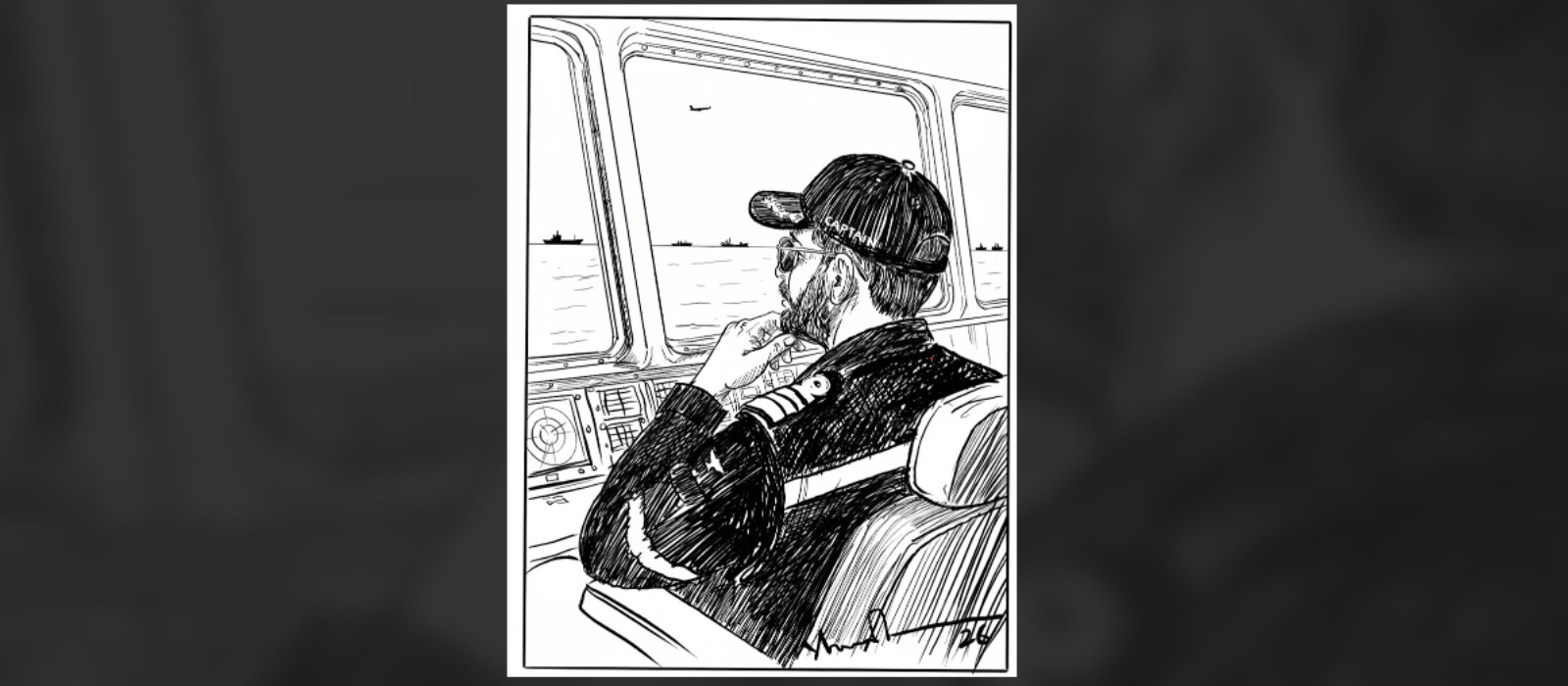


Editor's Note: Certain operational details, locations and timelines have been generalised for security and publication purposes. Artwork is by Capt Anshuman Chatterjee (Retd.)
There is an old saying in the Navy that the Captain gets paid the big money for the few seconds when nobody else wants his job. This is the story of one such moment. In early 2024, Indian Naval ships were deployed in the Gulf of Aden and the Western Arabian Sea amidst a geopolitical ferment that was rapidly transforming one of the world's busiest maritime highways into a floating seminar on contemporary conflict. Houthi missiles and drones were demonstrating an alarming enthusiasm for long-range diplomacy, Somali pirates were attempting to revive a profession many had thought extinct, and merchant captains were discovering that calm seas and peaceful voyages had become distinctly unfashionable. Indian warships were therefore tasked with protecting merchant vessels, escorting ships through dangerous waters and generally reassuring everyone that global trade—and civilisation itself—had not yet entirely broken down.
I was serving as the Navigating Officer on one such frontline warship. Before entering the operational area, the Command Team had spent countless hours war-gaming possible scenarios. Missiles, drones, suspicious fishing vessels, pirate motherships, asymmetric attacks—everything had been discussed. Every weapon and sensor had been tested and every drill rehearsed until responses became instinctive. The ship was as prepared as she could possibly be.
Then reality arrived.
The operational area was anything but quiet. Reports of attacks on merchant ships arrived with alarming regularity. Damaged merchant vessels were escorted to safety. Intelligence summaries painted a grim picture, but nothing drove home the reality of the situation quite like seeing a missile-struck merchant ship with one's own eyes.
To make matters more interesting, the tactical picture in the Gulf of Aden was becoming increasingly crowded. Merchant vessels, naval task groups, maritime patrol aircraft, shipborne helicopters, fishing vessels, pirate skiffs and the occasional unidentified contact all seemed determined to occupy the same piece of ocean at the same time. On some days the plot resembled less a carefully managed military operation and more the Sassoon Dock fish market on a busy Sunday morning, with everyone apparently moving in different directions while somehow avoiding collision. At other times it reminded one of the traffic near the Causeway during peak hours—except that in this case some of the vehicles were carrying missiles.
And then came the afternoon that none of us forgot.
It was a bright day. The sea was calm, the ship was settled into her patrol routine and, in the Operations Room, a young Sub Lieutenant was delivering a professional lecture. Fate, unfortunately, has never shown much respect for PowerPoint presentations.
Suddenly the Air Surveillance Radar operator reported: "Unidentified air contact. Range 90 nautical miles. Closing." The atmosphere changed instantly.
The lecture died a quiet death.
Action Stations were closed up. Consoles came alive. Operators bent over screens. Attempts were made to identify the contact using every available means.
The aircraft continued closing. Warnings were transmitted on international guard frequencies.
No response.
Warnings were transmitted on maritime frequencies. Still no response.
The contact maintained a steady course towards the ship.
In a region where missiles and drones had become part of daily life, uncertainty quickly became concern.
The ship's company had practised for this situation countless times. The difference was that this time the contact was real.
The burden of decision rested where it always does—on the Captain.
From where I sat, the Old Man appeared remarkably calm. Years later, I was reminded of Yusuf Dikeç, the Turkish Olympic pistol shooter who became famous for looking completely relaxed while competing at the highest level. The Old Man projected much the same appearance—calm, motionless and almost casual. What none of us could see was the storm raging behind that expression as he weighed the consequences of action versus inaction. His mind was undoubtedly processing possibilities faster than the radar was producing them.
The aircraft continued to close.
The Operations Room became so quiet that even the hum of the air-conditioning seemed unusually loud. Had somebody dropped a pin, the radar operators would probably have reported it as a new contact and initiated a classification exercise.
The situation inevitably brought to mind two famous incidents. The first was USS Vincennes in 1988, which engaged what was believed to be a hostile aircraft but tragically turned out to be Iran Air Flight 655, resulting in the loss of all 290 passengers and crew. The second was USS Stark in 1987, which, faced with an approaching aircraft that was not positively identified as hostile, delayed its response and subsequently suffered two Exocet missile strikes that killed thirty-seven sailors. One captain had acted too soon; the other had acted too late. Neither outcome was one any Commanding Officer would wish to emulate.
The unidentified aircraft continued to close. Warnings continued.
No response.
The Old Man watched silently.
Nobody offered unsolicited advice. Naval officers are generally intelligent enough to know when silence is the most useful contribution they can make.
Finally, the Captain gave an order.
The aircraft was illuminated by the ship's Fire Control Radar.
Almost immediately a transmission crackled across the guard frequency:
"This is NATO aircraft conducting routine patrol in the area."
Moments later the aircraft altered course and moved away. A collective exhalation swept through the Operations Room, and several officers immediately adopted expressions suggesting they had never been particularly concerned in the first place—naval officers, after all, are genetically incapable of admitting that they were worried. The ship resumed her patrol, while the Old Man resumed looking exactly as he had before the entire episode began, which was mildly irritating to the rest of us who were still waiting for our heart rates to return to peacetime levels.
Whether the NATO aircraft had genuinely missed our earlier warnings or only took us seriously once it discovered it was being painted by a fire-control radar is something we shall probably never know.
What we did know was that for a few minutes our Captain had stood precisely between the lessons of Vincennes and Stark, required to make a decision with incomplete information and potentially disastrous consequences either way. That, ultimately, is command at sea.
Technology may improve. Sensors may become more sophisticated. Artificial intelligence may assist decision-making. Yet there will always be moments when uncertainty remains and responsibility cannot be delegated. Rules of Engagement provide guidance, training provides confidence and experience provides judgement. But in the final analysis, there comes a point when no book, doctrine or checklist can make the decision. The responsibility rests on one individual alone.
Looking back, I remain convinced that command at sea is one of the few professions where a person may spend several minutes appearing perfectly composed while simultaneously conducting a full-scale war game inside his own head.
And long after the incident is over, one question remains:
What if?
