




“India has been following the developments in the Arctic region with interest and is also ready to play a significant role in the Arctic Council.”
- Hon’ble Prime Minister of India, Russia, 05 September 20191
Introduction
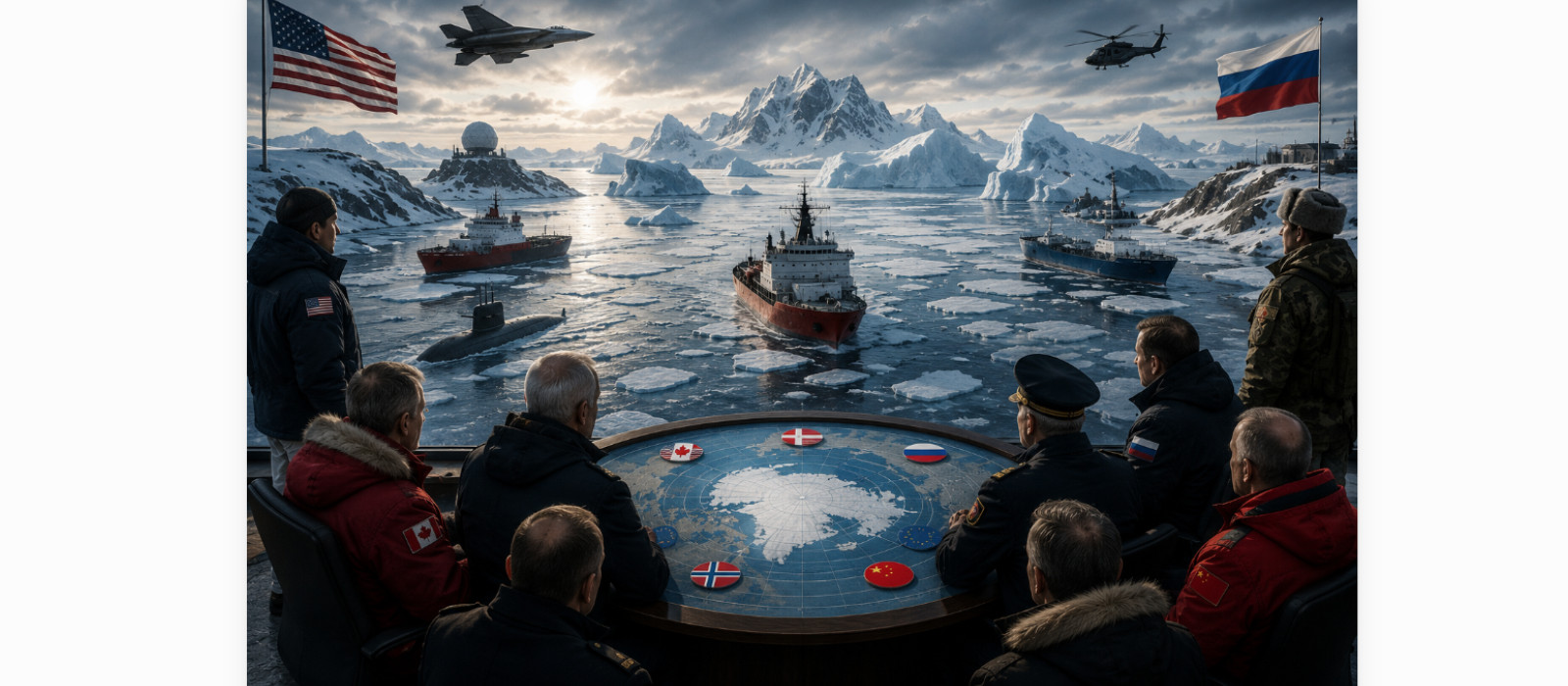
A principal factor affecting the geopolitical environment for the Arctic is the shift that has occurred in recent years from the post-Cold War era to a new international security environmentthat features, among other things, renewed great power competition. This shift, combined with the diminishing Arctic ice and the resulting increase in human activities, has several strategic implications for the region’s future. Renewal of great power competition has also raised a basic question, as to whether the Arctic in coming years will continue to be a region generally characterised by cooperation and low tensions, or instead become a region marked by competition and increased tensions. Although there continues to be significant international cooperation on Arctic issues, the region is increasingly viewed as an arena for geopolitical competition, primarily among USA, Russia, and China.
Russia’s Arctic Build-up
Arctic Territory. With a larger territory, population and military presence in the Arctic than any other country, Russia is well-positioned to assume a central role in the region’s future strategic trajectory. Concurrently, Moscow has also laid claim to more Arctic land and maritime territory than any other country. Adding to its territorial control and future ambitions is the fact that several million Russians live in the Arctic, giving it significant leverage in the region’s affairs. From an economic perspective, the region generates about one-fifth of the country’s GDP, compared with only 1% of that for USA.2 In fact, President Putin in 2017, estimated the mineral wealth in the region at $30 trillion.
Control over Arctic Sea Lanes. Acknowledging the significance of a strong and robust ‘presence-cum-control’ along the Arctic sea lanes and its resource-rich regions, Russia is pursuing several important maritime infrastructure projects, especially in the vicinity of the Arctic sea lanes. An augmented infrastructure base would also support its Arctic shipping fleet, oil and energy drilling ventures and other associated economic activities.An important development in this context has been development of the 5,000 km Northern Sea Route (NSR), which gives it considerable strategic as well as economic leverage in the region. The NSR has the potential to substantially reduce transit time for vessels transiting the Northern Hemisphere between northeast Asia and northern Europe, and is likely to attract considerable attention from a commercial perspective in times to come.
Build-up of Ice-Cutters. In order to support transit through the NSR, Russia has undertaken a sustained build-up of its fleet of ice-cutters. This includes nuclear-powered ice-breakers, with greater operating power and better endurance than conventionally powered vessels. It is also believed that the Russian government has regained control over most ice-cutters in the country, in consonance with its capability development plans to support civil and military operations.3
Military Posturing. In addition to controlling the region’s rich resource base and shipping lanes, Russia also aims to develop power projection and defence capability along its northern borders. Recent important actions by the Russian military, including restoration of Soviet-era facilities, strengthening of its Northern Fleet, and establishing new bases with advanced air-and sea-defence systems, is indicative of the country’s focus on security of its national interests in the region.4
China’s Arctic Ambitions
Arctic Strategy. To begin with, China owns no territory above 66.50° N, yet it claims to be a ‘near-Arctic’ state vying for equal rights in the region’s governance and resource exploration.5 It published its Arctic Policy in 2018, outlining a string of objectives that largely aim at greater Chinese presence and influence in the region. The policy prioritises Chinese use of Arctic shipping routes as part of a so-called ‘Polar Silk Road,’ resource exploration and exploitation in the region, and better Arctic governance. In addition to gaining access to the region’s rich resource and mineral potential, access to the Arctic would also assist China in mitigating its Malacca Dilemma. Moreover, the estimated 30% shorter transit route to European markets through the NSR, as compared to the Malacca-Suez route, also adds to China’s interests in gaining greater control over the region’s sea routes.6 Build-up of Ice-Cutters. To substantiate its ‘Polar Silk Road’ vision, China is in the process of acquiring a fleet of ice-breakers for its missions in the Arctic, as well as in Antarctica. This includes construction of a 30,000- tonne nuclear-powered icebreaker.7 In 2019, it commissioned Xue Long II, which completed an Antarctic mission in April 2020 and is currently deployed on its maiden Arctic deployment. The vessel is owned and managed by the Chinese Polar Institute and is the successor to the Ukranian-built Xue Long (Snow Dragon).8 Till date, China has conducted 36 Antarctic and 10 Arctic expeditions.9
Leveraging Russian Support. Chinese oil and gas companies are increasing their engagement with Russian firms, primarily with the objective of leveraging the latter’s expertise of offshore exploration in the region. The canvas of collaboration extends from joint offshore exploration, shared ownership of projects, joint development of deep water ports and undertaking joint research projects in the High North. Adding fillip to this collaborative tempo is the increased transit revenue for Russia, generated by the surge in Chinese trade passing through the NSR. At the same time, cooperation in the Arctic over the last few years has not contributed towards alleviating the longstanding conflict between the two countries in the Russian Far East, especially on demographic issues.10
The US Response
US Policy Focus. The renewal of great power competition has raised concerns on the priority that should be given to the Arctic in overall US policymaking. During the post-Cold War era, when the Arctic was generally a region of cooperation and low tensions, there may have been less need to devote attention and resources to the Arctic. But, with increasing polar ice melting and resultant quest for resources, USA is increasing its national focus on Arctic, while adopting a more prominent position regarding the region.
Response to Russian and Chinese Arctic Ambitions. In May 2019, the US Secretary of State, Mike Pompeo, acknowledged the Arctic as “an arena for power and for competition,” and countered China’s claims to be a ‘Near-Arctic State.’ Even though he was accommodative towards Chinese investments in the region, he insisted that it needed to be transparent and constructive, and avoid the “pattern of aggressive behaviour elsewhere.” As regards Russia, Secretary Pompeo expressed concern about Moscow’s territorial claims, intensified military presence, and plans to integrate the NSR with Beijing’s Maritime Silk Road. Summing up the US Administration’s outlook, he said, “Under President Trump, we are fortifying America’s security and diplomatic presence in the area.”11
US DoD Arctic Strategy. The US Department of Defence (DoD) released its Arctic Strategy in 2019 (an updated 2016 version), with specific focus on DoD’s strategic trajectory for the region. The document puts forth the department’s vision and strategic approach for protecting US national security interests in the region. Importantly, the document acknowledges the current period as an “era of strategic competition” and articulates the desired end-state for the Arctic as “a secure and stable region in which USA national security interests are safeguarded, the US homeland is defended, and nations work cooperatively to address shared challenges.”12
Military Actions. USA has also commenced construction of polar ice-cutters for undertaking both, Arctic as well as Antarctic missions by the US Coast Guard. As regards its operational philosophy for the region, the last few years have witnessed a strong case being made by the US administration for conducting freedom of navigation operations in the Arctic. Aimed primarily at contesting Russian claims, which categorise the NSR as an internal rather than an international body of water, these operations are an important cornerstone of the larger US strategy for the region. In a more recent development, and as a demonstration of its increased focus towards the Arctic, the US Navy deployed a four-ship Task Group in the Barents Sea in May this year.13 Importantly, this is the first such deployment by the US Navy in the region since the end of the Cold War.
Implications for India
India and the Arctic. India’s engagement with the Arctic started in 1923, when as part of the British Empire, it joined the Svalbard Treaty. The Treaty permitted signatories to undertake commercial activities on Norway’s Svalbard Archipelago. Subsequently, post-independence, India’s polar focus turned to the Antarctic, where it presently operates two research stations.14 Acknowledging the growing focus on the Arctic, in 2008, India inaugurated its first Arctic research station, Himadri. The other important developments included grant of Observer status in the Arctic Council in 2013, and conclusion of a deal between ONGC Videsh Limited (OVL) and Russia’s Rosneft in 2014 to explore oil and gas in the region.
Statement by the Indian Ministry of External Affairs - 2013. A statement titled India and the Arctic, released in 2013 by the Indian Ministry of External Affairs (MEA), articulated India’s official stance and objectives on the Arctic. It acknowledged that, “Arctic region is increasingly being effected by external global forces and in turn is poised to play an increasingly greater role in shaping the course of world affairs.”15 It also stated that, “India has been closely following the developments in the Arctic region and India’s interests in the region are scientific, environmental, commercial as well as strategic.” Importantly, the statement identified the following objectives of the Indian research in the Arctic: -
-
To study the hypothesised tele-connections between the Arctic climate and the Indian monsoon.
-
To characterise sea ice in the Arctic using satellite data to estimate the effect of global warming in the northern polar region.
-
To conduct research on the dynamics and mass budget of Arctic glaciers focusing on their effect on sea-level change.
-
To carry out a comprehensive assessment of the flora and fauna of the Artic vis-à-vis their response to anthropogenic activities.
Why is Arctic Important for India?
India’s Arctic focus, till date, has largely been centred on scientific research. The true potential of the region, in safeguarding and promoting India’s security and developmental needs, remains to be fully harnessed. With measures focused on increased cooperation and collaboration with important Arctic states, India would need to pursue a recalibrated approach to the region. The following four key issues emerge as the ‘front and centre’ of the Arctic’s growing strategic context and merit due consideration: -
-
Access to Resources. Receding sea ice and permafrost thaw is significantly impacting the accessibility to the region’s mineral and energy resources. A US Geological Survey report in 2008 estimated that the area north of the Arctic circle is likely to store 90 billion barrels of oil, 44 billion barrels of natural gas liquids, and 1,760 trillion cubic feet of natural gas, collectively accounting for nearly 22% of the undiscovered, technically recoverable resources of the world.16 With advancements in exploration technology, supported through climatic changes and access to shipping routes, the quest for these resources is likely to increase with time.
-
Increasing Chinese Influence. China’s interest and influence in the Arctic has witnessed a significant upsurge in the last few years, implementing a threefold strategy to meet its goals. First, is to use its economic might to gain leverage over the region’s vulnerable actors. Secondly, is to effectively tap into the multilateralism sentiment of many Arctic nations. And thirdly, is to invest in Arctic oil and gas, example of which is China’s significant investments in Russia’s Yamal natural gas fields. Collectively, this strategy would provide China increased access to the region and its resources, a passage through its shipping routes and, most importantly, an economic dependency for Arctic states, which it can exploit for unilateral advantage.17
-
Indian Investments in the Region. India has accorded a positive focus towards oil and gas exploration in the region. India and Russia’s oil and gas companies have signed agreements and are cooperating on 36 shared production projects as well as offshore exploration. Further, OVL holds a 26% stake in Russia’s Vankorneft and a 20% stake in the Sakhalin-I project. Recently, Gas Authority of Indian Limited (GAIL) renegotiated its 20-year LNG agreement with Russia’s Gazprom, adding two million tonnes to the previously concluded deal of 2.5 million tonnes per year and extending the term by three years. Further, in 2019, a consortium of Indian energy firms - Indian Oil, OVL and Bharat Petro Resources entered into an agreement with Rosneft for projects in the Arctic region.18 Expanding the basket of energy import options is an important planning agenda and, therefore, protection of these interests would remain a key security consideration in times to come.
-
Scientific and Environmental Interests. Melting Arctic glaciers are the chief contributor of global sea-level rise, estimated to be adding nearly 13,000 tonnes of fresh water into the oceans every second.19 As the leading cause of rising sea levels, this phenomenon has the potential to adversely impact coastal areas in India and across the Indian Ocean Region (IOR). For example, the Arctic ice-melt is appreciated to weaken the movement of monsoon breeze into India, through a chain of causal actions, which eventually would have cross-sectoral implications.20 Therefore, India has genuine reasons to be concerned of the developments in the Arctic, which are bound to have humanitarian, economic, and strategic consequences for the country and the sub-continent in times to come.
Policy Recommendations
National Strategy for the Arctic. In light of the increasing inter-linkages between the Arctic region and global power-play, it is imperative that an apex-level strategy be formulated with a coherent and synergised ‘whole-of-nation’ approach to the region. It is important for such a policy document to set India’s comprehensive strategic priorities, and position India to respond effectively to challenges and emerging opportunities arising from the significant increase in Arctic activity. India’s long-term national security interests in the Arctic region, and prioritised lines of effort, would need to be conceptualised as part of this strategic framework. In this regard, the following overarching strategic objectives are recommended to steer future national effort in the Arctic: -
-
Build Arctic awareness founded on the ongoing scientific research effort in the Arctic, with the aim of establishing an evidence-based causal relationship between the region’s developments and its impact on India.
-
Enhance engagement with Arctic states to shape India’s future cooperative engagement, and define our continuing and constructive role in the Arctic Council. Pursuing a strategy for conducting polar engagement, under a guiding principle of ‘Polar Zone of Peace’ may find wide spread support as well as global acceptance.
-
India’s firm and resolute commitment towards promoting prosperity and sustainable development of the region should serve as the guiding vision for our future presence and sustained operations in the Arctic region.
Arctic Strategy (Maritime). The importance of polar research to India is acknowledged in the Indian Maritime Security Strategy (IMSS). The document recognises the contribution of India’s overseas scientific research stations (Maitri and Bharati in Antarctica, and Himadri in the Arctic) towards researching climate and weather patterns, on which the Indian monsoons and, consequently, a substantial portion of the nation’s economy depends. Further, the growth in India’s overseas economic and trade relations across sectors is also mentioned in the strategy document. But, while the Southern IOR, with Antarctica, is included in India’s secondary areas of maritime interest, the Arctic does not feature as an identified area of maritime interest. This may be considered for inclusion in the next revision.21 This could flow out from the National Strategy, proposed above.
Polar Commission. At present, the Ministry of Earth Sciences (MoES) is responsible for scientific exploration and research undertaken in the polar regions of Antarctica and Arctic. While scientific research remains an important driver of India’s interest in these regions, the increasing economic, environmental and commercial stakes merit a broader management of India’s polar strategy. Therefore, it is recommended that, on lines of the domain of ‘space,’ a ‘Polar Commission’ be constituted. This would give a much required fillip to India’s polar strategy, bringing all concerned stakeholders together and channelising their efforts in a synergised manner.
Arctic Research
India’s commitment to research in the Arctic was bolstered in 2018, with the renaming of the National Centre for Antarctic and Ocean Research as the National Centre for Polar and Oceanic Research.22 Further, India’s first Polar Research Vessel is also likely to be commissioned soon. This would allow planning of diverse scientific programmes, which were limited hitherto, due to the chartered nature of ice-cargo vessels used for such missions by Indian researchers. The Navy could leverage this opportunity by participating in future Arctic missions and incorporate important domain aspects into future operational planning.
The frigid operating temperature and weather conditions of the Arctic warrant construction of role-specific platforms, capable of withstanding the harsh operating conditions. Under current standards, ships would have to be built as per the ‘Polar Code’ to operate in this region. Therefore, IN ships built in Russia, which may be suitable for Arctic missions, could be considered for deployment, as and when required, with suitable availability of polar-specific equipment. Concurrently, specialised training for the crew from the perspective of ice-navigation and equipment maintenance under extremely cold temperatures would be an important line of effort.
Conclusion
The Arctic’s sea ice is melting at a faster rate than ever witnessed earlier in history. Consequently, strategic commentators are increasingly discussing prospect of a great-power conquest for control of the region, on lines reminiscent of control over Africa in the 19th Century. Importantly, today, there is little consensus regarding the development of Arctic resources and the associated rights of states.
This renewed great power competition might be expressed in the Arctic in terms of issues like resource exploration, sovereignty disputes and military operations. Hence, there is need for devoting greater attention and resources to the Arctic. However, given current capacity and support constraints, it may be prudent to pursue a ‘whole-of-nation’ approach in crafting an overarching Indian Arctic Strategy. Downstream imperatives and enablers for the Indian Navy may be subsequently developed under such an overarching guiding framework.
Endnotes
-
“Reaching New Heights of Cooperation through Trust and Partnership,” MEA Press Release, 05 September 2019.
-
Richard Weitz, “US Policy towards the Arctic: Adapting to a Changing Environment,” International Centre for Defence and Security, 24 October 2019.
-
Ibid.
-
Ibid.
-
Ibid.
-
David Auerswald, “China’s Multifaceted Arctic Strategy,” War on the Rocks, 24 May 2019.
-
Aditya Ramanathan, “India needs an Arctic strategy urgently, before its opportunities melt away,” The Print, 25 May 2019.
-
Atle Staalesen, “China’s new icebreaker sets course for its first Arctic voyage,” The Independent Barents Observer, 17 July 2020.
-
Ibid.
-
Ling Guo and Steven Lloyd Wilson, “China, Russia and Arctic Geopolitics,” The Diplomat, 29 March 2020.
-
Weitz, Op Cit., n.2.
-
US Department of Defence Arctic Strategy, 2019.
-
“U.S.-British Arctic Exercise Shows U.S. Concern for Region,” US DoD Press Release, 07 May 2020.
-
Ramanathan, Op Cit., n.7.
-
MEA Press Release “India and the Arctic,” 10 June 2013.
-
Eeva Turunen, “Resources in the Arctic,” Nordregio, January 2019.
-
David Auerswald, “China’s Multifaceted Arctic Strategy,” War on the Rocks, 24 May 2019.
-
Sulagna Chattopadhyay, “Cold rush: Why India is rushing to the Arctic,” Financial Express, 30 September 2019.
-
Ramanathan, Op Cit., n.7.
-
Jacob Koshy, “India to expand Polar Research to Arctic as well,” The Hindu, 19 July 2019.
-
Ensuring Secure Seas: Indian Maritime Security Strategy [New Delhi: IHQ MoD (Navy), 2015], 32.
-
Devikaa Nanda, “India’s Arctic Potential,” ORF Occasional Paper 186, February 2019.