


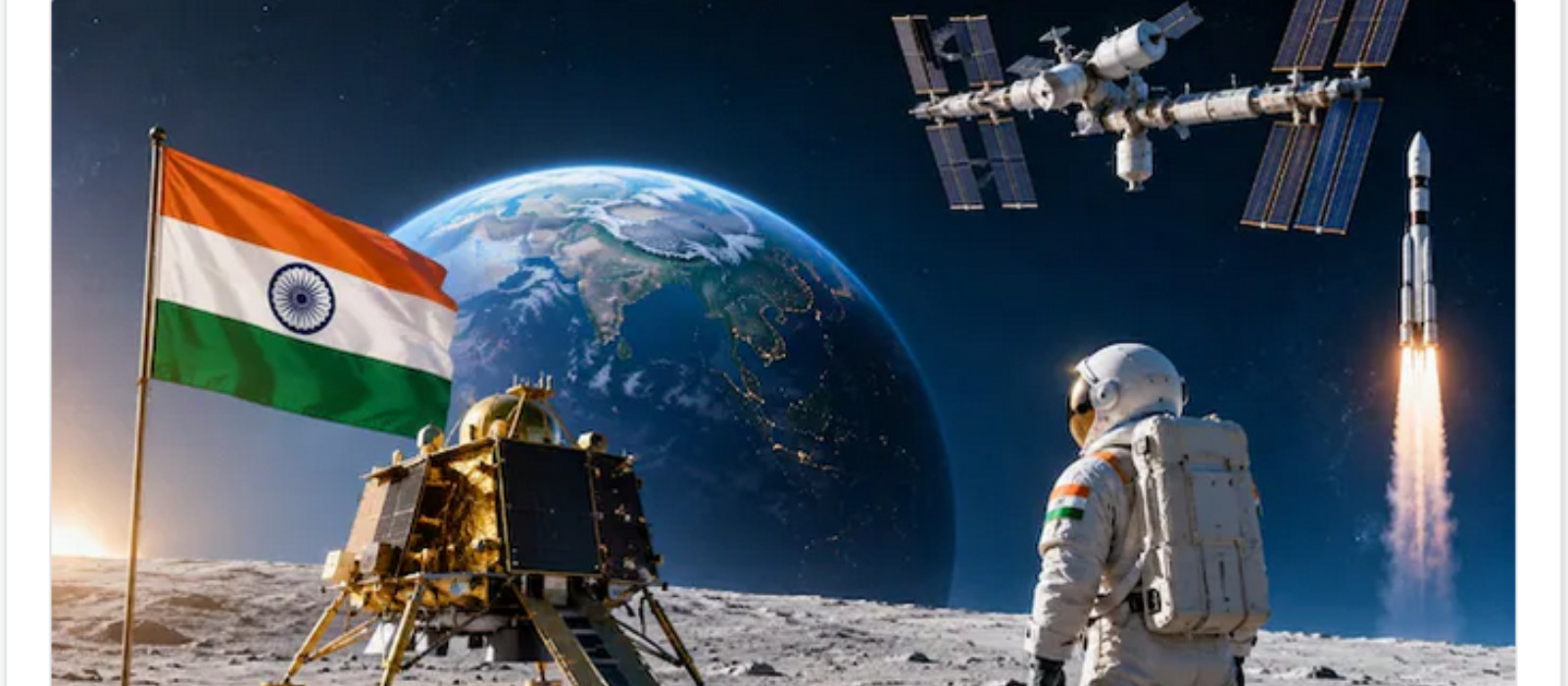


“Space is for everybody. It’s not just for a few scientists or astronauts. That’s our new frontier out there, and it’s everybody’s business to know about space.”
- Christa McAuliffe 1
Introduction
Since antiquity, mankind has gazed at the stars and wondered what lies beyond the horizons. While a few questions have been answered, the greater part of outer space still remains enigmatic.
The quest to convert this mysterious space into a province, is not a recent one. If ancient Vedic scriptures are to be believed, mankind may have ventured into space millennia ago. Almost all these scriptures describe Vimanas (aircraft) of several different types, including the ones capable of travelling across the country and even from planet to planet. The sacred texts of Ramayana and Mahabharata also have accounts of craft capable of undertaking hypersonic, invisible and extra-terrestrial flights. Some ancient Sanskrit texts speak of saucer shaped flying machines, which utilised mercury as part of their propulsion fuel and gleaned electric charge from the sun.2 While the existence of such niche aerospace technology in ancient times can be debated, it reiterates the fact that space as an arena has occupied the thoughts of mankind for millennia across all cultures.
First Sojourns. In October 1957, the Soviet Union placed the first artificial satellite Sputnik One into orbit, igniting the space race with the USA. The competition over who had superior technology and military power took centre stage during the Cold War. Soviets claimed first victory by sending the first man into space in 1961, on a capsule-like spacecraft, adapted from an Inter-Continental Ballistic Missile.3 The space race reached its dramatic high-point with the first American astronaut landing on the moon in 1969.
The aim of this essay is to undertake an analytical review of space as the next frontier and arena for competition and possible clashes. It also examines opportunities for India and suggests response strategies. The essay shall evaluate the following: -
-
India’s journey into space.
-
Existing global capabilities and strategic developments in outer space, including militarisation.
-
Implications for India’s national security.
-
A road map for India to counter challenges and tap opportunities in space.
Considering the limitation on the length of this essay, cyber-attacks, though associated with space warfare have not been addressed.
India’s Space Odyssey
Dawning in Space. The seeds of rocketry were sown in India by Haider Ali and Tipu Sultan, the rulers of Mysore who unleashed rocket barrages and wreaked havoc on British troops in the late 18th Century. However, the first contemporary steps into space can be traced back to 1963, when a sounding rocket named Nike-Apache was launched from Thumba Equatorial Rocket Launching Station.4 Much credit for this humble beginning goes to Dr
Vikram Sarabhai, the father of India’s space programme, who understood the potential of space for socio-economic development of the country. Despite political apathy and meagre resources, he worked hard to realise his long-cherished dream of India’s autonomous access to space. With a small group of young, inexperienced, but nevertheless energetic scientists and engineers to lead, which included Dr A P J Abdul Kalam, Dr Sarabhai created a new frontier in the field of science and technology in India. In the year 1984, Squadron Leader Rakesh Sharma became the first Indian to venture into space, albeit on a Soviet rocket and with Russian shipmates.
Present Framework
Organisational Structure. The Government of India established the Department of Space in 1972 with a view to ‘harness space technology for national development, while pursuing space science research and planetary exploration.’ It implements space programmes through various government owned laboratories and organisations like the Indian Space Research Organisation (ISRO) and the Defence Research and Development Organisation (DRDO).5 The security of India’s space-based military and civilian hardware systems is looked after by the Defence Space Agency, which is likely to be converted into a full-fledged military space command in the near future.6
The Space Programme. India’s space programme is primarily focused on peaceful uses with several scientific and technological applications that include communication, broadcasting, internet services, medicine, education, health, navigation and positioning. It also reduces the dependency on foreign satellites and enhances the overall national security by offering eyes and ears in the skies. Some of the existing capabilities are as follows: -
-
Remote sensing. Beginning with the Indian Remote Sensing series in the 1980s, an array of Earth Observation satellites now provide wide-field and multispectral high-resolution data for land, ocean and atmospheric observations. The existing imaging capabilities in visible, infrared, thermal and microwave regions of the electromagnetic spectrum, including hyper-spectral sensors, have helped the country in realising major operational applications. The imaging sensors have been providing spatial resolution ranging from 1 kilometre to 1 metre; repeat observation (temporal imaging) from 22 days to every 15 minutes and radiometric ranging from 7-bit to 12-bit. This has significantly helped in several applications at the national level.7
-
Satellite Communication. The Indian National Satellite is today one of the largest domestic communication satellite systems and provides communication and broadcasting, weather forecasting, disaster warning and search and rescue (SAR) services in the Indo-Pacific Region. The GSAT-7, Rukmini, is a multi-band military communications satellite with a comprehensive coverage over the Indian Ocean Region (IOR) and enables the Indian Navy to extend its blue water capabilities. It also enhances network centric warfare capabilities of the Indian Air Force (IAF) and the Indian Army(IA).
-
Satellite-Aided Navigation. Considering the limited accuracy and vulnerability of the US controlled, commercially available Global Positioning System (GPS), a need was felt to develop parallel indigenous capabilities. As a result, GPS-Aided GEO Augmented Navigation (GAGAN) and NavIC (Navigation with Indian Constellation) were launched in 2013. While GAGAN caters for the civil aviation requirements, NavIC provides precision navigational inputs for critical national applications.8
-
Launch Vehicles. Polar Satellite Launch Vehicle and Geosynchronous Satellite Launch Vehicle (PSLV/GSLV) are the two operational workhorses of the Indian space programme. In 2017, ISRO launched a record 104 satellites in two orbits, which was followed up with the success of GSLV Mk III. Powered by an indigenous high thrust cryogenic engine, GSLV Mk III has the capability of launching four tonne class of communication satellites.9
-
Space Probes. In order to expand the frontiers of knowledge in space science, astronomy, physics and celestial mapping, numerous deep space probes have been launched by India in the past few years. The most notable have been the Lunar Exploration Program - Chandrayaan and the Mars Orbiter Mission - Mangalyaan, with a manned space mission Gaganyaan, planned for its first test flight next year. The Mangalyaan, realised in a short span of 18 months was the first Mars mission in the world to succeed in its very first attempt.10 It was also the most economic interplanetary mission till date, with overall costs rather interestingly presented as lower than the Hollywood movie, ‘The Martian.’11 The project has opened a new regime for space physicists to analyse data.
-
Mission Shakti. With the increased dependency on space-based systems, a need was felt to secure the vulnerability of our precious space assets from hostile enemy action. As a result, India successfully launched ‘Mission Shakti’ in 2019, wherein a live satellite was engaged at a height of 300 kilometres in Low Earth Orbit (LEO) with an Anti-Satellite (ASAT) weapon. The DRDO claimed that the weapon had been developed to engage targets up to 1,000 kilometres in space but was tested at a much lower distance to minimise debris fallout from the test.12 The test catapulted India into an elite league of nations that includes USA, Russia and China; and provides India the much-desired capability of defending space assets while strengthening overall national security.
Commercial Global Developments
From Sputnik One to Falcon Nine - first reusable rocket - the world has come a long way, enabling manned and unmanned missions to explore the new ocean of space. This combined scientific quest has also produced wondrous technologies, which have been applied to practical benefits on earth in the field of medicine, aeronautics, metallurgy, disaster-relief, remote-sensing, weather watch, communication and many such useful domains. Some of these marvels can be seen in our day-to-day lives in the form of ultrasound scanners, Magnetic Resonance Imaging (MRI), artificial limbs, laser heart surgeries, convection ovens, carbon monoxide detectors, global positioning systems, infra-red cameras, solar powered appliances, satellite television broadcasting and internet services. As stated by Neil Armstrong, the first voyage to the moon was “One small step for a man, but one giant leap for mankind.”
Martian Mysteries. In 2015, NASA discovered liquid water running on the surface of Mars, which potentially brings new hope for the discovery of life on the red planet.13
Lunar Landers. On 22 February 2019, Israel made an unsuccessful attempt to land on the moon by launching her spacecraft Beresheet. India made a similar attempt on 22 July 2019 by launching Chandrayaan-2, which brought together an orbiter, lander and a rover with the goal of exploring the South Pole of the Moon. However, the lander deviated from its intended trajectory while attempting to land, resulting in a ‘hard landing.’14
Commercial Space Flights. The most recent advancements have come in the form of privatisation of the space industry. Technology is evolving at a rate never seen before, and it is well within the realms of possibility that we would see commercial space flights in the next few years. Space Exploration Technologies Corporation (SpaceX), the leading commercial space company in the world, is developing its Crew Dragon capsule to carry cargo, and eventually people into space orbit. This would be followed by the launch of the Boeing Starliner capsule, which is designed to land on the ground and can be reused up to 10 times. The Starliner will have a turnaround time of six months and will feature wireless internet and tablet technology for crew interfaces.15
Autonomous Docking. Launched on 02 March 2019, SpaceX’s Dragon became the first American spacecraft in the history to autonomously dock with the International Space Station (ISS).16
Space Colonisation. Space colonies are still a dream but progress in making space access easier is happening every day. With experiences gained form the ISS, NASA is planning a human mission to Mars by 2030 for the benefit of humanity.
Micro-satellites. The revolution in space technology has presented micro-size, lightweight, incredibly versatile, cube-shaped satellites that weigh between 10 to 100 kilograms. While commercial needs are primarily cost-driven, they also offer military advantages by spreading space assets over constellations of thousands of satellites. With too many targets orbiting in space, it makes it difficult for the adversary to detect, track and engage a particular satellite. Other categories include nanosatellites (1 to 10 kilograms), pico-satellites (0.1 to 1 kilogram) and femto-satellites (less than 100 grams).17 Planet Labs and Spire are the two well-known global companies in the field of nano and micro-satellites.
Military Global Developments
Today space is closely integrated with war-fighting and is extensively utilised for C4ISR, integrated early warning, navigation and precise positioning for ordnance delivery. The evolving counter-space weapons can be categorised into three distinct types: kinetic, non-kinetic and electronic measures like jamming and spoofing.
Kinetic Weapons. These weapons attempt to damage the space assets by making a physical contact. A few examples are as follows: -
-
SM-3. In 2008, USA deployed an Aegis Ballistic Missile Defence (BMD) System to destroy a decaying satellite with hydrazine fuel leak. This was also symbolic of its demonstration of offensive capabilities in space.18
-
XSS-11. XSS-11 is a small, washing-machine-sized, low-cost spacecraft developed by USA to demonstrate autonomous rendezvous and proximity manoeuvres. It is capable of approaching, investigating, and photographing another spacecraft in orbit.19
-
SC-19. China conducted a ground-based, mid-course anti-missile test in January 2010, which involved detecting, tracking and destroying a ballistic missile flying in space.
-
SJ-15. In July 2013, China launched the SJ-15 Shiyan satellite equipped with a robotic arm for grabbing or capturing items in space. The satellite is capable of shadowing and eventually hijacking a smaller satellite.20
-
Luch. Launched in 2014, this Russian satellite takes offensive space capability to a new level. It combines the advantages of a military fighter and a spy plane by manoeuvring through geo-synchronous space, up close to various communication satellites, listening to the flowing traffic and selectively attacking them.
-
Kosmos 2499. Launched in 2014 by Russia as an experimental satellite with plasma propulsion engines/ ion thrusters, Kosmos 2499 is capable of manoeuvring close to other satellites thereby, undertaking a kinetic attack.21
-
X-37B. With a striking resemblance to a space-shuttle, X-37B is a reusable spacecraft used to transfer payloads into space. While its actual employment remains classified, its manoeuvrability, payload space and ability to stay in orbit for hundreds of days gives it the potential for offensive and defensive missions in space. The spacecraft successfully completed its fifth classified mission on 27 October 2019.22
-
Nudol. Nudol direct-ascent ASAT missile was tested by Russia on 15 April 2020. The satellite has a maximum altitude of 1,500 kilometres and is capable of engaging satellites in LEO.23
Non-Kinetic Weapons. These include high-powered microwaves, electromagnetic pulses, lasers and linear particle accelerators that damage space assets without making physical contact. While kinetic weapons are necessary deterrents, non-kinetic and dazzling weapons offer the advantages of ‘speed, low signature and plausible deniability.’24
International Code of Conduct
The consequences of a battle in space could be devastating and lead to an orbiting minefield of debris. The resultant environment could render much of space unusable for centuries and may even take away the dream of exploring the darkness around the earth. Thus, there has long been some movement towards a rules-based order in space.
Extant Treaties. Presently, there are five United Nations (UN) treaties in force that govern the use of space for various exploration activities. These are: -
-
The Outer Space Treaty (1966).
-
The Rescue Agreement (1967).
-
The Liability Convention (1971).
-
The Registration Convention (1974).
-
The Moon Agreement (1979).25
Pitfalls. Each of these stress upon the notion that the activities carried out in outer space and the benefits accrued thereof, should be devoted to the well-being of all countries and humankind, with an emphasis on promoting international cooperation. While the stationing of weapons of mass destruction (nuclear, biological and chemical) in outer space is prohibited, none of these treaties address the more flexible non-nuclear systems.
India’s Outlook. India has ratified all treaties except the Moon Agreement, which has not been ratified by any nation that engages in self-launched human space-flight. Strongly opposing any attempts to place weapons in space, the Indian space programme has only been focussed for national security purposes, without violating any of the UN treaties. India looks forward to a global role in proposing a new legal and organisational framework that promises collective prosperity of mankind and sustainability in the use of the space environment.
Implications for India’s National Security
Geopolitical Considerations. India is among a few countries that face two hostile nuclear armed neighbours viz., China and Pakistan, with active space military capabilities and a history of mutual strategic cooperation. A low-intensity border skirmish intensifying into a two-front, full-spectrum (including space domain), sharp and intense combat engagement is a daunting reality that India must prepare for.
China’s Space Dominance. While China claims peaceful orientation of her space programme, its missions have strong military applications that project undertones of space weaponisation like the constellation of Chinese Yaogan satellites, which enables it to monitor military activity. Even the Anti-Access/ Area-Denial strategy, in the massive expanse of North Pacific Ocean utilises space capabilities for tracking, C4ISR and missile guidance. The wide array of ballistic missiles, space assets, and ASAT weapons demonstrate China’s growing capabilities in space and illustrate the challenges right in India’s neighbourhood and in the IOR.
Pakistan’s Space Potential. Pakistan does not have a confirmed offensive space capability but has an extensive missile programme and is capable of undertaking ASAT tests with Chinese assistance in the near future. Additionally, Pakistani missiles are potentially convertible to direct-ascent kinetic projectiles capable of satellite intercepts.26
Threat Perception
Given India’s dependence on space-based systems like GPS, internet, communication and remote-sensing satellites, China’s cyber and space-warfare potential could leave us deaf, dumb and blind in seconds. In the event of a two-front war, India’s precious space and land support systems are likely to become prime targets of Pakistani and Chinese missile forces. With the omnipresent risk of escalation, the armed forces need to formulate a multi-pronged approach and a joint war-fighting strategy to counter a superior enemy on land, sea, air, cyber and space domains. Credible BMD and ASAT capability will allow India to enhance space power deterrence and provide the option of an asymmetric escalation in extreme contingencies.
A Road Map - Challenges
Physical Characteristics. Despite its emptiness, space has physical challenges as existing in other dimensions. Apart from the need for certain orbital preferences, altitudes for satellites, etc, there are issues of space debris, extreme thermal conditions, radiation hazards, isolation, etc. Space engineering regularly needs to account for these.
ISRO’s Capacity. The demand for space-based services in India is far greater than what ISRO can presently deliver; yet it is the only agency in the country that builds spacecraft for civilian, commercial and military purposes. The existing workload, manpower shortages and deficit issues in technical capacity severely constrain its production and output.
Political Encumbrance. India’s recent ASAT tests received sharp criticism from several quarters. NASA identified 400 pieces of orbital debris from the test and claimed that at least 24 of them were found above the apogee of the ISS posing increased risk to human space life.27 Considering the fact that other countries have conducted similar, rather more powerful tests in the past, India would need to skilfully overcome such discriminatory reactions with deft diplomacy and strength of conviction.
Collaborations. India has a long history of cooperation in space with USA, Russia, France and Israel. While we have attained a very high degree of self-sufficiency, there still exists a need for international cooperation and technology assistance, especially in the field of carbon composites,semiconductor chips and radiation hardened electronic components. Until we become Atmanirbhar (self reliant) in these fields, collaboration and cooperation with various international agencies is of vital importance.
Triad of Kinetic Energy Weapons. In order to build up an operationally flexible deterrent with a vast geographical reach, the existing kinetic capabilities must be diversified to mobile land, sea and air platforms. IAF’s Sukhoi-30 MKI aircraft, being similar to the American F-15 in terms of thrust-to-weight ratio, could be the ideal platform for testing and demonstrating air-launched ASAT capability. However, the Indian Navy faces significant challenges in developing sea-launched ASAT capability, as the existing inventory of surface platforms does not include any ‘hit-to-kill’ BMD capability.28
Funding. Given that India is a developing country with enough socio-economic problems to address, it will be tough to support funding for space missions that do not have a direct bearing on economic development. The shrinking budgetary allocations to the defence forces in the recent years could also impact any attempts to integrate space capabilities on military platforms.
A Road Map - Opportunities
Interoperability. India’s need for utilising space for human progress, might be difficult without leveraging others. Strengthening partnerships, and pooling-in available space resources to attain interoperability, especially with member nations of the Quadrilateral Security Dialogue (Quad), is an important area to consider.
Private Entities. The value of the global space industry is estimated to be $350 billion today and is likely to exceed $550 billion by 2025. Despite impressive capabilities, India’s share is only $7 billion, which is just two percent of the global market. In order to enhance this share, a suitable policy environment for private players and level playing field for profitable revenue generation needs to be created.29
Indigenisation. In order to become self-reliant in the space domain, small-scale industries and start-ups must be encouraged to step-up commercial activity, especially in the small satellite segment. This would create an enabling ecosystem of entrepreneurial incubators, which will not only attract more talent, innovation and capital but also reap strategic, as well as commercial benefits for the country.
Research and Development (R & D). Adequate funding must continue, to promote R & D activities, especially in developing more compact, efficient and greener energy resources for space systems.
C4ISR Capacity Building. Satellite operations are conducted at speed of light, permitting near-instantaneous transfer of information and facilitate rapid application of force upon the adversary. It also prevents surprise by an adversary’s earth-based forces by revealing strategic mobilisations. Dedicating more space resources towards C4ISR is a critical requirement that will strengthen the overall security architecture and provide maximum decision-making window for a launch-on-warning posture.
Soft Kill Measures. American strategic studies scholar, Ashley J. Tellis argues, “India’s ASAT test was perhaps necessary, but it will not suffice to protect India’s space assets during any major conflict with China.” Therefore, blinding techniques and Direct Energy Weapons like microwaves and space-based lasers must be developed further, which can be equally effective, yet discrete in ASAT capabilities. A report by scientists working for China’s top laser-research institute admitted that China is developing ASAT laser weapons and conducted a test in 2005 that blinded a Chinese satellite. The test was not public knowledge until the report was published in 2013; this displays the ease with which soft-kill tests can be conducted.30
National Space Policy. Space is a vast and unpredictable domain that requires a well-thought out strategy and a vision to face future security challenges. With the recent successes of Mangalyaan and Mission Shakti, the time is now ripe to infuse more vigour into India’s space programme by means of national legislation. A comprehensive legislation that covers International Regulations, National Security Policies, Intellectual Property Rights (IPRs) and responsibilities of both public and private players is long awaited.
Jointmanship. In order to achieve operational synergy, various sensors on land, at sea and in the air should be integrated with space-based systems. This would significantly enhance battlespace transparency and enable cooperative engagement over prolonged ranges. As ‘Guardians of the Skies,’ the IAF could take the lead in collaborating with the other two services and civilian agencies and gear up to deter and counter conflict in the space domain. The proposed Joint Space Command of the three services should also integrate the existing civilian aerospace infrastructure into war-fighting capabilities.
Joint Space Doctrine. Aerospace power can be defined as the product of aerospace capability and aerospace doctrine.31 Doctrine is therefore, an important component that provides the underlying rationale for the development and deployment of capabilities. The existing doctrine only focuses on the security needs of yesteryears and does not clearly enunciate the probable character of future wars. Therefore, it must be reviewed rationally in a comprehensive manner to allow for the changing global military order and enable regulation of national space activities, depending upon perceived national threats.
Global Reforms. India’s failure to get a permanent seat in the UN Security Council in the 1950s was a missed opportunity. Before a formal treaty banning space-weapons is formalised, akin to the Treaty on Non-Proliferation of Nuclear-Weapons, India should gain recognition as a credible space power. At the same time, it should leverage its global standing to spur space reforms and control measures that are unbiased and enhance India’s national security.
Net Security Provider. India must continue to project herself as a responsible ‘space-faring’ nation and promote her vision of collective welfare of humankind and sustainability in the use of space environment. As a ‘Net Security Provider,’ we should be willing to share the benefits of our space programme with smaller nations in the IOR. The launch of GSAT-9 in 2017 as a gift to South Asian countries is a step in the right direction.
Conclusion
As space might be one more amphitheatre for gladiatorial contests, it poses myriad geostrategic challenges for a space-faring country like India, which guards its frontiers from not one, but a combination of hostile neighbours. Safeguarding the country from a space attack and building credible space deterrent is therefore, essential to ensure national security. India’s ability to grow into a global power would also depend upon space being a sanctuary for dominance. Towards this, India must develop indigenous, reliable, efficient, affordable and competitive technical capabilities, and adopt a comprehensive strategy in which space has a dominant role.
Endnotes
-
“A Historical Biography on Christa McAuliffle,” Lebanese Monthly Magazine, February 2006, 16.
-
GR Josyer and Subarya Shastri, Vymaanika Shaastra (Mysore: Coronation Press, 1973).
-
“The Space Race,” A & E Television Networks, 22 February 2010.https://www.history.com/topics/cold-war/space-race, accessed 25 July 2020.
-
A P J Abdul Kalam and Arun Tiwari, Wings of Fire (Hyderabad: Universities Press, 1999), 39.
-
Vision Statement for Department of Space, Government of India. https://web.archive.org/web/20140926005455/http://dos.gov.in/Default.aspx, accessed 16 June 2020.
-
Rajat Pandit, “Agencies Take Shape for Special Operations, Space, Cyber War,” Times of India, 16 May 2019. https://timesofindia.indiatimes.com/india/india-begins-setting-up-new-tri-service-agencies-to-handle-special-operations-space-and-cyberspace/articleshow/69346012. cms, accessed 27 June 2020.
-
“The Saga of Indian Remote Sensing Satellite System,” Department of Space, ISRO. https://www.isro.gov.in/saga-of-indian-remote-sensing-satellite-system, accessed 22 April 2020.
-
“Indian Regional Navigational Satellite System (IRNSS): NavIC,” ISRO, https://www.isro.gov.in/irnss-programme, accessed 22 April 2020.
-
S Seetha, ed., Space Research in India January 2016 - December 2017 for the 42nd COSPAR Scientific Assembly, (Bengaluru: ISRO, 2018), 12.
-
Department of Space, “India creates History: Mangalyaan Successfully Enters in Mars Orbit,” Press Information Bureau, 24 September 2014. http://pibmumbai.gov.in/scripts/detail.asp?releaseId=E2014PR1726, accessed 24 September 2020.
-
Statement by Prime Minister Narendra Modi at World Government Sumit, Dubai, made on 11 February 2018.
-
Rahul Bedi, “India's DRDO Reveals Additional Details of Recent A-SAT Missile Test,” Defence Research and Development Organisation, 10 April 2019.https://www.drdo.gov.in/indias-drdo-reveals-additional-details-recent-sat-missile-test, accessed 24 June 2020.
-
“NASA Confirms Evidence that Liquid Water Flows on Today’s Mars,” National Aeronautics and Space Administration, 28 September 2015.https://www.nasa.gov/press-release/nasa-confirms-evidence-that-liquid-water-flows-on-today-s-mars, accessed 20 September 2020.
-
“Chandrayaan-2: Expanding the Boundaries of Human Knowledge,” ISRO. https://www.isro.gov.in/chandrayaan2-home-0, accessed 13 May 2020.
-
“Overview of Dragon,” Spacex. https://www.spacex.com/vehicles/dragon, accessed 02 May 2020.
-
Ibid.
-
Erik Seedhouse, “Military Satellites – Current Status and Future Prospects,” Space Quarterly, vol. 2, no. 1 (2012, March).
-
“One Time Mission: Operation Burnt Frost,” Missile Defense Agency, US Department of Defense.https://web.archive.org/web/20120214031001/http://www.mda.mil/system/aegis_one_time_mi ssion.html, accessed 02 June 2020.
-
“XSS-11: Experimantal Satellite System,” National Aeronautics and Space Administration. https://nssdc.gsfc.nasa.gov/nmc/spacecraft/display.action?id=2005-011A, accessed 01 May 2020.
-
“SJ-12: Chinese Demonstrate Satellite to Satellite Rendezvous, Inspection Test Bed for Dual Purpose Military Technology,” Global Security, 02 September 2010.https://www.globalsecurity.org/space/world/china/sj-12.htm, accessed 12 July 2020.
-
Sam Jones, “Object 2014-28E – Space Junk or Russian Satellite Killer?,” Financial Times, 17 November 2014. https://www.ft.com/content/cdd0bdb6-6c27-11e4-990f-00144feabdc0, accessed 03 May 2020.
-
Mike Wall, “X-37B: The Air Forces Mysterious Space Plane,” Space, 16 May 2020. https://www.space.com/25275-x37b-space-plane.html, accessed 20 October 2020.
-
“Russia Tests PL-19 Nudol Direct-Ascent ASAT System,” Space Watch Global. https://spacewatch.global/2020/04/russia-tests-pl-19-nudol-direct-ascent-asat-system/, accessed 30 May 2020.
-
Major Andrew H. Boyd, Satellite and Ground Communication Systems: Space and Electronic Warfare Threats to the United States Army (Kansas: US Army Command and General Staff College, 2017), 20.
-
“International Space Law: United Nation Instruments 2017,” United Nations Office for Outer Space Affairs. https://www.unoosa.org/oosa/en/ourwork/spacelaw/treaties.html, accessed 17 July 2020.
-
SIPRI Yearbook 2018: Armaments, Disarmament and International Security (Oxford: Oxford University Press, 2018), 262.
-
Bill Chappell, “NASA: Debris from India's Anti-Satellite Test Raised Threat to Space Station,” National Public Radio, 02 April 2019. https://www.npr.org/2019/04/02/709032198/nasa-debris-from-indias-anti-satellite-test-raised-threat-to-space-station, accessed 27 June 2020.
-
Kartik Bommakanti, “Soft Kill’ or ‘Hard Kill’? The Requirements for India’s Space and Counter-Space Capabilities,” ORF Occasional Paper no. 224 (2019, November). https://www.orfonline.org/research/soft-kill-or-hard-kill-the-requirements-for-indias-space-and-counter-space-capabilities-57832/#_ednref59, accessed 18 May 2020.
-
Rakesh Sood, “Expanding India’s Share in Global Space Economy,” The Hindu, 05 July 2019. https://www.thehindu.com/opinion/lead/expanding-indias-share-in-global-space-economy/article28286469.ece, accessed 02 July 2020.
-
Bharath Gopalaswamy, Final Frontier: India and Space Security (Chennai: Westland Publications, 2019).
-
Basic Doctrine of the Indian Air Force 2012 (New Delhi: IAF Air HQ, 2012), 5.
