




Introduction
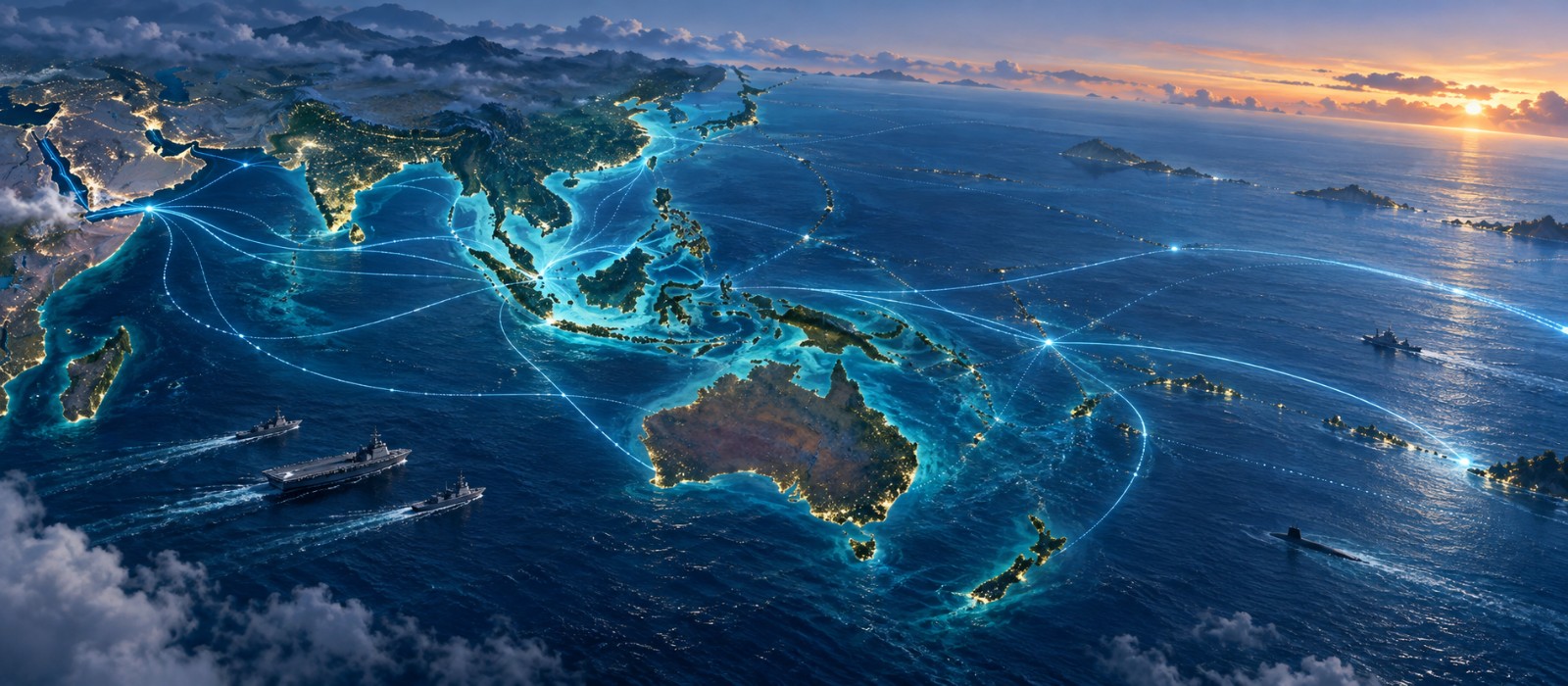
Background: History corroborates the close linkage between maritime power and the development of great nations. Even today, seas are a key enabler for the economic affluence of several countries. The IOR is home to several climacteric choke points such as Malacca, Hormuz, Bab-el-Mandeb, Sunda and Lombok straits, to name a few. International Sea Lanes (ISLs) and Sea Lanes of Communication (SLOCs) are critical for economic sustenance and military-maritime significance for countries in the Indo-Pacific. As is commonly known, around 80% of the world's maritime oil trade passes through the IOR.¹ In addition, 40% of global trade also passes through the region.² India’s geo-strategic position in the IOR is vital for India and for the freedom of the Indo-Pacific.³ As India moves forward, its development and prosperity will remain intertwined with the maritime domain.
Over the past decade, this region has grown into an economic and military hub and witnessed greater involvement from several maritime powers. The escalated turbulence in our areas of interest (AOI) and the extended neighbourhood is a major cause of concern for India’s security. With the increased involvement of our adversaries in the region, India should expect the deployment of adversarial navies in the IOR during any conflict. Consequently, the IN needs to counter threats from adversarial air, surface, subsurface and land-based platforms or a combination of any or all of them. The two more probable adversaries are Pakistan and China. For the purpose of this article, the focus is on China as the more formidable adversary.
Rise of China. The growth of Chinese maritime power is being studied meticulously the world over. China clearly laid out its ambitions to become a ‘world-class military’ at the 19th Congress of the People’s Liberation Army (PLA) in Oct 2017.⁴ As a result, recent years have seen many developmental milestones for the People’s Liberation Army - Navy (PLAN). It has bolstered its naval power in terms of ships, aircraft and submarines and its shore-based dimensions. This has helped to create composite sea power in terms of what the West calls A2AD (Anti-Access, Area Denial), which includes space and cyber domains. Apart from this, PLAN is making considerable progress on its own ‘places and bases,’ of which the commissioning of its military base at Djibouti in 2017 is a good illustration. There is also a shift of philosophy from offshore and regional defence to overseas maritime operations. In order to support its economic interests and trade with other countries, further its claims in the South China Sea, magnify its maritime operations overseas and most importantly, assert power in the region, the PLAN, has been expanding rapidly in particular, its surface fleet.
India has embarked on a voyage of enhancing its force structure and is transforming from a buyer’s navy to a builder’s navy, with increasingly higher indigenous content.⁵ It is beneficial, therefore, to undertake a comparative analysis of the quantity-quality relationship at the tactical level to appreciate the implications of future engagements in a conflict in the fundamental sense. This article explores the Hughes Salvo Model to focus on factors that present potential priorities in ship design and force planning to counter China in the surface domain, within the constraints of limited capital for military expenditure in order to tilt a possible conflict in our favour.
The Hughes Salvo Model
The Equations. The Hughes Salvo Model is a combat model that mathematically represents an outcome of simultaneous anti-missile salvo exchanges between naval forces. Wayne Hughes introduced this model in 1992 to depict the essence of a complicated surface battle in a simpler form.⁶ The model has its genesis in Lanchester’s equations that Hughes had explained in the first edition of his book, Fleet Tactics: Theory and Practice (Naval Institute Press, 1986), which were used to model gunnery engagements between two forces. The Hughes Salvo equations consider two forces; Red (A) and Blue (B) engaged in combat and predict the damage to the Red (A) forces by Blue (B) and vice versa depending on the characteristics of the forces involved.⁷ The equations are:
ΔB = (αA − b₃B) / b₁
ΔA = (βB − a₃A) / a₁
Where:
| Term | Meaning |
|---|---|
| A | Number of units in force A |
| B | Number of units in force B |
| α | Number of well-aimed missiles fired by each A unit |
| β | Number of well-aimed missiles fired by each B unit |
| a₁ | Number of hits by B needed to put one A out of action |
| b₁ | Number of hits by A needed to put one B out of action |
| a₃ | Number of well-aimed missiles destroyed by each A unit |
| b₃ | Number of well-aimed missiles destroyed by each B unit |
In other words, the equations state that in combat the number of units lost by the Red (A) force is equal to the product of the number of ships of the Blue (B) force and the number of well-aimed missiles each unit can fire, minus the product of the number of fired missiles destroyed by each unit of the Red force and the number of ships. The number of hits each ship of the Red Force can sustain before it is placed out of action divides the above.
Since its inception, the model has seen wide applications in other fields as well. It has been used to study the Battle of the Coral Sea (air battle).⁸ The First Battle of the Solomon Sea (torpedoes as the weapon of choice) during World War II explored close-in defence systems.⁹ It also strove for understanding the use of decoys against long-range bomber attacks.¹⁰ Studies on attacks on surface ships from shore-based missiles have also been undertaken.¹¹ Most recently, the sinking of the Russian Cruiser Moskva by the Ukrainian forces in the Black Sea in April 22 was analysed using the equations.¹² An overview of the analysis is presented below as an illustration of using the equations.
Moskva is assumed as Force A. Several open-source reports corroborate that the Ukrainians fired two Neptune anti-ship missiles. Values of various parameters in the equation are as follows:
ΔA = (βB − a₃A) / a₁

A = number of units in force A = 1
B = number of units in force B = 1
β = number of well-aimed missiles fired by each B unit
a₁ = number of hits by B needed to put A out of action
a₃ = number of well-aimed missiles destroyed by each A unit
It is assumed that the ship could neutralise an incoming salvo of six missiles with her suite of defensive countermeasure systems. Therefore, in order to sink the ship, the Ukrainian forces were required to fire 11 missiles as indicated below:
ΔA = (βB − a₃A) / a₁
ΔA = (11(1) − 6(1)) / 5 = 1
However, considering the fact that only two missiles were fired, the equations suggest that the Moskva had sufficient capability to withstand the attack by the missiles. Even if both missiles would have hit the ship, it had sufficient staying power to remain battle-worthy. Therefore, despite the fact that the ship was damaged it should not have sunk. This indicates an apparent lapse in training, alertness and crisis management onboard the Moskva compounded with ignorance of the developing situation. While the reader, without any knowledge of the equations could also have concluded this, the equations provide means to quantify these terms and their relationship to various ship attributes which are paramount in an engagement.
Enhancement in Equations
The basic equations are conditioned on simple but critical assumptions. Some assumptions considered are that the crew is well trained and motivated, the equipment onboard the ship is working optimally and the ship detects an incoming salvo with full accuracy. However, as seen in the case of the Moskva, these assumptions might not always hold. Such uncertainties, ubiquitous in combat are encapsulated with the help of improved equations elucidated below.¹³
Expanded Equations. Key terms introduced are as follows:¹⁴
-
Scouting Effectiveness. Scouting effectiveness describes the measure of acquiring effective targeting information about the opposing force and accurate delivery of ordnance on target. Scouting effectiveness is denoted by σA or σB and takes a value between 0 and 1, with 1 indicating accurate targeting and distribution of fire.
-
Defender Alertness. It describes the ability of a force to effectively identify, track, designate and formulate a fire control solution to destroy an incoming salvo. It is denoted by δA or δB and takes values between 0 and 1, with 1 indicating complete alertness.
-
Training. Lack of training and motivation can enable a weaker force to inflict sufficient damage on a stronger force, especially in case of a long-drawn conflict as was seen in the example of Moskva. This factor describes the level of training, motivation of the crew and organisational robustness to proficiently carry out designated tasks. It is represented by τA or τB and takes values between 0 and 1.
-
Soft Kill Measures. The use of soft kill measures and decoys to lure an incoming attack away from the target is well established. The equations also cater for use of chaff in seduction (denoted by a₄ or b₄) and distraction (denoted by ρA or ρB) modes for calculating the number of ships lost. These factors can take values of torpedo decoys or flares in case of an anti-submarine or anti-air scenario.
Thus, the equations now become:¹⁵
ΔB = ((α′A − b₃′B)b₄) / b₁
ΔA = ((β′B − a₃′A)a₄) / a₁

α′ = σAτAρBα
β′ = σBτBρAβ

b₃′ = δBτBb₃
a₃′ = δAτAa₃
Here, α′ denotes the hits accrued by A, degraded for its scouting and training deficiencies and use of distraction chaff by B. Similarly, β′ = σBτBρAβ. b₃′ represents the ability of B to successfully defend incoming missiles, degraded for defender alertness and training deficiencies. Similarly, a₃′ = δAτAa₃.
Implications of the Equations
Having provided an overview of the equations, one can now discuss some inferences and their implications in naval warfare.
Numerical Superiority
The bottom line of the equations is that numerical superiority has the greatest influence on the outcome of an engagement, especially during a larger campaign or longer conflict which may consist of several engagements. A term called Fractional Exchange Ratio (FER) further elaborates this. FER compares the relative effectiveness of the two sides involved and is expressed as:¹⁶
FER = (ΔB/B) / (ΔA/A)
    = ((αA − b₃B)(a₁A)) / ((βB − a₃A)(b₁B))
When FER > 1, B will lose more forces than A and when FER < 1, B will have more forces remaining at the end of the battle. The higher the numbers, the greater the probability of winning. A simple example below illustrates this. In both situations, we assume that the forces have equal scouting effectiveness, training and level of alertness.
Situation A. In this situation, we consider two forces with one ship each and with equal capabilities.
| Parameters | Red Force | Blue Force |
|---|---|---|
| No of ships | A = 1 | B = 1 |
| No of missiles fired by each ship | α = 4 | β = 4 |
| No of hits needed to be put out of action | a₁ = 3 | b₁ = 3 |
| No of missiles intercepted by each ship | a₃ = 2 | b₃ = 2 |
Using the formula for FER expressed above, we see that the FER = 1, i.e. there is parity.
Situation B. In this situation, we consider the Blue Force with two ships, however with lesser capability than the one in situation A (say a destroyer compared to a frigate), but the capability of Red Force remains the same.
| Parameters | Red Force | Blue Force |
|---|---|---|
| No of ships | A = 1 | B = 2 |
| No of missiles fired by each ship | α = 4 | β = 2 |
| No of hits needed to be put out of action | a₁ = 3 | b₁ = 2 |
| No of missiles intercepted by each ship | a₃ = 2 | b₃ = 1 |
FER = ((4(1) − 1(2)) × (3(1))) / ((2(2) − 2(1)) × (2(2))) = 0.75The FER < 1 implies that the Blue Force will have one ship remaining at the end of the engagement. As is evident from the example above, though the Blue force has lesser capability than the Red force, it was able to tilt the outcome in its favour due to its numerical advantage.
Offensive and Defensive Power
Offensive Power. The number of accurate strikes that a force can undertake describes its offensive power.¹⁷ It is equal to the number of shots fired times the accuracy with which they are fired. The number of units in the force and the amount of ammunition that can be brought to bear are vital in determining offensive power. Consequently, the higher the number of units and higher the weapon load, the greater the offensive power, provided the weapons are fired with reasonable accuracy. To illustrate this, let us consider the following example of an engagement:
| Parameters | Red Force | Blue Force |
|---|---|---|
| No. of ships | A = 4 | B = 4 |
| No. of missiles fired by each ship | α = 12 | β = 8 |
| No. of hits needed to be put out of action | a₁ = 3 | b₁ = 3 |
| No. of missiles intercepted by each ship | a₃ = 2 | b₃ = 2 |
FER = ((12(4) − 2(4)) × (3(4))) / ((8(4) − 2(4)) × (3(4))) = 1.66The FER is > 1, i.e. Red force has an advantage in this engagement only due to a higher offensive power.
Defensive Power. Defensive power is described as the ability of a force to intercept attacks made by the other force through a combination of defensive actions.¹⁸ Thus, the higher the number of units in the force and the greater the hard kill and soft kill measures to repel the attack available, the higher the defensive power. The following example, from the undersea domain, where a torpedo is the primary weapon illustrates this. We consider a scenario, where the Red Force consists of a submarine and the Blue Force consists of a surface ship with anti-submarine warfare (ASW) capability. The assumptions are as follows:
A = number of units in force A = 1
B = number of units in force B = 1
α = number of well-aimed torpedoes fired by each B unit
b₁ = number of hits by A needed to put B out of action = 1
b₃ = it is assumed that the ship could neutralise one torpedo with its
     torpedo countermeasures and a suite of anti-torpedo defensive systems.
The equations then become:
ΔB = (αA − b₃B) / b₁
ΔB = (2(1) − 1(1)) / 1 = 1
From this simple example we can see that the ship will be safe until it restricts the submarine from undertaking an attack with more than one torpedo. In order to sustain an attack with a higher number of weapons, it will have to improve its defensive capability and/or improve its staying power equivalently.
Lethality. The advent of technology and modernisation of systems including those for intelligence, surveillance and reconnaissance (ISR), hard kill and soft kill has enabled forces to exert considerable damage to the other force with a single salvo of weapons and obliterate incoming threats, i.e., ships have become more lethal in attack and better at defence. In the case of force-on-force combat, lethality expresses the difference between the ratio of our offensive power and the adversary’s defensive power and the ratio of an adversary’s offensive power and our own force’s defensive power.¹⁹ Greater the difference between the two ratios, more lethal is the force. As is the case with offensive and defensive power, lethality too depends on the relative strength of the two forces; i.e., ratio of number of units in force B to that in force A.
Scouting Effectiveness
Scouting is to gain accurate information about the presence, position and movement of adversary forces in the Area of Operations (AOO) so that precise targeting and distribution of fire can be undertaken. Although terms like Maritime Domain Awareness (MDA) and ISR are more commonly used now, the term Scouting (just like Search or Patrol) is important at the tactical level. It is an ongoing process carried out prior to weapon release and as described above, directly affects the offensive power of forces. While information about the scouting capabilities of our own force is available, information about the adversary’s capabilities that influences our defensive power is more vital. The inherent fog of war, compounded by the adversary’s ISR capabilities, deception and tactics, and other similar factors that degrade our Observe-Orient-Decide-Act (OODA) loop could lead to surprise attacks that prove detrimental in battle.
PLA’s ISR Capabilities
Space-Based Surveillance. Over the past ten years, China’s ISR capabilities have seen a significant rise, particularly with the fusion of space-based surveillance (SBS). In 2015, the official release of China’s Military Strategy directed the PLA to research and give priority to strategies to win ‘informatised local wars.’²⁰ PLA describes ‘informatised warfare’ as conducting joint military operations across land, sea, air, space, and cyberspace domains including the electromagnetic spectrum through acquiring, transmitting, processing, and using information during conflict and has devoted considerable economic and military resources to fructify the concept.²¹
China employs a robust space-based ISR capability designed to enhance its situational awareness. Its ISR satellites used for maritime surveillance and reconnaissance, are capable of providing electro-optical and synthetic aperture radar (SAR) imagery as well as electronic and signals intelligence data.²² As of January 2022, China had more than 250 ISR satellites in space, a number second only to the United States, and nearly doubling since 2018.²³ Recent improvements in China’s SBS capabilities indicate the development, procurement, and use of increasingly capable satellites for all weather and 24-hour coverage.²⁴ Therefore, there has been a significant improvement in PLA’s capabilities to search, detect, and track, making our fleets susceptible to long-range strikes. Electronic reconnaissance satellites that monitor radar and radio transmissions further augment these capabilities.
Information Operations. PLA considers information operations as a means of achieving information dominance early in the conflict. They aim at seizing the initiative and establishing conditions necessary to gain air and sea superiority.²⁵ China has continued to focus on developing its command, control, communications, computers, intelligence, surveillance, and reconnaissance (C⁴ISR) capabilities enabling rapid information sharing, processing, and decision-making for joint operations across the spectrum of conflict. In order to streamline the decision-making process, PLA is adept at making near-real-time ISR data available to field commanders. China has also developed the Integrated Command Platform (ICP) to facilitate communications between forces at various levels thereby enabling them to adapt their actions to shifting conditions in the battlespace.²⁶
In addition, China continues to bolster its electronic warfare and cyberspace capabilities to achieve complete information superiority in the battle space. Further, it has amalgamated the use of these modern techniques with traditional forms of information warfare such as false propaganda, misinformation, etc., to establish complete information dominance and constrain an adversary’s actions.
Effect of Scouting Superiority. With this overview of the PLA ISR capabilities mentioned in the preceding paragraphs, thereby equipping them with accurate targeting information about our force, it will be prudent to assume a high factor of scouting effectiveness for the PLAN. As can be seen from the equation below, in order to reduce the effect of superior scouting and consequent attacks, we need to increase the numbers of our forces or make the denominator large, i.e. increase our staying power through efficient ship design.
ΔB = ((α′A − b₃′B)b₄) / b₁Alternatively, further breakdown of the equations tells us that if we are to successfully engage a force, which has the advantage of numbers like the PLAN, we need to reduce its scouting effectiveness. Exploratory analysis was undertaken to deduce the relationship between scouting effectiveness and numerical superiority revealing that, in order to achieve parity with a numerically superior force we need to degrade its scouting effectiveness by a factor equal to the inverse square of the force’s numerical superiority.²⁷ To illustrate this, we assume two forces A and B, with similar characteristics; thus, the offensive, defensive and staying power are equal. We also assume equal defender alertness, training etc. for the forces. The following differentiates the forces:²⁸
- Force A has a numerical force advantage over force B by a factor ‘λ’, or A = λB where λ > 1.
- Force B has the capability to degrade force A’s scouting ability in relation to its own through superior sensors and counter-targeting, such that σB > σA.
In order to maintain parity, we have:
FER = (ΔB/B) / (ΔA/A) = 1To determine the targeting superiority required by force B to establish parity due to the numerical advantage of force A, we replace A with the parameter λB. As the characteristics of both forces are similar, we can further solve the equations to get:
σB λ² = σA

or

σB / σA = 1 / λ²
The figure below depicts this relationship. Effective tactics and command and control are the primary means of degrading the adversary’s scouting efficiency and denying vital information, which could be used to target own forces. Some of the other measures include the employment of electronic warfare to disrupt and deceive the adversary’s systems, electronic emission control measures, presenting a low radar cross-section, management of acoustic and magnetic signatures onboard, etc.
Fig 1: Degradation in Scouting Effectiveness. The chart plots “Degradation in Scouting Effectiveness Required wrt Numerical Advantage of Opposing Force.” As the numerical advantage rises from one to ten, required scouting effectiveness falls along an inverse-square curve from 1.0 toward zero.
Staying Power
Staying power is a quantifiable measure of the number of hits a ship can sustain before it is rendered out of action. Out of action signifies that the ship will no longer be able to continue its mission and take further part in the conflict anytime soon. It is important to note that, staying power is distinctively independent of all other factors such as offensive power, scouting, training and defensive power. As indicated in the equation below, it is in the denominator that acts as a reducing factor between the differences in the combat powers of the attacking and defending forces, thereby minimising our loss.
ΔB = ((α′A − b₃′B)b₄) / b₁Staying power connotes the fighting strength of the force, which is a direct measure of ship design. As India proceeds towards its goal of becoming a ‘designer’s Navy’ through self-reliance and indigenisation, making ship structures robust enough to resist attacks by the adversary in all domains of warfare needs specific focus. While we concentrate on increasing the offensive and defensive capabilities of the ship by a heterogeneous weapon fit and increasing weapon carrying capacity, the ability of a ship to withstand damage also needs impetus. Further, increasing staying power through improvements in ship design will also help us stand in good stead while facing threats from underwater weapons such as mines and torpedoes, detection and countermeasures which are less distinct due to myriad phenomena associated with detection underwater. To demonstrate the importance of staying power let us consider the following example:
| Parameters | Red Force | Blue Force |
|---|---|---|
| No of ships | A = 2 | B = 2 |
| No of missiles fired by each ship | α = 8 | β = 8 |
| No of hits needed to be put out of action | a₁ = 2 | b₁ = 3 |
| No of missiles intercepted by each ship | a₃ = 2 | b₃ = 2 |
| Scouting effectiveness | σA = 1 | σB = 0.9 |
| Training | τA = 0.8 | τB = 0.7 |
| Defender alertness | δA = 1 | δB = 0.9 |
We assume that the capability of employing soft-kill measures is similar of both sides. We now have:
FER = (((1 × 0.8 × 8 × 2) − (1 × 0.7 × 2 × 2)) × (2(2)))
      / (((0.9 × 0.7 × 8 × 2) − (1 × 0.8 × 2 × 2)) × (3(2))) < 1
From the example, we can see that even though the Blue Force was deficient in training, alertness and scouting, it was able to emerge victorious due to higher staying power. It is worth noting that in the example, staying power was able to compensate for weakness in other factors however, the converse will not hold.
Training
Proficient training, professional competence and organisational efficacy form the core of any armed force. Advancement in technology has provided us with more automated systems with minimal manual intervention. Nevertheless, the man behind the machine remains the most important cog in the wheel in the process of delivering ordnance on the desired target with precision. In our calculations, we usually assume flawless exploitation and textbook adherence to laid-down procedures for operating a particular system. However, the system is seldom exploited to its full potential due to human factors involved. While, the importance of training is well articulated and procedures for providing adequate training are in place, Hughes Salvo equations provide us with means of gauging the losses that could ensue due to training deficiencies. Let us revisit the example of the Moskva for understanding the application better. We know the following:
A = number of units in force A = 1
B = number of units in force B = 1
β = number of well-aimed missiles fired by each B unit = 2
a₁ = number of hits by B needed to put A out of action = 5
a₃ = it was assumed that the ship could neutralise an incoming salvo of
     six missiles with her suite of defensive countermeasure systems.
Considering the enhanced equations, we have:
ΔA = ((β′B − a₃′A)a₄) / a₁
ΔA = ((σBτBρAβB − δAτAa₃A)a₄) / a₁
As the Ukrainian forces were able to hit the target successfully, we will assume their factors of scouting and training to be 1 and due to lack of additional information, we will also assume that chaff was not used by the Russians. Thus, the equations then become:
ΔA = (βB − δAτAa₃A) / a₁Considering the highlighted portion of the equation, we see that the fighting efficiency of Moskva was severely diminished due to deficiencies in training and alertness of their crew which enabled the missiles to successfully hit their target. The contribution of each factor can only be determined once the exact sequence of events is known. However, both defender alertness and training played a pivotal role in the inability of the ship to defend itself from the impending attack, even though it had more than enough resources available to do so. Further, the fact that it sank in spite of having a high staying power, demonstrates an apparent failure of the damage control and fire-fighting organisation onboard the ship. It also indicates a lack of motivation amongst the crew and an insipid organisation to contend with an emergency onboard.
Conclusions
Having described the Hughes Salvo Equations in detail and their implications in force-on-force combat, insights gained from analysis of the equations are summarised below.
Key - Takeaways. Following merit attention:
-
Numerical Superiority. Numerical superiority is the dominant force attribute in almost all situations. The equations show that if one force is twice as numerous, keeping other factors such as scouting effectiveness, training, etc. constant for both sides, the other force needs to have twice the offensive power, defensive power as well as staying power to achieve parity.³² This is demonstrated by the following example:
Parameters Red Force Blue Force No of ships A = 4 B = ? No of missiles fired by each ship α = 8 β = 4 No of hits needed to be put out of action a₁ = 2 b₁ = 1 No of missiles intercepted by each ship a₃ = 4 b₃ = 2 Solving the equations further, we get B = 8 which implies that since force A had twice the offensive, defensive and staying power, B needs to have twice the numerical strength to achieve parity. The fact that present-day weapon-fit on either side will not allow for such a superior advantage compared to the other force, the advantage of numbers will most probably be the overriding factor.
-
Lethality. A combination of at-sea assets and varieties of shore-based and air-launched missile delivery systems with extended reach enables China to have a high difference in the ratio of their offensive power and the opposing forces’ defensive power and the opposing forces’ offensive power and their defensive power. This difference induces instability in the equations and forms a key factor of China’s A2AD bubble in the South China Sea. Therefore, a force with high lethality is desirable for a favourable outcome and force structuring should move in this direction. The number of units in the force has a direct bearing on its offensive and defensive capability.
-
Soft Kill Measures. The applicability of a range of soft kill measures in modern warfare has been under deliberation for some time. The example of the Moskva helps us to interpret the difference in the overall outcome that can be made by the use of soft kill measures. Therefore, there is a need to accord continued impetus to refining our tactics and doctrines for the employment of soft kill measures.
-
Scouting Effectiveness. A capability to gain accurate information about an adversary’s forces and movements is paramount prior to the conflict. In present-day combat, which is generally fought with weapons that can be fired from beyond visual range, the accuracy of targeting information defines a hit or a miss. It may be better known at some point in future, the difference in the outcome that would have ensued, if the Moskva had put together a prudent tactical picture using its own ‘scouting’ and inputs provided by the Russian Navy and joint ISR assets to warn of impending attacks, if any. Though India is making strides in the field of space-based surveillance and monitoring, the pace of activities needs further increase. Likewise, there may be a need to better comprehend PLA’s space and cyber ISR across IOR.
-
Countering PLA Capabilities. Considering the growing persistence of Chinese ISR capabilities, the equations demonstrate the effect of increasing numbers of our forces to strain the resources of an adversary. The increasing rate at which platforms are inducted into the Navy is a factor laden with many intangible elements beyond our control. Therefore, an appropriate alternative is to degrade the adversary’s scouting ability. Deception, intelligent use of electromagnetic spectrum, information warfare, enhanced stealth of our platforms through low radar cross section and, acoustic and magnetic signature control, reduced wake are all measures that may be employed to disrupt the adversary’s OODA loop. The development of doctrines and tactics complemented by effective command and control, along these lines is necessary to engage a numerically superior adversary. Moreover, refining tactics is more cost-effective than building more ships. Hence, it is recommended that additional effort and research, followed by at sea experimentation, be pursued to validate our tactics in degrading PLA’s ISR capabilities. As mentioned earlier, in order to achieve parity with a numerically superior force we need to degrade its scouting effectiveness by a factor equal to the inverse square of the force’s numerical superiority.
-
Staying Power. The value of staying power in the survivability of a force cannot be overstated. Ship design is the primary contributor to the staying power of a unit and is independent of all other capricious factors in warfare such as tactics, scouting, etc. Higher staying power has the capability to compensate for a low defensive power or scouting and training fallibilities. Developing, staying power though, is a combination of detailed engineering and design. Unlike in the past, where a designer might know how to improve the design of a warship, but may not know the effect it will have in an engagement, the equations enable the designer to quantify the gain of improved staying power in keeping a ship battle-worthy. Therefore, a multipronged approach through research, experimentation and active cohesion between the shipyards and relevant stakeholders in the Navy is required to make our designs sound and our hulls more resistant to damage. Efficient damage control and fire-fighting organisation through the training of personnel also need to complement the improved designs to accrue the envisaged gains.
-
Training. The equations aid in quantifying the significance of skilful employment of weapons and sensors for offensive and defensive actions as well as efficacious management of emergent situations in combat. It reemphasises the importance of persistent efforts in increasing the level of training of personnel, maintaining high motivation and an effectual organisation at all times.
Cost Considerations
An unstable geo-political and economic environment has capped our available capital for military expenditure. We need to contend with the requirement of multiple tasking of our forces and missions in combat to achieve our objectives under the constraints of limited capital to acquire naval platforms. Mahan captured the problem well as his observation shows:
A country can, or will, pay only so much for its war fleet. That amount of money means so much aggregate tonnage. How shall the tonnage be allotted?....... Will you have very few big ships or numerous medium ships? Where will you strike your mean between numbers and individual size? You cannot have both unless your purse is unlimited.
- Alfred Thayer Mahan33
Therefore, considering the present adversarial threat in IOR, there is a need to review the future force structure of IN to optimise the available resources. Through simple examples of the applicability of Hughes Salvo equations (the scope can be increased to model an engagement with several ships and stochastic parameters) this article examines warship attributes that are of primary importance in conflict. The equations suggest that numerical superiority is the pivotal factor in force-on-force engagements.
Historical data seems to suggest that even though larger platforms have greater offensive, defensive and staying power, they take longer to build and have higher life-cycle costs. The example highlighting numerical superiority given previously illustrates that two smaller platforms with lesser capability will provide a much better global return than a single power-packed platform. Additionally, they also offer the advantages of increased stealth with a lower radar cross-section and acoustic and magnetic signatures, which will lead to an increased scouting effort by the adversary. Although larger platforms are essential to the sea power calculus of any Navy, the recommended way ahead to circumnavigate present constraints of budget and shipbuilding timelines and to grow into a modern cutting-edge force is to invest greater in the option of “numerous medium ships” given by A.T. Mahan.
To conclude, the recommended way ahead to counter an assertive China in the Indian Ocean Region is to build numerous smaller platforms than a few larger platforms. While we focus on lethality, the distinction of staying power mandates concerted efforts to enhance that attribute of our platforms. Moreover, the impetus on improving our tactics and strategies, ISR capability and maintaining a high level of training and motivation is a step in the right direction.
Endnotes
-
C Jeffery, “The Indian Ocean Region may soon Play a Led Role in World Affairs,” The Wire. https://thewire.in/world/the-indian-ocean-region-may-soon-play-a-lead-role-in-world-affairs, accessed 14 February 2023.
-
“Indian Ocean Is A High Focus Region in Global Trade: Experts,” The Hindu. https://www.thehindu.com/news/cities/puducherry/indian-ocean-is-a-high-focus-region-in-global-trade-experts/article26368144, accessed 14 February 2023.
-
Ministry of Shipping, Government of India, Annual Report, 2021-22. https://shipmin.gov.in/sites/default/files/AnnualReport2021.pdf, accessed 07 February 2023.
-
M. Taylor Fravel, “China’s World-Class Military Ambitions: Origins and Implications,” The Washington Quarterly vol. 43, no. 1 (2020), 85-99. DOI: 10.1080/0163660X.2020.1735850M, accessed 26 February 2023.
-
Ministry of Defence (Navy), Integrated Headquarters, “Ensuring Secure Seas: Indian Maritime Security Strategy,” (New Delhi: IHQ (MoD), 2015), 130.
-
WP Hughes, Fleet Tactics and Coastal Combat (Annapolis: Naval Institute Press, 2000).
-
WP Hughes, “A Salvo Model of Warships in Missile Combat Used to Evaluate Their Staying Power,” Naval Research Logistics vol. 42, no. 2, 1995.
-
MJ Armstrong and MB Powell, “A Salvo Combat Analysis of the Battle of the Coral Sea,” Military Operations Research vol. 10, no. 4 (2005), 27-38.
-
J Cares, “The Fundamentals of Salvo Warfare,” Master’s Thesis (California: Naval Postgraduate School, March 1990).
-
R Snell, “Countertargeting in Naval Salvo Warfare,” Master’s Thesis (California: Naval Postgraduate School, March 1991).
-
CM Mahon, “A Littoral Combat Model for Land-Sea Missile Engagements,” Master’s Thesis (California: Naval Postgraduate School, September 2007).
-
A Cowden, “Neptune’s, the MOSKVA, and How Not to Sink a Cruiser,” Real Clear Defense, April 22. https://www.realcleardefense.com/articles/2022/04/19/neptunes_the_moskva_and_how_not_to_sink_a_cruiser_827840, accessed 12 February 2023.
-
Hughes, Op Cit., n.7.
-
Hughes, Op Cit., n.7.
-
Hughes, Op Cit., n.7.
-
Hughes, Op Cit., n.7.
-
Hughes, Op Cit., n.7.
-
Hughes, Op Cit., n.7.
-
MJ Armstrong, “Effects of Lethality in Naval Combat Models,” Naval Research Logistics vol. 51, no. 1 (2004).
-
“The State Council Information Office of the People’s Republic of China,” China’s Military Strategy, 26 May 2015. https://www.chinadaily.com.cn/china/2015-05/26/content_20820628.htm, accessed 12 February 2023.
-
Harvey Brian, China in Space: The Great Leap Forward (New York: Springer, 2013).
-
“Satellite Database,” Union of Concerned Scientists (UCS), 01 January 2022. https://www.ucsusa.org/nuclear-weapons/space-weapons/satellite-database, accessed 14 February 2023.
-
“Challenges to Security in Space,” Defense Intelligence Agency Report, 2022. https://www.dia.mil/Military-Power-Publications, accessed 12 January 2023.
-
Ibid.
-
Anthony H. Cordesman, Arleigh A. Burke and Max Molot, “Advanced Modernization and Preparation for War: China and the U.S.,” Center for Strategic and International Studies (CSIS). 2019. https://www.jstor.com/stable/resrep22586.45, accessed 31 January 2023.
-
Ibid.
-
Kline Jeffery, “Exploring Effects of Counter-Targeting in Naval Warfare,” Technical Report, (California: Naval Postgraduate School, 14 April 2021).
-
Ibid.
-
Jeffery, Op Cit., n.27.
-
Hughes, Op Cit., n.6.
-
IHQ (MoD) Navy, Op Cit., n.5, 130.
-
Hughes, Op Cit., n.6.
-
AT Mahan, Lessons of the War with Spain: and Other Articles (Boston Little, Brown and Company, 1899), 37.