




Editor’s Note. This research paper was specially written by the author for INDES. He presented a much abridged version during the 2021 Dilli Seapower Conference hosted annually by the Indian Naval Academy. His extensive research into Indian history has enabled Dr Kainikara to publish eight volumes of an ongoing series titled From Indus to Independence: A Trek Through History.
The earliest references to the Chola dynasty that ruled a Tamil empire in South India are the inscriptions from 3rd Century BC, left behind by Asoka, the Mauryan Emperor, in his Rock Edict Number 13, located near Delhi. In ancient times, the Cholas were one of the three ‘crowned’ kings of Tamilakam, along with the Cheras and the Pandyas. Tamilakam refers to the geographical region inhabited by the ancient Tamil people and encompasses today’s Tamil Nadu, Kerala, Puducherry, Lakshadweep, South Andhra and South-Eastern Karnataka. A little-known fact is that the Cholas are one of the longest serving dynasties in world history, governing varying territorial holdings from around 4th century BC till the end of 13th Century AD - a span of nearly 1800 years.
Despite this unusually long reign, the core Chola Empire is considered to have existed sometime in early 9th Century AD and to have lasted for three centuries till early 12th Century. This period is also considered the golden age of the Cholas; and hence the title of this paper encompasses the ‘Imperial Cholas.’ During this period (approximately 850-1250 AD) the Chola dynasty united and reigned over the entire territory South of the river Tungabhadra for slightly more than three centuries.1
Many historians classify the Chola Empire as having been a thalassocracy -‘thalasso’ meaning ‘of or pertaining to the sea’- and therefore, a fully maritime or seaborne empire. Traditionally, it is understood that such empires do not dominate the interiors, even in home territories. By this measure, the Cholas cannot be classified as a thalassocracy, since the entire peninsula South of the river Tungabhadra, from coast to coast, was held by the dynasty. They definitely had overarching maritime interests, but were equally in control of the hinterland. An empire with substantial maritime interests, at the height of their power the Cholas were the predominant military, economic and cultural power in South and South East Asia.2
Brief Introductory History
It is commonly agreed that ‘Chola,’ much like Chera and Pandya, was the name of the ruling clan from antiquity. The mention of Chola kings in early Sangam literature indicates that the dynasty antedates 1st Century BC, confirmed by the Asoka edict already mentioned about the Cholas as the ruling dynasty in South India.3 In these edicts, inscribed between 275-230 BC, the Chola kingdom is mentioned, not as a vassal state, but as an independent kingdom on friendly terms with the Maurya Empire. However, the narrative regarding Chola history till about 7th Century AD is somewhat broken with several gaps. Nonetheless, from then onwards, evidence and details of Chola rule are available without a break. In the past century, even the gaps before 7th Century AD are gradually being filled by research being carried out into Tamil literature and religious texts, as well as from temple and copper plate inscriptions.
Mahavamsa, a Buddhist text written in the 5th Century AD recounts many conflicts between the inhabitants of the island of Sri Lanka and the Cholas in the 1st and 2nd Century AD.4 Also, the Chola prince Ellalan is reported to have conquered Sri Lanka around 230-225 BC.5
Chola history is normally divided into four distinct periods-the early Cholas of the Sangam period; interim period of relative obscurity; the imperial (or medieval) Cholas; and the later Cholas. Sangam literature, which spans the timeframe from late 1st Century BC to early 4th Century AD, contains the first authentic mention of the Cholas.6 It mentions two prominent Chola kings, Karikala Chola and Kochchenganan Chola.7 From the end of the Sangam period around 300 AD, there is only very limited confirmed information available regarding the Cholas for the next three centuries. From an inscription in Thanjavur it seems that a much-diminished Chola kingdom, centred around Tiruchirapally-Pudukottai, was ruled by the Mutharaiyar dynasty.8 It is possible that the power of the Cholas had waned in the interim, while the Pallavas and the Pandyas were on the rise to the North and South of the Cholas.
Around 850 AD, Chola stars began to rise again. Vijayalaya Chola (848-871 AD), who is considered the founder of the Imperial Chola Dynasty, captured Thanjavur from the ruling Mutharaiyar and established firm Chola control over the surrounding region.9 Succeeding kings, like Aditya I (871-907 AD) wiped out the Pallavas to the North and conclusively defeated the Pandyas at Madurai in 885 AD. His son Parantaka I (907-955 AD) who had a long and distinguished reign, was victorious in all his battles, with a kingdom that encompassed the entire Tamil country. He also defeated the Sri Lankan king, although it is unlikely that he established Chola rule over the island. Parantaka's major achievement was that he defeated the Rashtrakuta dynasty under Krishna II in the Battle of Vallala.10 He was followed by five inconsequential kings over the next thirty years. The Cholas were fortunate that their main rivals had already been defeated before the combined reign of these weak kings, but this would change.
Towards Apogee: The Great Cholas
The two greatest father and son rulers of the Imperial Cholas, took Chola dominance to its zenith, building a powerbase so strong that the dynasty would continue for another three centuries and more. The first was Rajaraja Chola I (985-1014 AD), followed by his son Rajendra Chola I (1014-1044 AD) and this was achieved in a span of little over 50 years.
At the end of his reign, Rajaraja Chola’s empire encompassed the island of Sri Lanka in the South and the basin of the Godavari and Krishna rivers in the North; covered the entire Konkan coast up to Bhatkal; the Malabar coast; the islands of Lakshadweep and the Maldives. The capture of these islands indicates the existence of an efficient navy in the military line-up of the Cholas. His son, Rajendra Chola conquered Odisha, defeated the Pala dynasty of Bengal and marched victoriously to the river Ganga in North India.11 Rajendra also completed the conquest of Sri Lanka initiated by his father, taking the King Mahinda V prisoner. The kingdoms along the entire East coast of Peninsular India, from the southern tip to the mouth of the river Ganga in Bengal, acknowledged Chola suzerainty.12
However, his greatest achievement was the naval expedition to the Srivijaya Empire of South-East Asia, which was a resounding success. This expedition left a very great imprint on the South East Asian region in medieval times. Its influence reverberated down the ages to modern times. A contemporary Malay chronicle, Sejarah Melayu, mentions the expedition and names Rajendra Chola as the victor.13 (The development of Chola naval capabilities and their expeditions are evaluated later in this paper.) Rajendra also sent two diplomatic missions to China in 1016 and 1033.14
Even though the Western Chalukya rulers continually struggled to avoid Chola domination, they suffered regular defeats, keeping the region of Western Deccan under imperial Chola control.15 Of note however, is that the Cholas continued to have continental rivalries and concerns while becoming a maritime, expeditionary power. (Since this is only an introductory history of the Chola dynasty, meant as a background to the main narrative, greater details of their continental wars are not being provided.) Further, from late 1100s they had started to lose territory to other rising and more belligerent dynasties. In a nutshell, up to around 1280 AD, the Chola kings continued to be strong enough to hold their own, although expansionist strategies had been dropped much earlier. Their decline paralleled the resurgent rise of the Pandya dynasty, which went on to become the most powerful kingdom in South India.
The fall in status, power and influence of the Cholas was accelerated by the equally noticeable growth in the power of the Hoysalas, who played a divisive role in Tamil politics. Even though Rajendra Chola III (1246-1279) attempted to revive the dynasty’s fortunes, the rot had already eaten into the inner core of the dynasty. Rejuvenation was impossible. The last recorded entry of the Cholas is dated 1279 and there is no mention of another Chola prince following this Rajendra to the throne.16 The great Chola Empire had ceased to exist.
The Rise and Decline of the Imperial Chola Navy
The Broader Indian Context
Mesopotamian inscriptions indicate that by 2300 BC, Indian traders carrying copper, hardwood, ivory, pearls and gold were active in the region during the reign of Sargon of Akkad.17 There are suggestions that Indians plied their trade around the River Indus mouth even earlier. Excavations confirm that the world’s first dock was built in Lothal around 2400 BC by the Harappans who obviously had great and in-depth knowledge of tides, hydrography and marine engineering.18
The first direct mention of a naval force is found in the epic Mahabharata. The first organised Navy belonged to Chandragupta Maurya (322-299 BC). The Maurya dynasty had a standing Navy till at least 32 BC at the end of Asoka’s rule.19 There was increased activity in the Indian Ocean during the reign of Asoka, who sent diplomatic missions to Greece, Syria, Egypt and Macedonia. By the beginning of the 1st Century AD, Indian maritime navigational charts were in regular use. The Greco-Roman Periplus Maris Erythraei (Periplus of the Erythraean Sea) was written between 52-62 AD).20 It documents ports, coastal landmarks and distances for the use of seamen sailing the regular sea routes between India and Egypt.21 However, when the sources of gold in Central Asia declined and also became more dangerous to obtain, Indian interests started to shift towards the Malay Peninsula and South East Asia and that’s where the Cholas come in.
The Chola Beginnings
The earliest specific reference to the Chola Navy is found in a 1st Century AD Roman report of Kaveripoompattinam/‘Haverpoum’ (now Poompuhar).22 The Periplus also describes great ships called ‘Colandia’ sailing to the Pacific islands from three ports in Tamilakam (mentioned as ‘Damirica’) centred on Kaveripattanam.23 Colandia is a transliteration of the Chinese term ‘Kun-lun-po’, and is normally referred to in Tamil as Kolandiaphonta. These were warships that embarked soldiers. Its weaponry included a rudimentary flame thrower and a catapult.24
In their period of relative decline and obscurity, information on the Chola maritime tradition is quite shadowy. With the Cholas themselves reduced to possible vassalage status, there is not even a corroborated line of successive kings available. However, it is also possible that the Cholas maintained a small, but potent Navy in the inshore areas of the Kaveri delta and used it to dominate coastal and upriver trade with Masuri being mentioned as an inland port. This speculation is built on the fact that there is evidence of a dry-dock that they built inland, which has been excavated fully.25 From a seafaring Navy with large armed vessels, the Chola Navy had become a riverine fleet of small vessels.
The establishment of Thanjavur as the capital by the first of the imperial Cholas, Vijayalaya Chola, taking advantage of the Pallava-Pandya war, rejuvenated his power. He also began building a credible navy. His successor Aditya I defeated the Pandya invasion and by around 900 CE had conquered the Pallava kingdom. His son, Parantaka I had a long and successful reign. By 910 AD, he had captured the Pandyan capital, Madura: and had overthrown the ruling Pandyan king. More important to this narrative, Parantaka made a conscious effort to enlarge and strengthen the Navy. Having stabilised the kingdom, he mounted the first significant naval expeditionary campaign. This was a punitive expedition to Sri Lanka, annexing some parts of the north of the island, before returning.26
The Glorious Epoch
The four centuries after Vijayalaya assumed the throne in 848 AD could be considered the golden period of Chola maritime activity. Not surprisingly, this coincides with the reign of the imperial Cholas. This well documented period with its surviving edicts and other inscriptions, local narratives of events as well as foreign reports and records shows the blossoming of the Chola Empire from a small land-locked principality to becoming the most powerful and dominant empire of South and South East Asia.
Unfortunately, three decades of chaos and turmoil ensued after Prantaka I’s death, mainly because of internal dissentions followed by a series of rebellions by the Pandyan-Lankan coalition. Chola hold on the island had been tenuous at best. Parantaka Chola II, referred to in history as Sundara Chola, managed to defeat a combined Pandyan-Lankan army in 959 AD at the Battle of Chevur near Pudukottai. A contemporary inscription describes Parantaka’s son Aditya II as ‘Aditya Karikala who took the head of Vira Pandyan’, obviously a reference to the killing of the Pandyan king Vira Pandyan in battle. Aditya himself was assassinated in revenge a little later.27 Around this time, a Chola naval expedition to the island of Sri Lanka was unsuccessful.28
Sundara was forced to abdicate by Uttama who also appointed Aditya II’s younger brother Arulmozhi Varman as the heir apparent. The short reign of Uttama is not distinguished by any event per se, although it is reported that he attempted a reorganisation of the military forces. On Uttama’s demise, Arulmozhi came to the throne on 25 June 985 AD. He became famous by his regal name Rajaraja Chola I.29
Rajaraja Chola I - The Great
Rajaraja was the younger son of Sundara Chola, born around 947 AD. His accession to the throne was a convoluted journey, which is not directly relevant to this narrative. He came to the throne after Uttama died, being crowned on 25 June 985. The kingdom he inherited centred around the Thanjavur-Tiruchirapalli region, which had by this time become a Chola stronghold, and remained somewhat unstable after the concerted Rashtrakuta invasions of the past decade.30
Rajaraja decided that the territorial holdings, influence and the finances of the kingdom needed to be improved. Accordingly, he led a combined Navy and Army action against South Kerala, commencing with the Battle of Kadalur Salai, (which is assumed to be the same as the conquest of Vizhinjam, mentioned in the Thiruvalangadu Copper Plate).31 He then went on to conquer large parts of Kerala and Pandyan lands thus bringing South India entirely under a single ruler. In 993 AD, the Chola Navy invaded Sri Lanka, sacked Anuradhapura and captured northern parts of the island while establishing an interim capital at Polonnaruva.32 They went on to capture several more islands in the Arabian Sea, identified with the Laccadive and Minicoy island chain.33 Some accounts put the number at 12000, which is an obvious exaggeration.
Their Navy was commanded either directly by the king or through senior princes of the realm. The eastern seaboard of the Peninsula was their main strength and the Chola Navy controlled the area around the Bay of Bengal, which under Rajaraja became a ‘Chola Lake’. From this strong base, Rajaraja expanded his naval activities, gradually dominating the trade routes from the Indian sub-continent all the way to the Malacca Straits. The Cholas sailed regularly into South East Asia, although there are no indications of any expedition being oriented towards invasion of the Srivijaya kingdom, now encompassed within the Indonesian archipelago.34 They were merely meant to show the flag and strengthen trading ties, while safeguarding the trade routes. However, the Chola navy did initiate offensive action against a few ports in the Malay Peninsula, when they tried to obstruct Chola trade.
The relationship between Hindu Cholas and the Buddhist Sailendra dynasty ruling the Srivijaya Empire in South East Asia were cordial and even friendly. Rajaraja ensured that the Sailendra rulers understood that, even with the constant transit of their powerful navy through Srivijayan waters, Rajaraja had no territorial ambitions in the archipelago. This adherence to demonstrated neutrality made the Cholas a friendly trading kingdom for the Sailendras, although the exploits of their navy against Sri Lanka and the Konkan coast were well known across the seas. It could be said that the Chola navy’s reputation and their constant presence in South East Asian waters deterred any Srivijayan moves against the Cholas. Rajaraja’s vision was strategically long-term and he was more keen to ensure that the trade routes through Srivijayan waters that led to Chinese ports were kept secure so that the Chola kingdom continued to prosper as the central lynchpin in the lucrative East-West trade. The cordial relations were exemplified in 1006 AD, when Rajaraja gave permission for a Buddhist Vihara, called ‘Chudamani Vihar’, to be constructed at Nagapattinam by the Sailendra king.35 This mutual cordiality continued throughout Rajaraja’s rule and into the first few years of Rajendra Chola’s reign.
Rajendra Chola I
Rajendra was formally declared the crown prince, Yuvaraja, by Rajaraja in July 1012 AD and ascended the throne in 1014 AD.36 Four years later having settled domestic issues, Rajendra sailed on his first naval expedition to the traditional adversary of the Cholas the island kingdom of Sri Lanka. The young king felt that his father had not been able to complete the conquest of the island and therefore, decided to invade and make amends. This expedition was a resounding success: Rajendra captured the Sri Lankan king, Mahinda V who had been ruling for the past 36 years and transported him to Chola country, where he died in captivity 12 years later.37
The Great Chola Naval Expedition into South East Asia
Several kingdoms and dynasties from the Indian sub-continent maintained cordial trade relationships with the kingdoms of South East Asia. Skirmishes and conflicts were very few, all concerned resorting to diplomatic parleys to iron out any serious issues or challenges that croppedup. As mentioned earlier, Rajaraja was the first to initiate minor offensive action against some ports in the Malay Peninsula, essentially to ensure stability and facilitate expansion of Tamil trade activities.38 There is also a report that Rajendra Chola mounted a punitive expedition against Kedah (Kataha) in his sixth regnal year.
Lead up to Conflict
In the narrative of the imperial Cholas, the invasion of Srivijaya stands out as something of an aberration in an otherwise tranquil relationship between the two kingdoms. Srivijaya had maintained a particularly close relationship with the Pala kings of Bengal; there are inscriptions dated 860 AD in Nalanda that refer to the close ties between the two ruling families. King Balaputra of Srivijaya had dedicated a monastery at Nalanda Mahavira in Pala territory, associated with the famed Nalanda University. The Cholas, while not above resorting to piracy and plunder when thought necessary, also benefitted a great deal from peaceful maritime trade and commerce.39
Srivijaya was a major maritime trading nation and maintained a sizeable and powerful Navy, especially since they controlled the two major maritime choke points in the region the Malacca and the Sunda Straits. Thereby, Srivijaya enforced a maritime trade monopoly; ships that passed through these straits were required to call at Srivijayan ports or risk being plundered at sea. In the first two decades of the Second Millennia, the Srivijaya stranglehold on trade in the region must have started to irritate the Cholas, who were now the most powerful kingdom in the Indian sub-continent. Even so, the reason for the Cholas to initiate offensive action against Srivijaya cannot be accurately determined and must remain in the realm of speculation. Rather, there could be multiple reasons for us to examine what led to the conflict.
Immediate Reasons for the Conflict
By the turn of the millennia, the Cholas were already an established, but still growing, naval power. They already controlled the eastern seaboard of the Peninsula, all the way north to the mouth of the River Ganga in Bengal. Wary of this growing power, and fearful that they would impinge on the monopoly that the Srivijaya empire had so far enjoyed in the China trade, the Sailendra king made initially covert, and then, more open efforts to curtail Chola trade with the East, especially China.40 This situation would have irked the Chola emperor. On the other hand, it is highly possible that Rajendra Chola, already a victorious emperor with a vaulting ambition, could have conceived of a ‘digvijya’, victory over the immediate world, to add to his lustre. The invasion of Srivijaya could therefore, have been Rajendra’s own brainchild.
An analysis of the geopolitical situation and the religious influences of the time indicate that realpolitik, devoid of influence by strategic realities and religious imperatives, was at play in diplomatic and trade relations between the two large empires. It is reported that King Suryavarman of the Angkor Empire of Cambodia (also known as the Khmer Empire) requested Rajendra’s assistance against the Tambralinga kingdom (9th to late 12th Century AD), an Indianised kingdom located in the Malaya Peninsula.41 Tambralinga was already under the influence of Srivijaya and in turn, asked for their assistance. From a religious point of view, the Cholas and the Khmer kingdoms were Shaivite Hindus and both Srivijaya and Tambralinga followed Mahayana Buddhism. It was easy to draw religious battlelines.
The Invasion
Even though tensions between the two kingdoms had become obvious and had transcended diplomatic reconciliation, Srivijaya was taken by surprise when the Chola invasion actually materialised. The surprise was exacerbated by the fact that no diplomatic attempt had been made to ease the building tension and also, because Srivijaya had not considered relations to have become fully untenable. Chola vessels normally sailed from the Peninsula to the East across the Bay of Bengal, called on the port of Lamuri in Aceh and then entered the Malacca Straits. In 1025 however, the Chola fleet sailed directly to the West coast of Sumatra. Enroute, it quickly replenished at Barus in North Sumatra, a port already under the control of the Tamil trading guilds.42 From Barus, the armada continued southwards along the West coast of Sumatra and sailed into the Sunda Straits.
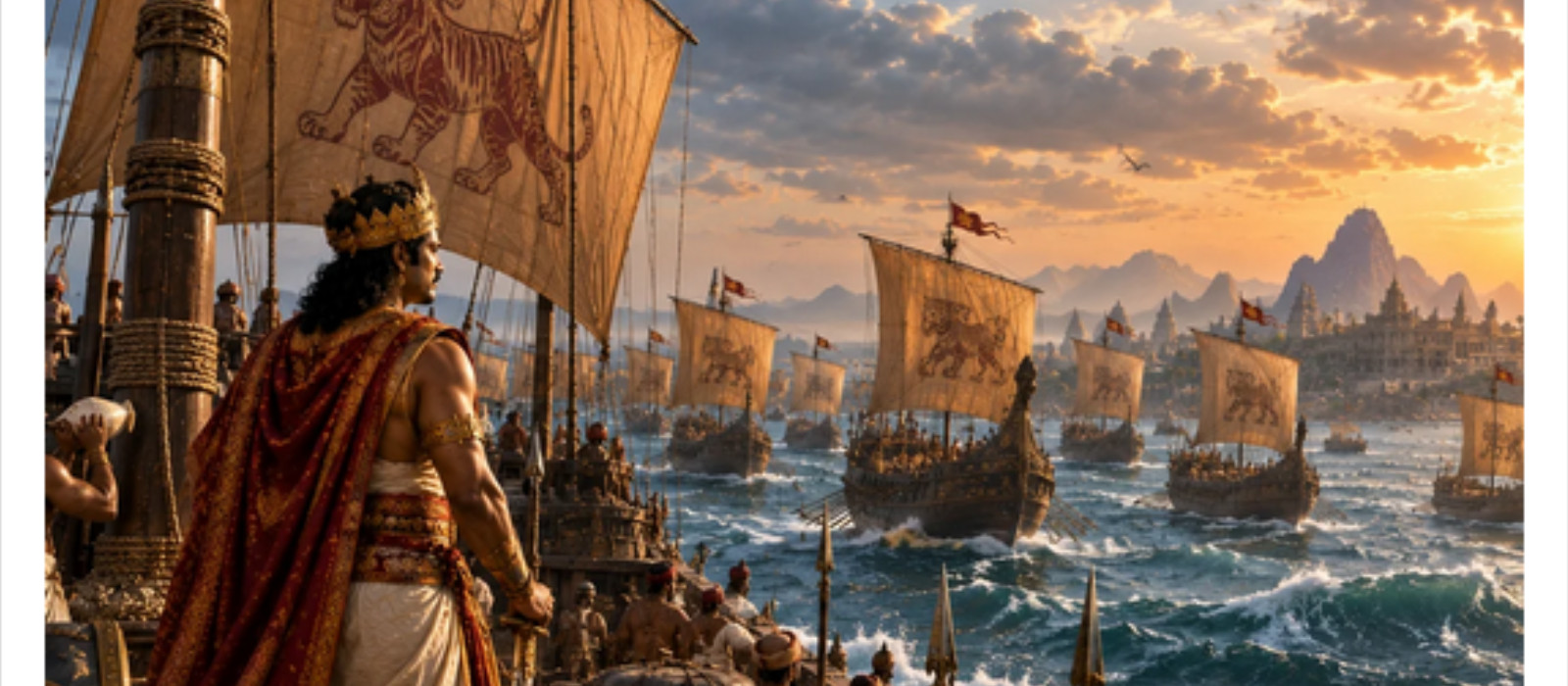
Since the Srivijaya Navy had expected the attack to come through the Malacca Straits and had guarded the North West opening of the strait, the surprise was complete. The first Srivijayan city to be attacked was Pelembang, the capital of the kingdom. Total surprise and an overwhelming superiority of arms enabled the Cholas to sack the city and plunder the palace and monasteries. A Thanjavur inscription states that Rajendra captured the Srivijaya king Sangrama Vijayottunga Varman. The Cholas also carried away the famed and bejewelled ‘war gate,’ the ‘Vidhyadara Torana’ of the kingdom, along with unmeasured treasure.43 The Chola Navy thereafter, launched successive attacks on the Srivijayan ports of Malayu, Tumasik, Pannai and Kedah, sacking and plundering each one of them with hardly any opposition. Although the invasion was extensive, the Cholas did not stop to annex any territory, the objective seems to have been merely to plunder and destroy the powerbase of the Sailendra dynasty.44 The swift, mobile force provided no opportunity for the Srivijaya forces to recoup, prepare any defences or retaliate.
The great Chola naval expedition is unique in the annals of the entire Indian history. No dynasty or king had previously undertaken such an enterprise and neither did any ruler who followed. The expedition however, was the culmination, not the beginning, of the enforcement of a well thought-through imperial policy. Although earlier it has been mentioned that the attack on Srivijaya was an ‘aberration,’ it was the actual attack and tactical actions that were being referred. The expedition itself could not have been an isolated event or an impulsively devised policy, conceived without taking into account any historical background. Evidence suggests that both Rajaraja and Rajendra had started to meddle in the political affairs of Indo-China well before the great expedition was launched.45 The geostrategic and political interference by the Chola kings were not confined to the Srivijaya Empire, but spread far beyond it, evidenced by the 55 copperplates that have been unearthed in the village of Puttur, found during the first three decades of the 20th century.46
The Consequences
The great naval expedition was a resounding success, an assessment based purely on analysing the objectives to be achieved and the end result. It achieved its primary objective of reducing the power of the Sailendra king, perhaps even more than what the Chola emperor had set out to do. Even though Srivijaya had attempted to rein in Chola activities, they were instrumental in stabilising a region and a trade route which were prone to competition and conflict. By imprisoning the king and sacking most of the prominent cities of the kingdom, the Cholas destabilised the kingdom and in turn, the region. The strong control that the Sailendra king had exercised on the trade routes through the Malacca and the Sunda Straits no longer existed. The region thereafter, entered a period of chaos: trade and commerce that had flowed relatively smoothly from the Indian Peninsula to China and back started to become somewhat uncertain. Although Rajendra Chola is reported to have married the daughter of the imprisoned Srivijaya king, the beginning of the end of the Sailendra dynasty was visible for all to see.47
Srivijaya survived despite the devastation, but with a much-diminished stature. For example, they were forced to make peace with the Javanese kingdom of Kahuripan, which was a short-lived Hindu-Buddhist kingdom of limited consequence. Such a peace treaty would not even have been considered by the Sailendra king before the debacle of the Chola invasion. The Cholas were not prepared to install their own direct administration over the defeated kingdom and did not to do so.It is clear that Rajendra Chola had embarked on the expedition to establish his supremacy over the Srivijaya king and reduce him to vassal status, without having to take on the administrative burden of a faraway kingdom. The weakening of the Sailendra dynasty, without providing a viable alternative, permitted regional powers to declare semi-independence and for smaller kingdoms to sprout, declaring ‘independence.’
The main impact of the expedition was on trade, which was felt almost immediately. With Chola ascendancy in the region, Tamil trade guilds started to quickly encroach on regions that were traditionally Sailendra strongholds, especially in the Malay Peninsula and the North coast of Sumatra. The Tamil guilds further reduced the influence of the Srivijaya kingdom. There was a positive, but unintended, consequence of the largescale arrival of the Tamil trading guilds into Indo-China, in that they facilitated the improvement of relationship between the Cholas and the Sailendras.48 By 1067 AD, Chola nobles were seen as semi-permanent members of the Srivijaya court. The Chola influence was such that a Chola prince, Rajendra’s nephew and later to be enthroned as Kulothunga Chola I (1070-1122 AD), was sent as the Srivijaya ambassador to China.49 It is obvious that the Sailendra dynasty had been informally reduced to vassal status.
Many decades before the great Chola expedition into South East Asia, Indian influence was obvious in the region. From early 1st and through 2nd Centuries AD, Indian traders were regularly visiting the region. By mid 2nd Century, Sanskrit was being used freely for record keeping in Cambodia and Vietnam. The influence came mainly from Tamilakam and Rajendra’s expedition that defeated the Sailendra king formalising the underlying sense of Tamil ascendancy, which had been predominant but not acknowledged as such for the past two centuries. The Sailendra dynasty never recovered from the defeat and plunder during the great Chola naval expedition and their decline was visible, although not very rapid. The decline of Srivijaya power eventually led to the rise of the Hindu empire of Majapahit in Java (1293–1527 AD).
An interesting aspect about the spread of Indian culture into South East Asia is that there is no evidence of the influence spreading in an overland movement, despite the close proximity of Bengal to Myanmar. Maritime trade from Peninsular India influenced Myanmar and the Myanmar script is derived from the script used by the Tamil Pallava dynasty of 3rd-5th Centuries AD.50 Similarly, the basis for the scripts of other South East Asian languages, such as Thai, Khmer and Javanese, is also the same Pallava script.
Enduring Lessons from the Great Naval Expedition
The great Chola expedition to South East Asia has variously been considered a success as well as an ill-conceived campaign born of the hubris of Rajendra Chola I, who had won battles and campaigns from the time of his ascension to the throne. There is no doubt that Chola power was at its zenith when the expedition was mounted. However, Chola interference in the geostrategic, political and even economic affairs of the several kingdoms of the region predates this event. A stable Chola kingdom always looked East for trade and the prosperity that such commerce brought to it. Considering the overarching and long-term influence that the Cholas brought to bear on South East Asia, any study of this major military expedition will bring out some enduring lessons regarding national security policies and imperatives at the strategic level. Six major - and enduring - lessons can be identified and are explained very briefly below.
The first lesson is that for a nation, prosperity and stability are two sides of the same coin. This depends on two major factors: the ability to trade with other nations in an unhampered and equitable manner, and the ability to create and maintain allies without diluting national security requirements, even when the geo-political situation becomes difficult and challenging. The Cholas reacted to Srivijaya restricting their ability to trade freely by enforcing their writ on the two choke points in South East Asian waters, the Malacca and the Sunda Straits, through concerted naval action. Through a judicious combination of show of force, coercion and diplomacy, the Cholas were able to create and maintain allies even far away from their core kingdom, the Khmer kingdom being a case in point.
The second lesson derives from the first in a conditional manner. If prosperity and stability are interconnected and fundamental to the well-being of a nation, the nation must be able to defend its sovereignty at all times. The concept of defending the sovereignty of the nation is nuanced and needs to be clarified further. Defending the sovereignty of a nation does not imply creating and implementing a defensive foreign policy or security strategy. In fact, a pro-active, and if necessary, an offensive grand strategy should flow from overarching, practical and active policies to ensure the sovereignty of the nation remains unchallenged. Through a major part of their centuries’ long rule, the Chola emperors maintained a ‘status quo’ relationship with their overseas trading partners, always through influencing and shaping the environment, deterring would-be miscreants and coercing potential adversaries, when required. It is a salutary lesson for modern nations that they did not hesitate to mount a naval expedition to destroy the rising power of a trading partner who had overstepped the mark. This was realpolitik at its stellar best. Further, the Cholas used calculated territorial expansion and the spread of their influence as pro-active tools that ensured optimum national security with minimum effort.
The third lesson would seem like stating the obvious, although it may not be that apparent to nations with historically different approaches to national security. An enduring lesson from the Chola experience is that a nation with a sizeable coastline must always consider itself a maritime nation. As a corollary, such a nation must maintain a powerful navy to protect its maritime interests. It is no surprise that the Chola Navy was the most powerful of its time. There is more to infer from the above statements. A ‘maritime nation’ must craft its national security strategy based on its maritime requirements, since its stability and prosperity would invariably be maritime - trade - dependent. In modern India’s case the dichotomy of having pursued a land-centric national security strategy for most of its independent existence, mainly influenced by historical reasons, while its large maritime region remained ‘unattended,’ is very apparent. The imperial Cholas give modern India a clear pointer to the direction in which the national security strategy must be developed.
The fourth lesson is that it is not sufficient to combine national policies and a strong maritime presence reinforced by a powerful navy to ensure prosperity and sovereignty. This combination needs to be demonstrably and unhesitatingly employed when required, thereby leaving no questions in the minds of potential adversaries that the nation possesses the will to employ its national power to protect and further its interests. This cannot be over emphasised. The Cholas had no hesitation in employing their navy to influence their neighbours or to subdue recalcitrant adversaries and bring them to vassal status when necessary. The use of their navy is a classic study in a maritime nation’s successful pursuit of national security based on clear policy and strategy match. Modern India would do well to study the Chola employment of national power through the entire gamut of security strategies from benign influence and shaping to the other extreme of punishment and destruction in the maritime regime.
The next enduring lesson is the need to affirm alliances regularly and bolster them with visible action on an as required basis. Alliances, irrespective of the formality or otherwise of the group, thrives on trust. The major partner in an alliance has the primary responsibility to ensure that this inherent trust is never in question. A strong coalition always enhances the power and prestige of all members, while the cohesion of an alliance can decline rapidly if not carefully nurtured. As a corollary, alliances must be carefully crafted with absolutely no hubristic expectations on the part of any of the members. The Chola assistance to the Khmer kingdom was a demonstration of a senior partner in an alliance responding to the needs of an ally.
The sixth major lesson with enduring relevance is the need to carefully combine the more benign security strategies, such as influence and shaping, with the more vigorous ones like coercion to create a hybrid strategy that is situationally fit for the purpose and which achieves the desired objectives. Coercion can be subtly superimposed on diplomacy to demonstrate intent, while good will continues to be predominant in a nuanced way to ensure that the coerced entity understands the strong will underlying gentle actions. The Chola king entering into a matrimonial alliance with the dethroned Sailendra king’s daughter is a good example of such a combination.
There are many more lessons that can be distilled from the Chola interaction with South East Asia and the way in which they influenced the region. From a military viewpoint, there are also lessons at the operational and tactical levels that could be considered timeless and valid under almost all circumstances. Their relevance in a strategic analysis is minimal and therefore, they are not being elaborated as this paper focuses on the legacy of the imperial Cholas regarding their maritime activities and the tangible strategic lessons that they have left behind for posterity and for others to follow.
Conclusion
The Chola dynasty left behind a glorious legacy. No other dynasty that ruled any part of the Indian sub-continent achieved either the spread of influence to the same level or lasted so long. In a very broad sense, the Cholas were the only dynasty to decisively move outside the confines of the borders of the sub-continent to pursue trade and commerce and in the bargain spread Indian religion, ethos and culture. This is no mean achievement, considering that there were competing with equally powerful dynasties ruling neighbouring regions and kingdoms. It speaks volumes about the sagacity and farsightedness of successive emperors of the imperial Cholas that they retain ascendancy in the consciousness of many Indian thinkers even in the 21st Century.
Endnotes
-
KA Nilakanta Sastri, A History of South India: From Prehistoric Times to the fall of Vijayanagar (New Delhi: Oxford University Press, 1975), 157-58.
-
John Keay, India: A History (London: HarperCollins Publishers, 2000), 215.
-
"Sangam Literature," Encyclopaedia Britannica, 13 December 2016.. https://www.britannica.com/art/shangam-literature, accessed 20 September 2021. Sangam Literature is considered the earliest writings in Tamil, produced in Madurai between 1 and 4 century AD. They consist of Tolkappiyam, a book on grammar and rhetoric and eight anthologies of poetry. A ninth gives a description of early life in Tamilakam. Sangam writings are unique for their time because unlike other Indian literature of the time, which are entirely religious, these poems deal with love and heroism, including detailing the deeds of kings.
-
John S. Bowman ed., Columbia Chronologies of Asian History and Culture (Columbia: Columbia University Press, 2000), 401.
-
R Narasimhacharya, History of the Kannada Literature: Readership Lectures (Mysore: University of Mysore, 1969), 48.
-
Kamil Zvelebil, The Smile of Murugan: On Tamil Literature of South India (Netherlands: E J Brill, 1973), 17-21.
-
RC Majumdar, Ancient India, Eighth Edition (New Delhi: MotilalBanarsidass, 1994), 137.
-
Sastri, Op Cit, n.1, 130-33.
-
Hermann Kulke, K Kesavapany and Vijay Sakhuja eds., Nagapattinam to Suvarnadwipa: Reflections on Chola Naval Expeditions to Southeast Asia (Singapore: Institute of Southeast Asian Studies, 2009), 122-23.
-
Sailendra Nath Sen, Ancient Indian History and Civilization (New Delhi: New Age International Publishers, 1999), 373.
-
Balaji Sadasivan, The Dancing Girl: A History of Early India (Singapore: ISEAS Publishing, 2011), 133.
-
Majumdar, Op Cit, n.7, 407.
-
C Gun Geoffrey, History Without Borders: The Making of an Asian World Region 1000-1800 (Hong Kong: Hong Kong University Press, 2011), 43.
-
Vidya Dehejia, The Art of Imperial Cholas (Columbia: Columbia University Press,1990), xiv.
-
PN Chopra, TK Ravindran and N Subramanian, History of South India: Ancient, Medieval and Modern (New Delhi: S Chan Ltd, 2003), 107-09.
-
Ramasankar Tripathi, History of Ancient India (New Delhi: Motilal Banarsidass, 1967), 472.
-
Stephen S. Gosh and Peter N. Stearns, Premodern Travel in World History (Oxfordshire: Routledge, 2007), 12.
-
SR Rao, Marine Archaeology in India (New Delhi: Publications Division, Ministry of Information and Broadcasting, Government of India, 2001), 27-28.
-
Prithwis Chandra Chakravarti, “Naval Warfare in Ancient India,” The MUA Collection. http://www.themua.org/collections/items/show/1333, accessed 17 September 2021.
-
Wilfred Harvey Schoff ed., The Periplus of the Erythraean Sea: Travel and Trade in the Indian Ocean by a Merchant of the First Century (New York: Longmans, Green & Co.), 7-15.
-
Gary Keith Young, Rome’s Eastern Trade: International Trade and Imperial Policy 31 BC-AD 305 (Oxfordshire: Routledge, 2001), 19.
-
Robert Bradnock, South India Handbook (New York: McGraw-Hill Education, 2001), 142.
-
Jaydeep Paul, “Maritime Trade Linkages with South East Asian Nations,” Dilli Series Seminar 2017, Proceedings, India and Southeast Asia-Maritime Trade, Expeditions and Civilizational Linkages (Kerala: Indian Naval Academy, 2017), 265.
-
J Hornell, “The Classes of Vessels Employed by Indians in Ancient Days Prior to Portuguese Maritime Dominance,” Memoirs of the Asiatic Society of Bengal vol. 7, Part IV (1920) Also see, For greater details regarding the early Chola navy read, Vincent,William, The Prof. Sanu Kainikara Commerce and Navigation of the Ancients in the Indian Ocean, printed by T. Cadell &W. Davies, London, 1807, available as an electronic resource in the National Library of Australia, Canberra. (Also digitised by Google Books in February 2009).
-
Duraiswamy Dayalan, “Ancient Seaports on the Eastern Coast of India: The Hub of the Maritime Silk Route Network, Korea Science,” vol. 4, no. 1 ( 2019), 65- 69. https://www.koreascience.or.kr/article/JAKO201921467620516.page, accessed 19 September 2021.
-
V Dhanalekshmi, Administration under the Imperial Cholas 850 to 1070 AD, PhD Thesis (Tamil Nadu: Manonmaniam Sundaranar University, 2017), 267.
-
Danny Craig, “Parantaka Chola II - Battle of Chevur and Assassination of Aditya Chola II,” India Contents, 22 July 2017. https://www.indiancontents.com/2017 /07/paran taka -chola-ii-battle-of-chevur-and.html, accessed 19 September 2021.
-
KR VenkataRama Iyer, A Manual of Pudukkottai State, vol. 1 (Sri Brihadamba State Press, 1938), 604. (Digitised by Google Books in August 2008.)
-
Dehejia, Op Cit., n.14, 51.
-
Dehejia, Op Cit., n.14.
-
MGS Narayanan, Perumals of Kerala: Brahmin Oligarchy and Ritual Monarchy (Kerala: CosmoBooks, 2013), 115-117.
-
Sastri, Op Cit., n.1, 3.
-
KK Pillai, TamilakaVaralaru: MakkalumPanpatum (Tamil: International Institute of Tamil Studies, 2015), 264-65. (Relevant part translated by the author)
-
The Srivijaya Empire was the dominant kingdom in the Indo-China archipelago and flourished between 7th and 13th centuries AD, controlling the trade routes and the Malacca and Sunda Straits. 35 KA Nilakanta Sastri, South India Influences in the Far East (Bombay: Hind Kitab Ltd, 1949), 144.
-
E Hultzsch ed., Epigraphia Indica and Record of the Archaeological Society of India, vol. 8 (Calcutta: Office of the Superintendent of Government Printing, 1905-06), 260. https://archive.org/details/EpigraphiaIndica/page/n9/mode/2 up accessed 20 September 2021.
-
Pillai, Op Cit., n.33, 279.
-
Sen, Op Cit., n.10, 564.
-
Craig A. Lockard, Societies, Networks and Transitions: A Global History (Boston: Cengage Learning, 2007), 367.
-
Praful Shankar, “The Wars That Were Won: Rajendra Chola’s Naval Conquest of South-East Asia,” Swarajya Magazine, 19 July 2020, https://swarajyamag.Com /ideas/the-wars-that-were-won-rajendra-cholas-naval-conquest-of-south-east-asia accessed 20 September 2021.
-
Munro-Hay, Stuart,Nakhon Sri Thammarat: The Archaeology, History and Legend of a Southern Thai Town (Bangkok: White Lotus Press, 2001), 22.
-
Lincoln Paine, The Sea and Civilization: A Maritime History of the World (London: Penguin Random House, 2015), 866.
-
Hermann Kulke, K Kesavapani and Vijay Sakhuja eds., Nagapattinam to Suvarnadwipa: Refelections on the Chola Naval Expeditions to Southeast Asia (Singapore: Institute of Southeast Asian Studies, 2009), 1.
-
RC Majumdar “The Overseas Expeditions of King Rajendra Cola,” ArtibusAsiae, vol. 3-4 (1961), 338-342. https://www.jstor.org/stable/3249234 accessed 20 September 2021.
-
Ibid.
-
TS Sridhar and R Balasubramanian, A Catalogue of Copper Plate Grants: 1918-2010 (Chennai: Government Museum, 2011), 4-5.
-
Tansen Sen, Buddhism, Diplomacy and Trade: The Re-alignment of Sino-Indian Trade (Maryland: Rowman & Littlefield, 2003), 225-27.
-
Kulke, Kesavapani and Sakhuja, Op Cit., n.43, 305.
-
Sailendra Nath Sen, A Textbook of Medieval Indian History (Delhi: Primus Books, 2013), 46-49.
-
Akhilesh Pillalamarri, “How India Influenced Southeast Asian Civilization,” The Diplomat, https://thediplomat.com/2018/10/how-india-influenced-southeast-asian-civilization/ accessed 20 September 2021.
