


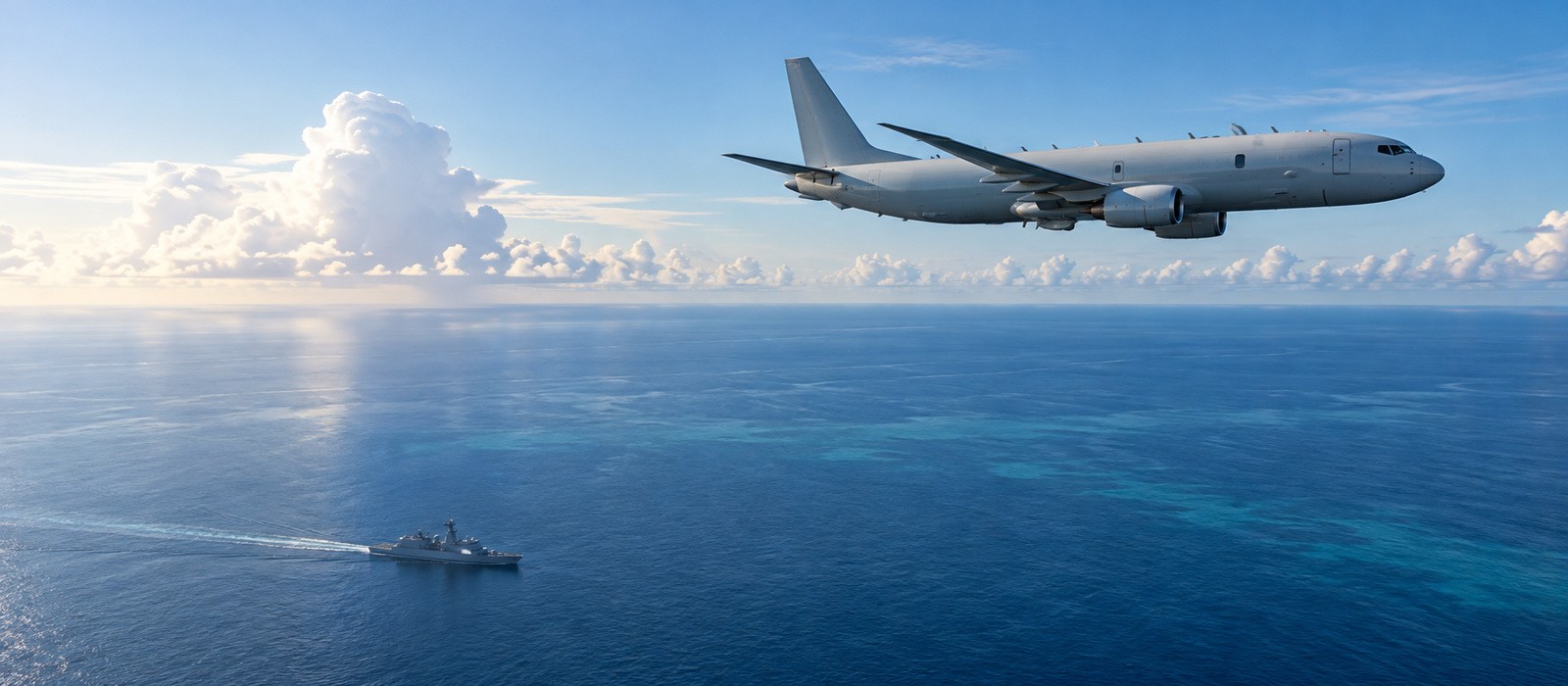


Indian Naval Despatch Spring 2023 - Volume 4 No. 1. “A Legal Analysis on Freedom of Maritime Air Operations under International Law” by Lt Cdr Pranav Pandey.
Lt Cdr Pranav Pandey’s article “A Legal Analysis on Freedom of Maritime Air Operations under International Law” delves into a subject vital for all Indian Navy (IN) Executive Officers. While the IN’s International Military Law curriculum provides a foundational understanding through Sub Lieutenants’, Long and Staff Courses, Pandey’s article explores advanced concepts that are often elusive but crucial for strategic and operational agility.
Since the mid-80s, the IN has operated in an expanded geopolitical arena. The evolving period witnessed rapid changes in the strategic and military landscapes, demanding adaptability and evolved thinking. The IN confronted the sanctions following the 1998 Indian nuclear weapon tests and navigated the challenges of the changing security environment with a new resolve. Events like the Kargil War of 1999 (Op Vijay) tested Indian military readiness. The military standoff between nuclear neighbours India and Pakistan (Op Parakram) in 2001 heightened tensions. A decade earlier, Indian military involvement in Sri Lanka (Op Pawan) led to a peacekeeping mission that unravelled into armed conflict and later the assassination of a Prime Minister.
During these critical times, the IN expanded to extensive air scouting and other essential missions, deploying manned maritime scouting resources. Such operations involve a balance between the airspace regulations governed by ICAO regulations and the leveraging of ‘military prerogatives’ to ensure operational security in international airspace and, sometimes, off the territorial seas of neighbouring states. The IN’s operational flexibility imperatives called for evolution from rudimentary and constrained military conditions to more advanced understandings.
As a case in point, negotiating Unmanned Aerial Vehicle (UAV) operations between the Directorate of Naval Air Staff and the Director General of Civil Aviation (DGCA) required innovative approaches. Overcoming civilian airspace regulations, including ceilings and separations, required the IN to emphasise ‘military prerogatives’ and ‘due regard.’ These discussions led to evolved deconfliction measures with air traffic in controlled airspaces, including Terminal Areas off busy international airports and through safe transits to and from Class G uncontrolled airspace. Such a balance is essential lest military advantages should take a backseat.
India’s domestic regulations, as enacted, follow the political, strategic and economic contexts of a coastal state and the mindsets of a developing post-colonial nation.1 These also influenced positions taken when the Third United Nations Convention on the Law of the Sea was negotiated from 1973 to 1982. Laws such as the “The Territorial Waters, Continental Shelf, Exclusive Economic Zones, and Maritime Zones Act 1976” and the “The Maritime Zones of India (Regulation of Fishing by Foreign Vessels) Act 1981” were enacted before the finalisation of the “The United Nations Convention on the Law of the Sea,” in 1982.
India’s legislation has its basis in resource-related considerations and coastal rights protections. The major maritime powers sought to protect the freedom to conduct military activities beyond the territorial sea. Re- examination of India's domestic regulations that include ‘prior notification for warships to enter the territorial sea’ and ‘prior permission required for military exercises’ by Indian naval scholars and its implications to current- day military contexts like mobility and freedoms of navigation can be an instructive exercise.
The strategic insights of enlightened naval leaders, like Admiral Gorshkov, shaped global governance regimes, thus allowing codifications of freedoms for military activities. A quid pro quo that allowed warm-water access by Soviet military vessels through International Straits without constraining their military imperatives led to Soviet support for the Laws of the Sea. Notably, China advocated for a 200 nm territorial sea with leadership among developing countries as a motive!2
However, recent events like Russia’s divergent military/grey-zone positions, such as seizing Ukrainian naval vessels in 2018 seeking to navigate the Kerch Straits, highlight how realpolitik can overshadow international laws and governance systems.3 Iran’s shooting down of a US Global Hawk drone in 2019, explained as a misunderstanding of International Aviation Law, raises questions about the legal framework of maritime airspace and military uses of such spaces.4
The shooting down of Korean Air Lines flight 007 by Soviet air-to-air missiles in 1983, killing all 269 persons on board, would lead to the ICAO recommending an amendment (Article 3 bis) banning military weapons against civilian aircraft in flight.5 The amendment’s ratification by 1998 would see thirteen more aeroplanes go down to military action, including the downing of Iran Air Flight 655 by USS Vincennes.
The San Remo Manual on Armed Conflicts at Sea, the Newport Manual on the Law of Naval Warfare, and the less-known HPCR Manual on Air and Missile Warfare provide the existing legal frameworks (lex lata).6 Nuanced perspectives for when contractors operate High Altitude Long Range unmanned-scouting assets as ‘civil’ aircraft and when used by the IN as ‘state’ aircraft are examples of how we need to align with fresh outlooks. To prepare for India’s enhanced global role, naval and military officers should consider the laws’ potential evolution (lex ferenda) and must articulate policy positions aligning with strategic imperatives and G5 kind of perspectives than those of the G77.
Amidst China’s assertive military expansion, India’s economic and military imperatives necessitate a robust capability for projecting forces extensively across the Indo-Pacific. The IN must align its policies to meet these requirements by thoroughly examining military maritime imperatives. Indian Naval officers should interpret not just the Laws of the Sea but also the Laws of Naval Warfare, broadly understanding their interrelationship.
The Indian Navy’s areas of interest and operations are aligned inescapably with India's growing economy. Its responsibilities cover vital Sea Lines of Communication to the East and the West. Safeguarding essential trade and energy routes across oceans requires the Navy to ensure legal alignments in keeping with India's enhanced role as a maritime nation committed to protecting global resources.
Endnotes
- D P. O’Connell, The International Law of the Sea, Volume 1, ed. I A Shearer (Oxford: Oxford University Press, 1982).
- James Kraska, Maritime Power and the Law of the Sea: Expeditionary Operations in World Politics (Oxford: Oxford University Press, 2011), 107.
- James Kraska, “Did ITLOS Just Kill the Military Activities Exemption in Article 298?” EJIL: Talk, 27 May 2019.
- James Kraska, “The Kerch Strait Incident: Law of the Sea or Law of Naval Warfare?” EJIL: Talk, 03 December 2018.
- In the context of international agreements and conventions, including the Chicago Convention on International Civil Aviation, “bis” is a Latin term that means “second.” So, Article 3 bis refers to the second addition or amendment to Article 3 of the convention.
- Louise Doswald-Beck, ed. San Remo Manual on International Law Applicable to Armed Conflicts at Sea (Cambridge: Cambridge University Press, 1995); James Kraska, “The Newport Manual on the Law of Naval Warfare,” International Law Studies vol. 101 no. 1 (2023); Harvard School of Public Health, HPCR Manual on International Law Applicable to Air and Missile Warfare (Cambridge: Cambridge University Press, 2013). Monsoon 2023 15
