


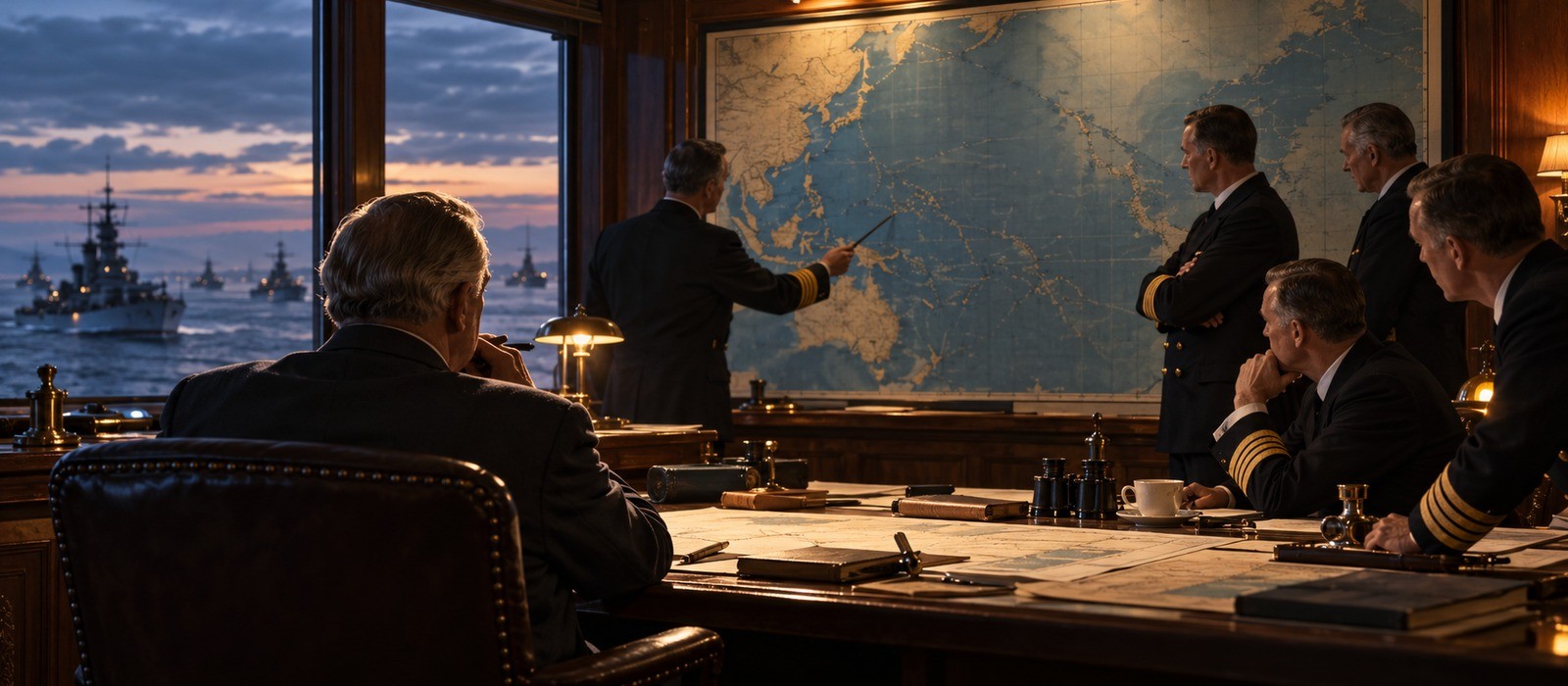


Abstract: Effective strategy requires bridging the gap between civilian authority and military decision making. This is especially true in democratic nations, where civilian authority is enshrined in law. U.S. President Franklin D. Roosevelt understood this and worked with his senior naval officers to effectively bridge the gap. In the year before the United States entered World War II, Roosevelt’s interaction with three senior naval officers—Admiral James O. Richardson, Admiral Harold R. Stark, and Admiral Ernest J. King—illustrated the challenges involved. An examination of Roosevelt’s approach to these officers and how he employed their leadership highlights the importance of skillfully bridging the gap between civilian authority and military decision making in order to effectively execute national strategy effectively.
Introduction
Effective strategy requires bridging the gap between civilian authority and military decision making. This is especially true in democratic nations, where civilian authority is enshrined in law. Recent developments in the United States have reinforced this, specifically President Donald J. Trump’s decision to relieve General Charles Q. Brown, Jr., U.S. Air Force, the Chairman of the Joint Chiefs of Staff, and Admiral Lisa Franchetti, U.S. Navy, the Chief of Naval Operations (CNO). President Trump’s decision is clearly within his authority under the U.S. Constitution as Commander in Chief. However, the relief of senior officers is seldom a simple or straightforward exercise because of the impact it has on the relationship between military and civilian leaders.
That relationship is vital because it influences the development and conduct of strategy. Prussian General Carl von Clausewitz highlighted that fact with his frequently quoted declaration that “war is simply a continuation of political intercourse, with the addition of other means.”1 Clausewitz’s statement reveals his view that policy and military action are intertwined, with military effort “restricted” and shaped by “political lines.”2 If we accept this perspective, then effective strategy emerges through a collaborative effort involving civilian and military leaders.
An earlier U.S. president, Franklin D. Roosevelt, illustrated how this could be done. In the two years before the 7 December 1941 attack on Pearl Harbor, Roosevelt and his senior admirals collaborated to devise a strategy that aligned with his goals. Roosevelt faced a difficult challenge. He wanted to support the European democracies in their fight against Nazi Germany—war had erupted in Europe in September 1939—but Roosevelt was constrained by American public opinion, which wanted to avoid war. That factor was foremost in his mind as he sought reelection for an unprecedented third presidential term in 1940.
Roosevelt’s challenge was further complicated by the Empire of Japan. Japan had initiated a war with China in July 1937 and Roosevelt feared that Japan would use the war in Europe as an excuse to seize French, Dutch, and British colonies, such as French Indochina (modern-day Vietnam), the Netherlands East Indies (Indonesia), Burma (Myanmar), Malaya (Malaysia), and Singapore. Roosevelt’s strategy had to account for this, and he felt the U.S. Fleet could be a powerful deterrent.
To achieve his goals of deterring Japan and supporting the European democracies, Roosevelt employed an emergent strategy, one that did not adhere to a predefined plan, but instead reacted to events while simultaneously trying to shape them. Implementing that strategy required a particular type of military commander, one who could accept the frequent adjustments necessitated by political uncertainty while simultaneously translating Roosevelt’s policy desires into operational direction.
Not all officers were up to this challenge. Roosevelt’s interaction with three senior naval officers, Admiral James O. Richardson, who held the post of Commander in Chief, U.S. Fleet (CINCUS), Admiral Harold R. Stark, the Chief of Naval Operations (CNO), and Admiral Ernest J. King, who became Commander in Chief, U.S. Atlantic Fleet (CINCLANT), illustrated the challenges involved. An examination of these interactions reinforces the importance of skillfully bridging the gap between civilian authority and military decision making in order to devise and execute national strategy.
Richardson and the Hawaiian Base
Admiral Richardson became CINCUS in January 1940. Officers normally held the post for two years, and, given the tense international situation, Richardson felt his primary focus ought to be preparing for war. At that time, the Navy’s war plans emphasised a trans-Pacific campaign against the Empire of Japan. However, Richardson felt existing plans were out of date because of recent developments in Europe and Asia. Accordingly, on 1 May 1940, Richardson requested a meeting with Admiral Stark, whose staff in the Office of the CNO (OPNAV) was responsible for the Navy’s war plans, to request a meeting.3 Richardson was thinking strategically; he wanted to ensure the Navy’s plans aligned with U.S. policy and reflected international developments.
However, instead of an invitation to reassess and clarify the Navy’s war plans, Stark sent Richardson a directive. The Fleet was in Hawaii for a large exercise, and, on 7 May Stark told Richardson the fleet would remain there “for about two weeks.” Richardson was frustrated. The supplies and material for the Fleet’s training regimen were on the West Coast, where it normally based. He needed to know how long the Fleet would stay in Hawaii. If it was a short stay, Richardson could delay his training exercises, but if the stay was extended, he would need to bring that material to Hawaii. On 15 May, Stark informed Richardson that the fleet was likely to “remain [in] Hawaiian waters for some time.”4
Stark did not fully explain the reason for this change in force posture, although Richardson suspected it. President Roosevelt had decided to keep the Fleet in Hawaii to deter Imperial Japan. This was a political decision. He feared that the Japanese would seize the opportunity created by the German invasion of Belgium, the Netherlands, and France to capture European colonies in Asia. By keeping Richardson and the bulk of his Fleet in Hawaii, Roosevelt hoped to show Japan that the United States was ready to move aggressively to defend U.S. and European interests in the Western Pacific. Stark finally explained this rationale on 27 May, telling Richardson that he was in Hawaii “because of the deterrent effect which it is thought your presence may have on the Japanese.”5
Richardson’s assessment of the international situation did not match Roosevelt’s. He did not think deterring Japan and preventing a broader war in Asia was a core U.S. interest. Instead, he felt the nation’s “paramount interest” was “the security of the Western Hemisphere.”6 Richardson was not alone in this assessment. Army and Navy war planners in Washington had devised a series of “Rainbow” plans anticipating U.S. involvement in a coalition war. The one that received the most focus as Germany overran France was “Rainbow Four,” a hemispheric defense plan that anticipated a “favorable” peace settlement with the Axis nations but not victory over Germany and its allies.7
President Roosevelt’s perspective was different. He embraced a more interventionist foreign policy and recognised that the nation’s defense had to extend beyond the boundaries of the Western Hemisphere.8 As 1940 went on, Roosevelt came to believe that the survival of Great Britain was a core U.S. interest. However, he had to tread carefully; he would not win reelection unless he respected the strong isolationist sentiment among the voting public. Democratic candidate Roosevelt tried to balance his interventionist sensibilities against public opinion by reconfiguring his cabinet. He made Henry L. Stimson Secretary of War and Frank Knox Secretary of the Navy. Both were prominent Republicans who supported Roosevelt’s views on preparedness and international intervention, lending a bipartisan authority to his administration.
In July 1940, Richardson traveled to Washington. While there, he tried to convince Roosevelt of the benefits of withdrawing the Fleet to the West Coast. Richardson failed and became convinced that Roosevelt and his advisors believed “Japanese aggression could be restrained by a strong attitude on the part of the United States.” The Fleet would remain in Hawaii “indefinitely.” 9 Upon his return to Hawaii, Richardson expressed his frustrations in an address to the Fleet’s officers. He felt that Roosevelt, Knox, and Stark were failing to support the Fleet’s preparation for war. Richardson shared his address with Stark, who felt it was an unfair and “unwarranted” characterization.10
Two months later, the situation had deteriorated further. Secretary Knox visited the Fleet in September 1940. He explained to Richardson the administration’s policies, the need to keep Great Britain in the war, and the value of the Fleet deployment to Hawaii.11 Richardson disagreed. He remained convinced that the Fleet ought to be withdrawn to the West Coast. In a lengthy memorandum for Knox, Richardson openly questioned the administration’s policies and questioned whether there was “full understanding and satisfactory cooperation between the State, War, and Navy Departments.”12 In this time before the creation of the U.S. Department of Defense, those three departments were the civilian agencies most responsible for foreign policy; if they were misaligned, decision making would suffer.
Richardson believed the Fleet had been stationed in Hawaii because of that misalignment. He did not think the President’s policies were working, and Richardson felt the root of the problem was that civilian officials—the President foremost among them—were not receiving appropriate advice from senior naval officers. Richardson’s memorandum sought to correct that by outlining his perspective in detail. In addition to the copy he gave Knox, Richardson sent versions of the memorandum to Admiral Stark and a friend at the State Department.13
Richardson was correct that there was some misalignment in Washington. The War Department, or at least the U.S. Army’s planners, agreed that basing the Fleet in Hawaii was ill-advised. They felt that the “show of strength in the Pacific might be taken by the Japanese Government as an occasion to open hostilities.”14 Accordingly, the Army planners felt the 14 Fleet should withdraw to the West Coast where it could better prepare for war.
However, what Richardson failed to realise was that the nation’s civilian leadership was largely aligned around Roosevelt’s approach. He and his cabinet agreed that Japan had to be deterred, and Great Britain supported. However, they continued to approach these policies cautiously because of the upcoming election. In October, Richardson returned to Washington. On the 7th, he lunched with Roosevelt again. When Richardson asked to move the bulk of the Fleet back to the West Coast, the President reiterated his stance that the fleet would stay in Hawaii to “exercise a restraining influence on the actions of Japan.”15
Richardson disagreed, but rather than confining his thoughts to matters of policy, he questioned Roosevelt’s ability to lead. Richardson explained that “senior officers of the Navy do not have the trust and confidence in the civilian leadership of this country that is essential for the successful prosecution of a war in the Pacific.”16 This came as a shock to Roosevelt. It was a frank admission of Richardson’s part. After five months in Hawaii, he had lost faith in the President’s leadership. Richardson seems to have hoped that his statement would lead to a reassessment of the U.S. Navy’s senior leadership. He did not believe Stark was advising the President appropriately and that was what was allowing decisions to be made for “party political reasons, rather than on the basis of what was good for the country.”17 However, Richardson revealed that he felt he had a better grasp of political decisions—what was best for the nation—than the President. This inverted the appropriate relationship between civilian and military leaders in the U.S. democratic system.
Stark and “Plan Dog”
Richardson miscalculated. He felt that his frank admission would allow him to exert more influence on the President and his policies. Instead, it undermined Roosevelt’s faith in his CINCUS. The President remained convinced that he could balance the limited preparedness of the Fleet in the Pacific against the need to deter Japan while he won reelection. In that assessment he was correct. In the November 1940 election, Roosevelt won a clear victory.
In the aftermath of that success, Stark formulated a strategy reflecting the President’s policy priorities. Stark’s “Plan Dog” memorandum presented four options for the United States in the event of war: a withdrawal into the Western Hemisphere, a “full offensive against Japan,” a simultaneous effort in both Europe and the Pacific, and a “strong offensive in the Atlantic” coupled with defense in the Pacific. Stark examined each alternative in turn and argued that only the last one—option “d” or “dog” in the Navy’s phonetic alphabet—was “most fruitful” as it would achieve Roosevelt’s policy goal of keeping Britain in the war.18 Secretary Knox and President Roosevelt welcomed Stark’s assessment. His memorandum became the basis for the “National Defense Policy of the United States” issued that December.19 That policy prioritised the threat of Nazi Germany, called for assistance to Great Britain, and held that British possessions in the Far East were less vital to the war effort than those in the Mediterranean. In essence, “Plan Dog” and the new National Defense Policy prioritised the Atlantic over the Pacific.20
To oversee operations in the Atlantic, Roosevelt, Knox, and Stark selected Rear Admiral Ernest J. King. He was appointed commander of the relatively modest Patrol Force, the Navy’s Atlantic squadron, on 17 December 1940.21 Soon thereafter, Roosevelt reconfigured the rest of the Navy’s high command.22 Admiral Richardson was relieved at the end of January 1941, after just thirteen months in his role as CINCUS. Fortunately, he recognised the President’s constitutional authority and accepted his relief gracefully. Admiral Husband E. Kimmel was appointed CINCUS, with a dual responsibility as Commander in Chief of the Pacific Fleet (CINCPAC). The Patrol Force was renamed the Atlantic Fleet and King became CINCLANT with the rank of full admiral.23
King as CINCLANT
King’s approach to Roosevelt’s policy direction was very different from Richardson. Where Richardson felt an obligation to challenge civilian authority in the best interests of the nation, King recognised that his authority derived from his civilian superiors. Consequently, rather than point out flaws in policy, King resolved to be a faithful agent of policy. When the Atlantic Fleet’s weaknesses in training and preparation became evident, King issued a fleet-wide memorandum that challenged his officers to “do all that we can with what we have.”24
That was difficult. The rapidly expanding Atlantic Fleet faced numerous deficiencies, including a “lack of trained seagoing personnel, inadequacies of material, [and] the necessity to continue [a high tempo of] operations.” Lack of personnel best illustrates the challenge. Destroyers built for a crew of 106 were entering the Fleet with a complement of just 56. That placed a tremendous burden on officers and sailors. King invoked national pride and encouraged his subordinates to face these difficulties with a “pioneering spirit.”25 Civilian leaders welcomed King’s approach. In contrast to Richardson—who was constantly complaining about his difficulties—King embraced the challenge. After reviewing King’s memorandum, Knox expressed his agreement: “To make the best of what we have is, of course, the only philosophy for us to pursue.”26
However, as the year 1941 went on and Roosevelt’s policies adjusted, it became difficult to craft a clear strategy for the Atlantic Fleet. The overarching challenge was how best to support Great Britain by safeguarding the convoys which sustained its war effort. From 29 January to 27 March 1941, military leaders of the United States and Great Britain met in Washington. These meetings built on the U.S. National Defense Policy and led to agreement that Europe was “the decisive theater” and that the “center of gravity” for the war at sea was the North Atlantic and its convoys.27 Consequently, even before the meetings concluded, Stark ordered King to establish a convoy escort force with the intent of sending it to Northern Ireland to operate with the British.28
Stark felt war was coming. On 15 March, he told King to reduce his operating tempo so that the ships of the Atlantic Fleet could return to port and fully mobilise. The President quickly endorsed the decision. Stark told King to be ready to enter the war by 1 May.29 In early April, Stark reinforced the Atlantic Fleet with three battleships, an aircraft carrier, and numerous smaller ships sent from the Pacific Fleet.30 Both Stark and King anticipated an immediate entry into the war.
Roosevelt, however, felt the nation was unready to take that step. As he tried to balance public opinion with his policy priorities, he triggered a series of “extraordinarily confusing” events in April 1941.31 Roosevelt initially tried to declare the entirety of the Western Hemisphere, which he extended as far east as Iceland and the Azores, out of bounds to Axis warships. He wanted any enemy warship within the boundary—set at 26 degrees west—to be challenged, and, if necessary, fired upon. Roosevelt’s intent was to protect British convoys inside the boundary without having to escort the convoys directly. When Roosevelt shared this concept in a 17 April cabinet meeting, Secretary Stimson challenged him and said it would lead to “clearly hostile” acts.32
Although Stark had issued orders to King calling for him to “attack” Axis ships inside the boundary, Roosevelt backed away from his aggressive stance before they went into effect.33 King’s instructions were changed to just “trail” and “report” the positions of Axis ships, not to fire upon them. Fortunately, King heard about the change directly from President Roosevelt himself when the two met over the weekend in Hyde Park, the President’s home in New York. Roosevelt told King that national policy required a combination of “bravery and bluff.”34
Further bluffs were coming. After the Atlantic sortie of the German battleship Bismarck in May 1941, President Roosevelt declared an “unlimited national emergency.”35 He also became concerned that a squadron of Vichy French ships at Martinique might also raid convoy routes. Plans were drafted for King’s fleet to invade the island and seize or immobilise the ships. However, Roosevelt called off the plans on 11 June. Instead, he would send some of the Marines earmarked for the assault to Iceland. Ostensibly, their mission was to relieve the British garrison, but Roosevelt’s real objective was to give the Atlantic Fleet an excuse to escort convoys in the Western Atlantic without officially entering the war.36
King took these adjustments in stride. He formed a convoy with heavy escort and ensured that the Marines arrived safely in Iceland on 7 July. While the Marines were on their way, Germany invaded the Soviet Union. Two days after the invasion, on 24 June, Stark suggested using it as an opportunity to start escorting convoys “immediately.”37 Roosevelt was receptive to the idea and told King to start preparing. A new plan was drafted that called for King’s Fleet to collaborate with the Royal Canadian Navy (RCN) and assume responsibility for escorting convoys in the Western Atlantic. However, the official integration of U.S. and British forces was a step too far for Roosevelt. He did not feel the American public was ready and rejected the plan on 10 July.38
The President’s dynamic approach to strategy began to frustrate Stark. Privately, he complained that “policy seems to be something never fixed, always fluid and changing.”39 OPNAV planners produced new guidance; King’s ships would escort convoys of Icelandic and American flagged vessels back and forth to Iceland. They would time their sailings so that other ships—ones bound for Britain—might join them. This was a clever way to have U.S. ships escort British convoys without “officially” doing so.40 However, before these plans could be implemented, Roosevelt learned of Japanese plans to invade Southern Indochina.41 Fearing that might signal a broader Japanese assault on European colonies, Roosevelt cancelled plans to escort ships of other nationalities because he did not want to transfer any more ships away from the Pacific. King’s Fleet would only escort U.S. and Icelandic ships.42
These more limited instructions still presented King with a significant challenge. He had to protect the merchant ships from what Roosevelt had called the “threat of attack.” What exactly this meant was uncertain. The President was reluctant to provide more specific guidance because of limited public support for war. It fell to King to provide the necessary specificity. In an operation plan issued on 15 July, he defined “threat” very specifically: “potentially hostile vessels… within sight or sound contact” should be fired upon.43 King backed these instructions with public support for officers who attacked threatening sonar contacts, showing his determination to stand by his interpretation of Roosevelt’s desires.44
In August 1941, President Roosevelt, British Prime Minister Winston Churchill, and their military advisors met in Placentia Bay, Newfoundland for the Atlantic Conference. King and Stark used the opportunity to clarify plans for convoy escort. In effect, the North Atlantic was divided in two, with the United States responsible for the western half and the British for the eastern.45 King used this agreement to assert control of the RCN forces in the Western Atlantic and divide convoy escort responsibilities between his ships and those of the Canadians.46 With an improved understanding in 46 place and the Atlantic Charter proclaiming the ideals the United States would fight for, Roosevelt was willing to approve convoy escort operations. They officially began at the end of August 1941.
King’s Atlantic Fleet entered a state of undeclared war. Combat was inevitable as his ships tried to prevent Axis submarines from attacking the convoys. The first exchange of fire came on 4 September when destroyer 47 Greer exchanged fire with U-652.47 President Roosevelt seized the opportunity. On 11 September, he delivered his “shoot-on-sight” speech, which compared Axis submarines to “rattlesnakes” and publicly endorsed the aggressive instructions King had already issued.48
Deadlier encounters were inevitable. The first came on 16 October, when destroyer Kearny was torpedoed by U-568, one of a group of submarines attacking Convoy SC-48 south of Iceland.49 Thanks to King’s emphasis on drill and preparation, Kearny’s crew reacted quickly, stopped the flooding, and saved the ship, but several of her crew were killed. Roosevelt used the attack to further justify his Atlantic policy and reiterated his orders to the Navy to shoot “the rattlesnakes” on sight.50
Soon thereafter, on 31 October, destroyer Ruben James, part of the escort for convoy HX-156, was torpedoed and sunk by U-552. The forward part of the old destroyer exploded, and the rest of the ship sank quickly with large loss of life. Just 45 sailors out of a crew of over 150 were rescued.51 The sinking of Ruben James caused a “stir” in Washington, but Roosevelt remained firm, and the American people backed him.52 Throughout these events, Roosevelt’s policy adapted to events and capitalized upon opportunities. Rather than viewing this adaptive approach as a frustration, King saw it as a challenge to be overcome. The result was a very effective strategy in the Atlantic that allowed Roosevelt to achieve one of his primary goals—support for Great Britain—while delaying U.S. entry into the war.
Conclusion
President Roosevelt’s relations with Admirals Richardson, Stark, and King illustrate the vital need to effectively bridge the civil-military divide in order to develop and employ an effective strategy. Throughout the latter half of 1940, Richardson did not bridge the gap. He felt he knew better than Roosevelt and, when confronted with a policy decision he opposed, felt that the appropriate response was to question the decision making of the President’s cabinet and quality of his leadership. In effect, Richardson inverted the civil-military hierarchy and assumed his view of the situation was superior. The result, quite appropriately, was his relief.
However, another result was the lack of a clear strategy for how to leverage the opportunity afforded by basing the fleet at Hawaii. When Richardson was relieved, this responsibility fell to Admiral Kimmel. He crafted a sophisticated plan for using the Pacific Fleet to raid Japanese positions and threaten the flank of a Japanese southward advance. However, Kimmel’s approach did not acknowledge the threat represented by the Imperial Japanese Navy, which, rather than a deterrent, saw the deployment of the Pacific Fleet to Hawaii as “an opportunity to cripple U.S. naval power in the Pacific.”53 A more balanced perspective over the year before Kimmel assumed command might have developed a mitigating strategy.
In contrast to the Pacific, a very effective strategy emerged in the Atlantic. That was because King, Stark, and Roosevelt collaborated very effectively. The President set the policy. That policy was vague and fluid because Roosevelt wanted the freedom and flexibility to respond to international developments—such as German aggression—as well as public opinion. Stark occasionally grew frustrated with the changing nature of Roosevelt’s policies, but he worked to translate the President’s desires into effective plans. King viewed the situation as a challenge to be overcome and he rose to it. He proved himself an extremely effective translator of vague policy guidance who could turn it into clear direction for the Atlantic Fleet.
The result was not only an effective strategy for the Atlantic. During his service in the Atlantic Fleet, King proved that he could work with Roosevelt and Secretary Knox to translate the administration’s policy goals and turn them into military action. In this regard, King was a very effective strategist, an officer who could navigate the gap between civilian authority and military decision making; he could speak to leaders on both sides of that gap with clarity and insight based on the successful command of increasingly complex and risky operations. Roosevelt recognised this was invaluable; after the destruction of the bulk of the Pacific Fleet at Pearl Harbor on 7 December 1941, he and Knox turned to Admiral King to lead the U.S. Navy. It would be one of the best choices they made.
Endnotes
- Carl von Clausewitz, On War, (Princeton, N.J.: Princeton University Press, 1984), VIII/6:605.
- James O. Richardson, On the Treadmill to Pearl Harbor (Washington: D.C.: Department of the Navy, Naval History Division, 1973), 308.
- Richardson, Treadmill, 310-311.
- Richardson, Treadmill, 310-311.
- Julius Augustus Furer, Administration of the Navy Department in World War II (Washington, D.C.: Naval History Division, 1959), 84.
- Richardson, Treadmill, 318.
- “The History of the Joint Chiefs of Staff: The War Against Germany and Her Satellites,” Chapter 1, Record Group 218, Records of the Joint Chiefs of Staff, National Archives, Washington, D.C., box 6. The “rainbow” plans involved multiple countries, hence no single color. Rainbows One and Four focused on defense of the Western Hemisphere. Rainbows Two and Three considered coalition war in the Pacific. Rainbow Five emphasized the defeat of Germany in alliance with Great Britain. See Steven T. Ross, American War Plans, 1941-1945 (London: Frank Cass, 1997): 4-6.
- David F. Schmitz, The Sailor: Franklin D. Roosevelt and the Transformation of American Foreign Policy (Lexington, Ky.: University Press of Kentucky, 2021): 95-113.
- Richardson, Treadmill, 386.
- Richardson, Treadmill, 389-395.
- Richardson, Treadmill, 377.
- Richardson, Treadmill, 379.
- Richardson, Treadmill, 380-381.
- Maurice Matloff and Edwin M. Snell, The War Department. Vol. 3, Strategic Planning for Coalition Warfare: 1941–1942. The United States Army in World War II (Washington, D.C.: United States Army Center for Military History, 1953), 15-16.
- Richardson, Treadmill, 425.
- Henry H. Adams, Witness to Power: The Life of Fleet Admiral William D. Leahy (Annapolis, Md.: Naval Institute Press, 1985), 132.
- Richardson, Treadmill, 435.
- Stark, “Plan Dog” Memorandum, 12 November 1940, World War II Plans, Orders, and Related Documents, Record Group 38, Records of the Office of the Chief of Naval Operations, National Archives, Washington, D.C. [hereafter: Plans and Orders], box 5.
- “The History of the Joint Chiefs of Staff: The War Against Germany and Her Satellites,” Chapter 1.
- Director, War Plans Division, “The importance of the British position in the Middle East,” 20 August 1941, Admiral Richmond Kelly Turner Papers, Naval History and Heritage Command Archives, Washington, D.C., box 5.
- CINCUS, “United States Fleet Organization, Third Quarter, Fiscal Year 1941,” 26 December Records of the Atlantic Fleet. Record Group 313, Records of the Naval Operating Forces, CINCLANT, Entry P91, National Archives, Washington, D.C. [hereafter: LANTFLT], box 9.
- Knox, “Organization of the Naval Forces of the United States,” 03 February, 1941, LANTFLT, box 6.
- CINCLANT, “Assuming Command of the United States Atlantic Fleet,” 01 February 1941, LANTFLT, box 1.
- CINCLANT, Confidential Memorandum 2CM-41, “Making the Best of What we Have,” 24 March, 1941, LANTFLEET, Box 1.
- CINCLANT, Confidential Memorandum 2CM-41.
- Knox to King, 3 April 1941, Ernest Joseph King Papers, Library of Congress, Washington, D.C. [hereafter: King LOC Papers], box 8.
- “ABC-1: United States – British Staff Conversations Report,” Washington, D.C., 27 March Plans and Orders, box 6.
- CNO, “Establishment of Support Force, Atlantic Fleet, 15 February 1941,” Plans and Orders, box 6; CINCLANT, Administrative History of the U.S. Atlantic Fleet in World War II vol. 1 (CINCLANT, 1946), 1:114.
- Stark to King, 15 March 1941, Fleet Admiral Ernest J. King Papers, Naval History and Heritage Command Archives, Washington, D.C. [hereafter: King Papers], box 1.
- Stark to Kimmel, 4 April 1941, King Papers, box 1; Samuel Eliot Morison, History of the United States Naval Operations in World War II. 15 vols. (Boston: Little, Brown, 1984. First published 1962), 1:56-57.
- CINCLANT, History, 1:141.
- CINCLANT, History, 1:142-143; Patrick Abbazia, Mr. Roosevelt’s Navy: The Private War of the U.S. Atlantic Fleet, 1939-1942 (Annapolis, Md.: Naval Institute Press, 1975), 153-54.
- CNO, “Navy Western Hemisphere Defense Plan No. 1 (Short Title WPL-48),” 17 April, 1941, Plans and Orders, box 6.
- CINCLANT, History, 1:144-153.
- CINCLANT, History, 1:157; Samuel I. Rosenman, Working with Roosevelt (New York: Harper & Brothers, 1952), 278-285.
- CINCLANT, History, 1:159-161; W. A. B. Douglas, Roger Sarty, Michael Whitby, with Robert H. Caldwell, William Johnston, William G. P. Rawling, No Higher Purpose: The Official Operational History of the Royal Canadian Navy in the Second World War, 1939-1943. Vol. 2. Part (St. Catharines, On.: Vanwell Publishing, Ltd., 2002), 211; Abbazia, Navy, 197-98.
- Quoted in Abbazia, Navy, 213.
- Douglas, et. al., Purpose, 212-216.
- Quoted in Abbazia, Navy, 216. Roosevelt and His Fleet Commanders: Effective Strategy
- CNO, “U.S. Navy Western Hemisphere Defense Plan No. 4, WPL-51,” Appendix I, 11 July 1941 Plans and Orders, box 7.
- Richard B. Frank, Tower of Skulls: A History of the Asia-Pacific War, July 1937-May 1942 (New York, N.Y.: W.W. Norton & Company, 2020), 188.
- Record of the deletion is preserved in the archival copy of the operation plan. See CINCLANT, “Operation Plan No. 6-41,” 19 July, 1941, Plans and Orders, box 15; CINCLANT, History, 1:185-.
- CINCLANT, “Operation Plan No. 5-41,” 15 July, 1941, Plans and Orders, box 15; CINCLANT, History, 1:173.
- Abbazia, Navy, 191-195.
- CNO, “U.S. Navy Western Hemisphere Defense Plan No. 4, WPL-51,” Appendix I, 11 July 1941 Plans and Orders, box 7; Douglas, et. al., Purpose, 220; Abbazia, Navy, 221.
- CINCLANT, “Letter of Instructions – My Operation Plan No. 7B-41,” 29 September, 1941, King LOC Papers, box 8; Douglas, et. al., Purpose, 224-231.
- CINCLANT, History, 1:216-217; Morison, Operations, 1:79-80; Abbazia, Navy, 227-28.
- Rosenman, Working, 290-294; Morison, Operations, 1:80; Abbazia, Navy, 231.
- Douglas, et. al., Purpose, 279-281; Morison, Operations, 1:92-93; Abbazia, Navy, 268-74.
- “President Roosevelt’s Navy Day Address on World Affairs,” New York Times, 28 October 1941 4; Rosenman, Working, 294-295; Schmitz, Sailor, 130.
- Morison, Operations, 1:94; Abbazia, Navy, 300-303.
- “Reuben James Hit,” New York Times, 01 November, 1941, 1, 3.
- Richardson, Treadmill, vi.
