


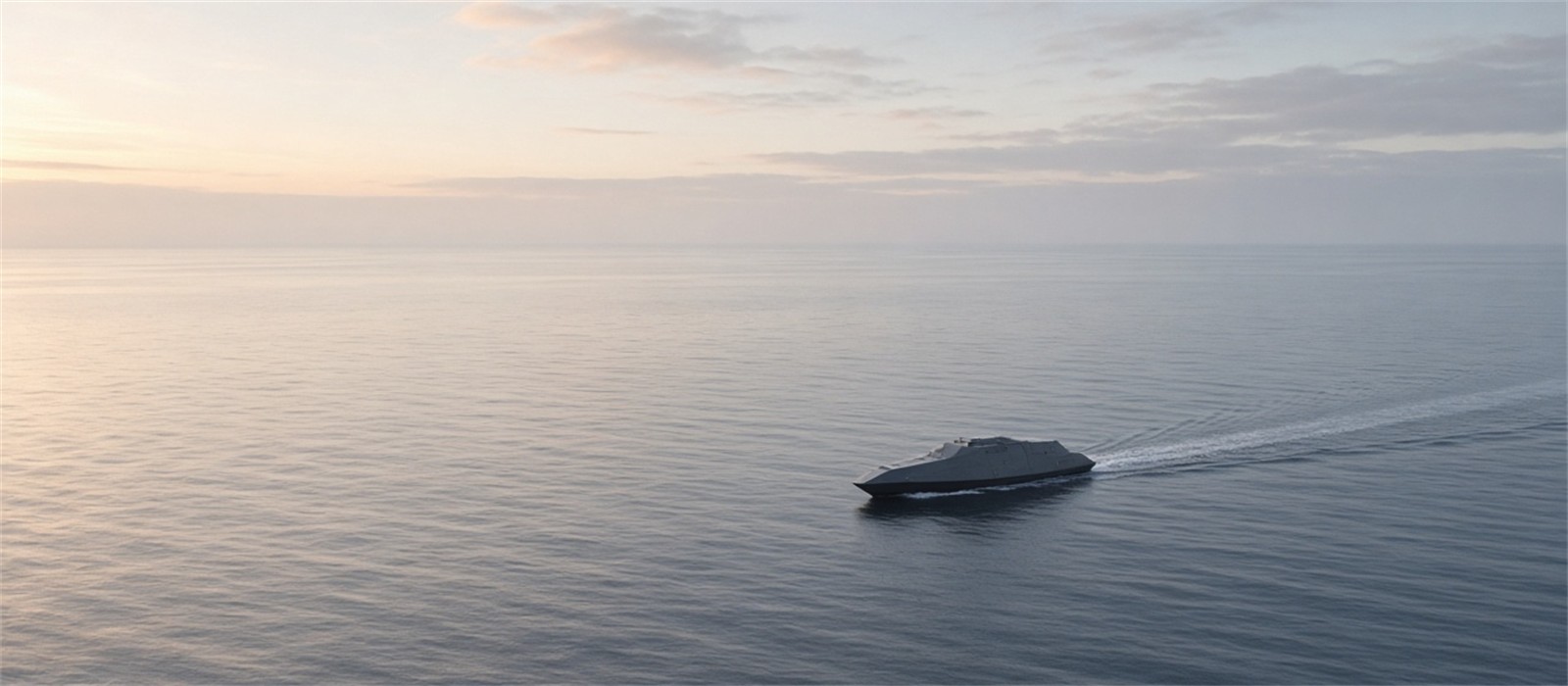


Editor’s note. In pursuit of examining ethical and operational issues of autonomous systems in the maritime domain, this article develops further on an earlier essay by Captain Alekh Agrawal in the Monsoon 2023 Despatch, “An Ethical Approach to Lethal Autonomous Weapon Systems.”
Abstract: The use of autonomous military systems in the maritime environment has lately become a matter of immense interest — or concern, depending upon which side of the fence you stand — for national security and operational planners. International law is still evolving with regard to such innovation in naval warfighting technology. This article begins by tracing the historic trends relating to the development of such unmanned maritime systems (UMS) by the global powers up to the present times. The central aim of this article is to deliberate upon their lawful employment for India and its lawful responses to such employment by its potential adversaries during peace and war. It attempts to clarify these issues through an interpretation of the United Nations Convention on the Law of the Sea, 1982, and the law of armed conflict (LOAC)
Introduction
It was not long ago when major global powers began to employ unmanned systems at sea and under the sea. Enabled by technological advancements in robotics, nations and their navies found that robotic systems using a tether or wireless link in relative proximity could help seafarers much with work that was either dangerous, dirty, dull or deep, adopted from the ‘4-D principle’ of robotics.1 Remotely operated vehicles (ROVs) began to be developed for various applications ranging from oceanographic research to tactical naval tasks like harbour security, as remote-controlled target boats for gunnery practice, or to neutralise sea mines. An example is the mine-countermeasures unmanned surface vehicle inducted by the US Navy in 2008 for its littoral combat ships.2 The employment of such remote-controlled systems did not raise any issues of international law, of course until such time as these were deployed in one’s own waters or the high seas.
In due course, unmanned maritime systems with varying degrees of limited autonomy were designed to operate for prolonged durations and at extended distances. An important feature of such autonomy was conformity with the 1972 International Regulations for Preventing Collisions at Sea (COLREGs 1972). Collisions at sea could be prevented with onboard self-learning, algorithm-enabled artificial intelligence. These autonomous vessels could undertake tedious benign missions such as search and rescue, but could also be employed in the maritime zones of potential adversaries for conducting surveys. This led to contestations relating to the interpretation of international law.
In wartime, autonomous unmanned vessels could be deployed for various missions ranging from intelligence, surveillance and reconnaissance to targeting. Pre-programmed to navigate along a route to the mission area, such vessels could employ onboard sensors based on predetermined parameters to generate targets and feed real-time data inputs from these sensors to their weapons for priority-based targeting. This also raises legal issues. Technology has not yet quite developed to the extent of providing unqualified and complete autonomy to unmanned systems — devoid of any human interface — to accomplish targeting missions. However, enabled by artificial intelligence and advanced machine-learning algorithms for decision-making, the potential exists, at least theoretically. This has given rise to debates over the legality and even the ethics of employing lethal autonomous weapon systems.3
The rationale for developing autonomous vessels for military applications ranges from addressing the shortfall of human resources to the immense value attached to the lives of highly trained crews. It is, therefore, understandable why the process began in the West, which is not only well endowed in terms of technological capacity and relatively constrained by human resources, but also because of its political factors during wars to avoid ‘bringing body bags home.’ Building unmanned vessels also costs less than manned vessels of similar capability, since their designs need not incorporate spaces and support equipment for the onboard crew.
For clarity, the various categories of unmanned maritime systems (UMS) referred to in this paper are broadly classified as either unmanned surface vehicles (USVs) or unmanned underwater vehicles (UUVs). USVs and UUVs include ROVs, as mentioned earlier, and remotely operated underwater vehicles, which remain under complete real-time human control. However, USVs and UUVs also include autonomous craft — autonomous surface vehicles (ASVs) and autonomous underwater vehicles (AUVs) — being designed with increasing degrees of autonomy.
In the context of the salient trends relating to the employment of autonomous unmanned maritime systems by major maritime powers, this paper seeks to clarify the legal foundations of their employment by governments and their navies in peacetime and during war. The scope of its analysis excludes the usage of maritime autonomous surface ships for seaborne trade. The specific aim of this paper is to provide functional guidance to government officials and naval practitioners on the legal perspectives and understanding of employing autonomous maritime systems and responding to the deployment of such systems by others in their maritime zones.
AUV and ASV Development Trends
Autonomous underwater vehicles
The worldwide development of AUVs preceded that of ASVs. In 1996, the US launched its first AUV — the Autonomous Benthic Explorer (ABE) — to perform a pre-programmed set of manoeuvres using thrusters to explore ocean depths.4 The British also began developing AUVs in the 1990s, which led to the first-ever oceanographic mission of Autosub-1 in 1997. The AUV was capable of GPS navigation between pre-programmed waypoints.5
The most notable of America’s first autonomous UUVs was the Bluefin-21, inducted by the US Navy in 2014 for mine-hunting.6 Equipped with side-scan sonar, it was deployed to search for the missing Malaysian airliner MH370.7 In November 2017, the US Navy deployed its upgraded Bluefin-12D (Deep) UUV to search for the missing Argentine submarine ARA San Juan. In 2017, the US launched its Orca extra-large UUV programme.8 Its key purpose was to deploy seabed-tethered Hammerhead mines armed with anti-submarine torpedoes. In 2019, the US Navy awarded America’s Boeing Company the contract for four Orca extra-large UUVs.9 The first Orca was delivered to the US Navy in December 2023.10
China launched its AUV development in 1989 with the “intelligent underwater robot” programme.11 With very few autonomous features, the AUV was essentially meant for stealthy intelligence, surveillance and reconnaissance missions.12 The programme fructified in 2000, when the PLA Navy inducted the Zhishui III (Smart Water 3) AUV.13 In 2014, China inducted the Haiyan AUV, which was designed for greater autonomy, increased endurance of 30 days and more operating depth, 1,500 metres.14 It was possibly derived from American technology, because in 2016 it came to light that a Chinese agent working in the US had been stealing American UUV and AUV technology.15 In 2016, China developed the Haiyi-7000 (Sea Wing) AUV and began deploying it in the Indian Ocean for missions lasting many months.16 Although the stated purpose was scientific studies and prospecting for deep-seabed minerals, Beijing’s actual aim was probably to use the stealthy AUVs to supplement the intelligence missions of China’s oceanographic research ships, since India had enhanced its surface- and space-based surveillance in its maritime zones. In response, India began bolstering its underwater domain awareness and initiated its own programme for the development of AUVs, which could be tasked not only for underwater surveillance but also for targeting. In July 2023, India launched its first AUV for user trials. Called Neerakshi, roughly translated as ‘eyes that see water,’ the limited-endurance AUV is meant for mine detection and underwater survey up to a depth of 300 metres.17
Until recently, the Chinese AUV programme was essentially meant for underwater surveillance. However, in February 2023, China revealed its new extra-large UUV, whose design is identical to the US Orca, except that it is the first UUV in the world to be designed for maritime targeting using onboard weapons. It incorporates a flank-array sonar with four torpedo tubes, implying an offensive capability against surface ships and even submarines.18 It is yet unclear whether such targeting will be controlled by human operators ashore, or whether the craft will be autonomous in this regard, and if so, to what extent.
Autonomous surface vehicles
In 2016, the US Navy inducted the Sea Hunter ASV as part of its anti-submarine warfare programme.19 In 2018, the British company SEA-KIT developed a semi-autonomous remote-controlled ASV called the Maxlimer, designed as a mother-ship platform to launch and recover ROVs, UUVs and AUVs. Hence, whereas an ASV itself does not provide value in terms of stealth, Maxlimer has the useful attribute of lift capacity.
In March 2021, the UK fructified its ASV programme called Madfox — Maritime Demonstrator for Operational Experimentation — to deploy these vehicles from the Royal Navy’s future Type 26 and Type 31 frigates for surveillance and force protection. Later that year, a Madfox prototype undertook a missile launch during a NATO exercise.
China is likely to have begun its ASV programme in the 2010s to reinforce its South China Sea claims. In January 2023, it inducted its first scientific-research ASV, Zhu Hai Yun, with an autonomous navigation function and the capability to operate autonomously in the Indian Ocean.20 Purportedly as its counter, India accelerated its own ASV programme for developing a water-jet-enabled autonomous fast interceptor boat. With an AI-enabled static and dynamic collision-avoidance system and mid-sea hover, it is meant for surveillance, search and rescue, mine clearance and even targeting up to a range of 10 nautical miles.21
Another valuable attribute of an ASV is speed. In October 2022, during the Russia–Ukraine war, Ukraine conducted a surprise attack on the Russian Black Sea Fleet using fast USVs, which was possibly the first-ever wartime employment of USVs for targeting at sea.
ASV and AUV Deployment in Peacetime
The employment of “vessels” and “ships” in the maritime domain during peacetime is governed by the United Nations Convention on the Law of the Sea, 1982 (UNCLOS). This umbrella maritime treaty does not define a ‘vessel’ or a ‘ship,’ and uses both terms interchangeably to mean any seagoing craft or vehicle. Nonetheless, COLREGs 1972 defines a vessel as “every description of watercraft, including non-displacement craft, wing-in-ground craft and seaplanes, used or capable of being used as a means of transportation on water.”22 Hence, the UNCLOS provisions for vessels and ships may be extrapolated to apply to USVs and UUVs. The deployment of USVs and UUVs thus pivots upon two key legal provisions of UNCLOS: the high-seas freedom and other navigational rights of a USV or UUV; and their sovereign immune status.
High-seas freedom and other navigational rights
According to the strictest interpretation of UNCLOS, all foreign-flagged vessels — including warships — enjoy the right of innocent passage through the territorial sea of a coastal state. Beyond the territorial sea, these vessels have the right to exercise all high-seas freedoms, with some caveats relating to the coastal state’s right to regulate foreign activities in the 24-nautical-mile contiguous zone relating to customs, immigration, fiscal and sanitary issues; and the foreign activities in the 200-nautical-mile exclusive economic zone related to economic resources.
It is, however, important to note that the national law of many states in the Indo-Pacific region, including India, imposes additional caveats on navigational freedoms based on their interpretation of UNCLOS and the declarations that these states have made while ratifying the Convention. For instance, India — like most other Asian countries — seeks prior consent for foreign military operations in its exclusive economic zone.23Such operations include hydrographic surveys with military applications. These caveats exist because, during the UNCLOS negotiations in the 1970s, the security concerns of the developing countries — who did not have adequate means to defend their sovereignty against maritime powers — were not addressed adequately. For instance, owing to the coastal state’s exclusive right to harness its living and non-living economic resources in the exclusive economic zone, UNCLOS made it obligatory for all foreign vessels to obtain the consent of the coastal state to undertake resource-related marine scientific research in its zone. However, the Convention did not incorporate a similar provision for related activities like oceanographic surveys, including hydrographic surveys, and acoustic mapping, wherein the collected data has substantive military applications, especially for submarine and anti-submarine operations. Being contentious, such issues were side-stepped during the UNCLOS negotiations. This void in UNCLOS has often led to discord among states. For instance, in 2009, the US alleged that Chinese vessels had harassed USNS Impeccable in the Chinese exclusive economic zone.24 Beijing believed that the US ship was gathering underwater acoustical data for anti-submarine operations.25 Another caveat to navigational rights imposed by many Asian states relates to innocent passage by foreign warships. For such passage, a few coastal states like India require “prior notification,” whereas many other states in India’s neighbourhood seek “prior authorization.”26
Such legal issues similarly apply to ASVs and AUVs. Their conduct of any activity in the maritime zones of a coastal state that contravenes its rights under UNCLOS, or such activities that contravene its national laws relating to its national security — ranging from oceanographic surveys to electronic intelligence — may be deemed to be unauthorised and responded to by the concerned coastal state.
Sovereign immune status
UNCLOS accords sovereign immunity to all government ships operated anywhere for non-commercial purposes, including warships and state-owned naval auxiliaries, provided these ships are exclusively employed in public or government service.27 If such a foreign vessel is conducting unconsented marine scientific research, legally forbidden by UNCLOS, or military or survey activities, not forbidden by UNCLOS, in the maritime zones of the coastal state, the state may lodge a diplomatic protest. In addition, to enforce its domestic law, it may use its warships, including coast-guard vessels, to facilitate the departure of the vessel from the state’s maritime zones by establishing real-time voice communication, adherence to the diplomatic protocol and escorting the vessel.
The issue of sovereign immunity applies similarly to ASVs and AUVs operated by the government of a sovereign state for non-commercial purposes in the maritime zones of a coastal state. Whether or not the craft is classified as a warship or a naval auxiliary is inconsequential to the issue. Such immunity will apply even in the territorial sea of the coastal state. However, if any unauthorised activity is being conducted by a foreign ASV or AUV in a coastal state’s maritime zones, the functional challenge for the state’s warship will be to enforce the national law, particularly by establishing real-time communications with the controllers of the foreign craft. Even if these vessels are equipped with advanced data communications with home-base command centres, such interface is unlikely to be continuous and real-time. Besides, mariners are more familiar with standard Channel 16 voice communications with foreign ships. In such a contingency, the coastal state’s warship will need to use good seaman practices and, if necessary, use proportional force, as guided by the application of relevant rules of engagement for peacetime and heightened states of readiness in short-of-war conditions.
If captured in accordance with the applicable rules of engagement, the foreign ASV or AUV will need to be returned to its owner state based on the principle of sovereign immunity. In 2016, the PLA Navy seized an American UUV in the exclusive economic zone of the Philippines, in an area also claimed by China. The UUV was being operated by the oceanographic and surveillance ship USNS Bowditch.28 China eventually returned the UUV within a week.29
ASV and AUV Deployment in Wartime
During an armed conflict, the international law of armed conflict regulates the methods and means of warfare by the belligerents, essentially to achieve a balance between military necessity and humanity.30,31 Whenever such conflict involves naval forces, the law of naval warfare — a constituent of the law of armed conflict — comes into play, which regulates the employment of the means and methods of warfare at sea. Naval platforms and the weapon systems onboard these platforms constitute the means of naval warfare. The law obliges the belligerents to adhere to the principles of distinction and proportionality. The distinction relates to distinguishing between military objectives and civilian objects, which is not easy during a war, considering the uncertainties in situational awareness experienced by the belligerents. This is the reason why only warships are accorded belligerent rights to conduct warfare at sea. These include the right to conduct attacks against military objectives, the right to enforce a blockade, the right to control neutral vessels and aircraft in the immediate vicinity of naval operations, and the right to visit, search and capture merchant vessels under prize law.
The legality of the employment of ASVs and AUVs in wartime needs to be understood in this context. It involves addressing some pertinent questions relating to these unmanned vessels, which are posed and answered below.
Are ASVs and AUVs legally forbidden as a means of warfare?
The first question is whether the law of armed conflict circumscribes or restricts the employment of ASVs and AUVs as a means of naval warfare. The answer is no. The law expressly forbids the use of certain means of warfare, such as biological weapons, chemical weapons, anti-personnel landmines, blinding laser weapons and cluster munitions, under the respective conventions. ASVs and AUVs are not expressly forbidden under any specific treaty.
Can ASVs and AUVs be designated as warships?
The second question is: can ASVs and AUVs exercise belligerent rights as warships? To answer this, the question arises: can these be designated as warships, as is the trend among the major naval powers led by the US? To answer this question, let us look into the definition of a warship. UNCLOS Article 29 defines a warship as
“a ship belonging to the armed forces of a State bearing the external marks distinguishing such ships of its nationality, under the command of an officer duly commissioned by the government of the State and whose name appears in the appropriate service list or its equivalent, and manned by a crew which is under regular armed forces discipline.”
At first glance, it may be argued that USVs and UUVs do not qualify as warships in existing international law, since the UNCLOS definition makes it obligatory for a warship to be “manned.” However, this argument is not valid. The essence lies in a more precise interpretation of UNCLOS by comprehending the context and spirit of its text, rather than drawing inferences from specific words of the text that may not be consonant with the broader context.
While formulating UNCLOS in the 1970s, by defining ‘warship,’ the broader aim of the drafters of the Convention was to reinforce the customary law against privateering. It was a widespread practice among European states before the mid-19th century for a privateer to supplement a state’s naval capacity during wartime through “letters of marque” issued by the state. For this contribution, the privateer was permitted to keep a percentage of a “prize,” enemy property collected, instead of being paid directly by the state. However, privateering was abolished by the 1856 Paris Declaration, and the distinction between warships, privateering vessels and non-combatant ships was later codified in the Hague Convention (VII) of 1907.32 Hence, the complete text of the UNCLOS definition of ‘warship’ is essentially meant to distinguish a ship under the direct constitutional control of a sovereign state meant for warfighting from that of a privateering vessel controlled by a private citizen, which is now illegal.
In the UNCLOS definition of ‘warship,’ the mention of the word “manned” was merely incidental to the context and a result of the fact that the drafters of the text could not have foreseen the future technological advancements at that point in time. Hence, there is no legal obligation for the operators of a warship to be physically present onboard. Therefore, if a state classifies an ASV or AUV as a warship, it is well within its rights to do so, since it retains the responsibilities and obligations of its legal conduct as a warship.
Can ASVs and AUVs conform to the principles of the law of armed conflict?
To reinforce the argument that ASVs and AUVs may exercise belligerent rights as warships, let us look at the third question: can ASVs and AUVs adhere to the principles of the law of armed conflict with regard to distinction and proportionality? Except for the means of warfare specifically circumscribed by law, as mentioned above, the law does not lay down any conditions for the employment of specific means of warfighting, but provides adequate flexibility to the belligerents to choose the means, until such time as such means adhere to the two essential principles of distinction and proportionality. These principles can be adhered to if the wartime employment of ASVs and AUVs has adequate human oversight. This is the case with ASVs and AUVs, with human operators being able to monitor, override and terminate targeting operations, if necessary. According to an Indian analyst, “Currently, risk aversion has become a big barrier for enhancing the degree of autonomy of weapon systems… fully autonomous systems of the more distant future may be able to adhere to the principles more objectively than humans, since these systems will not be overwhelmed by emotions during combat, process the available information more objectively and faster than humans, and avoid multitasking and information overload.”33 However, this is likely to occur only beyond the foreseeable future, when lex ferenda, future law, would evolve to address such technological developments. In the foreseeable future, therefore, with essential human oversight, ASVs and AUVs deployed for targeting would be able to conform to the essential principles of the law of armed conflict.
Wartime employment of craft not designated as warships
A pertinent question remains unanswered: can ASVs and AUVs, not specifically designated as warships, be employed in war, and if so, how? To answer this, we need to understand the legal status of small naval craft that are not classified as warships. Such craft — such as ships’ boats and rigid-hulled inflatable boats — may be deployed from manned warships. Legally being an extension of the launch platform, such craft possess belligerent rights. For instance, that is how a warship’s motor-whaler or other boat is deployed for a boarding operation against an enemy merchant vessel. Hence, any ASV or AUV deployed from a warship will retain the belligerent rights of its parent warship.
However, the issue becomes complex if the small craft in question is shore-based, such as the interceptor craft inducted by the Indian Navy for coastal security after the Mumbai terror attacks of 2008. Such a craft possesses sovereign immunity — since it is a government vessel on non-commercial duty — but the question of its belligerent rights remains unanswered. State practice indicates that, even without being formally designated as warships, such naval small craft may be employed in certain belligerent operations, such as attacks, minelaying and mine countermeasures. Hence, considering the absence of any black-letter rule against such state practice, shore-based ASVs and AUVs may be lawfully deployed during the war for all belligerent tasks, with the exclusion of visit, search and capture of merchant ships under prize law and the right to control neutral vessels and aircraft in the immediate vicinity of naval operations.
What about the adherence to the principles of the law of armed conflict by such craft? Again, the responsibility for such adherence lies with the shore-based human controller or decision-maker. In the extreme case — if at all, and whenever — the craft is fully autonomous and capable of targeting without human oversight, the principles of the law of armed conflict will not change. These principles will need to be adhered to by the designer of the craft, and the state deploying these craft may be held responsible for any deviation from these core principles.
Employment of Aerial Drones
While the emphasis of this paper is on unmanned surface and underwater vehicles, it is highly relevant to compare the legal underpinnings of their employability with those of unmanned aerial vehicles and unmanned aerial combat vehicles. UNCLOS is silent on the subject of aerial drones. Nonetheless, such aerial drones draw their peacetime rights as aircraft — essentially for overflight and sovereign immunity, the latter applicable only to state aircraft — from the Convention on International Civil Aviation, 1944, the Chicago Convention. The Chicago Convention does not make it obligatory for an aerial vehicle to be manned to qualify as an aircraft.34 Ostensibly, such a legal provision could emerge at that time because, up to the 1940s, aviation was still a relatively nascent industry, leading to a very low probability of mid-air collisions. Also, autonomous targeting by aerial combat vehicles was inconceivable at that time to cause any legal worries. Hence, the law also emerged stating that
“an aircraft operated by the armed forces of a State; bearing the military markings of that State; commanded by a member of the armed forces; and controlled, manned or preprogrammed by a crew subject to regular armed forces discipline” qualifies as a military aircraft that is entitled to exercise belligerent rights.35
State practice indicates that, in naval warfare, this legal tenet has been extrapolated to imply that an aerial vehicle deployed from a warship bears the status of both a military aircraft and a warship, as an integral part of that platform.36
Hence, military forces began to employ unmanned aerial vehicles long ago for various tasks like surveillance. In more recent decades, unmanned aerial combat vehicles are being increasingly employed in various scenarios, ranging from targeted killing of terrorists on land to hunting submarines at sea. Whether such targeting is undertaken on land or in the maritime environment, the employment of these aerial vehicles — like that of surface and underwater vehicles — is lawful as long as the principles of the law of armed conflict are adhered to by the state or authority controlling their employment.
However, unmanned aerial combat vehicles are increasingly incorporating more autonomous features, leading to legal debates. In the ‘fog of war’ environment, command decisions tend to be based more on subjective than objective factors. In such an environment, will these vehicles — like autonomous surface and underwater vehicles — with fully autonomous decision-making features be able to achieve the necessary distinction between military objectives and civilian persons or objects? This is a question that is too early to answer.
Conclusion
Unlike in the case of aerial vehicles, the employment of unmanned maritime systems has never been formally acknowledged by the law, either in peacetime or during armed conflict. UNCLOS 1982 predates the new technological developments relating to such surface and underwater vessels. This is also the case with the law of armed conflict, which is based on the Hague Conventions and the Geneva Conventions of 1949. Whereas the distillate of that law relevant for naval warfare is contained in the San Remo Manual of 1994, this document also predates the advent of the current revolution in naval warfighting technologies that have led to the current employment of autonomous surface and underwater vehicles.37 Hence, the law for employment of such autonomous maritime systems is evolving through state practice, and its interpretation in new restatements of law, such as the Newport Manual on the Law of Naval Warfare.38 However, state practice needs to evolve over many decades to be considered as constituting customary international law. Notwithstanding this challenge, this paper suggests that a more profound interpretation of the law does provide some answers to practitioners with regard to the lawful employment of such autonomous maritime craft in peacetime and during war.
During peacetime, as for any other seagoing vessel, an autonomous surface or underwater vehicle deployed by a state anywhere for non-commercial purposes enjoys all high-seas freedoms, including navigational rights, provided that it operates in conformity with all relevant international conventions, such as COLREGs 1972. If such a craft is undertaking an unauthorised activity in a maritime zone of a coastal state in abrogation of its national law, the state is authorised to enforce its laws, including through the use of force. In doing so, if the craft is captured, it must be returned to its parent state based on its sovereign immune status.
A contextual interpretation of the law also provides a legal basis for autonomous surface and underwater vehicles specifically designated as warships to exercise all belligerent rights during war. The other autonomous vehicles not designated as warships may also exercise certain belligerent rights. Furthermore, if the non-autonomous vehicles are deployed in wartime from warships, these attain belligerent rights by virtue of the status of their launch platform. In all cases, the conduct of all such craft with regard to conformity with the law of armed conflict rests with their parent state. The nuances of the evolving law, including treaties and conventions, as applicable to unmanned maritime vessels and systems — surfaced or submerged — should remain areas for study for all concerned with maritime operations in peace and in conflict.
Endnotes
- In robotics, the 4-D principle refers to “dull, dirty, dangerous and dear.” Andrew McAfee and Erik Brynjolfsson, Machine, Platform, Crowd: Harnessing Our Digital Future (New York: W. W. Norton, 2017), cited in Bernard Marr, “The 4 Ds of Robotization: Dull, Dirty, Dangerous and Dear,” Forbes, 16 October 2017, https://www.forbes.com/sites/bernardmarr/2017/10/16/the-4-ds-of-robotization-dull-dirty-dangerous-and-dear/.
- “Fleet Class Common Unmanned Surface Vessel (CUSV),” Naval Technology, 22 December 2014, https://www.naval-technology.com/projects/fleet-class-common-unmanned-surface-vessel-cusv/.
- “ICRC Position on Autonomous Weapon Systems,” International Committee of the Red Cross, 17 May 2021, https://www.icrc.org/en/publication/4550-icrc-position-autonomous-weapon-systems.
- “Autonomous Underwater Vehicle ABE,” Woods Hole Oceanographic Institution, https://archives.whoi.edu/ABE/main/ABE.html.
- “Autosub-1: Celebrating the 25th Anniversary of the NOC’s First AUV Mission,” National Oceanography Centre, 4 August 2021, https://noc.ac.uk/news/autosub-1-celebrating-25th-anniversary-nocs-first-auv-mission.
- Sally Cole, “Unmanned Underwater Vehicles Modernize U.S. Navy’s Sea-Mine-Hunting Capabilities,” Military Embedded Systems, 23 April 2014.
- “Bluefin-21 UUV Continues its Search for Missing Malaysian Airlines Flight,” Military Embedded Systems, 15 May 2014.
- Xavier Vavasseur, “Here is our First Look at the US Navy’s Orca XLUUV,” Naval News, 7 May 2022, https://www.navalnews.com/naval-news/2022/05/here-is-our-first-look-at-the-us-navys-orca-xluuv/.
- Vavasseur, “Here is our First Look at the US Navy’s Orca XLUUV.”
- “Boeing Delivers First Orca XLUUV to U.S. Navy,” Naval News, 20 December 2023, https://www.navalnews.com/naval-news/2023/12/boeing-delivers-first-orca-xluuv-to-u-s-navy/.
- “The Founder of Underwater Intelligent Robots, Xu Yuru, Passed Away in Harbin on the 17th,” Harbin News Network, 19 February 2012, archived copy.
- Michael S. Chase et al., “Emerging Trends in China’s Development of Unmanned Systems,” RAND Corporation, 2015, 3.
- As note 11.
- “China’s Self-Developed Underwater Glider Finishes Sea Trial,” People’s Daily Online, 28 May 2014.
- Military and Security Developments Involving the People’s Republic of China 2017, annual report to Congress, US Department of Defense, 15 May 2017, 71.
- Rajat Pandit, “India on Alert as China Deploys Dozen Underwater Drones in IOR,” The Times of India, 24 March 2020.
- Tamaghna Banerjee, “GRSE Launches Autonomous Underwater Vehicle in Kolkata,” The Times of India, 28 July 2023.
- “China Unveils Extra-Large, Heavily Armed Drone Submarine,” The Eurasian Times, 23 February 2023.
- James Vincent, “The US Navy’s New Autonomous Warship is Called the Sea Hunter,” The Verge, 8 April 2016, https://www.theverge.com/2016/4/8/11391840/us-navy-autonomous-ship-sea-hunter-christened.
- Sakshi Tiwari, “China Claims Inducting World’s 1st Unmanned Drone Carrier,” The Eurasian Times, 14 January 2023.
- Pradip R. Sagar, “How Indian Navy is Readying First Indigenous Unmanned Vessel to Counter China,” India Today, 24 July 2023.
- Convention on the International Regulations for Preventing Collisions at Sea, 1972.
- United Nations Convention on the Law of the Sea, 1982, status of signatures and ratifications, United Nations Treaty Collection, status as on 9 September 2022.
- “U.S. Accuses the Chinese of Harassing Naval Vessel,” The New York Times, 9 March 2009.
- Laura Zhou, “US Navy Keeps Closer Watch on China Submarines, Beijing Think Tank Says,” South China Morning Post, 14 July 2021.
- As note 23.
- The concept of sovereign immunity emanates from the long-standing rule of international law that no state has authority over another state, since all sovereign states are equals.
- Julian Borger, “Chinese Warship Seizes US Underwater Drone in International Waters,” The Guardian, 16 December 2016.
- Mark Katkov, “China Returns U.S. Navy Drone Seized in South China Sea,” NPR, 20 December 2016.
- The right of combatant forces to employ all lawful means and methods of warfare to achieve lawful military effects designed and intended to bring about the submission of the adversary’s military and other fighting forces at the earliest opportunity, with the least expenditure of one’s own forces.
- The principle forbids infliction of suffering, injury or destruction unnecessary to accomplish a legitimate military purpose.
- The customary law that declared privateering illegal emanates from the Declaration of Paris, signed on 28 February 1856 after the Crimean War, and later codified in the Convention relative to the Conversion of Merchant Ships into War-Ships (Hague VII), 1907.
- Jayakrishnan N. Nair, “Fully Autonomous Military Systems: Challenges in Development,” Indian Defence Review, 30 May 2020.
- Convention on International Civil Aviation, Article 8 (Chicago: International Civil Aviation Organization, 1944).
- Wolff Heintschel von Heinegg, “The Law of Armed Conflict at Sea,” in The Handbook of International Humanitarian Law, ed. Dieter Fleck, 4th ed. (Oxford: Oxford University Press, 2021). See also James Kraska et al., Newport Manual on the Law of Naval Warfare (Newport: Stockton Center for International Law, 2023), 63.
- Kraska et al., Newport Manual on the Law of Naval Warfare, 60.
- Louise Doswald-Beck, ed., San Remo Manual on International Law Applicable to Armed Conflicts at Sea (Cambridge: Cambridge University Press, 1995).
- Kraska et al., Newport Manual on the Law of Naval Warfare.
