




A picture of an Indian Naval ship named Androth recently launched by GRSE brought back memories of my own time onboard the earlier Androth, a ‘Petya’ (NATO class name for Soviet-era ASW light frigates of which our Navy had ten). I was the Engineer Officer (EO) from December 1979 to March 81. We had a very fine set of officers and men led by a colourful Commanding Officer. In later life, the Captain became a Flag Officer, the Executive Officer (XO) and the Torpedo and Anti-Submarine Officer (TASO) both became naval chiefs and yours truly didn’t do too badly either. There were many incidents of interest onboard, but I choose to narrate one particular evolution, quite unlikely to have happened in any other Navy.
As Ready as Can be, Except…
Four out of the five Petyas based in Mumbai (then Bombay) had been moved to the east coast and we were the only one still on the West Coast. There were no OPVs in the Navy then. The Coast Guard, which had been formed just a couple of years ago, had only two ex-IN steam-propelled frigates. None of them were suitable for a quick deployment for any SAR mission. With her gas turbines, Androth could put to sea quickly and sprint at thirty knots, the moment she left harbour. So, it naturally devolved upon Androth to be the ready duty ship almost continuously. Although no emergencies arose, being perpetually ready to deploy in an hour, was not easy. The CO especially was under quite some tension, as the ship had to constantly follow the two-watch system and as it usually happens, all the best and brightest watchkeepers are always off watch! When more Petyas were based in Mumbai, the problem was not so acute. One could always borrow a few officers and men from sister ships and they would have been familiar with all equipment and systems. Being the lone Petya in Mumbai, gave us no such options.
In those days, no one had a phone; only the CO was entitled to a landline at his residence. Whenever the CO raised his misgivings about recalling the off-watch crew within the hour for a do-or-die mission, the powers that be read out the WENGO (Western Naval Command General Orders), outlining the recall organization of the WNC which would get everyone onboard before the ship cast off. In a few pages of sepia-coloured cyclostyled paper, the WENGO outlined how the sailing signal for such sorties during off-working hours would be copied to INS Kunjali. Their OOD would immediately send out a jeep with a loud hailer all around Navy Nagar and NOFRA, asking all personnel of the Ready Duty ship to rush back to their ship. What such neat orders often fail to realise is the plight of the OOD of a Naval Provost establishment, when he receives such a signal. As conceived by Murphy the lawmaker, the only available jeep would have been sent on an errand; the loud hailer (being a prized possession bought out of non-public funds) would have been locked up in the XO’s cupboard; the duty watch personnel to be sent on the jeep to recall everyone, would probably have been musicians, etc. Those who knew reality on the ground would have easily pegged the recall time to three hours at best. The Ready Duty ship would have no option but to sail off with half the crew. As all of us know, pragmatism has never been a virtue of Command HQ staff. They were in total praise of the WENGO, prepared by none other than the Command Operations Officer (COPO), who had been a DS at the staff college in his previous tenure and had just been commended by the C-in-C for penning down such an effective yet concise order.
A Bird in Hand?
The CO had got tired of bringing up his misgivings of the recall organisation in many forums and was at his wit's end. That is when we sailed to Goa and enroute anchored off Ratnagiri, hoping to pick up some choice mangoes for the entire Western Fleet and also earn some pilotage for the chosen few. What we managed was just two cartons of mangoes given gratis by a customs officer, but the CO was able to gather some useful intel. Ratnagiri had an institute to train local fishermen on basic navigation and communication. When we saw this very Governmental looking, ramshackle building, the most noticeable aspect was the hundreds of pigeons sitting on the rooftop. Questions posed to the watchman revealed something we never knew. Once pigeons grow up in one place for a few generations, they would always fly back to the same place if released within a reasonable range. As part of the safety drill, fishermen carried a couple of pigeons while putting out to sea and if they had an emergency, scribbled out their problem on a piece of paper, attached it to the feet of the pigeon and let it fly off. Within a short time, the pigeon would land back in the institute building; be easily picked up, the message read and acted upon. We didn’t think much of it when we learnt of this ‘homing pigeon' system but didn’t fail to notice the smirk-laced smile the CO wore for a passing second. As a Long Communications officer of repute, his disdain for this pigeon-based communication was understandable.
And Two Birds on Deck!
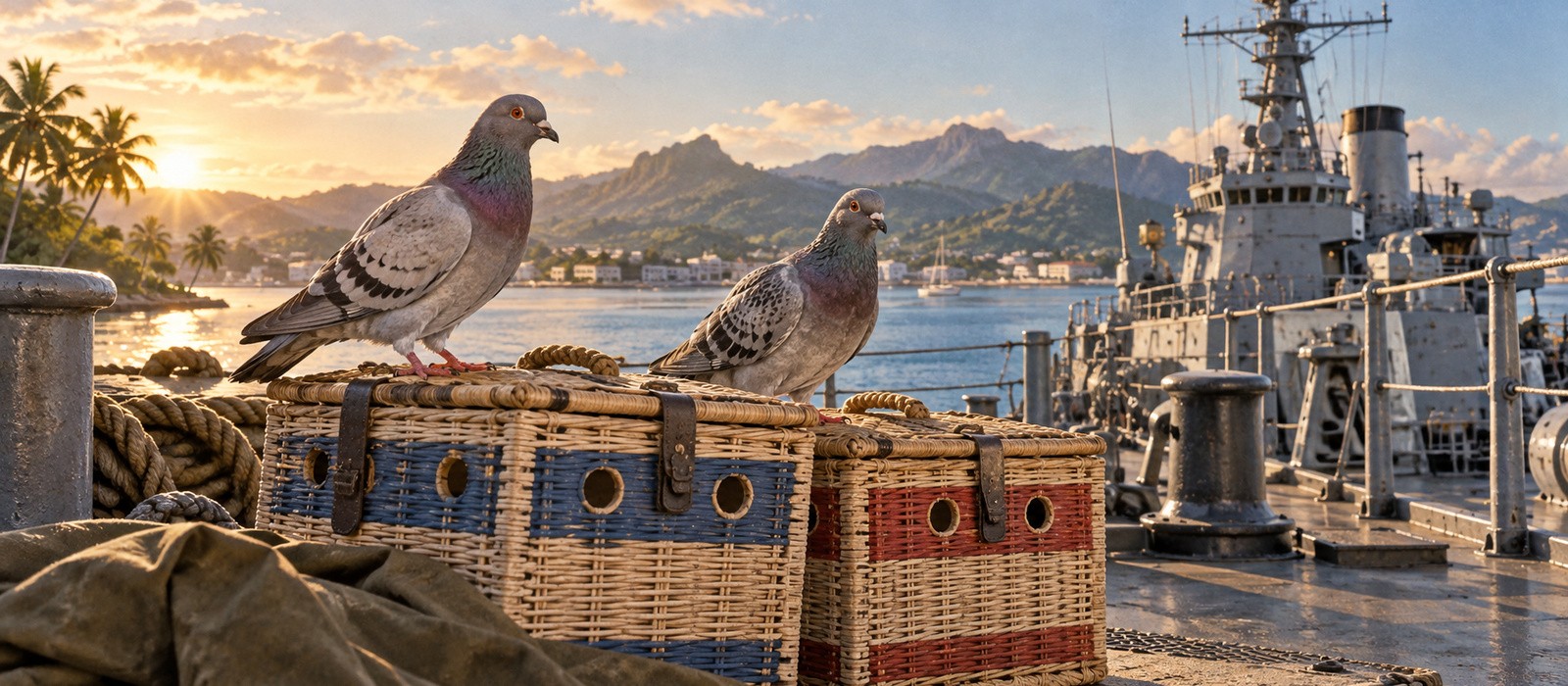
Within a day of our return to Mumbai, we saw the Captain’s coxswain bringing a couple of pigeons to the ship. It was by the Old Man’s orders and hence, no one questioned this rather strange addition to the ship’s crew. They were kept on the grating forward of the funnel near the ‘Podarak extra water tank,’ with wire mesh baskets, normally used for supplying bread, being inverted to form a cage of sorts. It was so named because it was a Russian gift or ‘podarak’ before the ship had sailed from the USSR. This part of the ship was also the open-air ‘dining hall’ for junior sailors and hence, the pigeons were invariably overfed. Very soon they became plump and could not have flown to save their own lives.
Harbouring a Plan for Harbour Inspection
A few weeks went by and the ship was inspected by the FOCWF. The sea inspection went off well and soon came the harbour inspection. The Admiral walked around the ship and found it shining from the jack to the ensign staff. He was very impressed and promised to get back for a glass of beer with the officers that afternoon. As the Admiral was about to step off the gangway from the raised breakwater in the forepeak, he saw an unusual movement to his starboard. Laid out on a lovely table covered with green bunting cloth were two freshly painted bread baskets, placed inverted and holding one pigeon each. One of them had a blue ribbon on its neck and the other had a pink one. Pigeons as you know, are not used to being stared down by Admirals and ignoring the presence of such a dignitary, were going about their movements with gurgling sounds. The Admiral was aghast, but as Flag Officers are wont to, didn’t show it.
Here I would like the reader to pause a moment and picture the situation in one’s mind. The Admiral and the Captain standing a couple of feet above the deck on the breakwater, just inches away from the gangway, all HODs lined up on one side and brimming with pride after having just shaken hands with the Admiral; the OOD in stiff attention having yelled out, ‘Standby to Pipe,’ the two Quartermasters with their chests filled with air waiting to pipe their lungs out and suddenly, the Admiral pauses to look at these pigeons and naturally asks, “What’s this?”
Not for the Pigeon-Hearted!
Having long anticipated just such a query, the CO quickly apologised for not having briefed the Admiral, during the walk around. “This, Sir, is Androth’s recall organisation. We found using the loud hailer with a jeep from Kunjali would never be fast enough and have developed our own method. This pigeon with the blue ribbon is Heckle and the pink one is Jeckle. When the OOD gets the SAR sailing signal during non-working hours, he will order the QM to lift the bread baskets and both Heckle and Jeckle will fly off. They are homing pigeons. Heckle will go straight to XO’s house and Jeckle will head to the Chief Bosun Mate’s. They both will know that the balloon has gone up and immediately round up our officers and men from their quarters. The entire evolution may take at best 15 minutes and the whole crew will be back on board before we cast off.”
There was pin-drop silence. Even the pigeons knew their time was up and kept unusually quiet. The gleam in the eye of the Admiral spoke more than what he would have liked to say. The side pipes shrilled and the Admiral was seen off with all formalities. Later he returned for the promised glass of beer before lunch and the noise of that party could be heard all the way to the Mantralaya.
May the new Androth and all those who sail in her have the same spirit as this illustrious crew half a century ago. They just need to follow the good old Naval dictum; Intellect, Enterprise and Humour resolve issues a lot easier. Perhaps cunning and conning are related?
