




Editorial Note: This article is a combination and expansion of two articles centred on the 1971 conflict, but also looks at issues a little beyond that. As a former Chief of the Naval Staff and a young participant in the war, in which he himself won a gallantry award on a citation forwarded upon him by the IAF, the Vir Chakra (which he does not mention), his observations on leadership, tactics, differences in professional cultures of the IAF and IN, jointness as well as the need for improvement of the way we archive, write histories and analyse past conflicts are important. Readers may not know that, years later Lieutenant Arun Prakash discovered that he had destroyed the famous USAF Brig General Chuck Yeager’s personal Beechcraft airplane at Chaklala airbase in Pakistan during the war. He makes no mention of it here, but has written elsewhere about it. He must have ruined Chuck Yeager’s day and more!
Preamble
By the time I had completed a decade of naval service in 1976, I realised, to my horror, that I had spent more than half of it with the IAF. Friends facetiously suggested that under these circumstances, I would be better off changing into khakis (then worn by our air force).
This ‘anomaly’ was the cumulative effect of the following sequence of events: I had spent 27-months (instead of 18) in flying-training, since I suffered a head injury after bailing out of a Vampire Mk 52. Just a year after acquiring Deck-Landing Qualification (DLQ) on board INS Vikrant in 1969, I served a two year tenure in an IAF squadron. Soon after returning to the Indian Navy, I was detailed for a six month course in the Test Pilots School, Bangalore. On completion, I spent another six months with No. 6 Squadron IAF, converting to the Super Constellation. All this, did add up to five and a half years - but I hung on in the navy!
I offer this bit of personal trivia, for two reasons. First, to explain my absence from Vikrant, during what was, no doubt, her ‘finest hour’ in 1971 when the carrier and her air squadrons played a key role in the tri-service campaign for the liberation of East Pakistan. It is also a prelude to the memoir that follows; a recall of the 1971 War, not as fought at sea, but as experienced in the air on the Western front.
Our Neglect of History
But before plunging into this account, I wish to digress a little in order to share, with the reader, my dismay about the state of history writing in India. While searching for information on the 1971 War, I came across an excerpt from the autobiography of retired US Air Force Brigadier General Charles ‘Chuck’ Yeager, which read: “The Pakistanis whipped the Indians’ asses in the sky...the Pakistanis scored a three-to-one kill ratio, knocking out 102 Russian made Indian jets and losing 34 airplanes of their own...I’m certain about the figures, because I went out several times a day, in a helicopter, to count the wrecks.”1 Elsewhere, he alleged that the IAF was supported by Soviet personnel, flying Tupolev 126 early warning aircraft, which jammed PAF radars and homed on Indian air raids in the dark of night.
Yeager was no ordinary commentator. He happened to be a WWII and Vietnam ‘fighter-ace,’ who had earned legendary fame as a test pilot by becoming the first aviator to shatter the ‘sound-barrier’ in 1947. Known for his acerbic nature and eccentric conduct, he rose to the rank of Brigadier-General, and in his pre-retirement posting, the Pentagon decided to send him to Islamabad as head of the US Military Assistance Advisory Group. Fellow staffers within the US Embassy, soon began to notice Yeager’s enthusiastic embrace of the Pakistan Air Force (PAF). It was rumoured that at the outbreak of war, he had moved into a PAF base and was personally directing operations against the IAF.
Knowing how preposterously inaccurate/untrue Yeager’s comment was, I wondered where one could find a record of India’s contemporary military, naval and air operations, which could confirm or debunk such exaggerated claims? While quite a few authors have penned valuable accounts, I started to search for an official history of the 1971 War, which could yield authentic data. In the Ministry of Defence website, I found mention of a History Division. Established in 1953, the division was said to have, “published 17 volumes so far,” after which it seemed to have gone into hibernation. The History Division’s 15th and 16th publications are titled, respectively, ‘Indo-Pakistan War of 1965’ and ‘Indo-Pakistan War of 1971,’ but none of them are available on the MoD website.
An internet search threw up a private military website, on which photostat copies of these two typed manuscripts, neither of which was designated as ‘official history,’ have been uploaded.2 The document, pertaining to the ‘Indo-Pakistan War of 1971,’ is dated June 1992, and contains an upbeat Foreword by the Defence Secretary (Shri NN Vohra). However, the author, a historian, Shri SN Prasad, writes in a melancholy Preface, “Although this history is complete and authentic… the draft has not been finally edited. The effort appears useless and wasteful, when the account is not to be published…” He adds, “I do not consider this account a proper history, but only a compilation of facts in narrative form.” All 19 chapters as well as the Foreword and Preface of historian SN Prasad’s work are available on the website mentioned above.
The question why this painstakingly compiled and researched 800 pages narration of 1971 War was never approved and published as ‘Official History,’ remains unanswered. Could it be because the ‘system’ found the historian’s objective commentary and frank analysis/critique unpalatable? Here, I will leave this discussion for the interim and resume my personal account.
A Fish Out of Water
Life as a pilot in 300 Naval Air Squadron (INAS 300: ‘The White Tigers’), was exciting and challenging because carrier operations and flying at sea demanded skill, and one’s first mistake could be the last. The Sea Hawk, a first-generation ground attack jet fighter, had few vices and forgave us many aerial trespasses. Although limited in performance, its modest payload of camera, guns, rockets and bombs, was adequate for its roles: air-defence of the fleet, anti-shipping strike, army close-support and photo-reconnaissance. There was never a dull moment on the carrier, but adrenaline pumped the fastest during the catapulted take-offs and arrested landings.
I had just settled down and begun to enjoy the carrier’s intense flying routine, when I received orders to proceed for a two year ‘exchange posting’ with the IAF. Bidding a reluctant farewell to my squadron-mates, I departed for IAF Station Jamnagar. There, I underwent a conversion to the Hunter ground attack fighter, a more powerful, swept wing, trans-sonic descendent of the Sea Hawk.
On completion of conversion, I reported to my new unit at the end of 1970. This was No. 20 Squadron, which bore the nom de guerre, ‘Lightnings.’ It was based in Hindon, close to Delhi. In an alien environment, a thousand kilometers from the sea, I felt like a fish out of water; my own unease being matched by the curiosity of my new squadron-mates about the ‘marine creature’ in whites! However, I was soon engulfed by traditional air force camaraderie, which ensured my quick acceptance into the ‘Lightning’ family.
The squadron was commanded by Wing Commander (later Air Vice Marshal) CV Parker, an accomplished flyer and outstanding officer, who evoked awe and respect in equal proportions. A strict disciplinarian and a daunting figure in the office, the ‘Boss,’ after work, was a changed personality. I was to witness this on many weekends, when the squadron indulged in the time honoured IAF custom of ‘bouncing.’ This meant that a bunch of us could land up, unannounced, in ‘Lightning House,’ late at night, and receive unstinted hospitality from a smiling Boss and Mrs Parker. Although I was treated just like any of the other squadron pilots, I did receive preference on the flying programme, which enabled me to earn ‘fully operational’ status (day/night) on the Hunter, ahead of the others.
Since I was designated ‘Office-in-Charge Diary,’ I became privy to almost all activities that took place in the unit and had the privilege of maintaining the squadron’s war diary. The next year and a half with the Lightnings was to be a great learning experience; not only about flying, but also about ‘officership’ and ‘leadership.’
The Operating Environment
For a naval aviator, used to operating in the cramped confines of a carrier, flying from a land locked air base was relatively relaxed, but required some mental re-orientation. A major change was freedom from the ever present concern about ditching or ejection over the sea. This absolved one from wearing a constricting ‘mae-west’ (life-jacket) and remaining hitched to a rubber-dinghy/sea-survival pack in the cockpit. When operating from the carrier, your mission often receded into the background as you faced the immediate challenge of a catapult launch or arrested recovery. Ashore, on the other hand, given the luxury of an 8000-foot runway, take-offs and landings were relatively relaxed events. There were other differences too.
Flying over a featureless sea, with no aids other than an obsolete and erratic radio-set, a Sea Hawk pilot had to keep a mental reckoning of his position in order to navigate back to the carrier. If unsure of position, the pilot’s ‘homing’ depended on the ship’s (equally obsolete and erratic) radars, with ‘Eyeball Mk1’ often becoming the last resort.
Another major challenge of carrier flying arose from the ever present submarine threat. Since the carrier (and escorts) had to turn into the wind for flying operations and hold a steady coursetillall aircraft were launched/recovered, a sub lying in wait, upwind, could get an easy ‘torpedo shot.’ To minimise the time into wind, each aircraft formation was given an exact ‘Charlie time’ to land on deck. By then the aircraft had to be at an exact weight for landing, so as not to stress the arrester-gear. However, if the pilot mismanaged his fuel or Charlie time, there would be frayed tempers - or worse - on the ship’s bridge.
Navigation ashore was relatively easier due to the abundance of terrestrial features like roads, railway lines, canals and bridges. However, map reading at low level involved looking inside the cockpit and enhanced the chances of a bird strike. The IAF demanded pinpoint accuracy in low level navigation, and a ‘time on target’ of plus/minus 10-15 seconds at 420 knots was considered the norm during training. Sortie duration and fuel-states as well as take off and landing times were stipulated, but unlike in the navy, deviations were not treated as ‘capital crimes.’
The major difference in aerial tactics at sea and ashore however, arose from the likelihood of air threat. At sea, since the carrier’s mobility enabled it to position itself outside enemy air strike range, it was assumed that the air threat in its vicinity was low. Consequently, aircraft generally flew in ‘close formation,’ which enabled the leader to exercise better control, but compromised on look out and freedom of manoeuvre if ‘bounced’ by enemy fighters. We were acutely aware that the Sea Hawk lacked the performance to take on an adversary like the PAF F-86 Sabre.
Given the proximity of most IAF bases to the border, air threat was considered ever present, and all tactics were based on the assumption that air combat was a distinct possibility. Close formation was therefore, rarely employed and aircraft flew in echelon or abreast, 150-500 yards apart. This permitted mutual cross cover and adequate flexibility for look out and quick manoeuver. It was customary for IAF bases to maintain a pair of fighters in readiness at dawn and dusk, on the ‘Operational Readiness Platform’ (ORP) close to the runway. At sea, it was only when transiting through air threat zones that the carrier, either mounted an airborne Combat Air Patrol (CAP), or had aircraft in readiness on the catapult.
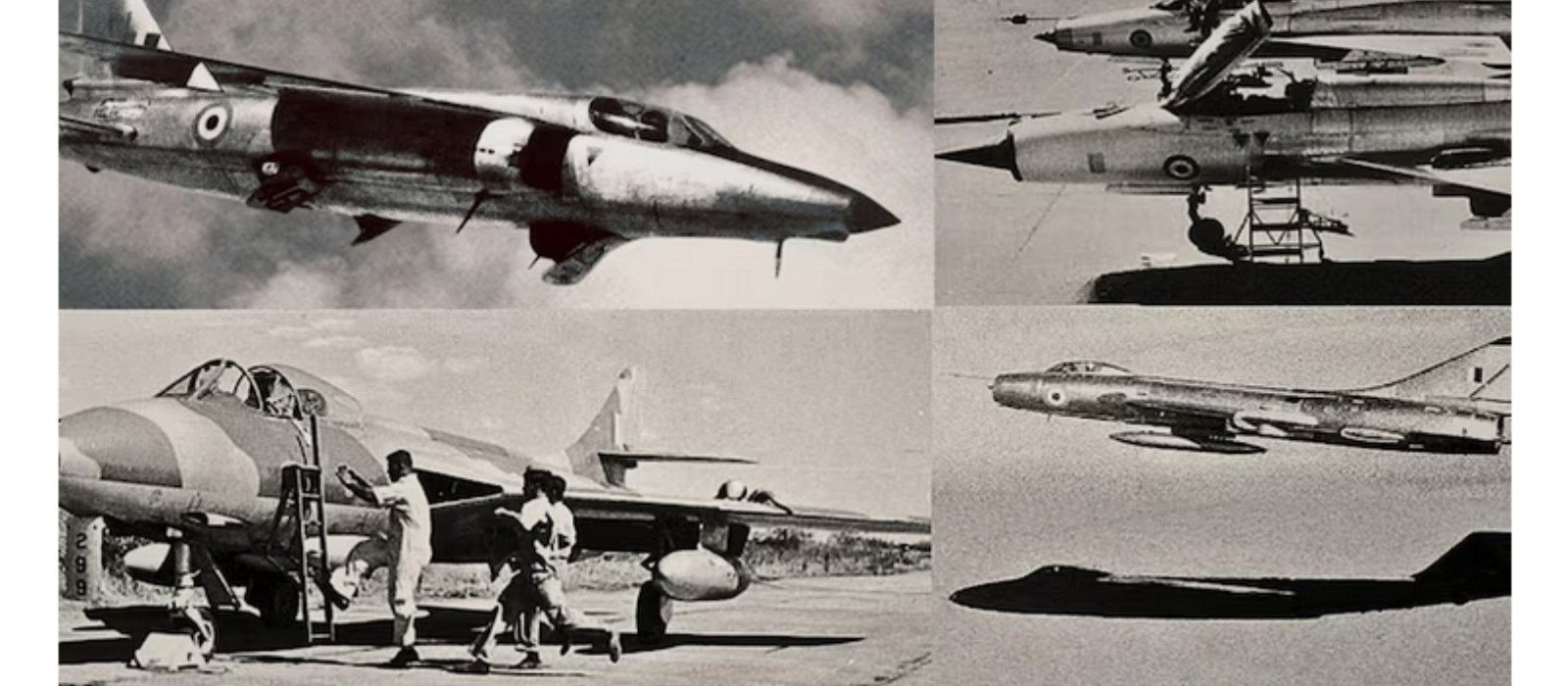
My squadron was one of two in the IAF, which flew a special version of the Hunter, designated Mk 56-A. A powerful machine, armed with four 30 mm guns, the Hunter could carry a heavy assortment of rockets and bombs. It provided a stable weapon platform for ground attack, and was also agile in air combat. The specialty of the Mk 56-A however, was that it could carry four large fuel drop tanks. This gave it an extraordinary radius of action at low level, next only to the Canberra bomber. While this meant sacrificing the under wing weapon payload, its four 30 mm guns delivered a deadly punch, delivering 5 kg of ‘hot lead’ per second, on the target.
However, the Hunter’s operating milieu was restricted to daylight hours, or dawn to dusk. Night bombing missions were the forte’ of the Canberra and its PAF counterpart, the American B-57. It was therefore, an unstated sine qua non that sub-continental conflicts would commence only on a full moon night so that the Canberras and B-57s (as well as the armoured forces of both armies) could be fully exploited.
Prelude to War
As 1971 wore on, we watched with growing concern that Pakistan, driven by political, linguistic and ethnic differences between its Punjabi-dominated western wing and its Bengali eastern wing, marched inexorably towards civil war. The Pak army, by its barbaric and unprofessional conduct, triggered a massive exodus of East Pakistani refugees, creating a social and economic crisis for India. The cynical American duo of President Nixon and his Chief of Staff, Henry Kissinger, not only lent full support to Pakistan’s military rulers, but also egged-on China to create military diversions for India. It was under these circumstances that PM Indira Gandhi, in consultation with her military commanders, crafted a grand strategy, which would halt the Pakistan army’s murderous rampage and reverse the refugee influx.
As part of all this, No. 20 Squadron was re-located from Hindon to Pathankot around mid-1971. Our new base was located just 2-3 minutes flying time from the international border and was to certainly be an exciting place when the ‘balloon’ went up. Despite growing tensions to our East and West, we all knew that no military action was likely till after the monsoons. During the prevailing lull, Wing Commander Parker put the squadron through a rigorous training programme to prepare us for the approaching conflict.
Given the Hunter’s versatility, it was made clear that our first priority was ‘counter-air operations,’ which involved attacking the enemy’s air power assets - aircraft, runways, fuel and ammunition dumps and radars - thereby, degrading his ability to interfere with our own operations. During such missions, we were also to engage ‘targets of opportunity,’ including troop trains, military convoys, electricity and petro-chemical infrastructure that may appear enroute. Our next priority was to provide close air support for army formations engaged with the enemy. For this purpose, the squadron had already attached its own junior pilots to the army as ‘forward air controllers.’ The air threat was expected to be all pervasive, and if ‘bounced’ we were to jettison drop tanks and engage the enemy with determination.
Thus, from Mondays to Fridays, we would practice low level navigation, weapon delivery on nearby firing ranges and air combat. On Saturdays, we would gather in the CO’s office and with doors locked, receive intelligence briefings on prospective targets in Pakistan. There was a lot of data and information to be absorbed; aerial photographs and layout of airfields, location of vital points/vital areas and anti-aircraft defences, as well as recognition features of our own and enemy armoured vehicles etc.
Navigation maps had already been prepared and required study so that there were no surprises enroute. We also received instructions on escape and evasion, along with an automatic pistol and ‘cover material’ like Pak currency and used train and bus tickets, that could help survival after ejection in enemy territory. Having done all that was necessary to prepare the squadron for war, the Boss declared that when hostilities commenced, he would lead the first mission.
To Action Stations!
Having learnt the right lessons after losing 35 aircraft on the ground to PAF strikes in 1965, the IAF had implemented a number of precautionary measures, which would pay off handsomely in this conflict. First, no aircraft were parked in the open or in dispersals. Fighters were housed in blast pens built at widely dispersed locations across air bases and connected to the runway via long, winding taxi-tracks; the whole complex covered with dense foliage. Secondly, most air bases either launched a CAP at dawn/dusk or maintained fighters at readiness on ORP. Thirdly, while newly acquired radars had improved coverage against low flying intruders, gaps had been plugged by a network of mobile observation units or MOUs, consisting of airmen equipped with binoculars and radio sets, who would sound an alert on sighting or hearing the approach of aircraft. Finally, as a measure of abundant caution, from August 1971, every full moon phase saw our squadron retiring to a rear base for a week or so.
Since 02 December 1971 was to be a full moon night, the ‘Boss’ dispersed the squadron to Ambala and Hindon on 25 November itself while he himself stayed back in Pathankot. On the evening of Friday, 03 December, while many of us were on ‘liberty’ in New Delhi, we learnt that PAF fighters had carried out a ‘pre-emptive’ strike on nine Indian air bases, including Pathankot. Rushing back to Hindon, we huddled around a transistor radio, to hear PM Indira Gandhi declare at midnight that Pakistan had “launched full-scale war against us…” We were up at 3.30 am on a bitterly cold morning, to find the Hindon air base blacked-out and covered in dense fog! In sections of 2-3 aircraft, we made a low-level dash for Pathankot so that we could commence retaliatory action against PAF bases.
Boss Leads the Charge
After landing in Pathankot, as I was walking towards the squadron, I was startled to see the Boss and his wingman, Flt Lt Dhillon, purposefully striding towards their aircraft. True to his word, he was going to lead the Lightnings’ charge; a strike on PAF Base Peshawar. The direct distance to Peshawar was 275 miles, but with tactical routing it was closer to 300 miles. As the squadron diarist, I had recorded the mission debrief as follows:
“Mission 15 rolled at 0643, and following a pre-planned low level profile, reached Peshawar on schedule. As Boss went in for an attack on two parked Sabres, No.2, while firing on a fuel dump, called out,‘Three Sabres, high!’The Hunter pair opened out westwards, came back for a second attack, and then departed for home, at tree-top level, leaving a pall of smoke from burning aircraft and fuel dumps. Unknown to them, the enemy CAP had followed them, and 3-4 minutes on the homebound leg, they were both attacked by PAF Sabres. As per SOP, the pair split and fought off the attackers in a fierce dogfight in the heart of enemy territory. With their guns empty, and fuel running low, the pair headed for home at full throttle. Boss landed with 22 bullet-holes in his aircraft and Dhillon’s engine flamed out on final approach. Mission 15 was completed successfully.”3
Boss having set the agenda, the squadron followed with nine days of intensive ‘counter air operations,’ in which we attacked PAF bases at Peshawar, Kohat, Chaklala, Mianwali, Murid, Walton and Chak-Jhumra; the radar station at Sakesar and oil refinery at Attock, while interdicting targets of opportunity. Then we switched roles and for the next seven days flew army close support missions in the Chhamb, Poonch, Nowshera and Sialkot sectors.
The squadron’s tally included 17 PAF aircraft destroyed on the ground and one in the air, in addition to destruction wreaked on enemy radars, fuel and ammunition dumps as well as hangars and other airfield installations. Damage and casualties were inflicted on Pak armour, artillery and infantry with bombs, rockets, guns and napalm. Two of our pilots were killed in action, and the squadron ended the war with the highest number of gallantry awards in the IAF.4 Wing Commander Parker led us all the way, ensuring that he flew a mission or two, every single day, and was awarded a richly deserved MVC for his personal gallantry and leadership during the war.
The Aftermath
After the heat and dust of the conflict had subsided, and the balance sheets struck, there still remained many a void in squadron crew rooms and aching hearts amongst families who clung to shreds of hope as they awaited confirmation about the fate of their dear ones. No. 20 Squadron had lost two pilots in the war; Fg Offr KP Muralidharan on 04 December and Sqn Ldr Jal Mistry the following day.
According to the squadron diary, Mission 09, led by Sqn Ldr Bajpai with Fg Offr Muralidharan as his wingman, had been tasked to attack PAF Peshawar. Since this was our second raid of the day on this base, the PAF would have been ready and waiting. The pair had carried out three firing passes before they were engaged by PAF fighters. Bajpai’s aircraft suffered heavy damage, but he managed to force-land in Jammu. Nothing was heard of Muralidharan, and he was declared ‘missing in action.’
The next day, Sqn Ldr Mistry was to lead a two aircraft raid on PAF Sector Operations Centre, Sakesar, in coordination with a simultaneous four aircraft raid on nearby PAF Mianwali; both targets deep in the heart of Pakistan. This plan unraveled as three out of the six aircraft became unserviceable and Mistry was faced with the choice of cancelling the mission or going it alone. Undaunted, he chose the latter option and apparently, went down fighting over Sakesar.
Although both pilots had been declared as ‘missing presumed dead,’ their families clung, for a long time, to the faint hope that they may have been taken prisoner and could possibly return home alive. Neither the MoD, nor their former comrades could provide them with a sense of closure. My search for authentic accounts of the 1971 war took me first to Brig Yeager’s autobiography, and his provocative remarks then led me to seek answers from historian SN Prasad’s ‘India-Pakistan War 1971.’ Both made interesting reading, but raised more questions than they answered.
Nailing Yeager’s Hyperbole
Chapter X of the ‘India-Pakistan War of 1971’ deals with IAF operations in the Western theatre, and after providing day-by-day accounts of air-defence, counter-air and close-support missions, attempts a cursory analysis of the air-war. While declaring the IAF as being “definitely on the way to victory” at the time of cease-fire, Prasad commends the PAF for having managed to survive in a war against an “enemy, double its strength.” He uses a boxing metaphor, to add a left-handed compliment; “...by its refusal to close with its stronger enemy, it at least remained on its feet, and in the ring, when the bell sounded...”5
This is this phrase that Pakistani Air Commodore M Kaiser Tufail (Retd) has picked up for the title of his 2018 book: ‘In the Ring and on its Feet,’ about the PAF’s role in the 1971 Indo-Pak war.6 Fortuitously, a friend gifted this book to me while I was engaged in my investigation of Yeager’s hyperbolic claims. Tufail, a former fighter-pilot, has rendered a detailed account of PAF operations in 1971, which can be accepted as authentic because he asserts that he had been accorded access to PAF’s war records and officially permitted to cite them in the book.
As far as IAF’s aircraft losses in the war are concerned, there is only a small difference between the figures in Prasad’s ‘History’ and those provided by Tufail. According to the tabulated Pakistani account, which provides names of Indian aircrew, the IAF lost 60 aircraft. Prasad records the IAF’s losses in action as 56 aircraft (43 in the west and 13 in the east). A divergence however, emerges when it comes to PAF losses. While Prasad credits the IAF with 46 Pak aircraft destroyed, (27 in the west and 19 in the east), Tufail lists the tail numbers of only 27 PAF aircraft destroyed. Both figures make nonsense of Brig Yeager’s biased and pompous declarations.
Interestingly, there was a subsequent e-mail exchange with the author, which he later posted on his blog.7 In it, this is what Tufail had to say about Chuck Yeager, “…he was a big mouth and a braggart. If you have read his book, he makes a preposterous claim that he had exceptional vision, and could easily spot an aircraft as far as 25 nautical miles! Now, as for the bit where he states, “I also worked with their squadrons and helped them develop combat tactics,” it is utter balderdash. All he did was to fly a couple of sorties on the Sabre in Peshawar, due to his friendship with Air Mshl Rahim, both having a penchant for hunting and fine Scotch.”
Setting Ghosts to Rest
Controversies aside, it was particularly gratifying to read Air Cmde Tufail’s reconstructions of many combat missions, which had remained shrouded in doubt and ambiguity for 47 years. Personally, I experienced a sense of closure after reading his accounts of the final heroic moments of my comrades of No. 20 Squadron, Sqn Ldr Jal Mistry and Flying Officer KP Muralidharan.
Describing the interception of Mission 09 of 4th December - the squadron’s second raid on PAF Peshawar that morning - Tufail says, “The dogfight had rapidly descended to a dangerously low level, of about 100 feet, with four fighters - the two attacking Hunters with two intercepting PAF Sabres - flying in a tight circle at a speed of around 400 knots.” As Muralidharan was determinedly closing in and firing at the PAF Leader, the No.2 caught up with him, and aimed a long burst which found its target. Says Tufail, “…the aircraft rolled over and crashed in a huge ball of fire… Fg Offr KP Muralidharan had been unable to eject and went down with his aircraft…near Bara village.”8
Describing Sqn Ldr Mistry’s Mission 11 of 05 December, Tufail, writes: “…a lone intrepid Hunter was able to sneak in for another successful attack on Sakesar, adding to the earlier damage…. the Hunter was intercepted by two Mirages from Mianwali.” Hit by cannon-fire and then by a missile, according to Tufail, “…the pilot ejected. But it was too late. Sqn Ldr Jal Maneksha Mistry of No. 20 Squadron was found fatally injured…near the small town of Kattha Sagral.”9
Tufail’s account also sets to rest the speculation surrounding the disappearance of a naval Alize on anti-submarine patrol on 10 December 1971. He mentions an “unusual maritime recce mission” flown by a PAF F-104 searching for Indian missile boats, which chanced upon the Alize flying off Jakhau on the Saurashtra coast. The Alize was shot down by the PAF fighter with the loss of Lt Cdr Ashok Roy, Lt HS Sirohi and Aircrewman Vijayan. Tufail also nails the canard about Soviet Tupolev-126 support to IAF, and describes how the IAF cleverly employed MiG-21s in the ‘radio-relay’ role, which enabled returning fighters to find their home bases.10
Tufail provides a tabular account of both IAF and PAF aircraft losses, with names of aircrew, squadron numbers and (for PAF aircraft) even tail numbers. To my mind, one particular statistic alone, confirms Tufail’s objectivity. As the squadron diarist of No. 20 Squadron, I had recorded the result of Mission 113, a raid by four Hunters on PAF base Murid, on 08 December 1971. The diary reads: “one transport, and two fighters and vehicles destroyed, two fighters damaged and many personnel casualties on ground.”
Describing the Murid raid in his book, Tufail states, “…the base took the worst beating of the war on 08 December, when two Hunters from a four-ship formation of 20 Squadron, were able to knock out two F-86s parked in the open. The ensuing inferno caused sympathetic detonation…three more F-86s were thus destroyed and two damaged.”11 Unbeknown to themselves (or to Air HQ), 20 Squadron pilots actually destroyed five F-86 fighters in this mission - making it the most spectacular IAF raid of the war!
Learning From History?
A few years ago, a trio of US Naval War College Professors, published a commentary on India’s recently promulgated Maritime Strategy. Claiming that navies were the manifestation of a society’s political and strategic culture, they sought - apparently, in vain - a ‘grand historical narrative’ in India’s past, that would justify the creation of a large navy. Insisting that a ‘usable past’, was most desirable to justify an expensive maritime build-up, they suggested that such a past, if not found, could be “partially manufactured” to enfold the sea in the national consciousness.12
Indians, conscious of their splendid, millennia-old maritime tradition, may indignantly refute the suggestion about “manufacturing” of history, but will have to admit the absence of a written narrative of our past glory. In his 1999 book, ‘Defending India,’ soldier-politician Jaswant Singh had said, “A sense of history, its recording, evaluation and assessment and utilisation as an input in decision-making has been absent, and this has affected the development of India’s strategic thought.”13
Both, the historical works that I have referred to; Prasad’s stillborn, ‘India-Pakistan War of 1971’ and Air Cdre Tufail’s published book, ‘In the Ring and On its Feet,’ demonstrate that there are good reasons for carefully recording events and writing war histories. Not only do they hold out lessons for politicians about the employment of military power, but they also enable militaries to test the validity of their doctrines, and make vital course corrections.
Sensible democracies, therefore, ensure that history is not replaced by mythology. Fortunately, there is a whole new crop of young scholar-warriors, emerging in India, eager to record its rich military history. But as long as individuals within the uniformed and civilian bureaucracies maintain their reluctance to share official records, this deplorable historical vacuum will persist. In this context, the preference of successive governments not to declassify the Henderson-Brooks report on the 1962 Sino-Indian War, may now be compounded by a new set of rules promulgated in May 2021, which state that retired officials who were part of “any Intelligence or Security-related organisation” cannot publish anything post retirement with reference to their previous area of work without officials reviewing the drafts.
Epilogue
For many years, post-bellum, I felt a twinge of regret, that I was not with my naval comrades, when they flew into combat from Vikrant. However, reviewing a 2005 graduation parade at the IAF Academy in Dundigal, I expressed my true sentiments when I said, “I received my wings, 37 years ago, in the Air Force Fighter Training Wing, not far from here. Over the years, the IAF has contributed in substantial measure to what I am, and where I stand today; and this is an appropriate occasion to acknowledge my personal gratitude to this fine service.”14
In 20 Squadron, I also experienced the special bond of camaraderie that only war can engender. Since the Pathankot air base, was an attractive target for PAF fighters in daytime and bombers at night, the pilots were moved out of the mess, into the underground operations room. At first, the air raid sirens, exploding bombs and ack ack fire did create palpable fear, but within days, gallows humour would cut the tension, and we would resume reading or snoring in our sleeping bags. In the air, your life depended on your buddy’s lookout, and as you dived for the attack, you placed total faith in your wingman/leader to keep your ‘six’ clear.
Good leadership is all about alleviating the fear of those whom you lead. For me, the most important lesson of the war came from our Squadron Commander’s courage and professionalism. By his fearless personal conduct throughout the war, he inspired us to follow him into action. At the same time, the fear of letting him down overcame the sum of all our other fears, and we dared not fail in our mission.
Endnotes
-
Charles Yeager and Leo Janos, Yeager: An Autobiography (New York: Bantam Books, 1985), 311-312.
-
SN Prasad, “The India-Pakistan War of 1971,” 12 October 2006. https://www.bharat-rakshak.com/ARMY/history/1971war/280-war-history-1971.html, accessed on 28 August 2021.
-
Ashok K Limaye, When Lightnings Strike, No. 20 Squadron, IAF, 1956-2006 (New Delhi: The Society for Aerospace Studies, 2006).
-
Ibid., 83-84.
-
Prasad, Op Cit., n.2, 449.
-
Kaiser M Tufail, In the Ring and on its Feet (Lahore: Ferozsons, 2018).
-
“An Indian Admiral and a Pakistani Air Commodore,” Aeronaut, 25 February 2021. http://kaiser-aeronaut.blogspot.com/2018/02/an-indian-admiral-and-pakistani-air.html.. accessed 02 September 2021.
-
Tufail, Op Cit., n.6, 72.
-
Tufail, Op Cit., n.6, 76.
-
Tufail, Op Cit., n.6, 83
-
Tufail, Op Cit., n.6, 82
-
James Holmes et al., Indian Naval Strategy in the Twenty-first Century (New York: Routledge, 2009), 1-22.
-
Jaswant Singh, Defending India (Bangalore: Macmillan Press Ltd, 1999), 16.
-
Arun Prakash, From the Crow’s Nest (New Delhi: Lancer, 2007), 183.
