


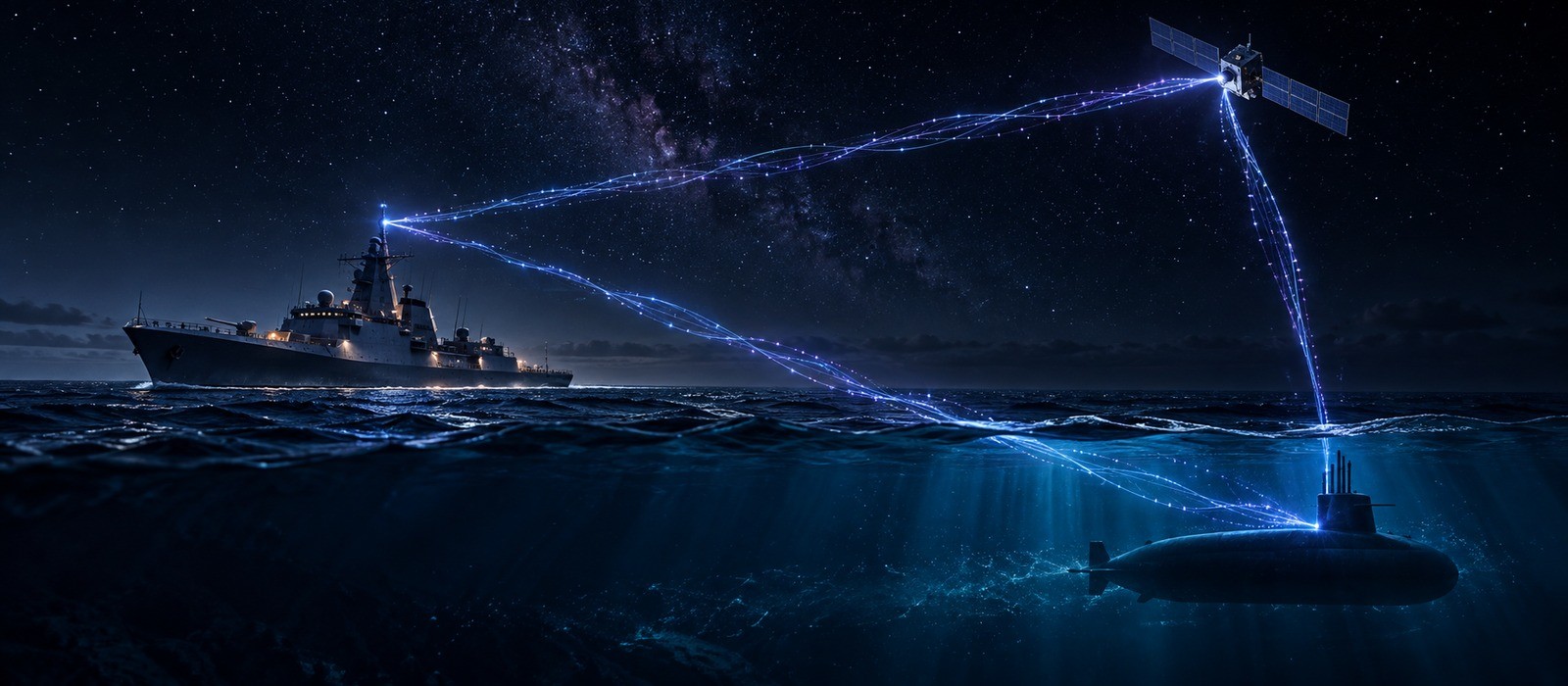


Abstract: As the maritime domain faces rapidly evolving cyber and electronic warfare threats, navies must modernise their communications infrastructure to ensure operational superiority. Quantum-secure communication promises to revolutionise naval operations by delivering unbreakable encryption and resilience against conventional and quantumenabled attacks. Technologies such as Quantum Key Distribution (QKD), Post-Quantum Cryptography (PQC), and Quantum Random Number Generation (QRNG) provide robust solutions for secure fleet coordination, submarine communications, and joint operations with allied forces. Underwater Quantum Communication (UQC) offers stealthy, jamresistant links for submarines, while quantum-enhanced AI supports realtime cyber-threat detection and proactive defence measures. Despite these advantages, significant challenges remain, including high implementation costs, integration with existing Command and Control systems, submarine deployment hurdles, interoperability across coalition partners, and the need for updated training and doctrinal shifts. This paper explores the underlying principles of quantum-secure communication, its applications in operational scenarios from carrier strike group coordination under electronic warfare attack to coastal UAV network and outlines the strategic imperative for navies to adopt and integrate these technologies. As quantum systems mature, their incorporation into naval strategy will be critical for ensuring secure communications, countering sophisticated adversaries, and maintaining strategic dominance in an increasingly contested digital battlespace.
Quantum Secure Communication
Quantum Secure Communication is poised to transform naval warfare by providing impenetrable encryption for critical military operations. As cyber threats grow more sophisticated, traditional cryptographic methods are increasingly vulnerable, particularly to quantum-powered attacks. By harnessing Quantum Key Distribution (QKD), quantum entanglement, and Post-Quantum Cryptography (PQC), navies can establish highly secure communication networks for fleet coordination, submarine missions, and intelligence exchanges. These advancements not only fortify defences against cyber espionage and electronic warfare but also enable stealthy, interference-resistant transmissions in high-risk environments. As quantum technology progresses, the future of naval warfare will be shaped by real-time, resilient, and tamper-proof communications, ensuring strategic superiority in the digital battlefield.
Quantum Secure Communication harnesses the principles of quantum mechanics to provide unbreakable encryption for military and defence network. Quantum Key Distribution (QKD) safeguards encryption keys by detecting any eavesdropping attempts through quantum state disturbances, ensuring tamper-proof security. Quantum Entanglement enables secure and instantaneous key exchanges between naval command centres, submarines, and warships, protecting battlefield coordination from cyber threat. Unlike conventional encryption, which is susceptible to quantum-powered decryption, Post-Quantum Cryptography (PQC) employs mathematically complex problems to secure classified communications. Together, these technologies strengthen ship-to-ship, ship-to-shore, and submarine communications, enhancing resilience against electronic warfare, cyber espionage, and emerging cyber threats in modern naval operations.
Quantum Key Distribution (QKD)
As modern naval warfare becomes increasingly dependent on networked systems and real-time intelligence sharing, securing classified naval communications from cyber threats is paramount. Quantum Secure Communication, powered by QKD and PQC, ensures hack-proof naval transmissions and resilience against electronic warfare threats. QKD enables unbreakable encryption, preventing adversaries from intercepting or manipulating transmissions since, any attempt to eavesdrop on a quantum-encrypted message alters its state, immediately alerting the system to a breach. QKD can also be seamlessly integrated with satellitebased naval communication, ensuring secure and tamper-proof transmission enhancing the overall security of naval operations.
The core principles of QKD ensure its unparalleled security in military encryption. The Heisenberg Uncertainty Principle guarantees that any attempt to measure a quantum system disturbs it, making eavesdropping immediately detectable. Quantum Entanglement and Superposition enable the secure transmission of encryption keys using entangled photons or single-photon states, ensuring tamper-proof communication. When combined with QKD, One-Time Pad Encryption offers theoretically unbreakable encryption for sensitive military data, providing an additional layer of security against quantum and classical cyber threats.
QKD follows a three-step process to establish secure communication. Quantum Key Generation involves the sender generating a random cryptographic key encoded in the quantum states of single photons, such as polarization states, which the receiver measures using a compatible basis to reconstruct the key. Eavesdropping Detection (BB84 Protocol) ensures security by leveraging the principles of quantum mechanics i.e. if an adversary attempts to intercept the photons, the act of measurement alters their quantum state, introducing anomalies in receiver’s measurements and alerting receiver’s and senders to a potential breach. If no anomalies are detected, the key is deemed secure. Secure Communication uses the final encryption key for highly secure symmetric encryption, such as AES-256 or One-Time Pad, enabling real-time, hack-proof communication across naval fleets, command centres, and defence networks.
China’s ‘Micius’ satellite has already demonstrated QKD over 7,800 km potentially enabling a secure command-and-control system in a fullblown war without fear of interception. In 2017, they did a quantumencrypted video call between Beijing and Vienna. Now imagine a PLA theatre commander having tamper-proof communication during a Taiwan conflict while everyone else is jammed.
Governments and private sector leaders are actively advancing spacebased quantum key distribution (QKD), with significant initiatives led by China, ESA, NASA, and private firms like SealSQ. However, due to high costs and technological challenges, widespread commercial adoption is unlikely before 2035. The space-based QKD market, driven by national security needs and rising cybersecurity threats, is expected to expand from $500 million in 2025 to $1.1 billion by 2030, while post-quantum cryptography (PQC) will likely serve as a scalable alternative alongside QKD.
In parallel, KDDI Research, Inc. and Toshiba Digital Solutions Corporation have introduced a multiplexing technology for QKD, optimizing transmission by assigning secret keys to the C-band while highvolume data signals are transmitted via the O-band—enabling more efficient multiplexed transmission over a single optical fibre.
Underwater Quantum Communication (UQC)
Underwater Quantum Communication (UQC) enables covert and interference-free transmissions between submarines and naval bases, preventing detection by adversaries. Unlike classical encryption UQC leverages quantum entanglement and QKD to establish tamper-proof, unbreakable encryption ensuring that any attempt to eavesdrop on transmitted data would immediately alter its quantum state, alerting of a security breach. Traditional Electronic Warfare (EW) techniques rely on jamming and spoofing while UQC is immune to these attacks because quantum signals cannot be copied, amplified, or modified without detection. While, acoustic or RF signals, which can be overpowered by stronger enemy signals, quantum communication relies on individual photons, making it impossible to introduce false data or disrupt the transmission. UQC does not rely on traditional electromagnetic (EM) signals instead, it utilizes quantum properties such as entanglement and single-photon transmission in optical or acoustic mediums. This makes it undetectable and immune to interference from EW tactics that target standard communication channels. In future UQC systems can be integrated with AI-powered quantum threat detection to monitor and analyse quantum communication channels in real-time. AI algorithms can identify suspicious anomalies or potential intrusion attempts, allowing naval forces to take immediate countermeasures against evolving EW threats.
Quantum Cryptography
Quantum cryptography is emerging as a critical defence mechanism against cyber threats in naval warfare. As naval forces increasingly rely on networked systems for Command and Control (C2), Intelligence, Surveillance, and Reconnaissance (ISR), and Maritime Cyber Operations, traditional cryptographic methods are becoming vulnerable to cyberattacks, especially with the advent of quantum computing.
QNu Labs in India specializes in quantum cybersecurity, developing QKD systems based on the Differential Phase Shift Protocol to enhance secure communications. The company has successfully raised $11.9 million USD to advance its mission of strengthening data protection through cutting-edge quantum technologies. Meanwhile, QuantumCTek and other key players are actively driving innovation in quantum cryptography and QKD, with applications that could render China’s military communications virtually unbreakable even against adversaries equipped with quantum-capable decryption tools.
Traditional encryption methods, such as RSA and AES, rely on mathematical complexity, making them vulnerable to brute-force attacks especially from quantum computers capable of rapidly breaking classical encryption algorithms. QKD eliminates this risk by leveraging quantum mechanics to generate encryption keys that are unbreakable. It uses quantum entanglement and single-photon transmission to establish encryption keys, ensuring that any attempt to intercept the key immediately alters its state, alerting the system to a security breach. This enables end-toend encrypted communication critical for battlefield data, mission planning, and naval intelligence from cyber espionage. While QKD secures data in transit, Post-Quantum Cryptography (PQC) strengthens the resilience of naval digital networks, cloud systems, and AI-driven cyber defence platforms against quantum-enabled cyberattacks. PQC addresses this challenge by employing mathematically hard problems that remain resistant to both classical and quantum attacks. PQC relies on cryptographic algorithms based on mathematical problems that are computationally infeasible to solve, even for powerful quantum computers.
Some of the approaches used by PQC are – Lattice Based Cryptography, Code-Based Cryptography, Multivariate Polynomial Cryptography.
- Lattice-based cryptography is built on the computational difficulty of solving Shortest Vector Problems (SVP) and Learning with Errors (LWE) problems in high-dimensional lattices, making it highly resistant to both classical and quantum attacks. These problems are considered hard even for quantum computers, since the efficiency of the algorithm to solve in polynomial time is challenging. Due to its robustness, lattice-based cryptography is a leading candidate for postquantum encryption and digital signatures, with Kyber being used for encryption and Dilithium for digital signatures both of which have been selected as part of NIST’s post-quantum cryptographic standards.
- Code-based cryptography relies on the computational difficulty of decoding random linear codes, a problem that has remained unsolved for decades and is considered resistant to both classical and quantum attacks. This cryptographic approach forms the foundation of Classic McEliece, a leading candidate for quantum-resistant encryption known for its efficiency, long-term security, and ability to withstand quantumenabled decryption techniques.
- Multivariate polynomial cryptography is based on the computational difficulty of solving systems of multivariate quadratic equations (MQ problem) over finite fields, a problem that remains intractable even for quantum computers. This approach is used in Rainbow, a post-quantum digital signature scheme designed to provide secure authentication and protect against quantum-enabled attacks.
Quantum Random Number Generation (QRNG)
Conventional random number generators (RNGs) in cryptographic systems rely on algorithms that can be predicted or reverse engineered. Quantum Random Number Generation (QRNG) produces truly random since it leverages the inherent unpredictability of quantum mechanics to produce truly random numbers, ensuring unbreakable encryption for military and defence applications. Unlike classical RNGs, which rely on deterministic algorithms and can be predicted or compromised, QRNGs extract randomness from quantum phenomena such as vacuum fluctuations or single-photon measurements, making them immune to external manipulation. Key approaches to QRNG for military encryption are: -
- Vacuum Fluctuation-Based QRNG – Vacuum Fluctuation-Based QRNG leverages quantum vacuum fluctuations, which are random energy variations in empty space, as a source of entropy to generate truly random numbers. Sensitive photodetectors measure these fluctuations, ensuring the randomness is pure and unpredictable. This approach provides a highly secure method for key generation in military cryptographic systems, making it resistant to external interference and ensuring unbreakable encryption for classified defence communications and cybersecurity applications.
- Photon-Based QRNG exploits the inherent randomness of photon behaviour when passing through a beam splitter, where the path each photon takes is fundamentally unpredictable. This quantum phenomenon ensures the generation of high-entropy random numbers, making them truly secure and resistant to external manipulation. Due to its robustness, Photon-Based QRNG is widely used in QKD for secure military communications, safeguarding encrypted transmissions against cyber threats and electronic warfare attacks.
- Quantum Tunnelling-Based QRNG harnesses the random quantum tunnelling effect in semiconductor diodes, where electrons unpredictably pass through energy barriers due to quantum mechanics. The behaviour of these tunnelling electrons is measured to create a high-entropy entropy source for cryptographic applications, ensuring secure and unpredictable key generation. This approach is particularly well-suited for on-chip secure key generation in military hardware and embedded defence systems, providing a resilient and tamper-proof solution for securing sensitive military communications and cybersecurity infrastructure.
Quside, a leading innovator in quantum technologies, is collaborating with Equinix, the global leader in digital infrastructure, to provide scalable and seamless access to next-generation QRNG solutions. This partnership is aimed at strengthening cryptographic systems against increasingly complex and evolving cyber threats by offering organizations a robust, hardware-based entropy source. In cybersecurity, entropy refers to the level of randomness or unpredictability used in cryptographic operations. Highquality entropy is critical for generating secure cryptographic keys and ensuring system integrity. Unlike pseudo-random number generators (PRNGs), which rely on deterministic algorithms, true entropy can only be derived from physical processes making quantum entropy generation one of the most secure and reliable methods available. Poor or predictable entropy can result in systemic cryptographic vulnerabilities, compromising the confidentiality and integrity of digital systems.
Through Equinix’s globally distributed Equinix Fabric, a highperformance, low-latency, and private interconnection platform. Organizations can now directly integrate Quside’s quantum entropy solutions into their operational environments. This enables seamless communication between QRNG systems and mission-critical IT infrastructure without the need for specialized on-premises hardware investments. For example, a financial institution connected to the Equinix ecosystem can now enhance the entropy quality underpinning its encryption protocols—thereby strengthening data protection—without altering its existing IT stack. This plug-and-play approach significantly reduces implementation complexity and accelerates the adoption of quantum-secure cryptographic practices.
Equinix, which interconnects over 10,000 customers globally, has emerged as a key enabler in the deployment of quantum technologies. Its platform supports multiple quantum-driven initiatives focused on cybersecurity, high-performance computing, and power efficiency. The partnership with Quside exemplifies Equinix’s role in facilitating access to cutting-edge security infrastructure, empowering organizations to proactively defend against next-generation cyber threats and transition toward quantum-resilient digital ecosystems.
As naval warfare enters the quantum era, Quantum Secure Communication will be a cornerstone of maritime defence, ensuring unbreakable encryption and cyber resilience against evolving threats. QKD eliminates the risk of eavesdropping by leveraging quantum mechanics to create tamper-proof encryption keys. Quantum Cryptography further strengthens naval networks, securing fleet coordination, intelligence exchanges, and critical command operations against quantum-enabled cyberattacks. Meanwhile, QRNG provides a truly unpredictable source of entropy, enhancing the security of cryptographic protocols used in military communications. As quantum technology advances, integrating these capabilities into naval defence strategies will be imperative for securing battlefield communications, countering cyber warfare, and maintaining strategic superiority in the digital battlespace.
Quantum-Enhanced Cyber Threat Detection
In an era where naval operations are increasingly digital, cyber resilience is as critical as kinetic readiness. Naval networks spanning shipboard systems, satellite communications, autonomous platforms, and logistics infrastructure are prime targets for sophisticated cyber adversaries. Traditional cybersecurity frameworks, while effective against known threats, often struggle with emerging risks like zero-day exploits and AI-powered attacks. This is where quantum-enhanced AI is reshaping the naval cyber defence paradigm. By integrating the advanced pattern recognition capabilities of AI with the computational power of quantum systems, naval forces can gain real-time situational awareness of cyber activity and proactively counter even the most advanced threats.
Conventional cyber defence systems typically rely on signature-based detection. They match known patterns of malicious activity against network traffic. This approach is reactive and often blind to novel or evolving threats, particularly zero-day vulnerabilities or adversarial AI techniques that can mask malicious intent. For naval command centres operating in contested or denied environments, this latency in detection poses an unacceptable risk to mission integrity, platform survivability, and decision-making superiority. Quantum AI combines the speed and scale of quantum computing with the adaptive learning of AI. When deployed in naval networks, this fusion provides several distinct advantages –
- Detection of Quantum-Enabled Cyberattacks – Quantum AI systems can recognize attack vectors designed using quantum algorithms—threats that traditional systems may completely overlook
- Real-Time Analysis at Scale – Quantum-enhanced algorithms process and analyse vast datasets from across the fleet—sensor logs, communications, platform diagnostics—in real time, flagging even subtle anomalies indicative of intrusion Ø
- Proactive Threat Neutralization – By predicting attacker behaviour and simulating likely threat paths, Quantum AI enables naval cyber defence teams to act pre-emptively, neutralizing attacks before they can breach mission-critical systems
As quantum technology reshapes modern warfare, Quantum Secure Communication will become a fundamental pillar of maritime defence, ensuring unbreakable encryption and cyber resilience against emerging threats. QKD eliminates the risk of eavesdropping by utilizing quantum mechanics to generate tamper-proof encryption keys. Quantum Cryptography fortifies naval networks, protecting fleet coordination, intelligence sharing, and critical command operations from quantumenabled cyberattacks. At the same time, QRNG provides an unpredictable entropy source, enhancing the security of military cryptographic protocols.
