

In the Navy, everyone’s familiar with the Parade Gunner’s booming command, “Praaade, Pay Tenshun!” This is typically followed by a colourful critique of everyone’s parade skills, lamenting the decline of naval discipline and the impending disappointment of the reviewing officer. Just before the final rehearsal, the Gunner grudgingly acknowledges some improvement, thanks to his and his GIs’ diligence. If the senior officer expresses satisfaction (which, if memory serves, they always do), the Gunner echoes the praise before dismissing the parade. There’s always the hope that the next parade will happen soon, giving them another chance to whip yet another sloppy lot into shape. And so, the cycle of life, or kaalchakra, continues.
An Honorary Gunnery Specialist
So there I was, a regular party crasher at the Navy’s parade grounds, even making an appearance at the Gateway of India for a Presidential Guard of Honour. The blame? Mostly mine. You see, ever since my school days, I’ve had this peculiar fondness for drills. They seemed to add a dash of smartness and a pinch of military discipline. This affinity followed me through the Academy and into the Service, though I’ll admit there were many differences in drill from school standards to the National Defence Academy, and then to the Navy. Drills in our Service involved action-posts work, gun loading, magazine duties, weapon fuzing, and target-tracking “drills.” And let’s not forget the grand shift from the Army-style drill to the more subtle movements that came with the limited deck space on a ship. In the early days on the Cadets’ Training Cruiser (the first INS Mysore), we were chided by the gangway petty officers and a couple of GIs for “saluting like DSC!” It took us a while, but we eventually got the hang of the Navy’s palm-down salute style, which I rather liked.
While the parade commands were in Hindi, the GIs commented, advised and berated mainly in English, which they used with every licence and leeway available. More on that later. Now, why was I frequently “nominated” to be the platoon commander, or the officer of the guard, and later as parade commander? Well, it might have something to do with my ‘gunnery’ officer status! My consistent crew cut had seniors convinced I was a gunnery specialist, not an anti-submarine warfare officer. Plus, most of my non-specialist time was spent as a surface-to-air missile officer in a destroyer. So, as an ‘honorary gunnery specialist,’ I found myself frequently marching off to the Navy’s parade grounds.
“Nothing is More Important, Not Even Gunnery!”
While penning this, I remembered reading in a much earlier edition of the British Naval Review in which a Royal Navy officer recalled a memorable proclamation by the Chief GI of the Royal Navy’s gunnery school on Whale Island, near Portsmouth. In HMS Excellent, the Chief GI had bellowed, “Nothing is more important in the Navy than ceremonials, not even gunnery!” Thank heavens Admiral Jackie Fisher, who had a soft spot for gunnery but a distaste for excessive ceremonials, had been out of the picture for a few decades. Whether the then Captain of the Excellent agreed with this profound declaration, it did seem that Divisions were the very purpose of creating the GI cadre. So, when the bugle sounded “Divisions,” it was party time for the GIs and the gunner. They outdid themselves with their admonitions and exhortations. One such Division for a Commander-in-Chief left an indelible mark on me from my days as a platoon commander of my ship’s company. The first practice, predictably dubbed the “worst” the Parade GI had ever witnessed, was so dreadful he wished he’d never been born. At one point he bellowed, “Don’t move your @@@@@ … Krekshun, Eye@@@@@!” But there was more.
“Horse is not to be Seen!”
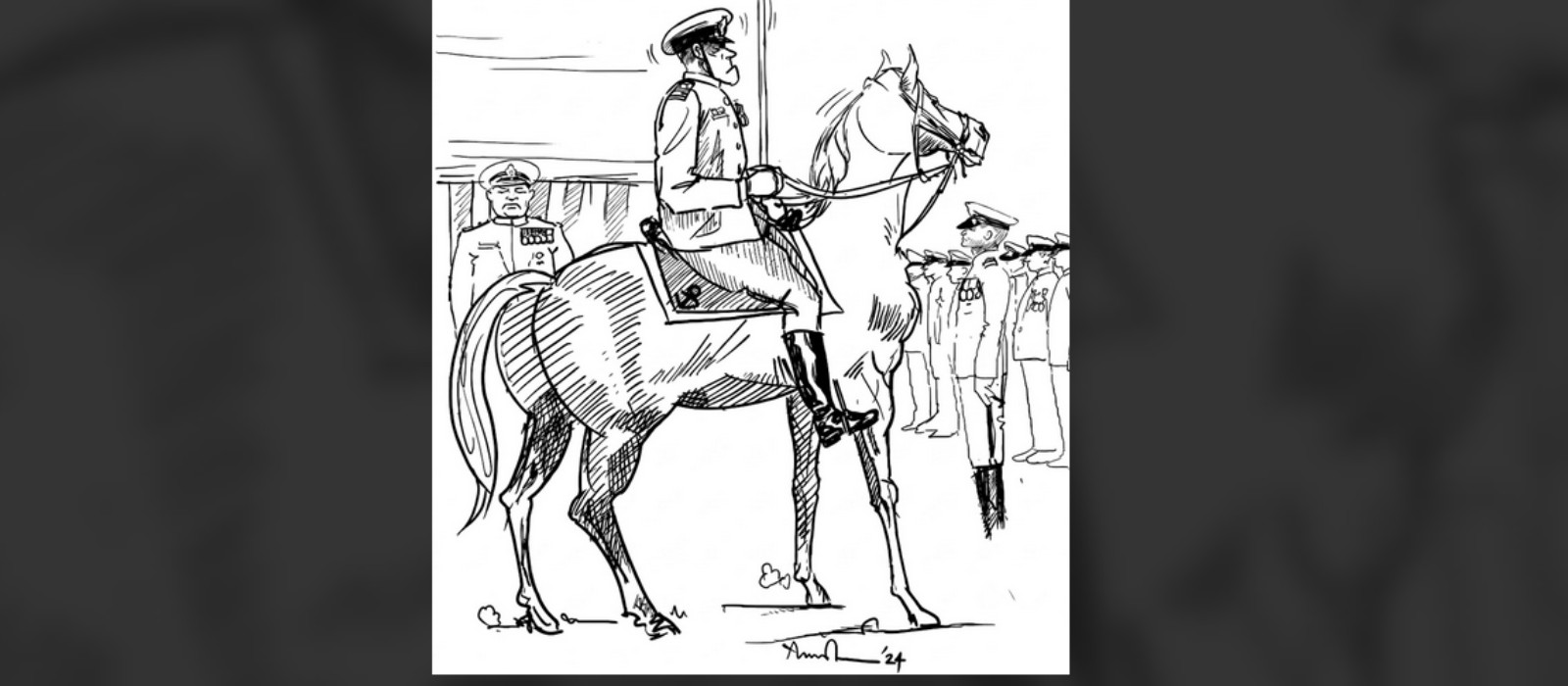
On day two of the said practice, word came from the Commander-in-Chief that he wished to inspect the Western Naval Command at Divisions on horseback. Naturally, his wish became the Command’s command. In a complex but very quick evolutionary process, the usual liveried jeep (actually a Maruti Gypsy by then) had morphed into a horse. The Commander-in-Chief was fond of riding, and some sort of a riding club had been created. For many officers, and almost all sailors on parade, horsepower was something their ship’s main engines had, and this translated into shaft horsepower.
So, the parade commander of day one was made to sit on a horse, where they seemed to have not much in common. The poor fellow was clutching the saddle’s pommel by his left hand and an oddly angled sword in his right. Not his fault in any way; only ex-NDA officers had done some riding and had seen the adjutant’s proud and steady horse on the hallowed Khetrapal Drill Square. At one stage, it became apparent to the parade gunner that shaft horsepower would yield to parade horsepower only with an accomplished rider. So, while we waited for about an hour in the stadium with divisions “at ease,” a rider who could be friends with a horse was located. What he might have lacked in parade-ground presence, he made up in his ability to remain on the horse, and keep the sword generally pointed skyward. Another rider, atop another horse, was now to masquerade as the Commander-in-Chief for the practices. But, for the Parade Gunner, most determined to keep the proceedings fault-free, the equine presence presented a new problem. He had explained in excruciating detail the previous day how platoon commanders had to raise their hands in salute just “as the headlight of the jeep came in line with the right-hand line and cut precisely when the taillight came in line with the left-hand man of the platoon.” This was not adequate, of course, because for the second set of platoons the sequence of right and left, and headlight and taillight, would be reversed as the jeep made a turn, which he explained in the same way. A point to note was that GIs and parade gunners, entrusted with safeguarding all that was good and noble about our fine Service, were convinced that platoon commanders were the dumbest officers that ships sent for divisions, and so had to be educated comprehensively. I always wondered how they had inside information about our intellectual shortcomings. If the heads and tails of vehicle lights were not complex enough, there was now a “jeep” without wheels and lights. Not being one to be intimidated by such evolutionary change, the parade gunner boomed once again: “When the face of the horse is in line with the left-hand man … and when the tail is in line with the right-hand man,” adding, “where the tail leaves the body, and not the tip of the tail because it moves,” till he thought we all had got it right. This was followed by a memorable admonition as a seemingly inebriated parade commander’s horse approached the “acting” Commander-in-Chief’s. The men on parade had not seen the sight of horses trying to keep pace like a more obedient jeep. “Horse is not to be seen!!” came the GI’s booming rebuke. Of course, he meant “Don’t look at the horse,” and certainly don’t move your heads or eyeballs as if on a target-tracking drill. Such is the flexibility and adaptability of the English language for stentorian GIs. The Gunner realised that horses in naval divisions were a sacrilege to be avoided. One does not know how the Commander-in-Chief’s enthusiasm to innovate was countered, but the jeep was back that day, and on D-Day the Commander-in-Chief seemed satisfied with our standard and the jeep as his steed.
A Tryst with Destiny
My journey with Divisions evolved as I moved from leading a platoon to commanding a few parades. I fondly recall the earnest efforts of GIs and Gunners, who, in their quest for perfection, often added a dash of unintentional humour through their remarks and reprimands. Reflecting on all this, two aspects stand out. First, the GIs’ and Gunners’ belief that parade proficiency was lacking, necessitating numerous rehearsals. Second, the depot ships and other units, and to some extent the ships themselves, could have done more to streamline their routine from “hands call” to the return of platoons to their primary duties.
As a relatively new Chief of Staff, it was time for the Flag Officer Commanding-in-Chief, South, to inspect the Command at Divisions, with six rehearsals scheduled on the Venduruthy parade ground. On the first day, I realised that sailors from most units had been roused in the wee hours to dress and be issued rifles. This process was time-consuming, as only a handful of sailors were handling the issue in some units’ armouries. Most hadn’t even had breakfast. And we had six more days of this. So, after the parade concluded and only the review order remained, I addressed the men on parade. Here is a paraphrased gist, based on some steps I could implement, some of which (other than the number of rehearsals) I had tried as a parade commander: “There will be only two more rehearsals. There is nothing about marching, dressing and deportment that you do not know already and have not practised. So, get on with it and show this improvement tomorrow. Be responsible for your smartness on parade and be conscious of your individual role in the movements of your line, file and platoon in relation to other platoons.” I also added, “Any sailor falling on parade is to be picked up only by the medical assistants. Those near him will not escort him out.” The last instruction flowed from my experience of commanding platoons and parades, and it worked. Sometimes fainting on parade was a ruse for one “Oscar” aspirant and two mates to leave and disappear from the ground for the day. All units also were asked to look at reducing the overall time spent on the exercise, from getting up to return to units. If one remembers, some of the outlying units saved as much as two hours the next day, and all hands arrived after an early-morning meal. In the two rehearsals, no one “fainted” on parade, and the story ends with the Commander-in-Chief being very pleased on the fourth day with what he saw.
However, this line of thinking was not one that made the GIs and the parade gunner happy. They perhaps could not see the value in the downstream benefits of fewer practices, and the thousands of man-hours saved, which could be devoted to primary duties that included training, of course. They had been schooled in a certain way; this was their arena to prove themselves useful and necessary. Perhaps, as for the British Chief GI, not even gunnery was more important. After I had left the scene, I believe there was a reset on the number of rehearsals, and perhaps lessons got lost. This does happen in any organisation. However, war, warfare, strategy, tactics and even parade training all have their enduring fundamentals and lessons. If only organisations could pay more “Tenshun” to processes and objectives a bit more closely.