


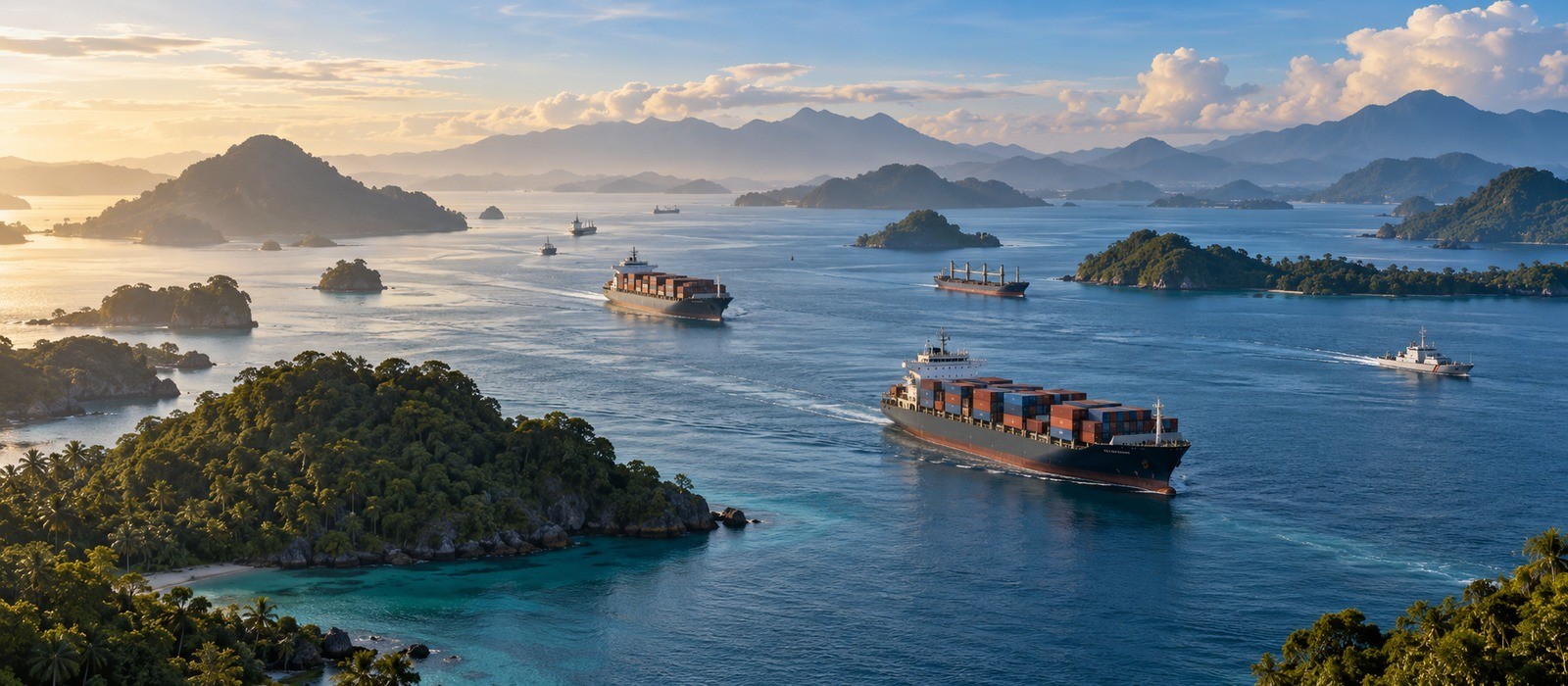


Abstract: The shift in the global economic centre of gravity to the east; 80% of global trade being maritime in nature; dependence of the rising economic giants of western Pacific on energy flow through the IOR, and over 94,000 ships transiting the Malacca Strait annually, have all combined to create an inextricable linkage between global prosperity and maritime security in the waters of Southeast Asia. This, coupled with the concerns of non-traditional threats to maritime security in these waters, has triggered a flurry of maritime security structures and operations, with mixed results. While AOIP in June 2019 and an ‘ASEAN Maritime Outlook’ in August 2023 are steps in the right direction, implementing measures to allay mutual suspicions, and deriving specific operational deliverables for various forums, will go a long way in realising a stronger collaborative approach towards comprehensive maritime security.
Introduction
With shipping being the cheapest and most efficient means of transportation through much of human history and likely to be so long into the future, and with the movement of resources, especially energy from West Asia to east, and that of manufactured goods from east to west, the geo-strategic significance of the waterways through ASEAN has historically remained significant. Of a total of well over 100,000 ships per annum transiting through the Indian Ocean, over about 94,000 use the Malacca Strait, thus creating an inextricable linkage between the Indian and Pacific Oceans.1 In fact, every link between the Indian Ocean to the west and the Pacific in the east is through one or more ASEAN countries. While the Sunda, Lombok and Ombai Wetar Straits pass through the archipelagic nation of Indonesia, the more frequented Malacca Strait has three littorals in Malaysia, Indonesia and Singapore. Almost all the solutions that aim to address the Malacca dilemma, such as the Isthmus of Kra project, the Kyaukphyu-Kunming pipeline project, etc., also ply through Southeast Asia.
Maritime ASEAN
A mental map of ASEAN would clearly remind us of its overwhelming maritime character. The sea, as a ‘liquid territory,’ covers 80% of the area of ASEAN. With Laos being the only landlocked country in ASEAN,2 the remaining nine countries have a total of 1,05,440 KMs of coastline, with nd th Indonesia and Philippines boasting of the 2 and 5 longest coastline among all countries in the world, as per The World Fact Book published by the CIA.3 The nature of their geography - with Indonesia and Philippines being archipelagic, Malaysia spread across two distinct and distant land masses, Thailand with two non-interconnected coasts across an isthmus, etc - also provides the ASEAN countries with expansive and, in several cases, overlapping EEZs, as well as a vast number of navigable waterways through them, that complicate the maritime security situation. The fact that the total trade value of ASEAN in 2021 was 3340.1 billion USD, of which a mere 21.3% is internal to ASEAN, inextricably links ASEAN’s prosperity to maritime security.4
Maritime Security Cooperation within ASEAN
With the nature of geography of ASEAN being overwhelmingly maritime, Maritime Security has a prominent position in all its discussions, plans and activities. While piracy and sea robbery have always been one of the biggest maritime threats that ASEAN has traditionally been concerned with, other non-traditional threats to maritime security, such as terrorism, smuggling, drug trafficking, illegal human migration et al. have been considered serious enough to warrant focused attention.5 Over a period of time, various structures have evolved within the ASEAN’s existing construct to address pertinent issues concerning maritime security within the ASEAN umbrella.
The ASEAN Regional Forum (ARF) came into being in 1994 with 27 members. Although the security focus of ARF is in a smaller area, the member-countries represent a much wider geographic swath. Unlike almost all other multilateral constructs, the ARF membership comes with equal rights for all its members. With a consensus-based functioning of the ARF, this translates to every member wielding a virtual veto power on any proposal and has the potential to stymie progress on any important issue that the forum may wish to consider.6 Hence, while the first objective of the ARF “to foster constructive dialogue and consultation on political and security issues of common interest and concern” has made considerable progress, the other objective “to make significant contributions to efforts towards confidence-building and preventive diplomacy in the Asia-Pacific region” has only been partly successful.7 The achievements of ARF as listed on its website indicate that these have generally been limited to providing a platform and encouraging willingness between members for consultations and discussions, networking and transparency between them on security issues, as well as undertaking various workshops and seminars. It has, however, made little difference to the constantly worsening maritime situation in the South China Sea between China and a number of ASEAN countries, the East China Sea between China and Japan, or the Russia-Japan dispute over Kurile Islands, all between ARF members and with the entire area within ARF’s geographical footprint. Especially in the case of South China Sea where a number of ASEAN members are directly involved, the lack of progress in the Code of Conduct could be attributable to prioritization of economics over security by those that are not littorals to SCS and the sides that they take in the great power rivalry.
While the ARF has little to show when it comes to its stated aim of conflict resolution, there has been considerable progress made in the field of non-traditional threats to maritime security in the region. With maritime security being an indispensable and a fundamental condition for the welfare and economic security of the ARF region, ARF issued a Statement on Cooperation Against Piracy and Other Threats to Maritime Security, Declaration of ASEAN Concord II’ (Bali Concord II), on 18 Jun 2003 at Phnom Penh, Cambodia.8 Having recognised the significance of maritime security at the 14th ARF Meeting, it was at the 15 ARF meeting on 24 Jul th 2008 at Singapore that the Concept Paper for the establishment of an ARF Inter-Sessional Meeting (ISM) on Maritime Security was initiated. The basic aim of the “forum was for a more focused dialogue and concrete cooperation and to assess basic and common regional needs, capacity building and developing practical forms of cooperation among concernedagencies of all ARF Participants dealing with maritime security issues”.9 While the 2009 Hanoi Action Plan for ARF endorsed commitment to th rd support the ISM on MS, the 17 ARF Meeting held on 23 July 2010 in Vietnam directed the ISM on MS to develop an ‘ARF Work Plan on Maritime Security’ by the next ARF Meeting. In the third ISM on MS meeting at Tokyo, the draft ARF Work Plan on maritime Security was finalised and was adopted by the 18 ARF Meeting held on 23 Jul 2011 at th rd Bali in Indonesia.
In the HANOI PLAN OF ACTION of 20 May 2010, to Implement the ASEAN Regional Forum Vision Statement 2009, ‘Maritime Security’ was included as a full paragraph within the precincts of the document.10 Paragraph 3 of the document, titled ‘Maritime Security’ included that, “by 2020, ARF should serve as a regional forum for maritime security issues that promotes and enhances maritime domain awareness, and develops concrete and effective regional responses to maritime security challenges.” These initiatives were aimed to be achieved through supporting the ARF Inter-Sessional Meetings on Maritime Security. The plan also aimed to promote networking among ARF, ASEAN Maritime Forum (AMF), IMO, IOR−ARC now Indian Ocean Rim Association (IORA), ReCAAP, as well as other maritime-related fora. Additionally, five of the 10 ASEAN countries are also members of the Indian Ocean Naval Symposium (IONS) that came into being in 2008.
There are a number of ASEAN specific and ASEAN Plus forums that deal with maritime security. Having adopted the Vientiane Action Programme (VAP) 2004-10 at the 10 ASEAN Summit in 2004, this th document not only identified promoting ASEAN Maritime Security Cooperation as one of the strategies for conflict prevention, but also, as a part of the ASEAN Security Community action plan, decided to ‘Explore the establishment of an ASEAN Maritime Forum.11 The ASEAN Maritime Forum and Expanded ASEAN Maritime Forum were established in 2010 and 2012 respectively.12 The fact that ASEAN lacks consensus over SCS, a reason that triggered the setting-up of EAMF, which is considered a Track 1.5 dialogue, that there are a total of about 10 different set-ups within ASEAN-Plus structures that deal with maritime security, and that the interest of most ASEAN nations, except Indonesia and Vietnam, look reduced, the AMF and EAMF appear to lose momentum.13 As the 10th ASEAN Summit adopted the ASEAN Security Community
(ASC) Plan of Action, one of the results of this summit was the establishment of an ASEAN Defence Ministers Meet (ADMM) as listed in the ASC Plan of Action. This intervention led to Malaysia hosting the maiden ADMM on 09 May 2006.14 The ADMM Plus was then established in 2010 that had the 10 ASEAN countries and the 8 ‘Plus' nations that included India, China, Russia, Japan, South Korea, Australia, New Zealand and the US - all members of the East Asia Summit (EAS), that now plays a major role in Maritime Security. Of the seven Experts Working Group that the ADMM Plus has, one is on Maritime Security (EWG on MS) that was formally established on 29 April 2011. Instituted with a purpose to “Developing a more effective defence and military response to maritime strategic challenges in the Asia-Pacific Region”, the EWG on Maritime Security identified enhancing maritime cooperation, identifying risks in the maritime domain and information sharing as its three specific aims.15 The efforts and programme of the EWG on MS complemented the other existing maritime security related structures, such as: The ASEAN Regional Forum Inter-Sessional Meetings on Maritime Security (ARF ISM MS); The ASEAN Maritime Forum (AMF) and Expanded ASEAN Maritime Forum (EAMF); The Regional Cooperation Agreement on Combating Piracy and Armed Robbery against Ships in Asia (ReCAAP); The Western Pacific Naval Symposium (WPNS); and the Indian Ocean Naval Symposium th (IONS). The 18 EWG on MS meeting conducted at Bangkok, Thailand also saw the first draft of the ‘Maritime Security Roadmap 2024-2040’ being accepted and subsequently discussed at the 19th meeting at Hawaii in September 2023.16
Maritime Security Initiatives in ASEAN
As the response to every type of non-traditional threat to Maritime Security, that are transnational in nature and multinational in character, is different and variable, there are numerous collective maritime security initiatives that ASEAN has implemented, either within the ASEAN construct or collaboratively with partner nations. This became apparent as piracy and armed robbery were rife in the Malacca and Singapore Straits within the ASEAN. With nearly USD 3.2 trillion worth of annual trade, 2/3 rd of China’s maritime trade, 40% of Japanese trade, around 15 million barrels rd of oil a day and around 1/3 of all the world’s traded liquefied natural gas to China and Japan, all passing through these straits, maritime security against any threat, especially piracy and armed robbery became crucial.17
One of the earliest initiatives to deter and fight piracy and armed robbery in the Singapore Strait and the Phillip Channel, which lie at the eastern end of the Malacca Strait, was the coordinated patrol launched by Indonesia and Singapore on 08 July 1992. Termed the ‘IndonesiaSingapore Coordinated Patrol or ISCP’, this operation was a collaborative effort between the Republic of Singapore Navy (RSN), the Singapore Police Coast Guard (PCG), the Indonesian Navy (TNI AL) and the Indonesian National Police (POLRI). As per the Standard Operating Procedures (SOPs) adopted in 1992, these were coordinated patrols in their own respective waters, with information sharing through portals such as ‘SURPIC’ portal launched in 2005 and upgraded to SURPIC-II in 2012, and an understanding to allow trespassing into each other’s waters while on a hot pursuit of pirates/sea-robbers.18
While the Indian Navy launched Operation Sagittarius in 2002 for safe escort of high value US cargo ships passing through the Malacca Strait with the intention of assisting the US in their Operation ENDURING FREEDOM in Afghanistan,19 the US Navy’s heightened security concerns in these vital straits prompted the then US Pacific Commander, Admiral Thomas Fargo, to propose the Regional Maritime Security Initiative (RMSI) in 2004. This was, however, seen by the littoral countries of Malaysia, Indonesia and Singapore as unnecessarily internationalising the issue. While Indonesia and Malaysia were against the plan to deploy US naval assets since they viewed such a move as a potential threat to their sovereignty, Singapore was accommodative and stated that no country was single-handedly capable of managing security issues in this long and critical waterway. This led to the plan being modified and the proposal of the US Navy calling for the deployment of warships was done away with, although contribution to maritime security in other ways, was encouraged.20 The criticality of safety and security of shipping through the Malacca Strait, the keenness of international players to be directly involved and the cartographic anxiety that the littoral nations faced, forced states likes Malaysia, Singapore and Indonesia to take it upon themselves to implement a number of measures to counter maritime security threats in the these Straits.
One such initiative was the Malacca Strait Patrol (MSP). This initiative included a number of practical measures implemented by the littoral states of Indonesia, Malaysia and Singapore in order to ensure security of shipping traffic passing through the straits of Malacca and Singapore. The Malacca Strait Patrol comprises the Malacca Strait Sea Patrol (MSSP), the Eyes in the Sky (EiS) Air Patrol, and the Information Exchange Group (IEG).21 The International Maritime Bureau’s (IMB) Piracy Reporting 21 Centre (PRC) located at Kuala Lumpur reporting a total of 28 piratical attacks in 2003 in the Malacca Strait, through which about 50000 ships passed annually then, proved to be a trigger to expedite implementation of the sea patrol. It was then called ‘MALSINDO’, an acronym for Malaysia, Singapore and Indonesia. MALSINDO was launched by the three Chiefs of Defence Forces and the three Naval Chiefs with a sail past by a total of 17 th ships of the three countries on 20 July 2004. A commitment by each of these three nations to provide 5 to 7 ships for patrol, a hotline for exchange of information expeditiously and an understanding to permit hot pursuit of pirates into each other’s waters — were all part of the MALSINDO agreement. While welcoming the support of other countries in terms of capability enhancement viewed in terms of equipment and skills training, any participation by a non-littoral was to be allowed only if these three states were in agreement.22
The launch of MALSINDO was, however, followed by a number of high-profile and well-publicised incidents in these waters. For example, an incident involving a Japanese owned tug and a Thai product-tanker being attacked were much reported. The worst attack on the image of MALSINDO was when the Malacca Strait was classified as a ‘high-risk war zone’ by the Lloyd's Joint War Risks Committee on 1 July 2005. This st action was justifiable as the Strait, that was used by 55000 ships in 2004, was witness to 37 piracy cases as reported by the Kuala Lumpur-based Piracy Reporting Centre (PRC).23 The Japanese offer of dispatching its Coast Guard units and the Malaysian suggestion of allowing Australian participation in the patrols were both disallowed by the littorals.
It was then, during the annual Shangri La Dialogue in 2005, that the three littoral states came to a consensus and arrived at three principles for comprehensive security in the Malacca and Singapore Straits: that the littorals were responsible; that international agencies such as the International Maritime Organisation (IMO) played a key role; and that any measures taken had to be in accordance with the existing international law and respect for sovereignty of the littorals.24 At this meeting, the Malaysian Defence Minister proposed an air patrol, named ‘Eyes in the Sky’. Subsequently, at Jakarta in September 2005, Indonesia proposed a Malacca Straits Security Initiative (MSSI) that was to consist of three components: the Malacca Straits Sea Patrol (MSSP – earlier MALSINDO), the Eyes in the Sky Air Patrol and an Information Exchange Group. While the participation in the Sea Patrol was restricted to the three littorals of Indonesia, Malaysia and Singapore, the Eyes in the Sky Air Patrol included the country that lay in the approach funnel to Malacca Strait – Thailand. Since then, India has advanced an argument to join these patrols on account of India too being in the approach funnel to Malacca Strait based on the geographic location of Andaman and Nicobar Islands. This has not materialised till date. Despite opportunities for collaboration, the Indian 25 Navy has not been able to directly participate in the initiative(s).25 The fact that representatives from all the four countries embark the aircraft provided in rotation by each of them26 is also indicative of the lack of mutual trust between them.
The next major step in collaboratively approaching a maritime security threat in the ASEAN region and beyond included the regional governmentto-government agreement to fight the menace of piracy collaboratively, called Regional Agreement on Combating Piracy and Armed Robbery against Ships in Asia, or ReCAAP with an Information Sharing Centre (ISC) at Singapore. With 14 countries as members, the agreement was finalised on 11 November 2004 and came into force on 04 September 2006. Interestingly, the two main littorals of Malacca Strait, Indonesia and Malaysia, are not members of ReCAAP mainly on account of perceived implications on sovereignty and objections over the location of the ISC at Singapore, as well as the loss of importance that the Piracy Reporting Centre at Kuala Lumpur may suffer.
Yet another initiative towards collaborative maritime security was the launch of the Information Fusion Centre (IFC) at the Changi Command and Control Centre (CC2C) in Singapore on 27 April 2009. With linkages th towards collaboration in building up Maritime Domain Awareness — the IFC at Singapore now has a burgeoning network and linkages with 100 partners across 43 countries. In addition to this, in 2010, the IFC also instituted a voluntary reporting system by merchant ships of any information of interest, while proving regional updates in lieu.27 With multilateral collaboration and capacity and confidence building as the key focus areas, the IFC also conducts various workshops and events, and has instituted a ‘IFC Real-time Information-sharing System’ (IRIS), towards contributing to cooperative maritime security.28
One of the other trilateral cooperation initiatives was the Trilateral Cooperation Mechanism in the Sulu and Celebes Seas. When early 2016 saw a spate of maritime incidents in the Sulu Sea, mainly perpetrated by the Abu Sayyaf group in the southern region of Mindanao in Philippines, an imminent need was felt by the three littoral states, Indonesia, Malaysia and 29 Philippines to begin trilateral cooperation in this area.29 This resulted in the “Joint Declaration on Maritime Security” being issued by the three Foreign th Ministers on 5 May 2016. Conduct of sea patrols, immediate assistance for the safety of vessels, establishment of a joint focal point for timely information and intelligence sharing, and a hotline were all a part of this Joint Declaration.30 After a number of meetings by Defence Ministers of the 30 three nations and a series of bureaucratic steps, the Trilateral Maritime Patrol (INDOMALPHI) was launched in June 2017, and the Joint Air Patrols in October 2017.31 Despite these efforts, the joint cooperation mechanism is crowded with challenges. These mainly are capacity limitations of all three when compared with the nature of threat; unwillingness of countries to allow joint patrols, as against coordinated patrols in their own waters; reluctance to permit hot pursuit into each other’s waters; and the issue of unsettled/un-delimited maritime borders.32
Conclusion
Despite not including the term ‘maritime’ in the first-ever ‘Declaration th of ASEAN Concord’ at Bali, Indonesia on 24 February 1976, the importance attached to the maritime domain has constantly been on an upswing.33 Such an evolution, coupled with the constant concerns of nontraditional threats to maritime security in the globally critical waters of Southeast Asia, will dominate ASEAN’s maritime security outlook in the years to come. However, a closer look reveals that mutual suspicions, unresolved boundary issues, capacity constraints with a number of them, lack of clearly articulated deliverables by various forums, as well as a consensus-based approach of multilateral forums including membernations that are geographically distant, have seen a number of major maritime issues being left untouched by ASEAN or have been less effective. It is however pertinent to highlight that it is common for collaborative maritime security operations to suffer from mutual suspicions between maritime neighbours and is not unique to ASEAN alone. rd Developments such as adoption of AOIP on 23 June 2019 that specifically reinforced the “ASEAN centred regional architecture” and “ASEAN centrality” as the underlying principle for promoting cooperation in the (ASEAN) region, and the promulgation of an ‘ASEAN Maritime Outlook’ on 01 August 2023 at the 13 ASEAN Forum in Bali in Indonesia, and th participation by a number of ASEAN countries in various pillars of IndoPacific Oceans Initiative (IPOI), launched by the Indian Prime Minister at th the 14 East Asia Summit at Bangkok in 2019, which also has a ‘maritime security pillar’, are steps in the right direction to enhance maritime security cooperation within and beyond ASEAN.34 Implementing steps to allay mutual suspicions and including maritime threats and challenges that exist in the region as specific deliverables of various forums will go a long way in realizing a stronger collaborative approach towards comprehensive maritime security.
Endnotes
- Talmiz Ahmad, “Indian Ocean: By the Numbers,” Frontline, March 07, 2024, https://frontline.thehindu.com/world-affairs/indian-ocean-region-by-the-numbers-vital-hub-forglobal-commerce-strategic-chokepoints-vast-oil-reserves/article67891133.ece, accessed 26 March 2025. Zahra Ahmed, “10 Things about Malacca Strait you might not Know,” Marine Insight, February 22, 2023, 10 Things About Malacca Strait You Might Not Know.
- For Liquid Territory - Itty Abraham, “A Doubled Geography: Geobody, Land and Sea in Indian Security Thought,” in Harsh Pant (eds.) New Directions in Indian Foreign Policy, New Delhi Cambridge University Press For 80% Sea Area in ASEAN - Arif Havas Oegroseno, “Dialogue and Cooperation in Maritime Security of ASEAN and ASEAN Regional Forum”, Overcoming Maritime Security Challenges Within ASEAN https://www.un.org/Depts/los/consultativeprocess/documents/9oegrosenopresentation2.pdf, accessed 19 June 2023.
- “Coastline,” The World Fact Book, https://www.cia.gov/the-world-factbook/field/coastline/, accessed 07 June 2023.
- “ASEAN Statistical Highlights 2022,” https://www.aseanstats.org/wpcontent/uploads/2022/12/A SEAN-Highlights-2022-02.pdf, accessed on 08 June 2023.
- “ARF Statement on Cooperation Against Piracy And Other Threats to Security,” ASEAN website, June 17, 2003, https://asean.org/arf-statement-on-cooperation-against-piracy-and-otherthreats-to-security/ accessed 15 July 2024. For other Non-Traditional Threats - ASEAN website, “Maritime Security- Overview,” https://asean.org/our-communities/asean-political-securitycommunity/peaceful-secure-and-stable-region/maritime-security/, accessed 14 August 2023. For other Non-Traditional Threats - ASEAN website, “Maritime Security- Overview”, https://asean.org/our-communities/asean-political-security-community/peaceful-secure-andstable-region/maritime-security/, Accessed on 14 Aug 2023.
- Mohamed Jawhar Hassan, “The ASEAN Regional Forum: Challenges and Prospects,” Pacific Forum Issues & Insights Working Paper, vol 21, WP 8, (2021), https://pacforum.org/wpcontent/uploads/2021/06 /issuesinsights_Vol21WP8.pdf, accessed 16 March 2025.
- ASEAN Regional Forum website, aseanregionalforum.asean.org/about-arf/, accessed 20 March 2025.
- Tanaka Akihiko, “The World and Japan Database,” ARF (ASEAN Regional Forum) - Related Documents, National Graduate Institute for Policy Studies (GRIPS) and Institute for Advanced Studies on Asia (IASA), The University of Tokyo, https://worldjpn.net/documents/texts/arf/20030618.O3E.html, accessed 02 Augus,t 2023.
- ARF Website, “Concept Paper - ARF Inter-Sessional Meeting (ISM) on Maritime Security,” https://aseanregionalforum.asean.org/wp-content/uploads/2019/08/55b.-Concept-Paper-onEstablishing-ARF-ISM-on-Maritime-Security.pdf, accessed 02 August 2023.
- Tanaka Akihiko, “The World and Japan Database”, ARF (ASEAN Regional Forum) - Related Documents, National Graduate Institute for Policy Studies (GRIPS) and Institute for Advanced Studies on Asia (IASA), The University of Tokyo, https://worldjpn.net/documents/texts/arf/20100 520.O1E.html, accessed 02 August 2023.
- Association of Southeast Asian Nations, “Roadmap for ASEAN Community 2009-2015,” https://www.asean.org/wp-content/uploads/images/ASEAN_RTK_2014/2_ Roadmap_for_ASEAN_Community_20092015.pdf, P-11.
- Centre for International Law, NUS, “ASEAN 2025: Forging Ahead Together,” https://cil.nus.edu.sg/wp-content/uploads/2019/02/2015-ASEAN-2025-Forging-AheadTogether-2nd-Reprint-Dec-2015-1.pdf, accessed 16 August 2023.
- Gurjit Singh, “The Relevance of the Expanded ASEAN Maritime Forum,” Observer Research Foundation, November 08, 2022, https://www.orfonline.org/expert-speak/the-relevance-of-theexpanded-asean-maritime-forum, accessed 22 March 2025.
- ADMM Website, https://admm.asean.org/index.php/about-admm/about-admm.html, accessed 08 August 2023.
- ARF Website, “ADMM – Plus Experts’ Working Group on Maritime Security,” https://aseanregio nalforum. asean.org/wp-content/uploads/2019/03/Annex-8-Briefing-onADMM-Plus-Experts-Working-Group-on-Maritime-Security-6th-ism-on-ms.pdf, accessed 10 August 2023.
- Ministry of Foreign Affairs of the Republic of Indonesia website, “ Indonesia Participates in ADMM Plus EWG on Maritime Security, Bangkok,” February 24, 2023, https://kemlu.go.id/portal/en/read/4481/view/indonesia-participates-in-admm-plus-ewg-onmaritime-security-bangkok, accessed 10 August 2023.
- Suki Basi, “Dire Straits for Flow of Trade through Malacca,” The Insurer, September 14, 2022, https://www.Theinsurer.com/viewpoint/dire-straits-for-flow-of-trade-through-malacca/, accessed 16 Aug 2023.
- MINDEF, “Fact Sheet: Indonesia Singapore Coordinated Patrol (ISCP),” Singapore News Release, May 11, 2012, https://www.nas.gov.sg/archivesonline/data/pdfdoc/MINDEF__3/MINDEF_20120511003_3.pdf, accessed 19 August 2023.
- Cmde Srikant Kesnur and Cdr Utkarsh Sharma, “A Golden Dawn for the Sunrise Fleet,” The Daily Guardian, November 01, 2021, https://thedailyguardian.com/a-golden-dawn-for-thesunrise-fleet/#:~:text=As%20a%20part%20of%20the,escorted%20by%20the%Indian%20Navy, accessed 16 August 2023.
- Yann-Huei Song, “Security in the Strait of Malacca and the Regional Maritime Security Initiative: Responses to the US Proposal,” International Law Studies, vol. 83, Chapter VII (2003)
- MINDEF, “Fact Sheet: Milestones of Malacca Straits Patrol,” Singapore News Release, March 28, 2008, https://www.nas.gov.sg/archivesonline/data/pdfdoc/MINDEF_/MINDEF _20080328002.pdf/, accessed 19 August 2023.
- YaleGlobal Online, “Indonesia, Malaysia, Singapore Launch Coordinated Patrol of Mlacca Strait,” Yale University, July 20, 2004, https://archive-yaleglobal.yale.edu/content/indonesiamalaysia-singapore-launch-coordinated-patrol-malacca-strait, accessed 19 Aug 2023.
- Bobby Thomas, “Malacca Straits a War Risk Zone? Lloyd’s Must Review its Assessment,” RSIS, August 19, 2005, https://www.rsis.edu.sg/rsis-publication/idss/718-malacca-straits-a-warrisk/#:~:text=A%20JUNE%2020%20list%20issued,Aegis%20Defence%20Services%20 (ADS).
- MINDEF, “Speech by Chief of Defence Force Major General Perry Lim, at the 10th Anniversary of the Malacca Straits Patrol,” Singapore, April 21, 2016, https://www.mindef.gov.sg/we b/portal/mindef/news-and-events/latest-releases/articledetail/2016/april/2016apr21-speeches-00897/, accessed 19 Aug 2023.
- Shishir Upadhyaya, “Malacca Strait Security Initiative: Potential for Indian Navy's Participation in the Evolving Regional Security Environment,” National Maritime Foundation, vol. 5 no. 2 (2010): 47-67. https://www.tandfonl ine.com/doi/pdf/10.1080/09733150903441986.
- MINDEF, “Fact Sheet: The Malacca Straits Patrol,” Fact Sheet: The Malacca Straits Patrol, accessed 21 March 2025.
- Information Fusion Centre, “The Singapore Fusion Centre’s Role in Maritime Security,” The Maritime Executive, December 11, 2022, https://maritime-executive.com/features/the-singaporeinformation-fusion-centre-s-role-in-maritime-security, accessed 20 August 2023.
- MINDEF, “Fact Sheet on Information Fusion Centre and the Launch of IFC Real-Time Information-Sharing System,” Singapore website, May 14, 2019, https://www.mindef.gov.sg /web/portal/mindef/news-and-events/latest-releases/article-detail/2019/May/14may19_fs, accessed 20 Aug 2023.
- Robert D Kaplan, Asian Cauldron: The South China Sea and the end of a stable Pacific (New York: Random House, 2014),117-139.
- Marguerite Afra Sapiie, “Indonesia, Malaysia Philippines Sign Maritime Security Declaration,” The Jakarta Post, May 05, 2016, https://www.thejakartapost.com/news/2016/05/05/indonesia-malaysia-philippines-signmaritime-security-declaration.html, accessed 20 Aug 2023.
- Raymund Jose G Quilop, “Trilateral Co-operation by Indonesia, Malaysia and the Philippines: Temper Expectations,” Global Asia, vol 13, no.1 (March 2018), https://www.globalasia.org /v13no1/feature/trilateral-co-operation-by-indonesia-malaysia-and-the-philippines-temperexpectations_raymund-jose-g-quilop, accessed 20 August 2023.
- Zachary Abuza, “Trilateral Maritime Patrols in the Sulu Sea: Asymmetry in Need, Capability and Political Will,” Centre for International Maritime Security (CIMSEC), July 06, 2016, https://cimsec.org/trilateral-maritime-patrols-sulu-sea-asymmetry-need-capability-politicalwill/#:~:text=the%20Philippines%20government.%E2%80%9DOvercoming Maritime Security Challenges Within ASEAN,Calls%20for%20Trilateral%20Maritime%20Policing,north%20and%20northeast%20of%20Sa bah., accessed 21 August 2023.
- Centre for International Law, “1976 Declaration of ASEAN Concord,” https://cil.nus.edu.sg/wp-content/uploads/2017/07/1976-Declaration-of-ASEAN-Concord.pdf, accessed 22 August 2023.
- Premesha Saha, “ASEAN’s Indo-Pacific Outlook: An Analysis,” Observer Research Foundation, June 28, 2019, https://www.orfonline.org/expert-speak/aseans-indo-pacificoutlook-an-analysis-52542/, accessed 22 Aug 2023. “ASEAN Outlook on the Indo-Pacific”, ASEAN website, https://asean.org/asean2020/wp-content/uploads/2021/01/A SEAN-Outlookon-the-Indo-Pacific_ FINAL_22062019.pdf, accessed 22 Aug 2023. ASEAN Maritime Forum,, th “ASEAN Launches Inaugural Edition of ASEAN Maritime Outlook at 13 ASEAN Maritime Forum,” ASEAN website, 01 August 2023, https://asean.org/amo/, accessed 22 August 2023.
