


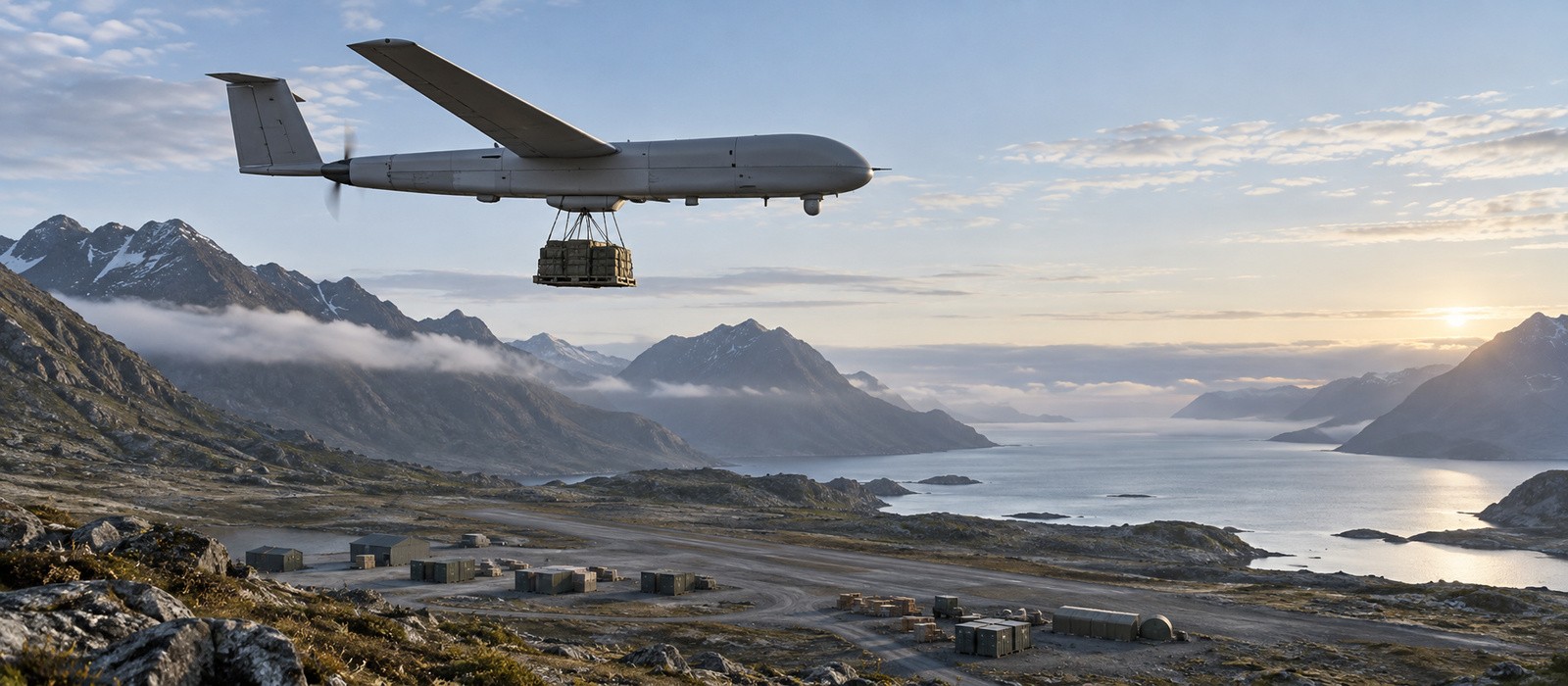


Abstract: Unmanned Aerial Systems (UAS) have emerged as a transformative capability that can redefine air logistics in contested and difficult environments. UAS promise greater flexibility, speed, economy of effort and survivability for military air logistics. India is behind the curve on induction of these systems especially for military air logistics. UAS in service across the globe are tactical in ranges as well as in payload capacity. There is a bigger envelope of intra-theatre and inter-theatre air logistics that has still not been addressed. Development and integration of capable UAS technology and tactics can be a capable force multiplier in the intra-theatre and inter-theatre air logistics operations within the Indian sub-continent. This article will analyse the technology and capability required by the long-range and heavy-payload UAS. It will also give a roadmap for organisational and structural requirements for operational integration of such systems in Indian Armed Forces and discuss the tactics most suited for their best operational employment.
Introduction
ogistics are paramount in war and peace alike. Military air logistics (MAL) are an integral part of this framework. Unmanned Aerial Systems have emerged as transformative tools which can redefine air logistics in varying environments whether contested, austere or developed. UAS promise greater flexibility, speed, economy of effort and survivability in the matrix of military air logistics.
Technological progress in propulsion, autonomous operations, sensors, weapons, and miniaturisation of many components, buoyed by recent operational successes for UAS in Iraq, Afghanistan and the Russia-Ukraine conflict, has prompted significant interest in developing new applications for UAS not only for combat but also for MAL. These reduce manpower demands, reduce the risk to humans in the battle space and produce other benefits.1 Various roles that have been validated and proven in operations are surveillance, reconnaissance, aerial strikes, electronic warfare and terrain mapping. Tactical air logistics have also been carried out extensively by UAS like K-MAX by the USA in Afghanistan.2 The Indian Army has also inducted a tactical logistics drone called Sabal 20 in November 2024.3
However, India is behind the curve on induction of UAS for military air logistics. Most of the logistics UAS in service across the globe are tactical in ranges as well as in payload capacity. There is a bigger envelope of intratheatre and inter-theatre air logistics that has still not been addressed. These longer missions account for a majority of all MAL missions in several types of conflicts as well as during peacetime. This specific operational space ideally entails requirement of UAS with longer ranges of more than 1500 km and payload capacity around four tonnes. Addressing this operational space with suitable UAS technology along with tactically sound implementation has the potential to redefine MAL. It is also important to analyse that can UAS fill the space of manned airlift aircraft and still be highly operationally effective. There is also a factor of time required to make these platforms operational in the current technological situation. This essay aims to lay forward the challenges, requirements and pathways for capability development and integration of UAS in military air logistics for intra-theatre and inter-theatre airlift missions within the Indian subcontinent.
Employment of UAS in Global Military Air Logistics Operations
Unmanned helicopters were experimentally used in the Vietnam War by the Americans for trial ammunition drops.4 UAS have come a long way since then. They have been used in various operational roles, and their evolution has been accelerated by other technological advancements especially in space domain, composite materials, microprocessors and artificial intelligence. These advancements have also made it possible for UAS to be employed in MAL. Effective military employment of UAS in logistics role was achieved in Afghanistan in Op Enduring Freedom.5 There has since been a steady increase in UAS employment in this role across the leading militaries.
A study conducted by RAND Arroyo Center in 2011, identified and analysed ten different potential uses of UAS in military logistics applications over and above the resupply operations. These include reconnaissance and surveillance tasks to secure logistics convoys through over-watch with UAS, route reconnaissance by looking for hazards that might endanger logistics convoys, surveillance of pipelines, electrical lines, rivers, supply depots, disaster scenes, and pre-deployment theatre reconnaissance. It also examined the potential for using UAS to locate airdropped cargo that misses the drop zone and to retrieve critical unserviceable items expeditiously.6 However, the primary task of logistical resupply remains a major part of the entire effort.
Globally, UAS employment in MAL has seen a steady rise in the past two decades. The primary employment has been tactical resupply. The U.S. Marine Corps’ Tactical Resupply UAS (TRUAS) and the Malloy T150 quad copter have been used for supplying troops with water and medical kits in austere conditions.7 Since the focus of this paper is on long range and heavy payload resupply UAS, it is important that we understand the classification and developments in this area across the world.
The categories for military drones are quite different from those for civilian drones. They are categorized based on their weight, range, speed as well as their specific capabilities. The classification is used by NATO and is according to the US Department of Defence:-
- Class I (< 150 kg) (Small). This class includes micro, mini or small drones with primary reconnaissance, surveillance and targeting purposes. They are often fixed wing with an average weight of about 20100 kg, a maximum speed of 100 km/h and a flight height of up to 4 km.
- Class II (150–600 kg) (Medium). This class includes drones with the size and capabilities of small aircraft. They feature a combination of flexibility, durability and robustness and are used for surveillance and monitoring in damage analysis and assessment, border surveillance, reconnaissance, resupply and emergency response.
- Class III (> 600 kg) (Heavy). This category includes aircraft sized drones. They have a wide range of applications, being used to determine the position of the enemy or the movement of certain targets.8 These can also be gainfully used for long range air logistics. Class II and Class III in the above categories can be used for MAL. There are many class II UAS developed and employed in this role by USA, Russia, China, India and Israel.
Recent Developments and Global Trends
Among other notable global developments, the US Air Force is undertaking a study called Agility Prime Program for autonomous cargo aircraft. China has developed FH-98 fixed wing heavy lift UAS, AV 500W rotor wing drone and is also employing Wing Loong variants for the air logistics role. Russia has invested in Altius and Orion UAS for Arctic logistics operations. Israel’s VTOL logistic drones are being combat proven in Gaza. Japanese unmanned helicopter ‘K-Racer’ demonstrated automated transport without human intervention at Nankai Rescue 2024.9 India had floated a Request for Information (RFI) in 2022 for logistics drones for the Indian Army including a resupply drone for high altitude.10 This has led to the induction of SABAL 20 drone in Indian Army. Even though these drones according to RFI are supposed to have payload capacity of up to 80 kg, they are still a step in the right direction.
These global developments indicate that the tactical usage of the UAS with lesser payload is dominant. The FH-98 UAS of China is a notable step in the long-range logistics UAS. It has a payload capacity of 1.5 T and range of up to 1200 km and has been developed by converting an existing manned aircraft Shifei Y5B.11
It is evident that UAS employment in tactical logistics missions has evolved significantly in the last two decades. Research and development for this class of drones is accelerating with more countries making a conscious effort to integrate this capability in their tactical military supply chains. This is also driven by the fact that there are hardly any UAS in operational use which have heavy lift and long-range capabilities. However, the US and China have taken the initiative in this domain. The ongoing Russia-Ukraine war and Op Sindoor have reignited the focus on effective air logistics in contested environments.12 UAS based air logistics can overcome this operational deficiency by employing hub and spoke methodology. Their integration could be worked backwards from spoke to hub as the technology matures in this field.
UAS Requirements for Intra-Theatre and Inter-Theatre Airlifts for India
Military deployments and operations in India are extremely diverse. Primary governing factors are geography and geo-politics. High altitude of Northern Ladakh and North Sikkim pose a very different challenge from the basic ALGs of North-East. Similarly, air logistics for desert and island territories of India have innately different requirements.13 Geo-political and military threat perceptions dictate force deployment and basing. This leads to complex requirements of op logistics in India. Air logistics is an integral part of this matrix and is stretched for the limited aircraft in the transport fleet of the IAF and some tactical capabilities in other services. Suitably designed and developed UAS can not only bridge this gap but also have the potential to perfectly fit in.
Requirements for Air Logistics UAS
It is important to first define the operational requirements for air logistics UAS and then match it with available technology, resources and environment. Let us consider some operational factors in air logistics. The current MAL assets are primary with the Indian Air Force. These vary from light (Do-228) to heavy payload capacity (C-17 and IL-76). These have operational ranges varying from 1000 - 5000 Nm, depending upon payload. However, such aircraft are seldom utilised to their maximum payload or ranges due to diverse payload requirements and relative geographical locations of the bases.14 The payload mainly consists of tri-services’ operational load and troops. The civil aviation boom has reduced routine personnel movement by service aircraft. Air logistics requirements are becoming increasingly load centric and this is an area where the initial UAS employment needs to be explored. Developing UAS initially only for payload and not for personnel carriage will help reduce design and certification complexities. Thus, in this segment the desired envelope can be broadly defined as load centric (4 tonnes) with ranges up to 1500 km. This segment is ideal for UAS integration due to the following factors:
- This combination of payload and range fits ideally in the hub and spoke model as the spoke element.
- It is the most subscribed op logistics segment, by all the three services, in the spoke part of the chain for air transportation.
- This segment is easily scalable to meet higher air logistics demands.
- It could be an ideal stepping stone for more extensive UAS integration in the op logistics. This is because assets required will neither be too big to manage nor be too small to meet the requirement.
- The technology required to achieve the requirements of this segment is available and feasibility exists to make it in India.15
This combination of payload and range needs to be augmented with other performance capabilities for such a UAS platform to suit Indian geography and meteorology. These primarily can be listed as follows:
- Ability to carry out ground ops from sea level to 14000 ft elevation. Ø Cruise ceiling with max payload as 25,000 feet AMSL.
- Ability to operate from - 40°C to ISA +40°C. Ø Possess effective anti-icing system for airframe and engines.
- Ability to operate from short and austere airstrips.
- Ability to carry out semi-prepared runway operations (SPRO) with robust undercarriage.
- Possess Environmental Control System (ECS) in cargo hold for specific temperature sensitive payload requirements. Among these the first two requirements are specifically for Northern Ladakh, and these can be lowered to cater for the rest of the national air logistics effort. Additionally, heavy jets are the primary airlifters in this area in any case.
Design Suitability, Technological Capabilities and Frameworks Required
Considering the above requirements, it becomes clearer that the most suitable UAS design would be a fixed wing platform with one or two engines and with an internal cargo hold. It could have a fixed or retractable landing gear which can be a trade-off between weight saving and reduction of aerodynamic drag. VTOL need not be a mandatory requirement; however, STOL capability would be quite necessary.
UAS comprises of airborne as well as ground-based support systems and procedural frameworks. This is analysed here: -
- Certification, air traffic integration and collision avoidance. The UAS will need to be certified according to the DGCA regulations for flying in civil airspace and civil routes. Promulgation of dedicated routes and requisite waivers may also be obtained initially for the military UAS. This will also entail that a Traffic alerting and Collision Avoidance System (TCAS II) based collision avoidance system is integrated in the UAS. The policy framework for establishing a UAS Traffic Management System in India has been drafted by the National Unmanned Aircraft Systems Traffic Management (UTM) Committee constituted by the Central Government. It has been drafted under the overarching framework of the Drone Rules, 2021.16 This policy also indicates Air Traffic Management (ATM) and UTM integration for future UAS employment. The ICAO document “Unmanned Aircraft Systems Traffic Management (UTM) – A Common Framework with Core Principles for Global Harmonization Edition 2” examines the issues related to the operation of aircraft (manned and unmanned) near or across boundaries between UTM and ATM airspace.17

Fig 118
- Modular palletisation of payload and loading/offloading mechanisms. The payload will need to be made modular and preferably palletised in existing 463L pallets of IAF.19 This will assist in quicker turn around times. Automated handling of payload at designated places at the base may also be developed like the palletisation hub model of C-130. Pallet based payload systems will be able to utilise the current available expertise and experience on palletisation and handling. This will also enable interoperability of payload with other air logistics platforms like C-295, C17, C-130 and Chinook.
- Communication, Control, SATNAV and SATCOM. Such UAS would require a robust command, communication and control setup. The integration of software defined radio and use of GSAT series of satellites for Beyond Line of Sight (BLOS) operations would also be essential due to the long ranges involved. Additional requirements would be Mode-S transponder for ADS-B and station keeping with other aircraft. NAVIC based satellite navigation with hardened receivers to guard against GPS jamming and spoofing; strap down inertial navigation systems to provide the operational redundancy and resilience in navigation; and a portable module option to be controlled by a mothership.
- Higher level of AI enabled autonomy. Higher level of autonomy using AI is the better way to optimise logistical effort with minimal human supervision for route planning and obstacle avoidance. This also enables personnel to be utilised for other duties. For example, integrated auto landing and recovery system would reduce or even eliminate the need of external pilots. UAS are thus, a ‘system of systems’, to use the cliché, which require ground support, satellite communications and procedural frameworks to integrate them into the framework of operational logistics. The Indian subcontinent’s varied geography and climate, impact on a wide spectrum of design requirements. Addressing all of them to achieve a system that can fit all the operational spaces will be a tall order. Hence, it is important employ an incremental approach and take small steps in specific domains. The requirements as deliberated above are achievable with the current Indian capacity and involvement of private industry.
Operational Integration of UAS for Long Range MAL
Operational integration of UAS for MAL would need to be incremental in approach. The Indian Army has taken a first step towards tactical air logistics for last mile delivery. These are highly localised and managed by units in the field. Integration of long range and heavy payload UAS is the next step and could be along four concurrent lines. These are, development of the aerial platform, ground support systems, formulation of operational procedures/tactics and establishing organisational structures. These four lines should be simultaneous and not sequential. IAF could be made the lead service for the programme and to validate the pilot project.
Development of Aerial Platform
Development of the unmanned aerial vehicles could be a ripe project for Make in India which can utilise the rapidly growing drone industry. The Indian government has banned imports of completely assembled drones and there is a top driven approach from the Ministry of Civil Aviation towards Atmanirbharta. The Drone Shakti 2023 Exhibition at Ghaziabad showcased and encouraged domestic development of UAS. MoCA recently announced that India would launch a $234 million incentive programme for civil and military drone makers to reduce their reliance on imported components. There are an estimated 600 drone manufacturing and associated companies in India.20 The involvement of IITs is an encouraging sign. For instance, recent DGCA approval for IIT Madras’ hybrid drone is a good example.21 Another recommendation here is to work on retrofitting the existing medium lift aircraft (C-295, An-32, HS-748) into unmanned platforms.
Developing a new UAS. Considering the technology and capability requirements for the UAS platform, the following can be factored in the developmental process: -
- Utilising COTS components and modular design for scalability and surge production with indigenised parts and production to reduce dependence on imports.
- Turbo prop engines may be explored with hybrid fuel options. The same in manned platforms like PW 127 series of engines which have a good performance envelope These may be coupled with the classic fuselage and wing configuration with cargo door and ramp configuration and roller-based cargo floor for 463L pallets.
- International standards such as the RTCA DO-377A, DO-362A, and ICAO guidance place stringent demands to account for both safety of flight and effectiveness of the mission. The C2 links should offer an availability of at least 99.9 percent, since loss of signal can directly endanger the aircraft. Latency requirement is also critical on large UAS flying beyond the visual line of sight. The round-trip delay of the control signals must remain typically lower than 300 to 400 milliseconds, so that the UAS can respond quickly to commands and to dynamic situations. Aviation authorities have left some spectrum within the Lband (960–977 MHz) and the C-band (5030–5091 MHz), specifically for the UAS. DO 362A specifically can be good reference point for the ground up development of the UAS C2 structure.22
Retrofit existing medium-lift military aircraft into UAS. As flagged earlier we must act on the second option as well by retrofitting existing medium lift manned aircraft like An-32, HS-748 and C-295 into logistics UAS. This can be a good stepping stone till a new UAS is developed. India’s maturing AI technology could be a key enabler. In doing so optionalmanning could be the initial step. These can only be regarded as stop-gap measures to prove the technology and work as test beds. This project could be spearheaded by ASTE at Bengaluru.
Development of Ground Support System
The development of ground support systems could be undertaken simultaneously since palletisation ecosystem has evolved over the past 14 years of C-130 and C-17 aircraft being inducted in the IAF. Of course, this will require higher scaling of more compatible pallets, lashing nets, straps and creation of dedicated palletisation hubs at the airbases.23
The airbases would need to identify designated parking spots and associated routes for taxiing in and out. UAS handling procedures would need to be formulated centrally. UAS would need to be compatible for all airfields with reference Code C or lesser as per ICAO Annexure 14 classification due to its expected medium size.24 Hence, existing infrastructure at almost all military air bases and even tier II civil airports may already be operationally compatible to these UAS. Simply stated, all air bases from where ATR-72 type of aircraft can operate; would be able to host these UAS. Moreover, infrastructural modifications and associated costs will be minimal.
Formulation of Operational Procedures and Tactics
India's current UTM protocols, controlled by the Directorate General of Civil Aviation (DGCA) and Digital Sky platform, are optimised mainly for peacetime civilian drone operations within Visual Line of Sight (VLOS) and Beyond Visual Line of Sight (BVLOS) areas.25 These protocols require airspace separation, real-time surveillance by NPNT (No Permission, No Take-off) mechanisms, geo-fencing, and centralised clearances to offer safety in highly populated peacetime civilian airspace. Instead of stringent geo-fencing and centralised clearances, the system would have to be adapted to mission lanes interfaced with military Air Traffic Management (ATM) that is resilient to cyber-attacks, conforms to needs of operational security and can operate where the environment is hostile. Military UTM for long-range missions also must integrate redundant C2 links (line-ofsight and satellite), secure identification friend-or-foe (IFF) integration, dynamic deconfliction with combat and transport manned aircraft, and interoperability with allied networks. Allotment of dedicated height bands and corridors may be explored in the initial period of trials and gradual integration may be achieved with incremental safety flight records.
Integrated procedures and tactics need to be formulated for MannedUnmanned-Teaming Tactics (MUM-T) to capitalize on the collaborative design of the UAS. These UAS could also be a good test bed to develop this technology and tactics. For instance, the Defense Advanced Research Projects Agency (DARPA) began the Gremlins program in 2015 to explore the concept of launching and recovering fleets of reusable unmanned air systems (UAS) from transport aircraft that could be made available such as the C-130 Hercules.26 The concept is of a manned transport aircraft as a mother ship launching a number of small unmanned air vehicles mid-air, retaining command and control of them during operations, and recovering them mid-air with a docking system. This has four distinct advantages: -
- Operational flexibility. The mother ship can have a modular, removable C2 console which can be installed on any similar performance transport aircraft enabling very significant operational flexibility.
- Scalability. Four such UAS with a mother ship will be able to airlift almost 20 T of payload which is equivalent of the maximum payload of a C-130. This will provide scalability and save more expensive manned platforms.
- Redundancy. These tactics could provide redundancy for the space based C2 structure. The mother ship can control an guide the UAS to destination in a formation.
- Higher survivability. A mother ship can guide the UAS to Forward Operating Bases (FOBs) during hostilities while remaining safe from the enemy AD threat. This will be extremely useful for armament bridging missions.
Establishing the Organisational Structures
The lead service for the logistics UAS integration could be the IAF. Directorates of Remotely Piloted Aircraft Ops and Directorate of Transport and Helicopter Ops (Dte of T&H Ops) would need to establish the policies and procedures for these operations. Operational control could be with the Ops T&H vertical which controls air logistics. At field levels, independent squadrons need to be raised, preferably co-located with other transport squadrons at the major logistics nodes to utilise the palletisation hubs and common maintenance support. The UAS with commonality with other transport platforms could be based accordingly. This will be specifically applicable if retrofitted aircraft are used as UAS. Once various UAS are proven in the role they could be inducted centrally though HQ IDS, for all Services. This will provide interoperability and will reduce the requirement-to-tasking period.
Recommendations
The following recommendations are made to make this integration a reality in the most optimum way: -
- Civil Military Fusion for development of this technology needs to be adopted involving IITs, private and public drone manufacturers and the three services.
- Retrofitting of manned platforms like An-32, HS-748 and C-295 into unmanned or optionally manned platforms is a good stepping stone for maturing this technology while retaining capabilities at marginal additional cost.
- Incremental approach needs to be followed towards the integration process. The UAS may be first validated in the plains, deserts, islands and in lower Himalayas of Northeastern India before validating it in forward area in Northern Ladakh. This will also scale the development process at a reasonable performance slope.
- Doctrinal revision will need to be undertaken to include UAS and their employment in combat enabling operations.
- Revision of UTM policy of India needs to facilitate induction of long range UAS for expanded operations. This may be preceded by requisite policy waivers for the military UAS operations in Indian airspace which may include provisions for reserved height bands or dedicated dynamic corridors for transit.
- Integrated induction process needs to be followed for the three Services. This will enhance interoperability and redundancies during peacetime operations and during conflicts. This may be centrally controlled by HQ IDS.
- Dedicated space-based assets, beyond the GSAT satellites, need to be requisitioned and made operational. These are critical for the C2 of long-range missions.
Roadmap for integration. The complete operational integration of these long range and heavy payload UAS in the MAL are proposed to be achieved in the following three stages: -
➢ Stage 1. This stage will need to be achieved in the first five years. This could include the following:
- Parallel pursuit of development of UAS, retrofitting of manned aircraft, revision of regulatory framework including UTM policy and doctrinal revisions.
- This would further involve testing and validation of platform in the routine air logistics role.
- After validation, operating procedures and tactics would need to be formulated and lead to the training of selected personnel on the system.
- Command and control structures need to be nominated and established with clear responsibilities and reporting verticals.
- Achieving dedicated space-based assets for C2 of long range UAS.
➢ Stage 2. This stage would need to be achieved in the next three succeeding years. This stage would include the following: -
- This stage would commence with the raising of a dedicated field unit in the form of a squadron in the IAF. This may be co-located with any military transport squadron, preferably with the one which already operates the aircraft with significant commonality with the UAS.
- This would be followed by validation of tactics, collaborative model and mother-ship operations.
- Trials for tri-service integration will commence and joint training of selected personnel would need to be undertaken.
➢ Stage 3. This stage would need to be achieved in the next three succeeding years. This stage will include the following: -
- This stage would commence with induction of the platform in logistics matrix of the Indian Army and Navy. This would be achieved through induction of that UAS in selected field/ shore units.
- The UAS would be developed and refined as per the feedback of the field units and high-altitude trials would also be required.
- Procedures and regulatory frameworks may be revisited for enhancing operational effectiveness.
- Future design developments, commercial applications and defence exports to friendly foreign countries may be explored.
Conclusion
The future of Indian military logistics does not lie only in the multiplication of manned platforms but in well-thought-out integration of unmanned air systems. Long-range and heavy-lift UAS could fill the critical distance between strategic airlift and the tactical last-mile payload delivery and can achieve persistence, survivability and versatility in hostile terrain. This is both a capability imperative as well as a doctrinal renewal. UAS-augmented military air logistics can be a force multiplier by adopting a phased development approach, institutionalising UAS operations, indigenous development and by involving public–private industry partnership. It is not merely an opportunity to overcome domestic challenges but also to make India a pioneer of unmanned military logistics evolution in the world.
Endnotes
- John E. Peters, Somi Seong, Aimee Bower, Harun Dogo, Aaron L. Martin, and Christopher G. Pernin, Unmanned Aircraft Systems for Logistics Applications (Santa Monica, CA: RAND Corporation, 2011). Rand Corporation (2011).
- Bill Carey, “K-Max Proves Unmanned Heli-Lift in Afghanistan,” AIN Online, April 20, 2012, https://www.ain online.com/aviation-news/defense/2012-04-20/k-max-proves-unmanned-helilift-afghanistan. Operational Integration of Unmanned Aerial Systems for Military Air Logistics
- Mayank Singh, “Indian Army Inducts ‘Sabal’ Logistics Drone, Boosting Operational Capabilities in Challenging Terrains,” The New Indian Express, November 27, 2024, https://www.newindianexpress.com/nation/2024/Nov/ 27/indian-army-inducts-sabal-logisticsdrone-boostin g-operational-capabilities-in-challenging-terrains.
- Philip A. Petersen, “Unmanned Aircraft Systems in Vietnam: Early Experiments and Lessons,” Air Power History 60, no. 2 (2013): 32–45.
- Thomas Withington, “Unmanned Cargo Helicopters: K-MAX in Afghanistan,” Jane’s Defence Weekly, June 2014.
- John E. Peters et al., Unmanned Aircraft Systems for Logistics Applications (Santa Monica, CA: RAND Corporation, 2011).
- Sam LaGrone, “Marines Pick Winner for TRUAS Cargo Drone Prototype; UK’s Malloy T150 Among Contenders,” USNI News, December 09, 2022, https://news.usni.org/2022/12/09/ marines-pick-winner-for-truas-cargo-drone-prototype.
- Nikolay Nichev and Krasimir Koynakov, “Use of Unmanned Aircraft in the Logistics Support of Military Formations,” The Eurasia Proceedings of Science, Technology, Engineering & Mathematics (EPSTEM), vol. 31 (2024): 92–99, https://epstem.net/en/download/articlefile/4402564.
- Kawasaki Heavy Industries, “Unmanned Helicopter ‘K-RACER’ Demonstrates Automated Cargo Transport without Human Intervention at ‘Nankai Rescue 2024,’” news release (PDF), January 14, 2025, https://global.kawasaki.com/news_250114-1e.pdf.
- Government of India, Ministry of Defence, “Request for Information (RFI): Logistic Drones,” December 16, 2022, https://www.mod.gov.in/sites/default/files/RFI.
- Press Trust of India, “China Successfully Tests World’s Largest Unmanned Transport Drone,” NDTV World, October 17, 2018. https://www.ndtv.com/world-news/china-successfully-testsfeihong-98-worlds-largest-unmanned-transport-drone-1933626.
- The Economic Times, “Logistics Management Was Deciding Factor in Success of Op Sindoor: Rajnath Singh,” July 27, 2025. https://economictimes.indiatimes.com/news/defence/logisticsmanagement-was-deciding-factor-in-success-of-op-sindoor-rajnath-singh/articleshow/ 12293425.cms.
- Manmohan Bahadur, Air Maintenance 2025: Prospects and Limitations (New Delhi: Centre for Air Power Studies, September 2022), https://capsindia.org/wp-content/uploads/2022/09/ Manmohan-Bahadur.pdf.
- Ibid.
- As brought out in an interaction with an Indian Experimental Test Pilot.
- Directorate General of Civil Aviation (DGCA), National UTM Policy Framework (New Delhi: Ministry of Civil Aviation, Government of India, October 24, 2021), https://civilaviation.gov.in/sites/default/files/migration/National-UTM-PolicyFramework2021_24_Oct_ 2021.pdf.
- Ibid.
- Ibid.
- John Schroeder and Christine Martinez, 463L Pallet and Dunnage System Evaluation (WrightPatterson Air Force Base, OH: United States Air Force Armstrong Laboratory, Human Resources Directorate, Logistics Research Division, 1997).
- “India Plans $230 Million Drone Incentive after Pakistan Conflict, Sources Say,” Reuters, July 04, 2025, https://www.reuters.com/world/india/india-plans-230-million-drone-incentive-afterpakistan-conflict-sources-say-2025-07-04.
- “IIT Madras-Incubated Amber Wings Gets DGCA Nod for Hybrid Cargo Drone ATVA-1,” The Economic Times, March 01, 2025, https://economictimes.indiatimes.com/tech/ technology/iit-madras-incubated-amber-wings-gets-dgca-nod-for-hybrid-cargo-drone-atva1/articleshow/122664202.cms.
- Federal Communications Commission, “Spectrum Rules and Policies for the Operation of Unmanned Aircraft Systems,” Federal Register 88, no. 26 (February 07, 2023): 7910, https://www.federalregister.gov/documents/2023/02/07/2023-00961/spectrum-rules-andpolicies-for-the-operation-of-unmanned-aircraft-systems.
- David J. Kolleda, Developing the Theater Level Aerial Port of Debarkation, Organization and Structure (Fort Leavenworth, KS: School of Advanced Military Studies, United States Army Command and General Staff College, 1996).
- International Civil Aviation Organization. Annex 14 to the Convention on International Civil Aviation: Aerodromes. Vol. I, Aerodrome Design and Operations. 8th ed. Montreal: ICAO, 2018.
- Directorate General of Civil Aviation (DGCA), National UTM Policy Framework (New Delhi: Ministry of Civil Aviation, Government of India, October 24, 2021), https://civilaviation.gov.in/sites/ default/files/migration/National-UTM-Policy-Framework2021_24_Oct_2021.pdf.
- Defense Advanced Research Projects Agency (DARPA). Gremlins: Airborne Launch and Recovery of Unmanned Systems. Washington, DC: DARPA, 2018.
