


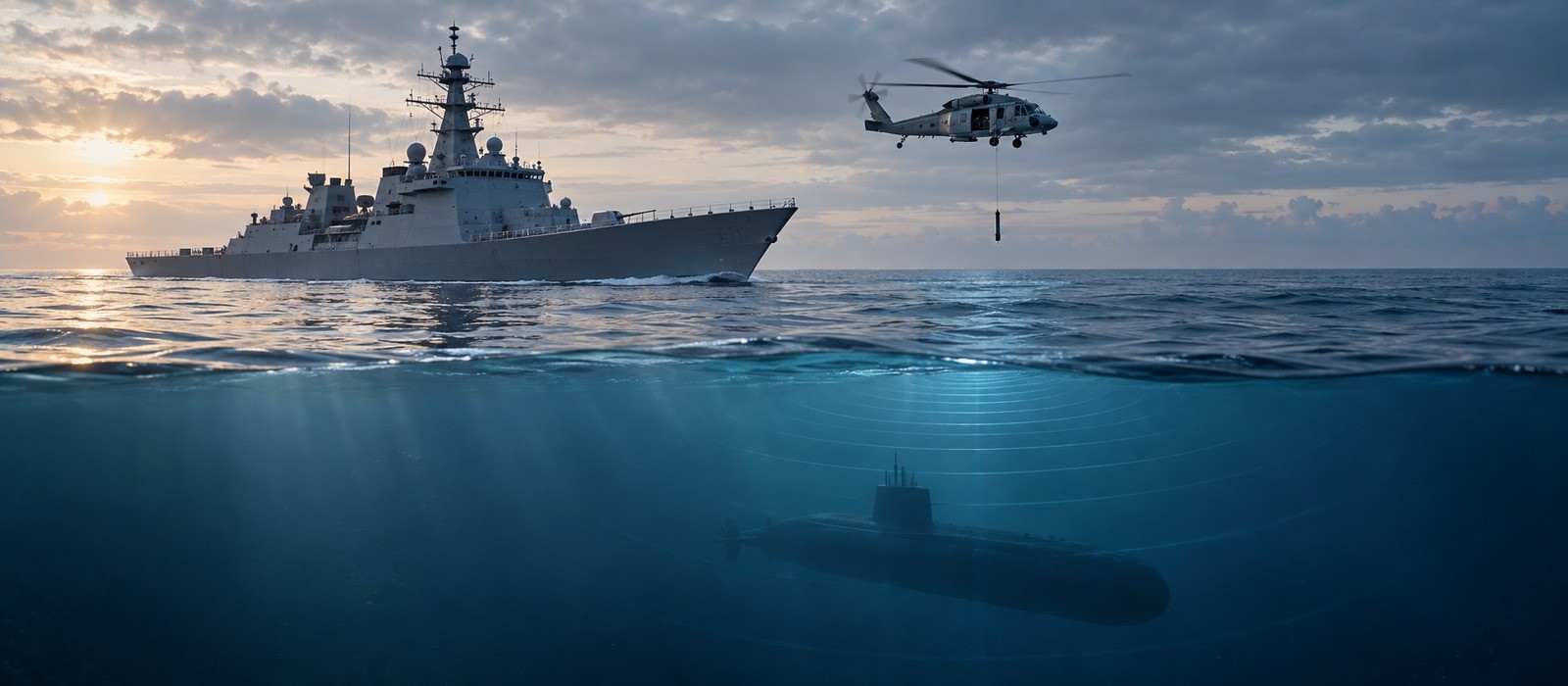


Most people when queried on the aim of ASW tend to answer “To Seek, To Classify, To Destroy.” This is the motto and not the aim. The aim of Anti-Submarine Warfare is ‘To deny the enemy the effective use of his Submarines.’
The aim is very clear. For then, Anti-Submarine Warfare would also involve not allowing the enemy to have a submarine; preventing the submarine from sailing out; having sailed out ensuring that the submarine is out of action or out of the equation completely and so on. This may all sound unwarrior-like very passive, very defensive and very unglamorous. Hence, the evolution of a more aggressive motto, which people tend to confuse or associate with the aim.
ASW is a branch of underwater warfare and ideally, most people will agree that it should be called Undersea Warfare for the term ‘Anti-Submariner’ just does not sound right. For one, Submariners too do Anti-Submarine Warfare Courses and more importantly, no one dislikes the submariner; one respects one’s adversary. It is an art that both are engaged in and ‘Undersea Warfare’ has the right ring.
The old name for ASW in our Navy was Torpedo & Anti-Submarine and the officers were referred to as TASO. Colloquially, one joked about TAS as the ‘Thomas-Antony-Subramaniam’ School for the plethora of officers and ratings, particularly as the UC ratings in this field were from ‘God’s own Country’ and near about. Even today, the banter is that ASW is for ‘Antony-Subramaniam-William.’ It is an amazing coincidence that till recent years the majority of officers and especially, the UC ratings, were from the South (particularly Kerala and Tamil Nadu). Likewise, one did have a Malayalee flavour among the communication ratings, a Jat flavour in the Diving branch etc. This has since blurred and there is a larger homogenous mix now but the banter remains.
ASW is different from other forms of Warfare, for the tactics involve a lot of ‘mind games’ involving a lot of manoeuvring, positioning and long periods of supposed inactivity. We often jest that actual tactics are in ASW and all the rest is closer to being drill or procedure-oriented. There is some element of truth in the banter, for a lot depends on the mind of the Commanders at sea, both the hunter and the hunted. The hunter and the hunted can be a ship or submarine or aircraft and the roles can reverse very quickly. One part of ASW covers preventing and avoiding the encounter itself. There are a large number of options that sound not too glamorous but are important nonetheless.
Any ASWO, or ‘Pings’ as he is colloquially referred to, knows that the initial advantage rests with the submarine. It is a ‘given;’ the medium they operate in is such and the way the sound waves propagate, the submarines benefit immensely. Simplistically put, submarines will be quiet and in listening mode whilst the ship has to make her way through the water.
The game starts after that. What does the Submarine do after the initial detection of the target? How does the boat move into position to engage the ship? Does the Submarine Commander have a choice not to manoeuvre? If he manoeuvres, what are the chances of being detected by the ship? When he manoeuvres, the probability of detection increases and a cat-and-mouse game begins even if the mouse (an unlikely term for a ship) is unaware of the stalker. The stalker has to be prepared that the chances of detection are increasing when he begins his manoeuvre. Herein, we have not yet factored in Air ASW, for the submarine may not know where the next dunk could come or whether there are sonobuoys or other modes of detection ongoing. It takes but a moment for the situation to change, and for the roles to reverse.
The Submarine Commander has to decide whether to go in for the kill in this uncertain environment. His advantage is stealth and surprise, and that advantage could disappear in a moment. After weighing all the options, the Submarine Commander then takes the call to commence the attack. To be effective he has to first get into a firing position. The first preference for a boat will be the torpedo, a subject for another debate for some but agreed to by most specialists. Once the boat has fired or when firing, the boat has to assume that its position has been compromised and that the boat would need to take evasive measures. This presents a different challenge to the Submarine Commander and I am sure most will be willing to take on the challenge and accept the risk. That is how all of us are trained. But it’s a challenge nevertheless.
Now, what can ships do? Without getting into details, if a ship is alone she is severely challenged, vulnerable and at extreme risk of being attacked and re-attacked. Of course, high speed, evasive measures and manoeuvres etc. are available and are fairly effective too. Ships in formation do provide greater protection and here, the challenge to the Submarine is more, for then the boat has to be mentally prepared that she is going to be under severe attack after her first action.
We have not even talked of the elaborate manoeuvres that the boat has to do to get the Fire Control Solution (FCS) to be in a position to fire. This is an important aspect to understand and every specialist, particularly ASWOs, must go through the process to understand the challenges. ASWOs must have enough sailing time on submarines. I have been lucky that I have more than 25 days at sea on submarines (courtesy of my Commanding Officers).
Since the submarine generally operates in the passive mode, she has to manoeuvre to obtain the Target Motion Parameters (TMP), obtain an FCS and get into a position to fire. Considering the slower speed of the conventional Submarines, the challenge is even more. Now consider that the boat moves into position and precisely at that moment the ship manoeuvres out (zig zag’s, alters course, etc. that is any of the submarine evasive measures). It may well be nigh impossible for the Submarine Commander to get a favourable position again. The opportunity would be lost and she would be left out of battle or it can also be that the ship alters course into a waiting Submarine, and the Submarine Commander has to be prepared for this too and seize the opportunity.
While engaging ships in formation, the Submarine Commander has more to think about. A lot depends on the ‘mind of the Commander’ as well and while it is different for different individuals, in situations like this, one would tend to assume and believe that every Commander at sea, be it on a boat or a ship would be willing to take on the challenges. And needless to say, accept the risk.
And now add this - Air ASW, radar transmissions to keep the boat down, Dunking Sonar, Sonobuoy Fields, PTAS ships, MAD, satellites and other forms of detection including EW. All this makes the art of Anti-Submarine Warfare so interesting that the possibilities and options are tremendous with a lot of variables, thrown in. More importantly, it forces the Submarine Commander to think like the adversary. What will the other man do in this situation? Can we guess that? Can we know that? How do we train for it?
To be able to think like the adversary one has to put himself in his shoes. So, surface ship ASWOs must sail on Submarines and Submariners on surface ships to understand perspectives, and to experience them; for only then will one evolve as an Under-Sea Warfare Specialist.
Our exercises and training are well structured and we need to evolve to add more realism to them. This can happen through discussions with each other and using the opportunity to fine-tune the exercises. Say during a Coordinated Anti-Submarine Exercise No. A17 (CASEX A17) when the submarine penetrates the screen and has an FCS, she pings on her sonar when she is about to fire the torpedo. This makes the sonar operator on the ship a little more alert and brings in an element of realism.
As Commanding Officer of INS Ranjit, I was the senior-most ASW Specialist in the Eastern Fleet and later, as Fleet Operations Officer (FOO), we evolved several exercises. Briefing and debriefing were attended by the practitioners to evolve and understand each other’s perspectives. We instituted the mechanism of ‘On the Spot Analysis’ post a CASEX and detailed debrief purely dedicated to ASW aspects only between practitioners of the art (i.e. Submariners and ASWOs).
These debriefs were carried out away from the Fleet glare purely by the practitioners, had a great learning value (the younger officers interacted more freely) and the discussions led to other ways of getting more value from the exercise. For example, the submarine giving a ‘ping’ when she had an FCS, or firing an SSE at a pre-described time and so on. Eventually, it is not Blue vs Blue but Blue vs Red and all exponents in this ‘cat and mouse’ game need to get the best value out of the exercises.
A Submariner gets sufficient exposure onboard a surface ship (in his formative years and some submariners are also posted as ASWOs on surface ships post-specialisation). But for a surface ship ASWO to perceive the submariners’ psyche and challenges, one has to go out of the way to train and develop this understanding. A day’s sortie on a submarine does not help and it should be participation in tactical exercises to understand the processes/ challenges of submarine operations.
Later as FOO, I continued this practice of debriefing and interaction and we went a step further by having Fleet Captains who were submariners explain the nuances to young ASWOs. If the ASWO could not sail on a submarine, we had Commanding Officers of Submarines in refit/AMP sail on a surface ship to explain to the young ASWO what a Submariner would do at that time. These interactions and discussions were very productive and led to a better understanding and appreciation of each other. During my period as FOO, we also enjoyed some wonderful exercises with our nuclear submarine and there were plenty of lessons learnt with which we could rework tactics and plans. These interactions and professional discussions in our Navy have been mostly dependent on personalities and the rapport one enjoyed with each other. The corollary to this is that if a young ASWO, a submariner or any practitioner of any art for that matter engaged in such professional interaction and discussions, the necessary rapport would develop, which would become a natural process in the later years.
In conclusion, there are many challenges in undersea warfare and the ‘psyche’ and ‘mind’ of the Commander plays a very crucial job in the progress of operations. There are bound to be long periods of ‘inactivity’ followed by short periods of intense activity. Undersea warfare is an art that no one can claim to have perfected and needs continuous training and interaction between the ‘hunter’ and the ‘hunted’ due to the dynamic and complex operating environment. The saying ‘the more you sweat in peace the less you will bleed in war’ would be very apt for the practitioners of undersea warfare.
