


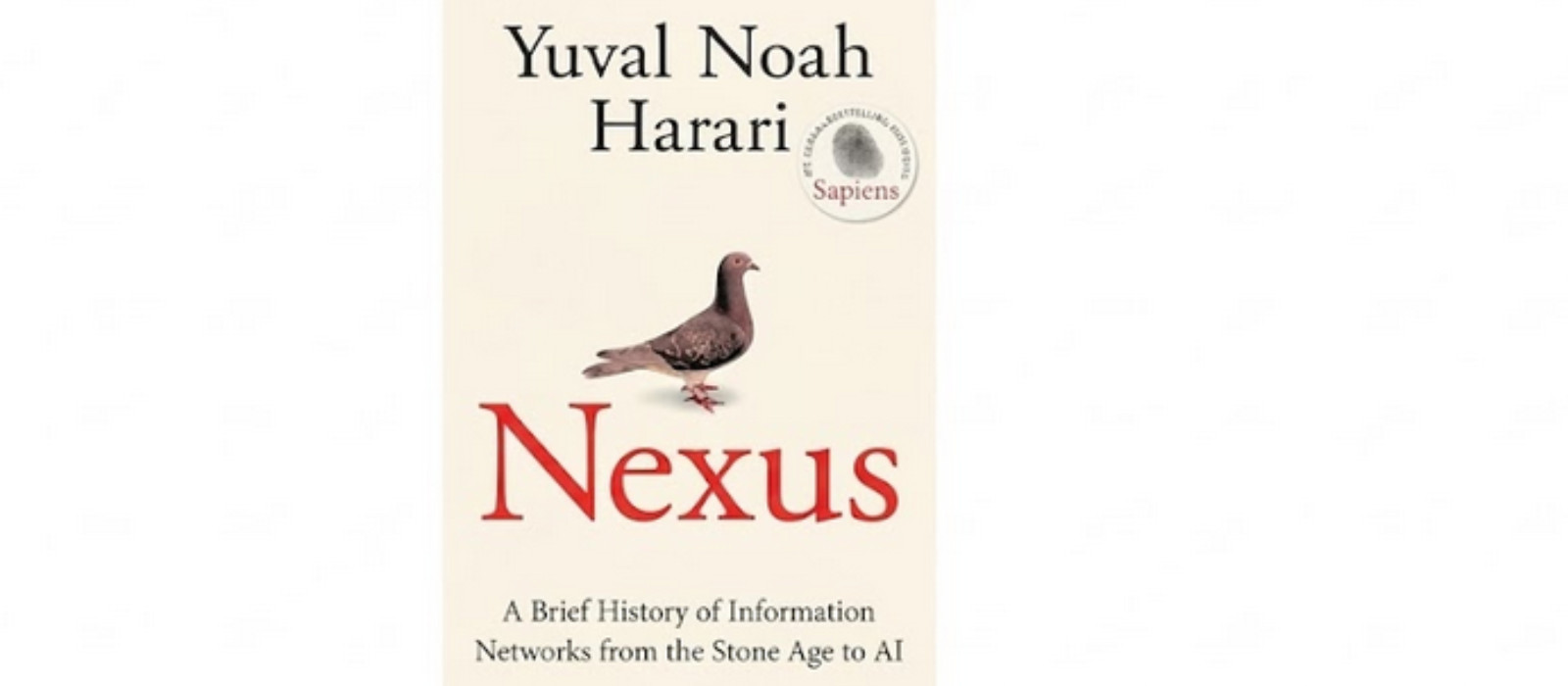


Nexus: A Brief History of Information Networks from the Stone Age to AI
Author: Yuval Noah Harari
Published by: Penguin Random House, Edition: 2024 ISBN: 978-1529369250 Pages: 528
Book Review by Commodore Himadri Bose, VSM
Yuval Noah Harari's Nexus ambitiously attempts to chart the long arc of human communication, tracing our relationship with information from prehistoric storytelling to today's AI-driven digital ecosystems. While undeniably sweeping in scope, the book often reads as more of a grand narrative than a grounded analysis. Harari weaves strands of history, philosophy, technology, and politics, suggesting that the flow of information has been the defining force behind human society. Yet, his treatment of "information" borders on abstraction, occasionally glossing over the messy human realities like power struggles, manipulation, inequality, etc, that have always underpinned and distorted communication networks. However, rather than merely celebrating the evolution of these informational systems, Nexus invites a deeper reflection on how the control and deformation of information continue to shape and sometimes distort our collective destiny.
The book is structured in three parts, each focussed on a different aspect of the development of human informational networks. In Part I of the book 'Human Networks', Harari explores the deep roots of information networks by examining how early humans relied on storytelling and myth-making to foster large-scale cooperation. He contends that these primitive forms of communication weren't just cultural expressions. They were essential tools for uniting strangers under common beliefs and symbols. Myths, in his view, played a foundational role in the development of complex societies by enabling trust, coordination, and collective identity among people who had never met.
He adds a philosophical layer to his narrative by highlighting the complexities of defining "information" across disciplines like physics and biology. Instead of seeking a one-size-fits-all definition, he focuses on how information has functioned historically as a mechanism for forging cooperative networks. A central claim he makes is that human societies have long depended on factual data and shared fiction, such as myths and religious beliefs, to bind people together and sustain large-scale social structures. These arguments are similar to the ones in Sapiens. Humans dominate because they can believe in things that don’t physically exist such as nations, gods, money, laws, rights, corporations. The transition from oral traditions to written culture represented a significant turning point in how human societies organised and preserved information. Harari underscores that the invention of writing enabled more precise, durable record-keeping, laying the groundwork for the rise of complex bureaucracies. However, he also warns of the fragility hidden within these systems, introducing the concept of "paper tigers" as institutions that appear formidable on paper but can quickly unravel when faced with changing circumstances they are ill-equipped to handle.
In Part II, 'The Inorganic Network', Harari delves into the emergence of technology-driven information systems, with a definite focus on the rise of computers, the internet, and artificial intelligence. He reflects on how this shift, from humans managing information to machines doing much of the heavy lifting, marks a profound transformation in our relationship with knowledge. He cautions that it is not just about speed or efficiency, it is about how we increasingly rely on algorithms to make sense of the world, raising new questions about control, trust, and the human role in decision- making. These sets of arguments are much like those in Homo Deus, that humans are deep-down, complex algorithms, therefore there is no principled reason as to why silicon-based algorithms cannot outperform carbon-based ones resident in humans.
Harari argues that unlike past technologies, which mainly served to enhance human abilities, artificial intelligence marks a radical departure. AI doesn't just assist humans; it can analyse data, make decisions, and even generate original insights independently without our direct input. This development, he suggests, carries far-reaching consequences. AI isn't merely a more innovative tool; it represents a fundamentally different kind of intelligence that doesn't think, learn, or interact as we do. As this new kind of "participant" enters our global information networks, it is beginning to transform every aspect of human life, from how we work and govern to how we wage war.
Harari delves into how today's digital world is shaped by nonstop information flows. He points out that we now live in a reality where information networks never sleep. The networks are always alive, buzzing, updating and connecting. He argues that this relentless pace of informational flow overwhelms our human brains, which simply weren't built for such constant, relentless input. Harari also raises concerns about how much trust we place in modern information systems, especially those powered by AI and algorithms. While these technologies are undeniably powerful, he reminds us that they are far from perfect. They often get things wrong, sometimes with serious consequences. He shares real-life cases where AI has shown bias or made flawed decisions, whether in criminal justice, healthcare, or on social media.
At the heart of his argument is a warning: we tend to assume that AI systems are more accurate and objective than they really are. However, as we hand over more and more decision-making power to these systems, the impact of their mistakes could become increasingly damaging.
In the last part of his book, “Computer Politics,” he concentrates on the political and social ramifications of the development of artificial intelligence and digital information networks. Harari examines how AI may affect international power structures and the conflict between democracy and totalitarianism in the digital era. Harari cautions that knowledgeable citizens capable of reasoned discourse are essential to democracy. However, this is undermined by how digital information networks are currently set up, distorting public debate and producing echo chambers. Harari contends that because AI-powered systems can handle enormous volumes of data, authoritarian governments would find it simpler to keep tabs on their subjects, quell dissent, and hold on to power. He compares historical control mechanisms like censorship and propaganda with contemporary AI technology. Harari also considers the prospect for a future where artificial intelligence replaces human rulers as the supreme authority. Without human supervision or involvement, AI systems would make decisions in this scenario using enormous datasets.
In closing, Harari challenges readers to re-evaluate their preconceptions about technology and how it shapes society. He cautions against the perils of naively believing that technology is infallible and urges a renewed emphasis on the human components in information networks. Harari highlights throughout the book that power and knowledge control have always been synonymous. Those with the keys to information networks have enormously influenced communities, from ancient scribes to contemporary AI engineers. However, the emergence of AI brings a new difficulty: these networks can no longer be controlled exclusively by humans. In the future, as Harari portends, people might submit to the networks they have established.
The notion of technological determinism, which holds that technology propels human advancement and permanently alters society, is a topic that Harari finds extremely troubling. Harari contends that people still possess agency even if he recognises the power of technology. In order to avoid becoming merely instruments of the machines we once controlled, he emphasises that we must be accountable for the technology we develop. A large portion of the book serves as a warning about the possible risks associated with artificial intelligence and the unbridled growth of digital information networks. Harari does not believe that AI can be neutral or helpful. He challenges humankind to carefully consider how we regulate these systems, warning that the concentration of power in AI-driven networks may result in previously unheard-of oppression and domination.
Harari’s core argument is that our handling of information networks has consistently shaped our societies and will continue to decide how humankind develops in the future. Attempting to answer the question what can we do to preserve our common reality and human civilisation? Harari argues that it is quite simple, we need to focus on "building institutions with strong self-correcting mechanisms" and impose strict official regulation on AI and algorithms. Maybe, then we shall continue to be liberal democracies? It's a weak ending to a book that has such a wide canvas overlayed with a rather depressing tone. The book appears excessively detailed in certain sections and the criticism of AI appears unidimensional. Nexus captures an eventful past and portends a dystopian future and leaves readers with questions of the path in between.
