


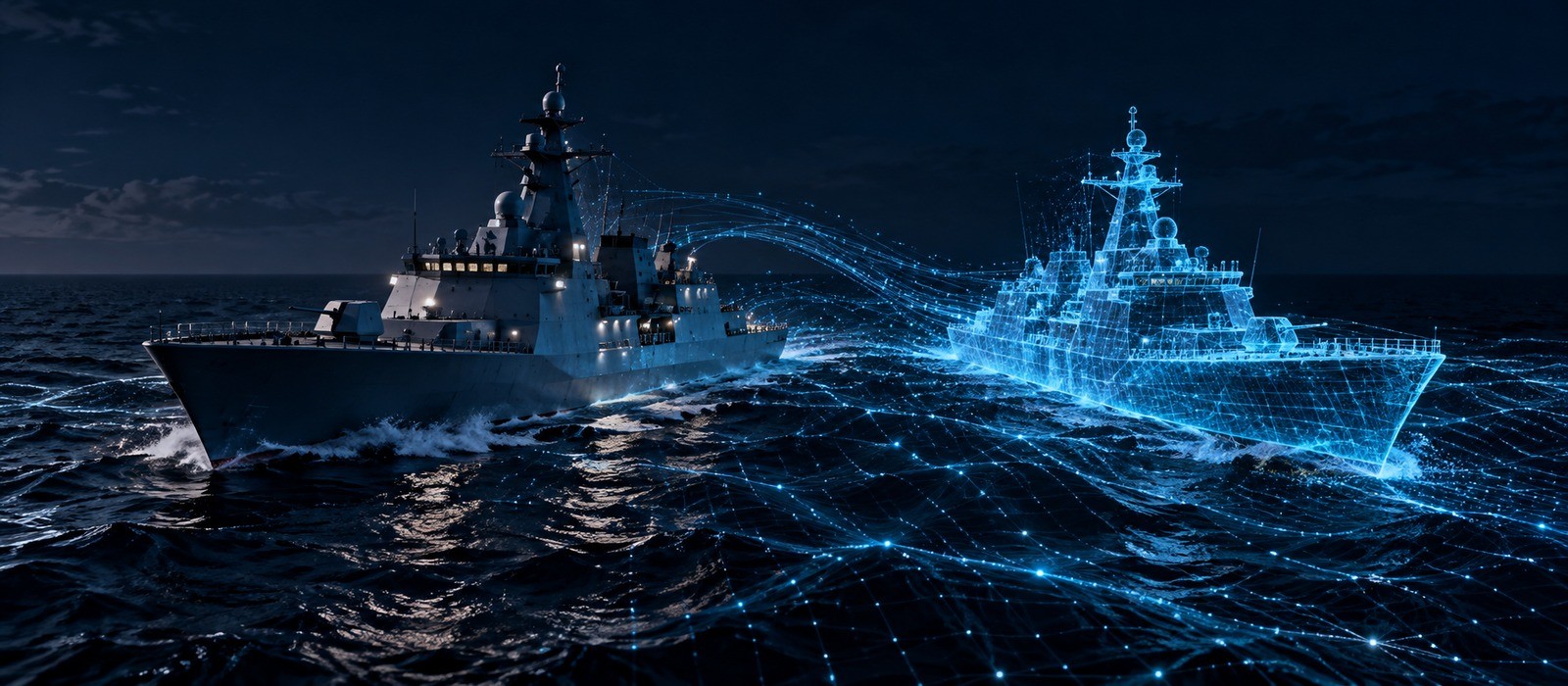


Abstract: The integration of digital twin technology into naval wargaming stands for a transformative approach to maritime strategy and operational training. This article explores the concept of digital twins—virtual replicas of physical systems—and their application in simulating complex naval environments. By creating real-time models of ships, fleets, and operational scenarios, digital twins enhance decision-making and strategic planning, allowing naval forces to anticipate and respond to evolving threats with greater precision. The effectiveness of digital twins in wargaming lies in their ability to simulate diverse scenarios, enabling comprehensive analysis of tactics and operational outcomes. This technology provides significant advantages, including improved predictive analytics, reduced costs associated with traditional training methods, and the ability to conduct iterative experiments without real-world risks.
Additionally, digital twins can integrate data from various sources, providing a holistic view of naval operations. However, the adoption of digital twins is not without challenges. Technical limitations, such as data integrity and computational complexity, can hinder the accuracy of simulations. Furthermore, the dependence on digital models may lead to oversimplifications of real-world dynamics, potentially misguiding strategic decisions. This article presents a critical analysis of the advantages and disadvantages of employing digital twins in naval wargaming. By evaluating case studies and theoretical frameworks, it aims to provide insights into the future of naval warfare training and the potential of digital twin technology to shape modern maritime strategies. The findings underscore the need for balanced integration, emphasising the importance of human intuition alongside advanced digital tools.
Introduction
Digital twins stand for a groundbreaking technology that enables the creation of virtual models of physical entities, allowing real-time monitoring, simulation, and analysis. In the context of naval warfare, wargaming has long been an essential tool for training, strategy development, and operational planning. This article aims to delve into the intersection of digital twins and naval wargaming, illustrating how this collaboration can enhance military preparedness and strategic decision-making. Naval wargaming has evolved significantly over the years, transitioning from traditional tabletop exercises to sophisticated computer-based simulations that reflect the complexities of modern naval engagements. As militaries look to adapt to rapid technological advancements, understanding how digital twins can augment these wargaming scenarios becomes increasingly crucial.
The Evolution of Naval Wargaming
Naval wargaming has a rich history that stretches from ancient civilizations to contemporary military strategy. This evolution mirrors the development of naval warfare itself, adapting to modern technologies, strategies, and geopolitical landscapes. Further paragraphs explore the historical foundations of naval wargaming, its pivotal role in military training, and the transformative impact of modern technologies, particularly artificial intelligence (AI) and digital twins.
In antiquity, Greeks and Romans engaged in rudimentary forms of naval wargaming, using physical models to simulate battles and refine their tactics. These early games laid the groundwork for strategic thought in naval warfare, which would be further developed by influential figures such as Sir Julian Corbett in the early 20th century. Corbett emphasised the importance of naval strategy in national policy, establishing principles that continue to inform modern naval doctrine.
The introduction of H.G. Wells’ "Little Wars" in 1913 marked a significant turning point, introducing structured rules for tabletop gaming that would influence the design of future wargames. The mid-20th century saw further advancements with the publication of David Manley's "Naval War" and John Harshman's “Sail Power,” both of which emphasised
realistic tactics and engagement strategies reflective of contemporary naval operations. During World War II, naval wargaming became an essential training tool, allowing strategists to simulate real combat scenarios and enhance decision-making processes. This period underscored the utility of wargaming in preparing military leaders for the complexities of modern warfare.1
The Role of Technology in Progression of Naval Wargaming
As technology advanced, so too did the sophistication of naval wargaming. The U.S. Navy played a crucial role in this evolution, particularly during the Cold War when researchers like Dr. Paul McGinnis developed simulation models to train military personnel. These early computer-based simulations set the stage for the US Department of Defense's (DoD) broader adoption of simulation technologies.2
JANUS. The introduction of the Janus conflict simulation model in the 1980s exemplified the U.S military's shift toward computer-based training tools. Janus served as an operational planning resource for key military operations, including Operation Just Cause and Operation Desert Storm for USA. Following its success, the American DoD expanded its use of simulations, integrating systems like Lockheed Martin’s Warfighters’ Simulation (WarSim), the Army’s One Semi-Automated Forces (OneSAF), the Marine Corps’ Marine Air-Ground Task Force (MAGTF) Tactical Warfare Simulation (MTWS), and the Air Force’s Advanced Framework for Simulation, Integration, and Modelling (AFSIM).3
Despite their advantages, traditional computer-based simulations have inherent limitations. They often rely on pre-established scenarios and require significant human heuristic decision-making, which constrains their ability to simulate diverse vignettes and scenarios. The dependence on human inputs can lead to biases and restrict the exploration of unconventional strategies.
Development in Western Navies and India
USA
In response to escalating concerns about its shipbuilding capacity, theU.S. Navy is exploring the implementation of digital twin technology as part of its strategic wargaming efforts. This initiative comes in the wake of a comprehensive internal review that revealed significant delays in many of the Navy's top programmes. As a result, the US Navy has revised its Naval Science and Technology Strategy, emphasizing the need for innovative solutions to complex operational challenges. At the forefront of this strategy is a commitment to reassessing its procurement plans, which include a reduction in the number of ships being acquired and the retirement of existing programmes. This ongoing shipbuilding controversy has cast a long shadow over Sea-Air-Space 2024, the U.S Navy’s premier tradeshow.4
The newly unveiled roadmap indicates that the U.S Navy will operate within the guidelines established by the Chief of Naval Operations, focusing on experiments designed to address intricate technical problems aligned with the Naval Implementation Framework and the broader Force Design directives of both the Navy and the U.S. Marine Corps. To ensure a robust evaluation of its technological advancements and strategic approaches, the Navy will adopt an adversarial method known as "red teaming." This technique aims to rigorously assess and challenge the 5 Navy’s technologies, strategies, and defensive capabilities.5
Moreover, the roadmap emphasises the need for advanced wargaming techniques that can confirm operational assumptions and help the rapid integration of emerging technologies into existing systems. Continuous advancements in artificial intelligence, quantum computing, biotechnology, and autonomous systems will be pivotal to this endeavour. The Pentagon is increasingly shifting towards AI-driven testing frameworks that can evaluate a multitude of scenarios, maximizing the potential of available processing power. Drawing on successful applications of digital twin technology, the Navy looks to the U.S. Space Force, which has effectively used this innovation for in-orbit wargaming. Developed by Slingshot Aerospace, the Digital Space Twin technology allows operators to virtually rehearse manoeuvres and devise responses to potential threats, such as incoming objects, prior to actual deployment. For example, the U.S. Navy has integrated VR (virtual reality) simulations into its training programs, such as the US Navy’s Integrated Training Environment (NITE), which allows personnel to practice shipboard operations in realistic scenarios, fostering teamwork and tactical skills without the risks associated with live exercises.6
United Kingdom
The U.K. Ministry of Defence is fast-tracking new virtual reality technology from M/s Improbable Worlds Ltd to create a digital replica of the country, known as a "single synthetic environment". This technology integrates maps of geographical terrain and critical infrastructure with details on fuel, power, water supplies, telecom networks, and weather patterns. It uses AI to simulate future scenarios, allowing for effective wargaming of responses to pandemics, natural disasters, and hostile state attacks. The goal is to enable governments to test actions in a virtual setting before real-world implementation. The demand for analytical wargaming is increasing, helping the Ministry identify options for enhancing capabilities and integrating modern technologies to counter evolving threats and plans to expand its team and secure wargaming facilities, focusing on developing skilled personnel, robust tools, and reliable data.7
The integration of wargaming and analysis, alongside horizonscanning technologies, is essential for prioritizing innovations to address future threats. Investment in autonomous systems, directed energy weapons, and enhanced command and control capabilities is crucial for maintaining operational effectiveness. Recent wargaming efforts have proven valuable, particularly in supporting the Ukrainian Armed Forces, and will be integral to the U.K. military's force design and operational planning moving forward.
NATO Navies
Several western naval exercises have successfully implemented digital twin technology. For instance, a recent joint exercise between NATO allies used digital twins to simulate maritime operations, resulting in improved coordination and strategic responses. Exercise REPMUS 23 (Robotic Experimentation and Prototyping with Maritime Unmanned Systems) focuses on capability development and interoperability. REPMUS was coorganised by the NATO Centre for Maritime Research and Experimentation (CMRE), the University of Porto’s Laboratory for Underwater Systems and Technology, Portugal (LSTS), and NATO’s Maritime Unmanned Systems Initiative (MUSI). Fifteen NATO nations took part in the exercise, along with partners Ireland and Sweden.
Both REPMUS 23 and DYNAMIC MESSENGER 23 have developed significant partnerships between the private sector and academia, and provide guidance for technology advancements, operational concepts, doctrine, and future work programmes. Both exercises are being held around the Troia Peninsula, in Portugal. Exercise Dynamic Messenger 23 and Exercise REPMUS 23 were conducted in Sep 2023. The exercises highlighted how digital twins could enhance situational awareness and provide real-time feedback on decision-making, ultimately leading to more effective strategies.8
India
ARNAV is an advanced war-gaming simulator that meets the contemporary simulator-based war-gaming requirement of Indian Navy. It is capable of simulation with multiple forces and all domain warfare such as surface warfare, air warfare, sub-surface warfare. ARNAV is playable over a secure naval network with other Maritime Warfare Centres and remote bases. It infuses virtual equipment, environmental factors, merchant shipping and engagement results that realise the prime need of the Indian Navy to 'train as we fight'.
The wargaming software has been designed and developed by Defence Research and Development Organisation, Institute for Systems Studies and Analysis (DRDO)’s Institute for Systems Studies and Analysis (ISSA), Delhi, in collaboration with Maritime Warfare Centre (MWC), Visakhapatnam. The software has been meeting the contemporary operational and tactical level wargaming requirement of the Indian Navy since its launch in 2019. The wargame has been successfully evaluated with TLIU (trusted LAN interface network) network security components developed by Centre for Artificial Intelligence and Robotics, a Bengalurubased DRDO lab. It has also been extensively evaluated over Navy’s Wide 9 Area Network (WAN) between Kochi, Visakhapatnam and Chennai.9
The key focus of the wargame has been to create a wargaming environment, which facilitates MWCs to train using the latest technological and computing tools. The software enables globally playable wargaming scenarios between multiple forces. The wargame also allows exercises to be conducted between geographically dispersed locations over WAN. The architecture is forward compatible and new functional and equipment modules can be developed and plugged in.
Technical Aspects ARNAV. The Web-based 3-tier architecture of the software provides scalability and platform independence. It can be scaled from procedural to theatre level games in real-time. It supports Electronic Navigational Charts overlay. ARNAV’s Record and Replay Module enables hi-fidelity recording of game parameters, which can be later used for video-like replay during exercise de-briefing. However, it does not have the capacity to integrate technologies such as Digital Twin, AI, IoT to increase the learning from wargaming simulations with improved strategic decision making.
Understanding Digital Twins
Digital twins are digital replicas of physical systems or processes that use real-time data to simulate and analyse the behaviour of their physical counterparts. They include three main components: the physical entity, the digital model, and the data connection that allows for continuous feedback. This technology helps a deeper understanding of system dynamics, enabling users to predict outcomes and optimise performance. Digital twin technology is a subset of several interconnected fields, primarily within the realm of the Internet of Things (IoT), Artificial Intelligence (AI), Machine Learning (ML). It also intersects with: -
- Simulation and Modelling: Digital twins rely on advanced simulation techniques to create accurate representations of physical systems with help of Extended Reality tech (XR).
- Data Analytics: They use real-time data with help of Internet of things (IoT) analytics to continuously update and optimise the twin based on actual performance and environmental conditions which is stored on a secure cloud.
- Artificial Intelligence (AI): AI techniques enhance the predictive capabilities of digital twins by enabling them to learn from historical data and improve their simulations over time.
- Cyber-Physical Systems (CPS): Digital twins are integral to CPS, where physical processes are monitored and controlled through digital systems.10

Fig 1: Digital Twin Co - Dependencies11
Advanced Digital Twin Systems in the future shall aim to leverage AIdriven data analysis to improve situational awareness and predictive modelling, allowing naval commanders to make informed decisions based on real-time intelligence. These systems analyse vast amounts of data from sensors and other sources to generate actionable insights, improving operational readiness.
Actual Vs Virtual Dissonance. Despite these advancements, challenges remain in effectively integrating real-time data and predictive modelling. For instance, during training exercises, discrepancies between simulated scenarios and real-world conditions can impact the effectiveness of the training. Additionally, ensuring that AI algorithms can accurately predict enemy actions and environmental factors, such as weather or sea conditions, is still a work in progress.12
Integrating Digital Twins into Naval Wargaming
Integrating digital twins into naval wargaming involves creating virtual models that mirror actual naval assets, including ships, aircraft, and subsystems. This integration allows for real-time data collection and analysis, enabling teams to simulate various scenarios and assess potential outcomes. By incorporating operational data, digital twins can provide insights into system performance and help identify vulnerabilities.
The concept of the Digital Twin (DT), which is using virtual digital equivalents to present physical products, was introduced in 2003 by Mr Michael Grieves, a systems engineer from University of Michigan for Product Life-cycle Management (PLM). The DT is a real-time digital counterpart of the physical object or process. Generally, the DT modelling of a physical product has three parts: -
- The physical products components and parameters in the real environment,
- The mapping of physical products to virtual products in the virtual/digital environment,
- The connections of data and information that ties the virtual and real products together.13
DT can be used to ensure the sustainability and enhancement of existing processes in Critical National Infrastructure (CNI) which is achieved through advanced data analytic and essential resources to inform better decision-making. Normally, a DT solution is characterised by: -
- Its intended areas of application,
- The used technologies, and
- he data integration level.14
Classification of the DT can be based on how the data exchange between the virtual replica and its physical counterpart takes place. Table 1 presents the terms digital model, digital shadow, and digital twin, defined based on the data flow to and from the virtual products. The trend demonstrates that DT can rapidly and effectively visualise CPS (cyber – physical systems) and its performance and may be implemented in a variety of ways throughout the lifespan of the systems. There are three categories for use cases of DT: -
- Monitoring (e.g., health assessment),
- Mirroring the operation of systems (e.g., lifecycle management), and
- Decision support (e.g., modelling, visualisation, simulation and optimisation).
Table 1: Classification based on the level of data integration.15


Fig 2: Digital Twin-Enabled Online Battlefield16
Generative AI for Simulation/Wargames. Generative AI (GenAI) specializes in creating new content that resembles what it learns from. This capability has led to its widespread application across various industries and has become a part of our daily lives, like ChatGPT. The primary advantage of GenAI is its capability to address the problem of limited operational experience or training data.6 From this perspective, one notable application is in generating vignettes. Given basic parameters such as the enemy navy’s estimated size and ship types and quantities, GenAI can generate numerous realistic scenarios. This enables operational planners to explore and experiment with various vignettes that might be beyond human thinking yet plausible.
GenAI such as COA-GPT, developed by Vinicius Goecks and Nicholas Waytowich, also can suggest courses of action by interacting with command-and-control personnel to support decision-making (see Fig 2). The Navy could use this method to generate courses of action from simple scenarios, such as finding the most efficient formation or positioning in the open sea, blockade to complicated scenarios, such as combat situations near coastal regions and islands.

Fig 317
Another aspect of GenAI implementation is scenario generation. From historical experiences and known enemy tactics, objectives, and missions, GenAI can generate synthetic enemy behaviours tailored to the vignettes created. This capability would enable the Navy to prepare for unexpected situations by simulating various potential adversary actions, thereby increasing its readiness for dynamic threats at sea.
Digital twins will allow naval decision-makers to see the outcomes of their decisions and revise their choices. They can predict desirable, circumvent predictable undesirable, and lessen the impact of unpredicted undesirable behaviours. This dual-layered approach extends beyond prediction and life-cycle management of equipment on a ship; it significantly enhances strategic planning and real-time decision-making in various operational scenarios. By using comprehensive data analysis and simulation, digital twins foster a deeper understanding of maintenance systems, enabling the fleet to optimise ship performance, increase reliability, and fight with greater confidence. Furthermore, digital twins play a crucial role in risk management by providing a safe environment in which to evaluate hypotheses and assess potential interventions without having to physically alter the actual system. Consequently, digital twins are not just helpful but essential for maintaining competitiveness and achieving operational excellence in today’s rapidly challenging operational maritime situation.
Enhancing Decision-Making and Strategy Development
One of the most significant advantages of integrating digital twins into naval wargaming is the ability to conduct real-time analysis. As scenarios unfold, digital twins can provide instantaneous feedback, allowing commanders to adapt strategies on the fly. This capability was exemplified in a recent wargaming exercise where teams used digital twins to change tactics in response to evolving threats, demonstrating improved situational awareness and responsiveness. Digital twins excel in predictive modelling, allowing for scenario forecasting based on historical data and real-time inputs. By simulating various operational conditions, military strategists can evaluate potential outcomes and prepare for contingencies. This predictive capability not only enhances decision-making but also supports resource allocation and strategic planning, making naval operations more efficient and effective.18
Table 2: Comparison Matrix19
| Aspect | Web-based 3-tier architecture | Digital twin AI-based |
|---|---|---|
| Structure | Three layers: presentation, application and data tiers. | Combines digital-twin frameworks with AI. |
| Components | Data tier: database for game states and user data. | Digital twin: virtual replicas with AI; AI models; real-time dynamic simulations. |
| Technology | Frontend: HTML, CSS and JavaScript; backend: Python, Java and Node; database: MySQL and PostgreSQL. | AI/ML frameworks including TensorFlow and PyTorch; visualisation tools; APIs for real-world data. |
| Deployment | Hosted on a secure on-premises server. | Requires high-performance computing and IoT integration for real-time data. |
| Capabilities | Scenario generation and static simulations; role-based UIs; multiplayer use; data analysis and replay. | Real-time dynamic simulations; predictive modelling with AI-driven decisions; high-fidelity representation; live-system integration. |
| Examples | Advanced Real-time Naval Wargaming / Augmented Reality Naval Wargaming; JSAF; CMANO. | DARPA STORM; AI-based logistics simulators. |
| Advantages | Easy web access; lower computational requirements; scalable; modular for maintenance. | Highly realistic adaptive simulations; autonomous decision-making; real-time data integration; predictive analysis. |
| Limitations | Static scenarios; predefined rules and user inputs. | High computational-resource requirements; expensive development and maintenance; needs accurate real-world data. |
Limitations Static scenarios High computational resource Predefined rules and user inputs requirement Expensive development and maintenance Requires accurate real-world data
Government of India (GoI) Initiative and Collaborative Tri Services Wargaming
The "Digital Twin: Sangam" initiative of Department of Telecommunication (DoT) by GoI is an innovative venture to explore and prove the transformative potential of integrating diverse data sources with Digital Twin technology in infrastructure planning and design. The industry experts and leading academics from this initiative can be onboarded for the development of indigenous digital twin wargaming software.20
In an increasingly interconnected world, joint operations among tri services are paramount. Digital twins can ease collaborative wargaming scenarios, enabling multiple fleets, theatres and services to train together in a shared virtual environment. This approach shall foster interoperability and strengthens alliances, as participants can engage in realistic simulations that mirror real-world dynamics.
Conclusion
The recent lessons from Russia-Ukraine War, Israel-Palestine and the Syrian conflicts imply a significant shift from a relatively predictable to an unpredictable battlefield environment. Thus, there is an urgent requirement to develop and implement innovative technologies to manage and reduce uncertainty effectively. Digital twins have the potential to revolutionise naval wargaming, enhancing strategy development, decision-making, and training effectiveness. By providing real-time data and predictive insights, these technologies can create more realistic and adaptive training environments, ultimately improving military preparedness. As we look to the future, the integration of digital twins into naval wargaming represents a significant leap forward in how military organizations approach training and strategy, ensuring that they are better equipped to face the challenges of modern warfare.
Endnotes
- “History of Wargaming Project,” accessed January 20, 2025, http://www.wargaming.co/ recreation/details/ewvol1.htm.
- “The Pioneering Role of CIS in American War Gaming | MIT Center for International Studies,” accessed January 20, 2025, https://cis.mit.edu/publications/magazine/pioneering-rolecis-american-war-gaming.
- “A Glimpse into the Future Battlefield with AI-Embedded Wargames _ Proceedings - JuneVol. 150_6_1,456,” n.d.
- “Navy Explores Digital Twin Wargaming _ Mike Kalil,” n.d.
- “Chief of Naval Operations Releases Navigation Plan for America’s Warfighting Navy,” U.S. Indo-Pacific Command, accessed January 20, 2025, https://www.pacom.mil/Media/News/NewsArticle-View/Article/3911945/chief-of-naval-operations-releases-navigation-plan-foramericas-warfighting-navy/https%3A%2F%2Fwww.pacom.mil%2FMedia%2FNews%
- FNews-Article-View%2FArticle%2F3911945%2Fchief-of-naval-operations-releasesnavigation-plan-for-americas-warfighting-navy%2F.
- “Navy Integrated Tactical Environmental System (NITES2),” SlideShare, July 28, 2008, https://www.slideshare.net/slideshow/navy-integrated-tactical-environmental-systemnites2/531171.
- “The Eponymous Pickle_ Digital Twins in Wargaming and Beyond,” n.d.
- “Factsheet-REPMUS23.Pdf,” accessed January 20, 2025, https://www.nato.int/ nato_static_fl2014/assets/pdf/2023/9/pdf/factsheet-REPMUS23.pdf.
- Newsmeter Network, “Indigenously Developed DRDO-ENC’s Wargaming Software Inducted into the Navy,” September 16, 2019, https://newsmeter.in/indigenously-developeddrdo-encs-wargaming-software-inducted-into-the-navy/.
- “Digital Twins in Cyber Effects Modelling of IoT_CPS Points of Low Resilience - ScienceDirect,” n.d.
- “Digital Twins_ Accelerating Innovation, Enhancing Reliability, and Revolutionizing Military Readiness – International Defense Security & Technology,” n.d.
- “Digital Twins_ Accelerating Innovation, Enhancing Reliability, and Revolutionizing Military Readiness – International Defense Security & Technology.” Naval Wargaming: Harnessing Digital Twins Technology
- Jonathan G Metcalf and Joseph A Laffey, “Integrating Digital Twin Concepts to Enhance Agility of the United States Marine Corps’ Decision Support Framework,” n.d.
- Jonathan G Metcalf and Joseph A Laffey, “Integrating Digital Twin Concepts to Enhance Agility of the United States Marine Corps’ Decision Support Framework,” n.d.
- Peng Wang et al., “Digital Twin‐Enabled Online Battlefield Learning with Random Finite Sets,” ed. Qingshan Liu, Computational Intelligence and Neuroscience 2021, no. 1 (January ), https://doi.org/10.1155/2021/5582241. Wang et al.
- “A Glimpse into the Future Battlefield with AI-Embedded Wargames _ Proceedings - June Vol. 150_6_1,456.”
- “CAPGEMINI DIGITAL TWIN AI WARGAMING,” n.d.
- Wang et al., “Digital Twin‐Enabled Online Battlefield Learning with Random Finite Sets.”
- “Digital Twin: Sangam - Revolutionizing Infrastructure Planning,” Digital Twin: Sangam, accessed January 14, 2025, https://sangam.sancharsaathi.gov.in/.
