


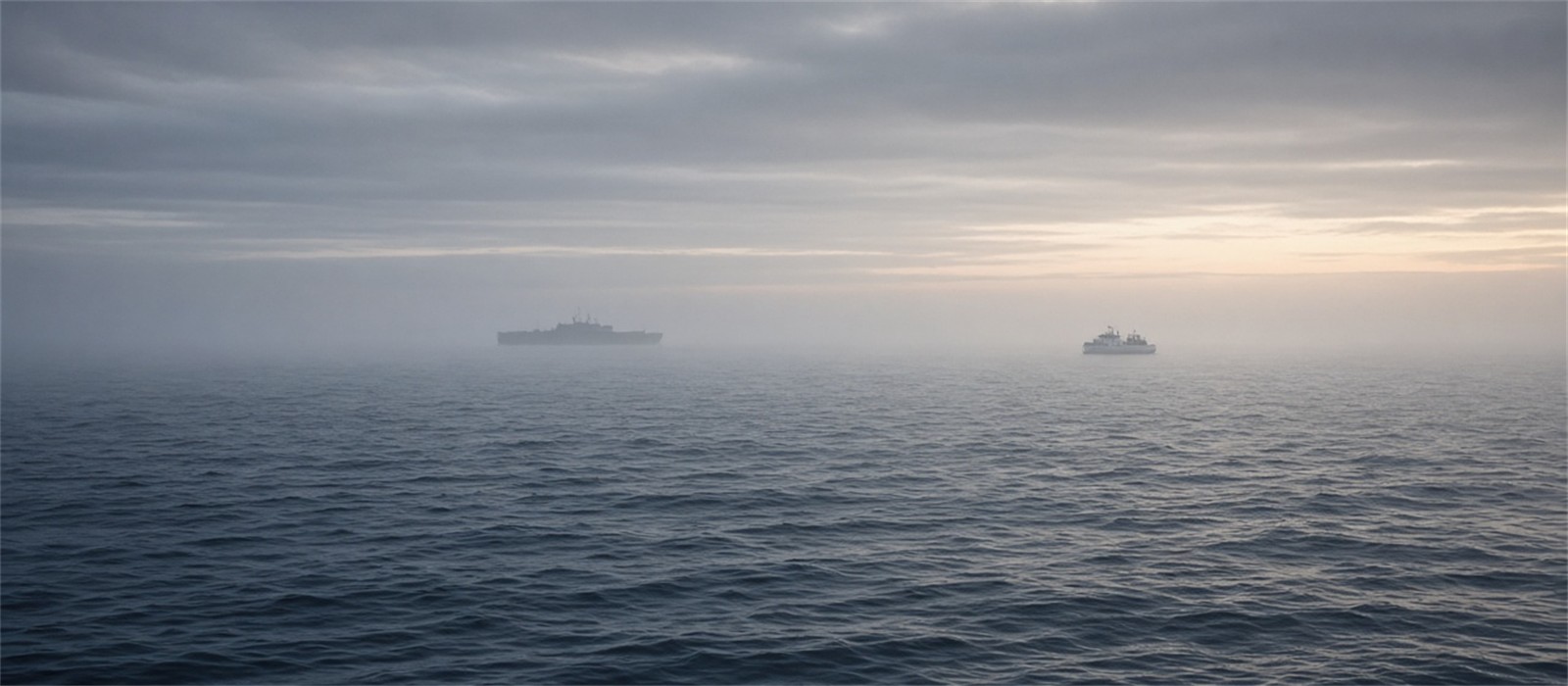


Indian Naval Despatch, Vol. 4 No. 1 (Spring 2023). “Grey Zones in Blue Waters” by Cmde Himadri Bose.
In his well-articulated essay, Commodore Himadri Bose has primarily extended the contentions of Donald Stoker and Craig Whiteside in their article titled ‘Blurred Lines: Gray-Zone Conflict and Hybrid War—Two Failures of American Strategic Thinking.’ The essay succinctly summarises some of the key challenges of and within the grey zone in the maritime dimension and provides practical recommendations to mitigate these. In an effort to provide an alternate view on the subject, this commentary challenges some of the main arguments of Commodore Bose.
The essay has presented three key arguments. One, since ‘war’ as such is difficult to define, any notion that there are actions short of war in the so-called ‘grey zone’ is elementally flawed. Two, there is nothing new about the idea of grey zone and all activities in the grey zone are nothing but tools for geostrategic competition, and this need not be conflated with war. Three, proliferation of doctrinally erroneous concepts such as ‘grey zone’ fuels revisionist schemes, in addition to the convolution it causes in strategic thinking. These shall be discussed in turn.
The very logic of the first argument — the lack of an agreed definition of war as a reason to refute the idea of ‘grey zone’ — is flawed in the context of the fact that only a very few terminologies in political science have definitive definitions. For instance, the concept of power, a central tenet of the realist school of international relations, is ambiguous at best.1 However, the essay itself has quoted terms such as ‘comprehensive national power’ and ‘instruments of power,’ which should otherwise be flawed by the logic of the first argument. In other words, any student of international relations must seek to describe or frame a concept rather than searching for firm definitions. What is, therefore, required is a general — not definitive — conceptual clarity that involves a broad understanding of the general characteristics of the grey zone.
Second, the argument that there is nothing new about the grey zone is valid in absolute terms. But this argument will always apply to almost all concepts in relation to the use or threat of use of force. Therefore, this contention is not substantive enough to discount the very existence of a space between peace and war, and such a space being termed as the grey zone. For instance, Commodore Bose quotes Carl von Clausewitz’s definition of war: “an act of force to compel our enemy to do our will.” He then extends its application to the Westphalian system. However, nation-states, even before the Treaty of Westphalia, at least as far back as Thucydides and Kautilya, have always waged war for the same purpose. Consequently, there is nothing new even in Clausewitz’s definition. But Clausewitz’s endeavour was not to find something new. Probably he wanted to theorise the instrument of war in relation to policy and the various factors that may influence its choice and conduct.2
The essay quotes the idea of compellence as an example to further substantiate the argument that there is nothing new in the means of the grey zone. Commodore Bose refers to a paper by Adam Elkus, wherein it is argued that the concept of ‘grey wars’ lacks strategic sense and that venerable ideas such as ‘compellence’ cover such concepts.3 Unfortunately, this venerable idea itself is one such new term introduced amidst another new term — ‘Cold War.’ Thomas Schelling, who coined the term ‘compellence,’ says, “There is, then, a difference between deterrence and what we might, for want of a better word, call compellence.”4 He further adds that although ‘coercion’ covers the meaning of compellence, it includes both deterrent and compellent intentions. Essentially, Schelling wanted to theorise an existing phenomenon and throw light on its subtle variation from deterrence under the umbrella of coercion. But compellence, as a tool of geostrategic competition, is evident even in the Melian dialogue when the city of Melos was besieged by Athens in 416 BCE. Was there a necessity for Schelling to coin a new term — that too, a non-lexical one? It can be summed up that the search for new terms is not to convolute the existing ones but to throw into greater relief the differentiation among them, if any.
A degree of novelty in the concept of the grey zone is established within the essay’s suggestions to counter actions in grey zones. The essay observes that peacetime rules of engagement of naval forces may not be adequate to address transgressions by para-naval forces of a peer competitor. It then recommends — as an option — creation of maritime militia structures with matching capabilities of the competitor. These two combined together present three inferences. One, there exists a situation which is different from peacetime. Two, the situation is not wartime, as that would call for more ‘grey hulls’ rather than maritime militia. And three, the need for newer structures suggests that there is a newer problem, or an old problem gaining newer proportions. The growing preference for actions in the grey zone is more about its increasing proportion within the ubiquitous competition for relative power.
Nonetheless, Elkus’ criticism against putting everything — ‘Putin’s various operations, Chinese territorial disputations, civil wars in Iraq and Syria, and Boko Haram’s terrorism in Nigeria’ — under the ambit of grey-zone wars is completely valid. So, the key question is not whether the grey zone exists or not, but what forms of contestation should be grouped within this space for examination and contestation itself.
A broad description of the character of the grey zone will be useful in further refining the above contention. The grey zone may be described as a conceptual space between peace and war, wherein actors purposefully engage in activities that are ambiguous by intent or cloud attribution.5 These actions “exceed the threshold of ordinary competition, yet fall below the level of large-scale direct military conflict.”6 The characteristics of ambiguity and non-attributability have been acknowledged in the essay as well. ‘Grey zone’ is, therefore, neither a form of war nor a type of warfare such as trench warfare or mechanised warfare. It is the intervening space between the conditions of peace and war. Quite naturally, such a space always existed, although it may not have been termed the grey zone. The extent of this space has, however, expanded for numerous reasons. Some notable reasons are its associated cost efficiency and newer means available to contest in this space. In other words, the boundaries of this conceptual space are elastic depending on the circumstance.
The third argument, on the proliferation of erroneous terms such as grey zone fuelling revisionist designs, is quite inconsistent. Firstly, for the above argument to stand scrutiny, it must establish a causal relation between the genesis of the term grey zone and the fuelling of revisionist designs. This may not be empirically possible. Secondly, a few scholars, Michael J. Mazarr in particular, have argued that grey-zone strategy (although incorrectly qualified) is being employed by revisionist states to change the status quo. Paraphrasing Nicholas Spykman and Machiavelli, even to maintain their relative power, states need to expand, which may be in other domains, if not territorial.7 Therefore, both status-quo powers and the so-called revisionist powers are all essentially revisionists from a given temporal referential status of power distribution. In the ongoing Russia–Ukraine conflict, who is the revisionist — NATO to the east or Russia to the west? The grey zone is a common space for all to operate — the revisionist, the status quoist, the strong, the weak, the good and the bad — because it may be likely that neither side, or not even those on the outside helping the belligerents, may want escalation to the other extreme.8
Although the article has almost discounted the term ‘grey zone,’ its recommendations to counter grey-zone actions are quite practical and valid. Some of the key recommendations that necessitate further examination by experts of maritime warfare include the ways and means to signal a preference and ability for an escalatory response; capability development and force structuring of para-naval forces; development of a maritime militia; command arrangements for response in quick time before the actions in the grey zone settle in; and the expansion of de-escalatory mechanisms so as to remain within the ‘grey zone.’ One recommendation that may be difficult to pursue is the articulation and enforcement of ‘red lines in the grey zone.’ Actions in the grey zone, as a guiding principle, are ambiguous enough that one cannot verifiably establish whether a red line has been crossed or not.
Colin Gray argues that a theory of war is yet a theory of peace, and it must develop analytical tools to “cope with conditions that are neither plainly of war nor peace, rather both.”9 The concept of the grey zone is just yet another analytical tool for students and practitioners of war. Moreover, the way or the space in which a problem is viewed helps develop potential for fighting in that space. Thus, rather than totally discounting the term ‘grey zone’ for various reasons that are debatable, it must be studied in detail, and we must develop capabilities to operate better than our adversaries in that space.
Endnotes
- Brian C. Schmidt, “Competing Realist Conceptions of Power,” Millennium: Journal of International Studies, vol. 33, no. 3 (June 2005), https://doi.org/10.1177/03058298050330031401.
- Michael Howard and Peter Paret, eds., Carl von Clausewitz, On War (Oxford: Oxford University Press, 2007), viii.
- Adam Elkus, “50 Shades of Gray: Why the Gray Wars Concept Lacks Strategic Sense,” War on the Rocks, 15 December 2015, https://warontherocks.com/2015/12/50-shades-of-gray-why-the-gray-wars-concept-lacks-strategic-sense/.
- Thomas C. Schelling, Arms and Influence (New Haven: Yale University Press, 2008), 70. The extract prints the place of publication as London.
- Lyle J. Morris et al., Gaining Competitive Advantage in the Gray Zone: Response Options for Coercive Aggression Below the Threshold of Major War (Santa Monica: RAND, 2019).
- Morris, Gaining Competitive Advantage in the Gray Zone.
- Nicholas J. Spykman, America’s Strategy in World Politics: The United States and the Balance of Power (London: Routledge, 2007); and Niccolò Machiavelli, The Prince and The Discourses (New York: Modern Library, 1950), 351.
- S. Y. Shrikhande, “The Many Shades of Grey: Countering and Exploiting Grey Zones at Sea,” Synergy, CENJOWS, 26 February 2020, 43, 47.
- Peter L. Hickman, “Cold Wars, Grey Zones, and Strategic Competition: Applying Theories of War to Strategy in the 21st Century,” Military Strategy Magazine (Spring 2023).
