




Introduction
Southeast Asia has been a region of strategic rivalry for several centuries. As early as the 11th Century, trade influences from India and China touched the region, bringing with it the impact of growing trade rivalries that existed at that point. Two very critical works by Professor Anthony Reid highlight the concept of Southeast Asia’s importance in the maritime extents of what is, today, increasingly being referred to as the Indo-Pacific. These two works, Southeast Asia in the Age of Commerce and A History of Southeast Asia: Critical Crossroads, critically analyse the importance of the region’s vibrant historical connect with the trading empires that surrounded the areas of insular and mainland Southeast Asia.1 As the colonial powers began to carve a space for themselves, Southeast Asia was an important space between the trading interests of the British, Dutch and French. Pivotal to this trade was linking regions of China and India together, which were major trading centres, and the rest of Southeast Asia geographically was in the middle of this region.
This was followed by the Cold War in the post decolonisation phase. Again, the region saw great power rivalry as a result of the Cold War. Ideologically, the region at this time was divided into two distinct halves. The focus of maintaining regional stability from external power rivalry pushed the original members of ASEAN to attempt formation of the regional grouping. Through the period of the Cold War, the ASEAN region remained ideologically polarized. It was only after 1991 that the actual expansion of ASEAN occurred, to cover all member states of Southeast Asia and to eventually include its various dialogue partners. One of the core dialogue partners of the ASEAN was India.
From 1992, when India evolved the Look East Policy (LEP), it began the shift towards greater integration with its eastern neighbours, primarily increasing economic integration with a limited focus on improving political and security related ties. As India-ASEAN ties are going through the third decade, several shifts are visible with ASEAN and the wider region of the erstwhile Asia-Pacific, currently called the Indo-Pacific. In 2014, India’s Look East Policy was renamed as the Act East Policy.
The reasons for the shift in nomenclature can be attributed to three factors - first, at the domestic level it heralded a change from the old to the new. As the Congress leadership gave way to the new government led by Prime Minister Modi, it also required a distinct new identity, which was critically evident in the name change from Look East to Act East Policy. Secondly, the Act East Policy was to focus on ensuring a more robust approach to the erstwhile LEP, and completion of pending projects under the LEP that had remained in limbo. Thirdly, the Act East Policy also aimed to ensure that greater integration took place by expanding India’s geographic reach beyond the ASEAN, with a focus on security related matters.
While ASEAN and its centrality have remained at the core, the shift was to integrate further with East Asia and the Pacific. When the Act East Policy was announced, in November 2014, it was to look at furthering India’s interaction with the region along three broad areas - known as the three Cs: commerce, connectivity and culture.
Economic Indicators and Connectivity under the Act East Policy
Beyond the initial reference to furthering ties related to these three areas, a closer look at the level of development along these reveals little in terms of actual progress. It is important to remember that when the Act East Policy was conceived, India was still an integral part of the negotiations for the Regional Comprehensive Economic Partnership (RCEP). After several years of being in these negotiations, in November 2019, India announced its withdrawal from the RCEP on grounds that it did not meet the spirit of inclusiveness.
This decision was critical in terms of preserving India’s domestic market from the pressures of tariff reductions, which would allow flow of goods from other countries. Looking at the RCEP from two parallels, it becomes imperative to understand the tight rope walk that was undertaken. For ASEAN countries, the inclusion of India into the RCEP is critical - ASEAN does not see India’s role in strategic aspects of the region as being different or distinct from its role in economic integration. Therefore, ASEAN looks at the economic and strategic dimensions as “two sides of the same coin.”2 Probably the most critical impact of the RCEPwithdrawal has been contending with the role that India seeks for its engagement with the region. Tang Siew Mun states clearly that, “finding the amicable balance between domestic interests and the undeniable benefits of regional cooperation will be key in India realizing its regional leadership potential.”3 As far as the Indian view is concerned, there has been considerable opposition to the RCEP domestically. The challenge of tariff reduction is key to understanding this opposition, because the RCEP would have led to “tariff reduction of 90% with ASEAN, Japan and South Korea, and 74% with China, Australia and New Zealand.”4 Moreover, Free Trade Agreement (FTA) in services has not been completed according to India’s expectation. As a global player in the services sector, India’s concerns relating to this core area have to be met by the region for moving the process forward.
In terms of trade with the region, the volume still remains below par. For 2020, the targeted trade with ASEAN was expected to reach $200 billion, but it still remains at around $80 billion. In case of China, India’s trade was to the tune of $81.44 billion for the year 2017-18.5 Since then, it has dipped by around $3 billion.
In comparison, the trade with Japan is around $17.63 billion and with Australia is around $30.3 billion. The biggest challenge has been with connectivity projects, which have faced a very serious delay in completion. The India Myanmar Friendship Road was opened only in August 2016. The trilateral highway linking India, Myanmar and Thailand is still to become operational. Even the finalization of the Kaladan Multimodal Transit Corridor is yet to be completed, especially the road link, which is currently under construction. There is a serious delivery deficit when it comes to completion of connectivity projects, which has impacted India’s image with regional states of the ASEAN.
Why is Maritime Security Critical Under the Act East Policy?
The ‘Indo-Pacific’ terminology is now being used more frequently, in several multilateral meetings and forums. It is important to look at how the region, which has been referred to by Prime Minister Shinzo Abe as the “confluence of the two seas,” wherein he quoted works of the Mughal Prince Dara Shikoh, has emerged as the most critical region of geopolitical challenges.6 While the region is, more often than not, recognized by the oceanic extent of the Indian and Pacific Oceans, Rory Medcalf also highlights the growing importance of both, China and India in this region. He states that the expanding influence of these two countries brings in territorial dimensions of structural changes shaping this region, giving way to broader understandings of shifts in the Indo-Pacific.7
The question of major power rivalry is of critical interest to the study of the Indo-Pacific, particularly when seen from the focus of the prevailing normative order in the region, which is being contested by the rise of China. The US presence in the region has been longstanding. Since the end of the Second World War, USA has been the predominant player in this region. With the rise of China, there has been increased contestation between these two players,
resulting in pulls and push for regional states, particularly members of the ASEAN. The continued presence of USA in the region was supported by two policies of the Obama and the Trump administrations - the ‘rebalance to Asia policy’ and the ‘Free and Open Indo-Pacific’ respectively. These emphasized the growing power dynamics in the region, and importance of maritime security and cooperation among regional players in this contested space.
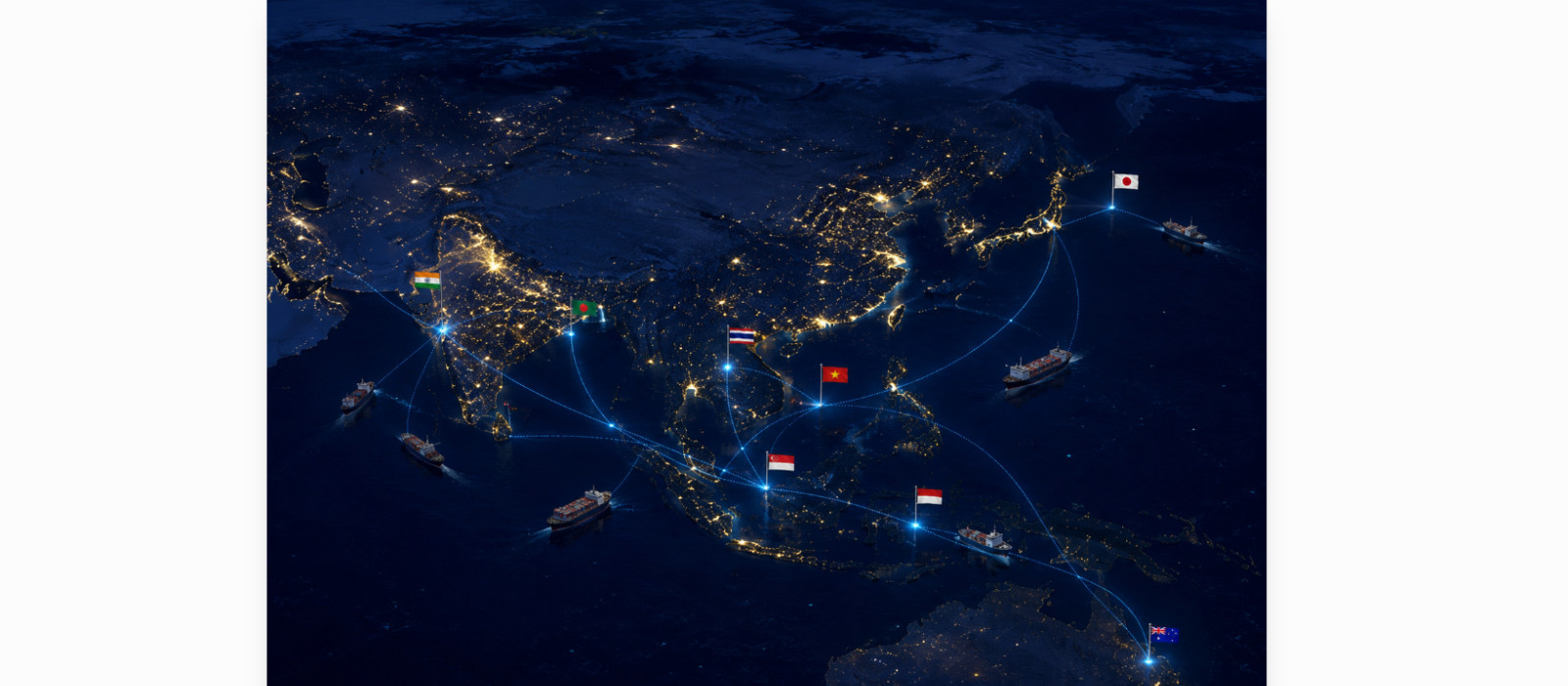
Increasingly, in multilateral forums, there is an emphasis on the importance of the global commons, especially the maritime commons. The region of Southeast Asia is home to four of the most important choke points the Malacca, Sunda, Lombok and Makassar Straits, which act as vital links between the Indian and Pacific oceans. The United Nations Conference on Trade and Development (UNCTAD) estimates that 80% of global trade by volume is transported through the seas, of which nearly 60% moves through the waters of Asia, making the South China Sea a critical link in the Indo-Pacific, as it oversees the movement of nearly one-third of global trade.8 Angel Damayanti cites a source from UNCTAD, that the volume of energy trade through this region is about 60%, and that nearly 80% of China’s energy supplies pass through the waters of the Indo-Pacific, which underscores China’s efforts to leverage the region as it is critically dependent on energy resources from West Asia.9 The increasingly strident positions taken by China over its ‘historical claims’ to regions of the South China Sea, and rejection of the ruling by the Permanent Court of Arbitration (PCA), are linked to reliance of China’s economic growth on uninterrupted supply of energy resources. Furthermore, China views the South China Sea as being able to deliver on its energy resource crunch, since energy reserves therein remain untapped. According to the Asia Maritime Transparency Initiative (AMTI), the US Energy Information Agency estimates that the South China Sea has natural gas reserves to the tune of 190 trillion cubic feet and 11 million barrels of oil.10
Apart from the issue of energy security, the Indo-Pacific region is also emerging as a contested area of marine resources and fisheries. As one of the primary sources of protein that is popularly consumed by littoral states around these waters, demand for fishing is likely to increase rivalry over these maritime spaces. The levels of competition between the fishing industries of littoral states has led to a significant deterioration of sea food reserves, which have reduced by about 33% during the last 30 years.11 Increasingly, issues related to Illegal, Unreported and Unregulated (IUU) fishing and Distant Water Fishing are impairing relations between littoral states. A study by the Stimson Centre, which looked at problems related to Distant Water Fishing, states that China and Taiwan account for about 60% of the problem as these two countries are impacting availability of marine resources in waters of other littoral states.12 Further, issues of energy security and food security, which earlier fell under the context of non-traditional security challenges, are pushing states to take more hard-line nationalist positions, blurring the distinctions between areas of traditional and non-traditional security. This is clearly evident in the Chinese claims to its so-called historical nine-dash line, contravening principles of the United Nations Convention on the Law of the Sea (UNCLOS).
It is against this background that any effort at maritime cooperation needs to be assessed, within the context of the Act East Policy. While the Act East Policy came into focus in 2014, India’s engagement with Southeast Asia from 2012 already focused closer attention to maritime cooperation. One of the important shifts under the Act East Policy has been the expansion of maritime cooperation to other regional states that are part of East Asia and the Pacific. Maritime security cooperation was made a priority concern in the 2012 India-ASEAN Commemorative Summit, making it the central pivot of regional issues. Apropos the Act East Policy, increased emphasis has also been given to the Western Indian Ocean. In March 2015, Prime Minister Modi’s visit to Mauritius and Seychelles led to articulation of the vision of Security and Growth for All in the Region (SAGAR), placing importance on areas of maritime cooperation. This was seen as a critical step forward in India’s promotion of its Indian Ocean diplomacy, following the announcement of the Act East Policy. Subsequently, the Indian Maritime Security Strategy 2015 clearly identified the entire Indian Ocean as its primary area of interest and the Western Pacific as a secondary area of interest, giving further impetus to foreign policy approaches towards the Indo-Pacific region.13 This shift clearly brought India’s approach to the Indo-Pacific into sharper focus, as there was greater convergence between areas of foreign and defence policies.14
The question of recognizing the normative order has been a critical aspect of the Act East Policy, even as India has expanded its relations with countries beyond Southeast Asia. This has been clearly endorsed in repeated stands taken by India with regard to ASEAN centrality. Within this normative context, adherence to UNCLOS and a rules-based international order has received constant support of India in various multilateral forums led by ASEAN processes. More recently, ASEAN’s focus on these aspects has enhanced convergence with Indian perceptions. Both, the ASEAN Outlook on the Indo-Pacific of June 2019 and the recent ASEAN summit of 2020, emphasise importance of UNCLOS as a dispute settlement mechanism and have urged moving towards concluding a ‘Code of Conduct’ for the South China Sea.
Even as India has been clear in its stand on centrality of ASEAN, it will be critical for it to prioritise certain key countries. From among ASEAN states, priority countries that India needs to focus on are Indonesia, Myanmar and Vietnam. Bilateral ties with these are likely to grow further and will remain crucial. In recent times, India and Indonesia have moved ahead on areas of bilateral cooperation to forge stronger ties. In May 2018, the visit of Prime Minister Modi to Indonesia was a significant step. Prior to this, the Indonesian Coordinating Minister for Maritime Affairs had visited New Delhi to finalise the issues to be discussed.15 India and Indonesia have also made concrete efforts to address settlement of maritime boundaries of their Exclusive Economic Zones (EEZ) on the basis of UNCLOS. In August 2018, the two sides agreed to disconnect processes of maritime boundary delimitation and separately address the issues of continental shelf and EEZ.16 India’s involvement in building infrastructure at Sabang is another significant step in the move towards closer relations. During the visit of Prime Minister Modi, the two countries brought out a Joint Vision on Maritime Cooperation in the Indo-Pacific, clearly highlighting core areas of convergence between the two.17
Myanmar, too, has progressed towards closer ties with India, particularly in defence cooperation. Myanmar has been part of the regional MILAN interactions since 2006. From 2013 onwards, Myanmar has shown keen interest in procuring Offshore Patrol Vessels, and this was again highlighted in 2015. The two navies also instituted Coordinated Patrols (CORPAT) annually, since 2013. The year 2017 was a watershed, with the first India Myanmar Bilateral Military Exercise. In October 2020, the Indian Foreign Secretary, Harsh Vardhan Shringla and the Chief of the Army Staff, General MM Naravane, visited Myanmar as part of an outreach strategy. The focus of this trip was to assist Myanmar in pandemic relief. Even as Myanmar was able to tackle the first wave of Covid-19 effectively, the second wave has led to greater spread of the virus and loss of lives. India’s gift of 3,000 vials of Remdesivir, a medicine that is proving effective in treating Covid-19, has been an important humanitarian gesture in helping Myanmar in these times.
Vietnam’s relations with India have also expanded considerably. In September 2014, India extended a $100 million Line of Credit to Vietnam, which was further increased in 2016 to $500 million. These were to be utilised to enhance defence cooperation between the two countries. Other critical areas of cooperation are increasingly visible in the maritime domain, where the two sides have issued a Joint Statement on maritime security cooperation as well as the importance and adherence to UNCLOS. The civil nuclear deal between the two countries is expected to further strengthen bilateral ties.
Similarly, both Japan and Australia have been significant partners of India. Ties are based on areas of mutual convergence and seek to promote issues of bilateral importance, while ensuring regional stability. In terms of the various mechanisms that India will choose to engage with, it is important to understand that current transitions in the region do not allow for singular options to be followed. India will, therefore, choose a plethora of methods through which it will engage with the region. These include bilateral, trilateral, quadrilateral and multilateral mechanisms. Recently, on 06 October 2020, the second Foreign Ministers meeting of the ‘Quad’ took place in Tokyo. Significance of the Quad has gained more importance, even as Chinese belligerence in the wider region has increased. The repeated emphasis of the Quad has been to look at preservation of the normative order and, simultaneously, create space for an inclusive Indo-Pacific region. As the region also battles with the Covid pandemic, the Quad will seek to address challenges of global order in a post-Covid world. Critical among these challenges will be the issue of global supply chains, wherein shifts are taking place as evident by the Supply Chain Resilience Initiative proposed by Australia, India and Japan on 01 September 2020.18
Conclusion
In assessing distinctions between the Look East Policy and the Act East Policy, it is evident that the Act East Policy has increased India’s strategic focus and commitments to the region - including Southeast Asia and beyond. Under the LEP, India began to take small steps into the arena of multilateralism, and was considered to be more of an observer rather than an active participant. These steps were critical in the evolution of its journey in the region, where it began as a sectoral dialogue partner with the ASEAN. As its engagement with the ASEAN states increased, India began to take a more active role in the expansion of its diplomatic engagement across multiple areas, particularly focussing on economic and security realms. Since the current strategic imperatives demand greater attention, due to structural changes shaping the region, India’s role has become more active while lending greater support to issues that impact the normative order. This shift in approach to ASEAN driven multilateral processes has allowed India to evolve a significant role for itself. This can be summarised through the words of Nitin Pai, who states that, “India was initially an observer, but currently is a more conservative contributor to the balance of power in the region.”19
Endnotes
-
Anthony Reid, A History of Southeast Asia: Critical Crossroads (West Sussex, UK: Wiley-Blackwell, 2015), 57-74.
-
Tang Siew Mun, “What India’s Withdrawal from the RCEP Means for ASEAN, India and the Indo-Pacific Concept?,” ISEAS Commentary 2019/93, ISEAS, Singapore, 6 November 2019.
-
Ibid.
-
Niranjan Marjani, “India Had Good Reason to Pull Out of the RCEP,” The Diplomat, 05 November 2019.
-
“India China Trade Hits A Record US $81.4 billion,” The Hindu, 07 March 2018.
-
Rory Medcalf, “The Evolving Security Order in the Indo-Pacific,” Indo-Pacific Maritime Security: Challenges and Cooperation, ed. David Brewster (Australia: Australian National University, July 2016).
-
Ibid.
-
“How Much trade transits the South China Sea,” China Power. https://chinapower.csis.org/much-trade-transits-south-china-sea/, accessed 05 October 2020.
-
Angel Damayanti, “Indo-Pacific Maritime Cooperation: ASEAN Mechanisms on Security Towards Global Maritime Governance,” Journal Global & Strategies vol.13, no.1 (April 2019).
-
South China Sea Expert Working Group, “A Blueprint for Cooperation on Oil and Gas Production in the South China Sea,” Asia Maritime Transparency Initiative. https://amti.csis.org/a-blueprint-for-cooperation-on-oil-and-gas-production-in-the-south-china-sea/, accessed 02 January 2018.
-
Michael Perry, “Maritime Law Enforcement and Overfishing in the South China Sea,” 10 April 2020. https://www.maritime-executive.com/editorials/maritime-law-enforcement-and-overfishing-in-the-south-china-sea, accessed 05 May 2020.
-
Stimson Centre Resources and Climate Report, “Shining A Light: The Need for Transparency Across Distant Water Fishing.” https://www.stimson.org/wp-content/files/file-attachments/Stimson% 20Distant% 20Water%20 Fishing%20Report.pdf, accessed 12 July 2018.
-
Ensuring Secure Seas: Indian Maritime Security Strategy (New Delhi: IHQ MoD(Navy), 2015)
-
Ibid.
-
“Indonesia’s Balancing Act: A Road with China, a Port with India,” The Wire, 30 May 2018.
-
Sidharto Suryodiporo, “EEZ of Doing Watery Business,” The Economic Times, 29 August 2018.
-
https://www.mea.gov.in/bilateral-documents.htm?dtl/29933
-
Shankari Sundararaman, “Chinese Belligerence and the Rise of the Quad,” The New Indian Express, 06 October 2020.
-
Nitin Pai, “India and the Indo-Pacific Balance,” Brewster, Op Cit., n.6, 85.
