




Note: This article is adapted from the address delivered by RAdm Aaron Beng during the 3rd Goa Maritime Conclave on 09 November 2021.
Introduction
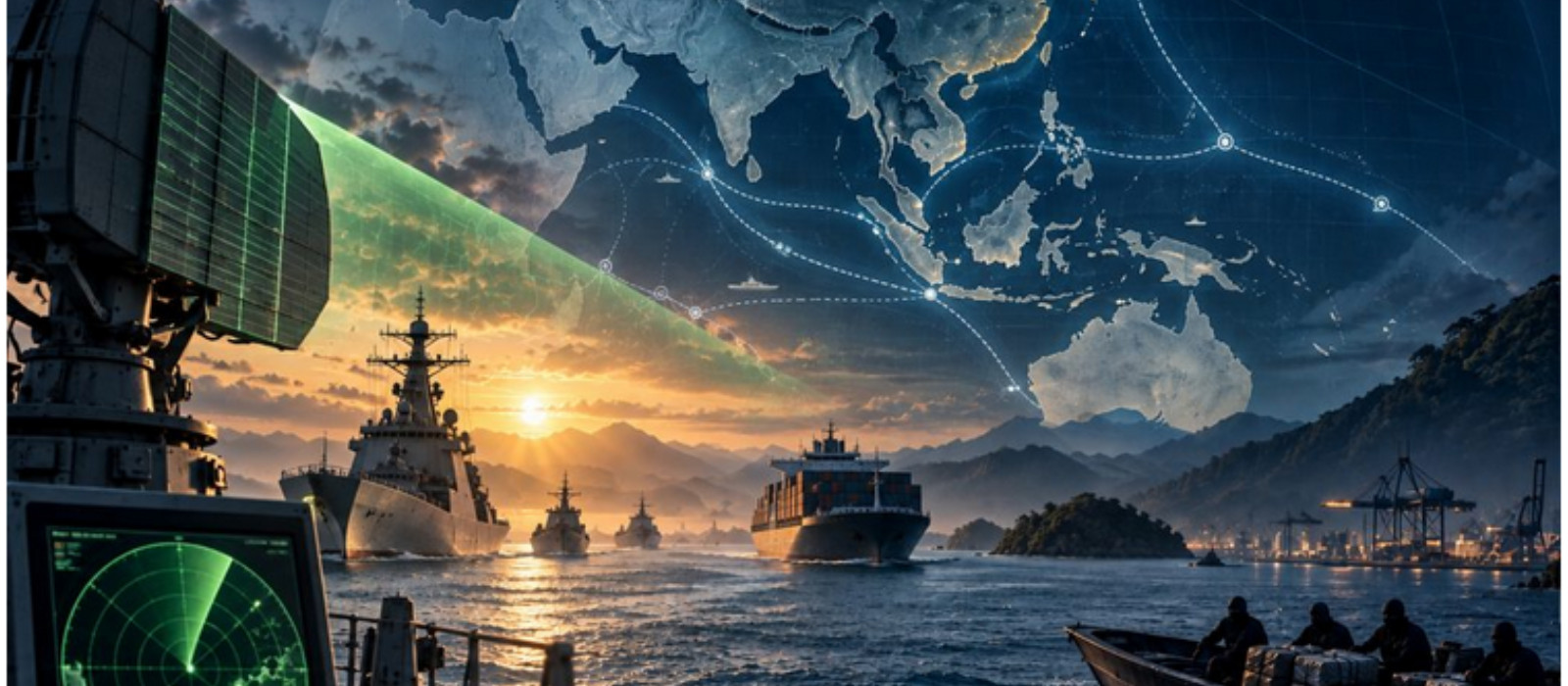
The Indian Ocean Region (IOR) is one of the world’s most geographically significant regions today. It is home to major Sea Lines of Communication (SLOC) that connect East Asia and West Asia, with Europe and Africa. With around two thirds of the world’s maritime oil trade and half of the world’s container ships passing through the IOR, it is a critical link that drives the global economy.1 Any disruption to the safe passage of ships through the IOR would undoubtedly have significant impact to the world. Therefore, nations have actively contributed in efforts to ensure the safety, security and unimpeded lawful access for all in the IOR.

However, recent events have threatened to upend the peace and security in the IOR. These include challenges to international rules and norms, which have led to increased tensions at sea and potential spill over of maritime disputes that undermine regional stability. There has also been a rise in non-traditional security threats in the IOR, such as piracy and sea robberies. According to the International Maritime Bureau, the number of piracy and sea robbery attacks within the IOR increased by 21 per cent from 2019 to 2020, comprising approximately 41 per cent of such incidents worldwide for 2020.2 If not tackled effectively, the increase of such non-traditional security threats in the IOR will threaten to disrupt global trade and maritime traffic significantly.
Due to the complexity and transnational nature of these non-traditional challenges, it is imperative that IOR nations adopt a collaborative approach to overcome these issues. Navies need to work closely with one another to engender greater understanding and higher transparency in order to facilitate constructive discussions on ways to achieve common goals. For the Republic of Singapore Navy (RSN), these goals manifest in two priorities that we aim to work towards with like-minded partners in the IOR: upholding a rules-based order and collaboration on maritime security.
Upholding a Rules Based Order
The foremost maritime priority is the commitment to a rules-based order. Adherence to a rules-based order can reduce the likelihood of conflict between nations and facilitates the peaceful resolution of disputes, especially in the maritime domain where the seas are global commons to be shared by all. It is critical therefore, that all nations that use these commons abide by and uphold the established international rules and norms.
The United Nations Convention on the Law of the Sea (UNCLOS) is the backbone of good order at sea. It is comprehensive, complete and enjoys broad-based acceptance with 168 parties. However, revisionist interpretations of UNCLOS, leading to excessive maritime claims or impediment of lawful freedom of navigation, continue to cause rising tensions at sea.
These tensions undermine the stability of the region, and risk spiralling into larger-scale confrontations that could affect the peaceful flow of trade. Hence, the RSN aims to work with like-minded partners to uphold the rules-based order in the IOR, and wherever applicable, to minimise conflict. There are three ways through which we can continue to ensure that a rules-based order prevails.
-
Dialogue. There needs to be frank and open dialogue among all parties. This is one area in which the IOR has done well. Conferences such as the biennial Goa Maritime Conclave, which the RSN has been a strong supporter of since its inception in 2017, have given all participating Navies a chance to come together and have free-flowing conversations. Existing maritime security architecture such as the Indian Ocean Rim Association and the Indian Ocean Naval Symposium (IONS) have promoted greater cooperation and closer interaction among member states. Singapore also hosts the biennial International Maritime Security Conference, where prominent academics and key naval leadership from Navies around the world come together to speak on and discuss maritime security issues. These conversations mark a crucial first step towards building trust, and Navies must endeavour to continue engaging each other openly.

Fig 1: 7th IONS Conclave of Chiefs in Paris from 15 - 16 November 2021.
-
Respect for Institutions. Dialogue alone will not be purposeful if not followed through with actions. International agreements such as UNCLOS and institutions such as the International Court of Justice (ICJ) are only as powerful as the willingness of its members to adhere to them. A positive example of this was in 2014, during the Bay of Bengal Maritime Boundary Arbitration between Bangladesh and India. Both countries took their dispute to the Permanent Court of Arbitration (PCA), and subsequently, honoured the judgements that were passed. Such amicable resolutions serve to buttress international norms and institutions. Like-minded nations that share similar views on the significance of multi-lateralism and a rules-based order must strive towards preserving the integrity of multi-national architectures that were painstakingly built, without bias for the outcome.
-
Platforms to Support the Regional Security Architecture. There is also a need for region-centric platforms to promote dialogue on specific issues of interest. This is critical to address region-specific issues and promote the development of rules and norms aligned with the broader rules-based order. I am heartened to note the growth and maturity of critical regional platforms such as the Indian Ocean Naval Symposium whose 7th edition was chaired by France in 2021, and the 4th edition of the International Maritime Security Symposium hosted by Indonesia.
The Importance of Collaboration on Maritime Security
The other maritime priority is collaboration to enhance maritime security. The collective security of the seas in the IOR must not be taken for granted. The open nature of the seas renders littoral states vulnerable to a wide spectrum of maritime threats, ranging from piracy and sea robbery to maritime terrorism. This is a common area of concern for all regional Navies and provides an opportunity for the establishment of regional frameworks essential for increased collaboration and improved interoperability to deal with these threats effectively.
First, regional Navies should increase collaboration in information sharing in order to build a more holistic maritime picture. Navies should also establish close partnerships with key international agencies to enable early detection of imminent threats to tackle them in a timely fashion. This was exemplified in the successful apprehension of the illegal fishing vessel STS-50 in Indonesia in April 2018, just after it had escaped detention from Mozambique. Before this, the STS-50 had been on the run for 10 years, and had evaded capture by flying no less than eight flags at different times. Its swift capture was made possible only through the close collaboration between numerous international agencies and regional countries. These include the INTERPOL, the eight FISH-i Africa countries, the Regional Maritime Information Fusion Centre (IFC) in Madagascar, the Indonesian authorities as well as IFC Singapore, which helped to coordinate real-time tracking of the vessel during its transit and provided the information to Indonesian authorities through the Indonesian International Liaison Officer (ILO) in Singapore. This incident highlights the importance of information sharing and close international partnerships in tackling the issue of maritime security.
The IOR has been a useful platform for the hosting of ILOs from different nations to facilitate closer and more integrated communication. IFC Singapore has hosted ILOs from the Indian Navy (IN) since 2009. Despite the COVID-19 pandemic, Singapore attached our Defence Advisor and former Head of IFC Singapore to the IFC-IOR in 2021. In addition, IFC-IOR and Singapore IFC have established operational system linkages for white shipping information exchange, with IFC Singapore’s Real-time Information-sharing System providing partner maritime stakeholders a common platform for tighter collaboration and improved shared awareness of the maritime domain. The close operational linkages and collaboration between the RSN and IN throughout the years, which have contributed to the successful conduct of maritime security operations, is testament to the importance of shared commitment to developing opportunities for close communication.

Fig 2: ILO from the IN and participants of the Regional Maritime Security Practitioner Programme 2019 held in RSN Changi Naval Base.
Secondly, it is to catalyse practical cooperation, which serves to build interoperability, mutual understanding and trust among the IOR Navies. Bilateral exchanges and exercises are excellent platforms to create opportunities for interactions with other Navies, to forge deeper and more trusting relationships. The RSN and IN have developed a collaborative architecture of interoperability since the first bilateral exercise between the Navies in 1993. Today, the two Navies have completed 28 editions of the annual Singapore-India Maritime Bilateral Exercise (SIMBEX), the longest uninterrupted exercise the IN has had with any foreign navy.3 These exercises play an important “confidence building” role between the two Navies thereby, increasing mutual interoperability. Cooperation between the Navies also extend to operational agreements. In 2018, the two countries ratified the Implementing Agreement Concerning Mutual Coordination, Logistics and Services Support where each country’s ships may access the other’s logistics facilities during port calls. The two countries also successfully signed the Implementing Agreement on Submarine Rescue Support and Cooperation in 2021. The numerous bilateral dialogues and Passage Exercises (PASSEX) between IOR Navies that persisted despite the ongoing pandemic also reflect the commitment and significance of such avenues for interaction to Navies. It is important that countries continue to encourage interactions so as to develop stronger mutual understanding and trust as a foundation for future cooperation.
Beyond bilateral interactions, another important plank is multi-lateral interactions. This expands the scope of interoperability and cooperation between across multiple countries and navies and helps to further regional trust and understanding. One useful example is the Singapore-India- Thailand Maritime Exercise which conducted its 3rd edition in 2021. Looking forward, it is essential to continue enhancing and developing efforts to build a strong base of interoperability among Navies in the IOR. This will allow IOR members to better address common maritime security challenges in a collaborative manner, and uphold an international maritime rules-based order.

Fig 3: Vessels from the RSN (left), IN (right) and Royal Thai Navy (middle) conducting manoeuvring drills in the Andaman Sea during SITMEX 2021.
Conclusion
The IOR will continue to rise in prominence as a key conduit for international trade and the global economy. It is vital to ensure the uninterrupted freedom of navigation and safe passage of shipping through the IOR, as sea trade will remain as a major engine of growth for countries in the region.
That is not all. The rise of non-traditional security threats poses a challenge to the safety and peace that IOR member states currently enjoy. It is therefore, important that IOR Navies continue to work together on our common maritime security priorities. We must buttress international rules and norms through dialogue and continue to provide support for multi-national architectures such as the ICJ and PCA. We also need to be forthcoming in our partnership on maritime security issues, particularly on information sharing and building interoperability. If we can do this successfully, the IOR will continue to have prosperity and stability in the years to come.
Endnotes
-
Secretariat of the Indian Ocean Rim Association (IORA), “Trade & Investment Facilitation,” IORA. https://www.iora.int/en/priorities-focus-areas/trade-and-invest ment-facilitation, accessed 28 October 2021.
-
International Maritime Bureau, International Chamber of Commerce, Annual Piracy and Armed Robbery against Ships Report 2020, 13 January 2021. https://www.icc-ccs.org/reports/2020Annual_Piracy_Report.pdf, accessed 28 October 2021.
-
Ministry of Defence, “28th Edition of Singapore-India Maritime Bilateral Exercise SIMBEX,” Press Information Bureau, 04 September 2021. https://www.pib.gov.in/PressReleasePage.aspx?PRID=1751973.
