


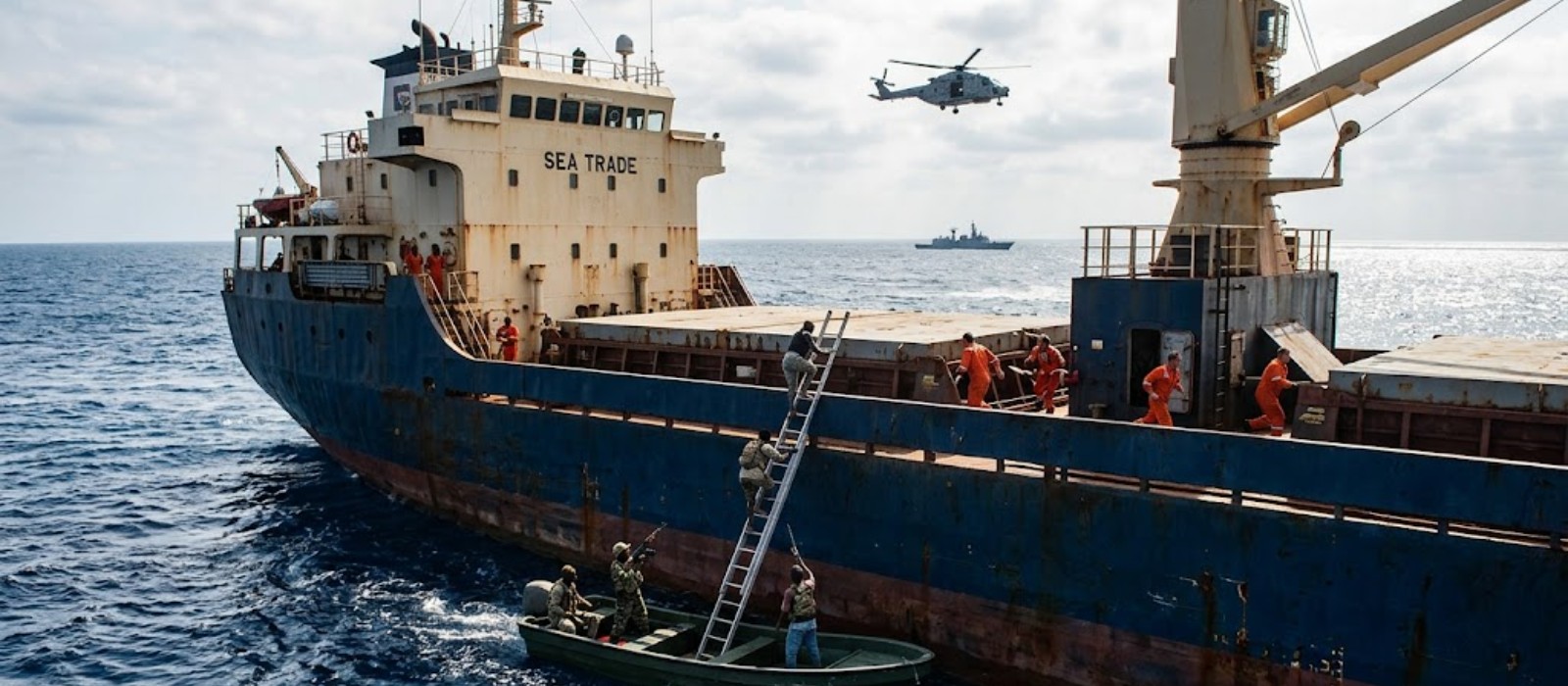


Abstract: This article examines the Maritime Anti-Piracy Act, 2022, enacted by India to address the threats of piracy on the high seas under its domestic law. It intends to explore the Act’s strengths, possible limitations, and proposes measures for the Indian Navy towards establishing protocols to ensure effective prosecution of the apprehended pirates. The paper evaluates whether the act remedies earlier gaps arising out of ad hoc legal approaches. It concludes that although the Act is a significant legislative advancement, its success will depend on efficient implementation, procedural clarity and sustained coordination among stakeholders.
India’s Anti-Piracy Imperative
Pirates’ haves been considered as enemies of all mankind (hostis humani generis) which means a pirate is not enemy of the state Pbut of humankind itself.1 Maritime piracy remains a persistent threat to international shipping, undermining the security of sea lines of communication (SLOC) and exposing seafarers to violence and unlawful detention. Jin and Techera link suppression of piracy directly to UN sustainable development goal 16 (peace, justice and strong institutions) noting that piracy undermines maritime transport, food security and seafarer welfare.2 Given India’s dependence on maritime trade and its expanding strategic footprint in the Indian Ocean Region, the suppression of piracy is both an operational necessity and a legal obligation. Parliamentary debates in India on the issue reflect similar reasoning, stressing the need of not only providing protection to India’s vast maritime trade routes but also to preserve global credibility.3
Despite sustained naval deployments in the Gulf of Aden and Western Indian Ocean since 2008, India operated for over a decade without an AntiPiracy Statute. Apprehended pirates were prosecuted under the Indian Penal Code, 1860 and the Admiralty Offences (Colonial) Act, 1849, although this legislation was never designed to address the complexities of modern maritime piracy committed on the high seas. Ahmad had pointed out that India’s earlier reliance on general criminal statute exposed courts to procedural hurdles.4 The Hon’ble High Court of Bombay, in Christianus Aeros Mintodo Vs The State of Maharashtra, Criminal Appeal No. 541 of 2003, indicated that no evidence came on record to indicate the person so arrested (apprehended pirates) were the same person who had committed offence of piracy on the high sea and that the Captain of the Ship, i.e Prosecution Witness No. 2, in his evidence was not in a position to identify the accused in test identification parade.5 This legal vacuum exposed serious jurisdictional and procedural vulnerabilities. The Alondra Rainbow case (November 1999), among the earliest piracy prosecution before Indian Courts, revealed the fragility of relying upon general criminal law for offences committed beyond territorial waters.6 Questions arose regarding extra-territorial jurisdiction, evidentiary standards, and identification of accused persons. The absence of a codified framework meant that successful interdiction at sea did not necessarily translate into sustainable conviction ashore.
A Legislative Turning Point
The enactment of the Maritime Anti-Piracy Act, 2022 marks a decisive correction of this deficiency. The need was already felt by the Government when the first Anti-Piracy bill was introduced in 2012. However, the bills could not become an Act, and it lapsed due to dissolution of that Lok Sabha. Thereafter, in 2019 the Anti-Maritime Piracy bill was again introduced by the Ministry of External Affairs and after many deliberations MAPA, 2022 came into existence. The Act came into force on 22nd February 2023 through the Government of India Gazette Notification.7 The Act was designed to give effect to India’s obligations under the UNCLOS, 1982, which India ratified on 29 Jun 1995.8 It provides explicit extra-territorial jurisdiction 8 over acts of piracy committed on the high seas, including within the Exclusive Economic Zone; it incorporates internationally accepted definitions aligned with UNCLOS. More significantly, MAPA creates an integrated legal pathway, empowering authorised naval and Coast Guard personnel to arrest and seize pirate vessels; mandating production before judicial authorities; establishing designated courts for trial; and introducing evidentiary presumptions tailored to the peculiar realities of maritime crime. In doing so, the Act bridges the structural divide between military enforcement at sea and civil prosecution on land. It transforms piracy from a jurisdictionally uncertain offence into a clearly defined statutory crime under Indian law, backed by procedural authority and institutional mechanisms.
The Core Challenge: From Interdiction to Conviction
While MAPA resolves long-standing jurisdictional ambiguity, the true test of its efficacy lies beyond the statutory text. Piracy operations occur in volatile maritime environments, often involving multinational crews, perishable evidence, damaged vessels, and rapid tactical decision-making. The critical question therefore is not whether India now possesses the legislative authority to prosecute pirates, but whether the chain from interdiction to conviction can be executed without procedural infirmity. For India to fully realise the strategic value of MAPA, operational action at sea must translate into prosecutorial success ashore. The “legal finish” of piracy cases ensuring evidentiary integrity, maintaining chain of custody, and sustaining inter-agency coordination will ultimately determine whether MAPA serves merely as a declaratory statute or as an effective instrument of justice in the maritime domain.
The process starts with interdiction and apprehension of the suspected pirates by the empowered agencies, collections and preservations of incriminating material / evidence, handing over of the pirates as well as the evidence to the local police, and subsequent due process before the designated Court of Law. The various stages as brought out above, have to be synchronised to ensure that the object with which the Act has been passed, is achieved.
A flow chart indicating the process is as brought out below:

Fig 1.1: Flow Chart of Pirate Apprehension and Judicial Process
Source: Author’s conceptualisation; diagram created using an open-source tool.
The Indian Navy as the First Responder
In counter-piracy operations, the IN inevitable acts as the First responders and the first to reach the crime scene. To ensure that the apprehending agencies like Indian Navy have the necessary legislative backing, MAPA, 2022 has now empowered its personnel powers analogous to those of Police officers under the Bharatiya Nagarik Surakhsha Sanhita, 2023 (India’s present Criminal Procedure Code, replacing the Code of Criminal Procedure, 1973). Officers and sailors assigned to Indian Navy warships, Coast Guard vessels, and other designated government platforms are authorised to arrest suspects, seize property, and initiate investigative processes at sea. This statutory recognition bridges a critical institutional divide. Piracy interdictions are executed by military platforms, yet prosecutions unfold within the civilian criminal justice system. By codifying arrest and seizure authority, MAPA eliminates uncertainty regarding the legality of naval interdictions and provides continuity between operational action and judicial process. The Act thereby institutionalises what was previously an operational practice grounded largely in executive authority and international mandate. However, empowerment also imposes responsibility. Once apprehension occurs, the procedural chain is set into motion and must be preserved meticulously to withstand judicial scrutiny. MAPA provides the authority; its effective utilisation depends upon disciplined execution.
The Nature of the Crime Scene
It needs to be appreciated that maritime piracy is unlike conventional crime committed on land. It unfolds in ungoverned spaces, far from state authorities, where evidence is perishable, witnesses having multinational personalities, and enforcement begins not with the police but with the Navy or the Coast Guard. Prosecutors have a hard time gathering witnesses, finding translators and, even if the charges are proved, the states are reluctant to imprison pirates, as they would be saddled with them upon their release.9 The transitory nature of the crime at high seas makes the collection of evidence a major issue and therefore, prosecution are presented with formidable challenges.10 The processing at a crime scene is one of the most important phases of the investigation and the investigator should always be able find evidence at the scene of the crime, linking the perpetrators to the crime scene and possibly connecting them to the elements of the crime.11 In cases involving the IN, duly enforcing MAPA, the Officer in Charge handling such a high-octane operation, is already saddled with the responsibility of ensuring threat neutralization and rescuing of hostages. His actions are calibrated towards speed and decisiveness. This urgency is likely to clash with the methodical approach expected in a criminal investigation, as these operations would ipso facto initiate the criminal justice chain, under the MAPA, 2022. Therefore, there is a dual hatting to be done by the IN, when conducting Anti-Piracy operations; one as a combat force and the other as a law enforcement body, thus creating a difficulty where operational speed may compromise later judicial scrutiny.
Evidence Collection and Preservation at Sea
Scholars note that investigations are often undermined by the absence of forensic infrastructure at sea and difficulty of preserving of the chain of custody.12 The task of conducting investigation in a maritime piracy case would be as per the domestic statute, as clarified by Shri S Jaishankar, Minster of External Affairs, before the Parliament.13 However, the onus of collection of evidence and its preservation by the Navy would be critical towards ensuring a water- tight case against the apprehended pirates in the Court of Law. A piracy incident does not unfold in a controlled environment. The ship may be damaged, weapons discarded overboard, obtaining testimonies from traumatized multinational crew members may have unique challenges. Therefore, investigation and evidence collection would be a task in itself and ensuring its integrity would also present its difficulties. Furthermore, the evidence collected can be damaged during investigation and there are additional factors contributing to the loss of evidence due to weather condition (e.g. humidity or the strong wind); or the special location (a vessel is always rolling), etc.14 Amrillia Kiss emphasizes that collecting evidence in piracy cases is ‘incredibly difficult’ and failed investigation usually doom the prosecution’s case.15 Similarly, chain of custody and early crime scene protocols, as enforced by the first responders, are critical to admissibility.16 The IMO Code of Practice for the detailed investigation of crimes of piracy and armed robbery stresses a detailed forensic investigation of the crime scene.17 Therefore, collections of evidence in the form of fingerprints, weapons, or digital records assumes significance especially considering the weather condition, panic and deliberate actions on the part of apprehended pirates.
Transition to Civil Authorities
Once the apprehended pirates are brought ashore, responsibility towards investigation and prosecution passes to the civil police as per the provisions of the Bhartiya Nagarik Suraksha Sanhita.18 An FIR is required to be registered and evidence collected are to be handed over to the civil police.19 Considering the nature of the crime, translating a military style operation at sea into a criminal case, would be a challenge for the local police, considering that they have little to no exposure to piracy as a crime, unlike routine offences under domestic criminal law. The issue of effective prosecution was also highlighted by the Government of India when introducing the bill in the Parliament.20 Ensuring proper chain of custody of the evidence in the form of body receipts, seized articles or testimonies would be an important factor wherein the role of Navy would be critical. Therefore, handover of the apprehended pirates to civil authorities represents a decisive stage in the prosecution process. In practice, the transition is often marked by procedural discontinuity. Civil police authorities may lack familiarity with maritime offences, while naval personnel may perceive their role as concluded with the transfer of custody.
Reluctance of First Responders to Civil Agencies
Despite successful naval interdictions of pirates at sea, the first responders are reluctant to fully support the ensuing civil police investigations once the suspects are handed over. It needs no emphasis that such reluctance can manifest into an incomplete evidence transfer and weakening of case against the apprehended pirates. The first responder’s role does not end at the handover of the apprehended pirates and the evidence so collected, at the end of a piracy operation. Naval personnel are key witnesses in such cases and must co-operate with the investigation and prosecution phases. Courts would, no doubt, rely on the evidence of the Naval personnel involved in the piracy operations to arrive at a legally sound decision when dealing with such cases.21 International frameworks stress that effective piracy prosecution (the ‘legal finish’) requires close collaboration between military and civilian authorities. Therefore, reluctance by the Navy or the first responder to actively engage with the civil police and judicial processes after handing over of the pirates, not only jeopardizes individual prosecution but also weakens the overall counter piracy efforts as well as the legislative intent behind the passing of MAPA, 2022.
The disconnect between naval authorities and the local police, risks undermining the prosecution. Effective transition requires structured documentation, including detailed seizure records, arrest memos, and preliminary reports. Naval personnel involved in interdiction operations must remain available as witnesses, as their testimony is often central to establishing the prosecution’s case. The operational narrative must therefore be translated into a legally coherent case file. This requires institutional alignment, not merely procedural compliance.
Enabling Provisions of MAPA, 2022
Whilst recognising the peculiar nature of the crime of piracy and the various facets involved therein, the Government realised that there need to be safeguards added in the legislature to ensure that the actions of the interdiction agencies are protected as well as the crime of piracy is punished. Piracy prosecutions are notoriously evidentiary-intensive. Taking into consideration the operational realities and challenges, MAPA incorporates a presumption clause under certain circumstances. It states that where arms, ammunition, or incriminating material are recovered, or where an individual is found on board a vessel engaged in piracy, the Court may presume involvement unless rebutted. This reverse evidentiary burden departs from the ordinary presumption of innocence characteristic of criminal law. Similar approaches exist in other specialised statutes addressing grave offences. In the maritime context, the provision acknowledges the difficulty of reconstructing events that unfold far from conventional investigative infrastructure. Yet, such presumptions must be applied cautiously. Judicial oversight will be essential to ensure that operational exigency does not erode due process protections. The effectiveness of this provision will depend upon its balanced interpretation, ensuring that it supports prosecution without compromising constitutional safeguards
Designated Courts and Procedural Continuity
The statute further strengthens prosecutorial architecture by mandating trial before designated courts notified by the Central Government. Specialisation serves two purposes. First, it avoids fragmentation of jurisdiction across ordinary criminal courts unfamiliar with maritime offences. Second, it promotes judicial capacity-building in handling evidentiary and procedural complexities unique to piracy cases. By creating a defined forum for adjudication, MAPA attempts to ensure continuity from arrest at sea to trial on land. This institutional clarity reduces delays, mitigates forum disputes, and reinforces the seriousness with which piracy is treated under Indian law. The establishment of designated courts thus reflects a recognition that piracy is not a routine offence, but a transnational crime requiring focused judicial engagement.
Protection for Actions Taken in Good Faith
MAPA also provides protection to authorised personnel for actions taken in good faith under the Act. In high-risk maritime interdictions, hesitation can carry operational cost. Legal immunity for Bonafide actions encourages decisive response while shielding officers from vexatious proceedings arising from operational decisions made in dynamic environments. At the same time, the clause does not extinguish accountability. Judicial scrutiny remains available where malafide conduct is alleged. The provision therefore reflects an attempt to balance operational confidence with rule-of-law principles and equilibrium central to democratic maritime governance.
Humanitarian and Diplomatic considerations
Piracy cases are not nation specific. MAPA,2022 is not restricted to only Indian vessel but extends universal jurisdictions to ships and vessels for foreign nationals who are under attack from pirates on the high seas.22 Thus, there are diplomatic considerations in dealing with such cases, since foreign governments and international shipping companies are involved. Provision of extradition have been enacted in the Act, and these would have to be exploited as and when requests are made. The intervention of the Ministry of External Affairs in this regard, is likely to come up either during the investigation or the trial. In addition, humanitarian appeal will also be required in dealing with victims of piracy onboard, accused who are minor, or of different gender than male and so on. These issues cannot be discounted, and the first responder needs to be geared for dealing with them.
Institutional Responsibility and Procedural Discipline
The Maritime Anti-Piracy Act, 2022 is still a recent legislative endeavor of the Govt of India, and thus far no case under MAPA, 2022 has reached final adjudication to test its provisions on ground. Whilst the Act fills a longstanding gap by codifying piracy as a distinct offence and establishing designated courts, its practical efficacy remains untested. International experience has revealed that piracy prosecutions are often beset by evidentiary challenges, inexperienced courts and issues of fair trial and rights for foreign nationals who are being subjected to the domestic statute of the state. Going forward, Indian Courts may need to evolve jurisprudence under MAPA, to address challenges of evidentiary integrity, sentencing consistency, due process in piracy prosecution as well extradition issues as and when they crop up. The Indian Navy must recognize its role beyond operational actors, responsible for ensuring evidence collections at sea in difficult circumstances. In addition, Civil Agencies and prosecution authorities will require continued co-operation from IN, ranging from documentation of seizure and medical examinations reports to witness’s testimony. Further, the BNSS 2023, which has replaced the Code of Criminal Procedure, provides that arrests must comply with safeguards ensuring humane treatment, information of rights, and proper documentation. These safeguards echo the Supreme Court’s ruling in D.K. Basu v. State of West Bengal (1997).23 Compliance with these provisions is essential since failure may render arrests illegal and evidence inadmissible.
Embedding Procedural Discipline in Naval Operations
The effectiveness of the Act ultimately depends on institutional integration. First, the arresting authority under MAPA must be exercised with procedural precision by occasionally simulating anti-piracy exercises. This suggestion is simply along the lines of the Visit-Board-Search and Seizure (VBSS) exercises done so frequently. It would involve rehearsing clear identification of authorised personnel, contemporaneous documentation of arrest, recording of grounds, and compliance with statutory safeguards under the BNSS 2023. These must become embedded practice rather than post-facto formalities. Procedural compliance is not merely defensive; it safeguards the admissibility of evidence and preserves the integrity of prosecution. Second, evidence handling requires institutional standardization. Weapons, navigation instruments, communication devices, and other material seized during interdiction must be documented, sealed, and logged in a manner capable of withstanding judicial scrutiny. The maritime environment presents inherent risks of degradation; therefore, evidentiary discipline must compensate for environmental fragility. Chain-of-custody documentation from the point of seizure to transfer ashore must be uninterrupted and auditable. Third, digital evidence management demands particular attention. GPS logs, AIS data, satellite communications, and mobile devices increasingly form the evidentiary backbone of maritime cases. Preservation protocols, extraction procedures, and certification under domestic evidentiary law must be institutionalized through training and technical support. As piracy evolves technologically, evidentiary competence must evolve correspondingly.

Fig 1.2: Processing involving Arrest and Legal Sequence
Source: Author’s conceptualisation; diagram created using an open-source tool.
Engagement with Civil Authorities
The transfer of suspects and material evidence to civil police constitutes a critical inflection point. MAPA envisages continuity between naval interdiction and civilian investigation; however, such continuity must be actively maintained. Standardized handover documentation, structured preliminary reports, and coordinated liaison with designated investigating officers will reduce procedural rupture. Equally important is sustained naval engagement beyond the moment of transfer. Boarding officers and commanding officers may become key witnesses. Operational logs and communication records, subject to appropriate security vetting, may be required to corroborate factual narratives. Institutional recognition that naval involvement does not conclude at handover is central to achieving prosecutorial finality.
Capacity Building and Inter-Agency Coordination
The implementation of MAPA would benefit from structured capacitybuilding initiatives. Joint training modules involving naval officers, coast guard personnel, investigators, and prosecutors could enhance shared understanding of evidentiary expectations and operational constraints. Periodic review of concluded cases once jurisprudence develops may identify recurring procedural vulnerabilities and facilitate corrective refinement. Formal liaison frameworks between the Indian Navy, Ministry of Home Affairs, prosecutorial agencies, and designated courts could further strengthen coherence. Piracy cases are inherently transnational. Therefore, consular coordination, translation, and witness management require early planning. Institutional preparedness will reduce delays and mitigate diplomatic friction.

Fig 1.3: Flow Chart for improving Evidence Handling
Source: Author’s conceptualisation; diagram created using an open-source tool.
Strategic Implications and Deterrence
Effective prosecution serves a deterrent function. Where apprehended pirates face credible judicial consequences, the incentive structure shifts. Conversely, if procedural infirmities result in acquittal or dismissal, the deterrent effect of interdiction diminishes. The credibility of India’s maritime security posture therefore depends upon the reliability of its legal finish. MAPA equips India with the necessary statutory tools. Its long-term impact will depend upon disciplined execution, institutional integration, and sustained commitment to evidentiary rigor. Operational excellence at sea must be matched by prosecutorial precision ashore.
Conclusion
The Maritime Anti-Piracy Act, 2022 represents a decisive maturation of India’s maritime legal framework. It resolves jurisdictional ambiguity, empowers enforcement agencies, and creates a structured pathway for adjudication. Yet the statute’s transformative potential lies in its implementation. For India, a nation whose economic security is deeply intertwined with maritime trade, the suppression of piracy is both a strategic necessity and a demonstration of commitment to the rule-of-law. By institutionalizing the operational- legal continuum and ensuring that interdictions culminate in sustainable convictions, India reinforces its standing as a responsible maritime power prepared not only to patrol the seas, but to uphold justice upon them.
Endnotes
- Ahmad Khorsand Asgari, Laws Relating to Piracy: A Critical Study with Special Reference to India, n.d.
- Jin and Techera, “Strengthening Universal Jurisdiction for Maritime Piracy Trials to Enhance a Sustainable Anti-Piracy Legal System for Community Interests.” Sustainability 13, no. 13 (2021): 7268.
- India, Parliament, Standing Committee on External Affairs, The Maritime Anti-Piracy Act,(MAPA), Sixth Report, Seventeenth Lok Sabha (2020–21), https://prsindia.org/files/ Maritime Anti-Piracy Act, 2022: Strengthening India’s Legal Architecture billsacts/bills_parliament/2019/17_Ex ternal_Affairs_6.pdf.
- Mazyar Ahmad, “Prosecution of Maritime Pirates in India: A Critical Appraisal,” Journal of the Indian Ocean Region 18, no. 1 (2022): 60–74, https://doi.org/10.1080/19480881. 2022.2054506.
- Christianus Aeros Mintodo v. State of Maharashtra, Criminal Appeal No. 541 of 2003, High Court of Judicature at Bombay, decided March 07, 2005.
- India, Parliament, Standing Committee on External Affairs, The Maritime Anti-Piracy Act, (MAPA), Sixth Report, Seventeenth Lok Sabha (2020–21), https://prsindia.org/files/bills acts/billsparliament /2019/17_External_Affairs_6.pdf.
- India, Ministry of External Affairs, “Notification,” February 22, 2023, https://egazette.gov.in/ Wri teReadData/2023/243787.pdf.
- India, Ministry of External Affairs, “Question No. 1053: Support on Law of the Sea,” https://mea.gov.in/lok-sabha.htm?dtl/35535/QUESTION+NO1053+SUPPORT+ON+LAW+ OF+THE+SEA.
- Jagdish Wamanrao Khobragade, Abhishek Kumar, Saidatul Nadia Binti Abd Aziz, and Devesh Maurya, “The Anti-Maritime Piracy Law in India and Malaysia: An Analytical Study,” Journal of International Maritime Safety, Environmental Affairs, and Shipping 5, no. 4 (2021): 208–91, https://doi.Org/10.1 080/25725084.2021.2006462.
- Mazyar Ahmad, “Maritime Piracy Operations: Some Legal Issues,” Journal of International Maritime Safety, Environmental Affairs, and Shipping 4, no. 3 (2020): 62–69, https://doi.org/10.1080/25725084.20 20.1788200.
- Henri Fouché and Jacques Meyer, “Investigating Sea Piracy: Crime Scene Challenges,” WMU Journal of Maritime Affairs 11, no. 1 (2012): 33–50, https://doi.org/10.1007/s13437-012-0020-7.
- Amarilla Kiss, “Problems of the Investigation and Prosecution in Case of Piracy at Sea,” Proceedings of the Faculty of Law, Novi Sad 49, no. 1 (2015): 361–74, https://doi.org/10.5937/zrpfns49-8319.
- S. Jaishankar, “Reply on the Maritime Anti-Piracy Bill, 2022,” Sansad TV, YouTube video, 22:30, December 21, 2022, https://www.youtube.com/watch?v=k0eX4P1UiZU.
- Amarilla Kiss, “Problems of the Investigation and Prosecution in Case of Piracy at Sea.”
- Amarilla Kiss, “Problems of the Investigation and Prosecution in Case of Piracy at Sea.”
- Harendra Nath Singh, “Crime Scene Investigation,” International Journal of Science and Research (IJSR) 10 (2021): 642–48, https://doi.org/10.21275/SR211112005543.
- International Maritime Organization, Code of Practice for the Investigation of Crimes of Piracy and Armed Robbery against Ships (Resolution A.1025(26)), https://wwwcdn.imo.org/ localresources/en/KnowledgeCentre/IndexofIMOResolutions/AssemblyDocuments/ A.1025(26).pdf.
- India, Parliament, Standing Committee on External Affairs, The Maritime Anti-Piracy Act,(MAPA), Sixth Report, Seventeenth Lok Sabha (2020–21), https://prsindia.org/files/bills acts/bills_parliament/2019 /17_ External_Affairs_6.pdf.
- India, Ministry of Home Affairs, The Bharatiya Nyaya Sanhita, 2023, https://www.mha.gov.in/sites/d efault/files/2024-04/250883_english_01042024.pdf.
- India, Parliament, Standing Committee on External Affairs, The Maritime Anti-Piracy Act, (MAPA), Sixth Report, Seventeenth Lok Sabha (2020–21).
- Christianus Aeros Mintodo v. State of Maharashtra, Criminal Appeal No. 541 of 2003, High Court of Judicature at Bombay, decided March 07, 2005.
- S. Jaishankar, “Reply on the Maritime Anti-Piracy Bill, 2022.”
- D. K. Basu v. State of West Bengal, (1997) 1 SCC 416 (Supreme Court of India).
