

Indian Naval Despatch Spring 2024 - Vol. 5 No. 1 “Transparent Oceans – Implications for Naval Operations’”
by Cdr Rajiv Lochan.
The article titled ‘Transparent Oceans – Implications for Naval Operations’ written by Cdr Rajiv Lochan is a stark reminder of things to come as we move to a regime of assured domain awareness, at least insofar as naval surface warfare is concerned. Near certain detection coupled with long range strike from a bevy of options ranging from Anti-Ship Ballistic Missiles to low-cost loitering munitions has already begun to profoundly impact warfare at sea. This trend will get further accentuated with full and rapid reusability of rockets such as the Star Ship, so dramatically demonstrated by SpaceX at Starbase near Boca Chica, Texas on 13 October 2024 when the arms of the launcher caught the heavy booster as it returned to the launch site in its fifth test flight.1 SpaceX has targeted reducing the cost of satellite launch to Low Earth Orbit (LEO) to ten dollars a kilogram2 from the current amount that typically reigns between 3,000 to 10,000 dollars a kilogram. A disruption of this nature will have a cascading impact on both the elements driving change in Naval Warfare – assured detection (through the rapid proliferation of exceptionally low-cost launch of satellites) and long-range strike (through the potential of using sub orbital projectiles lofted into space by reusable rockets).
Whether these changes are purely evolutionary in nature that will progressively allow existing assets to develop countermeasures and continue operating akin to how they have been doing hitherto, or are revolutionary and will herald the demise of large decks much as the aircraft carrier did to the battleship in the middle of the last century, is yet to be determined. However, discounting any of the above possibilities without adequate research would expose the service to an inordinate amount of risk in the years to come. In any event, whatever be the outcome, one certainty is that we will have to continue to employ our current inventory in combat for at least the next few decades.
While we spare no effort to search for technical solutions to mitigate the growing vulnerability of our assets at sea, it would be prudent to adopt organisational solutions as well. While Cdr Lochan has made a passing reference to these in his article, this piece will delve into such aspects in much greater detail.
The efficiency of a combat force is determined by a vast array of parameters, a significant one of which is its Command-and-Control organisation. In an ideal world, this need to be adaptive to changes in perceived missions, technology, and wherewithal available for tasking.
Insofar as the Navy is concerned, the bedrock of our fighting ability remains the Fleet. The bulk of our combat assets are divided amongst the Western and Eastern Fleets, each under a Fleet Commander with a competent professional staff specialised in different domains of warfare. The Commander and his staff normally plan operations ashore and execute them at sea embarking a ship that has adequate command and control facilities as well as administrative bandwidth to accommodate them. More often than not, they move as a single entity and seldom distribute themselves across more than one vessel. Such an arrangement with minor variations has persisted since the constitution of the Eastern Fleet in November 1971.
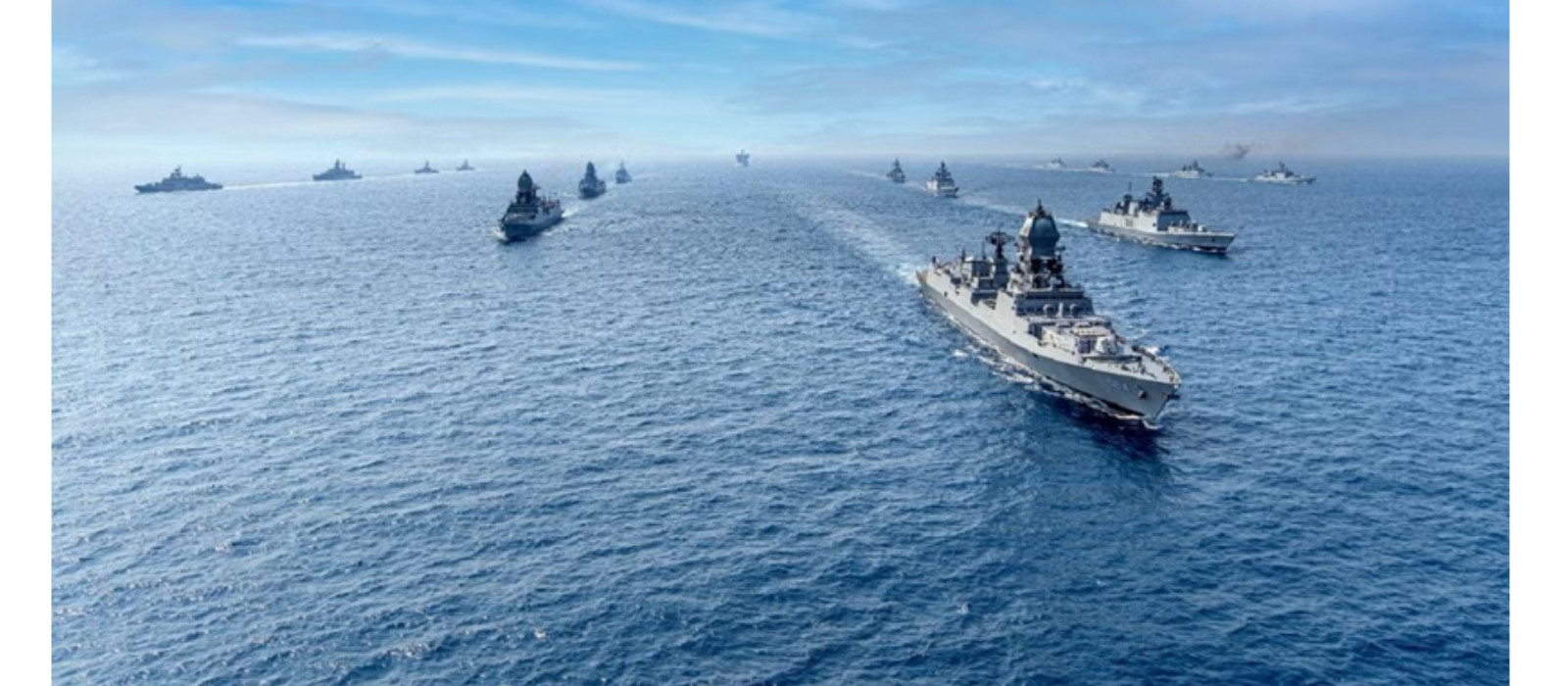
As mentioned earlier, significant changes in the domain of maritime warfare have largely been driven by enhanced domain awareness, robust networking as well as the exponential increase in the range of available ordinance delivery vehicles. These may be manned, unmanned, loitering or missiles and coupled with far more diffused maritime security and geopolitical challenges have resulted in naval assets being distributed in smaller numbers across vast expanses of the ocean. Under such circumstances, the erstwhile model of having a single Fleet Commander along with his staff, at sea in one of many pockets of activity distributed across the Indian Ocean Region (IOR) and beyond, does not serve the purpose of effective command and control. Being unable to be near the scene of action at multiple widely dispersed locations, his value addition tends to get restricted to waters which are in his proximity. On the other hand, units deployed at considerable distances from him could be placed in situations where they must manage complex operations involving multiple ships and aircraft without requisite command and staff support.
A possible solution to this problem could be to adopt a model wherein the Fleet Commander along with his staff control operations from ashore. Being co-located with Commander-in-Chief or Theatre Commander (in due course) means that he would be totally synchronised with the higher level of direction, particularly when it comes to rapidly evolving situations. The C-in-C/ Theatre Commander will also benefit from a clearer appreciation of the capabilities and limitations of units of the Fleet as he goes about orchestrating, sequencing and phasing the application of various vectors he has at his disposal.
To augment Command and Control with associated staff support afloat, a finite number of Commander Afloat Groups (CAGs) could be created, each under the command of a Rear Admiral/Commodore. They could be assigned a small number of ships with adequate flexibility to add or subtract to this number to cater for evolving operations at sea. While permanence in assigned ships has the advantage of allowing for a detailed knowledge base of ship specific strengths and limitations, flexibility caters for optimization in tailoring the force to meet evolving threats. A delicate balance between the two will, therefore, have to be maintained. A certain degree of specialisation could also be built into the tasking of the CAGs. These for instance could be Combat Operations, Maritime Security Operations, and Expeditionary Operations for a start. With time, both the number as well as specialisations of the CAGs could evolve based on experience gained. Specialisation of this nature will result in improved professionalism as each CAG will be focused on a smaller spectrum of operations instead of diluting itself over the entire ambit of tasking. With time, they could also become repositories for their designated spectrums thereby ensuring greater efficiencies in capturing and applying lessons learnt from erstwhile and ongoing operations.
Such a model will share some similarities with the US Navy wherein distributed operations are controlled by numerous Carrier Strike Group (CSG) and Expeditionary Strike Group (ESG) Commanders. The digression between the proposed model and the USN is that while their model is more platform specific (each commander being assigned to a specific Aircraft Carrier or LHA/LHD) ours could be platform agnostic. Further, we would not have the equivalent of a Numbered Fleet Commander. Thus, while the US model has a four echeloned Command and Control structure, these being the Theatre Commander, Fleet Commander (who is essentially the component commander), Numbered Fleet Commander, and CSG/ESG Commander; ours would be restricted to three echelons i.e. the Theatre Commander/C-in-C, Fleet Commander, and CAG. This would be in keeping with our regional focus and the relatively smaller number of assets we can field.
Apart from the USN, several other navies have conceptually adopted similar models. One such example is the Brazilian Navy where the Commander Surface Forces (equivalent to our Fleet Commander) has three subordinate Commanders under him, each with their own staff. These are the 1st Escort Squadron, 2nd Escort Squadron and the 1st Support Squadron.3
While the current model of the Indian Navy may have stood the test of time, given the rapid changes in technology prevalent today, coupled with the rise in the number of geo-political hot spots, the current model of over concentration of command and staff supervision at one location while being devoid of similar guidance/support at others is not the most efficient. A re-structured Command and Control organisation that facilitates a redistribution of such activity in keeping with the overall concept of distributed operations needs to be considered. Let the debate begin!
Endnotes
-
“Starships Fifth Flight Test; SpaceX Official Website,” SpaceX, October 13, 2024, https://w ww.spacex.com/launches/mission/?missionId=starship-flight-5.
-
Brian Wang, “How will SpaceX Bring the Cost to Space Down to $ 10 per Kilogram from Over $ 1,000 per Kilogram?,” nextBig Future, January 19, 2024, https://www.nextbigfuture.com/2024/0 1/how-will-spacex-bring-the-cost-to-space-down-to-10-per-kilogram-from-over-1000-per-kilogram.html.
-
Daniela Meireles, “The Future of the Squadron Starts Now – Investments in Strategic Naval Programs Strengthens Brazil’s Defence at Sea; Agencia Marhina de Noticias;Brazilian Defence Forces,” https://www.marinha.mil.br/agenciadenoticias/o-futuro-da-esquadra-comeca-agora.