


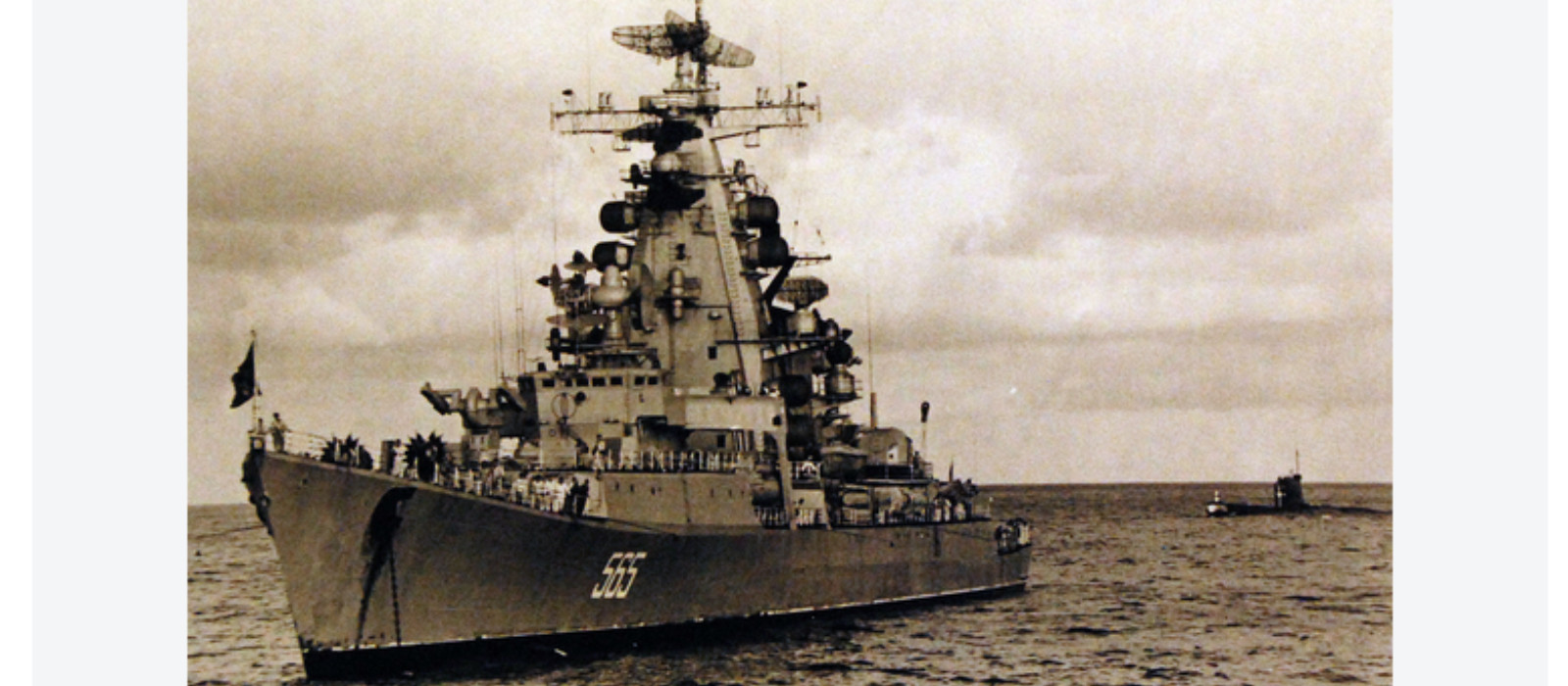


Perhaps the most difficult decade for our armed forces was the 60s. The Sino-Indian war of 1962 exposed our chinks on the land border, without testing the Air Force or the Navy. The 1965 Indo- Pak war was a stalemate; until 1971 placed us right on top. Not often is one blessed to see a new nation born in a short war of under two weeks. The army had to handle 93,000 prisoners of war and oversee their repatriation to Pakistan. Having been posted in Islamabad as the Naval Attaché in 1985, I can vouch for the goodwill that our Army earned while looking after the well-being of Pakistani prisoners in make shift camps. The Geneva convention was followed in letter and spirit.
But this is not about the war. This story is about how the Soviet Navy trained us in their own way to be effective in combat. In fact, they could not have believed that we would use their ships not only as well as they might have, but even better than they could. Quite by default, they had created just the environment to make our crews bond as never before. This story captures the gist of what happened on a remote island off the secret city of Vladivostok in 1969.
So secret was our training mission that little was known about the missile boats that we were to acquire. Need-to-know communication and the absence of reference material on both the city and the platform merely helped to accentuate the mystery.
We were in our early twenties and unlike the more senior officers with families, we didn’t really care much about our destination. Not many of this generation may know that in the1950s and 60s, an average Indian had to struggle for any comfort, which is taken for granted today. We lived in non-airconditioned ships, sometimes infested with bandicoots. Cabins below upper decks were uninhabitable to sleep at night. Most of us would carry our beds to the open decks just to sleep. Nonetheless, we were content with our life as we were better off than many of our countrymen. Going to the Soviet Union we thought, was a leap from the Third world to the First world.
So, in August 1969, when we found ourselves on an island, eight kilometres off a secret city called Vladivostok, it did not worry us. Our navy had been training there for what NATO called Foxtrot class submarines, and the Petya class frigates. When we landed with over two hundred officers and men, the island hosted the largest Indian naval contingent in the USSR.
It is pertinent to recall that it was then very much a bi-polar world. The Soviet Union and its Warsaw-pact allies were arrayed against the United States, NATO and other allies. India was seen as an ally of the West despite our ‘non-aligned’ policy. Paradoxically we were, until then, trained, manned and taught to fight with largely what we had inherited from the West. This encompassed our doctrines, training, traditions, logistics and even thinking! Given the freedom that we enjoyed in our democratic system, we were not quite equipped to comprehend the Marxist-Leninist political, social and economic under-pinnings, which governed every aspect of their lives well into the early 1980s, when it began unravelling. But, we couldn’t have known that in 1969!
The Soviet Union was a powerful country with a command economy and highly centralised planning. To meet its ideological focus on beating the West, it invested heavily in education, science and technology, child Welfare and the Military. In particular, the Soviet Union had made rapid strides in missile and space technologies.
The point relevant to my story is that until the mid-1960s, the Soviets had not dealt with the military of a free, democratic and a highly diverse country like ours. Dealing with us might have presented challenges for them, which we may not fully understand. For us, in turn, this was uncharted territory.
Here were some unforeseen problems. For one, we stumped them with our dietary preferences. We had vegetarians, non-vegetarians, amongst whom some ate only chicken or fish or just eggs and so on. Neither were the Russian galleys equipped to prepare a multi-cuisine meal, nor were they able to procure enough vegetables in a neglected part of the Soviet Union.
The USSR had conscripts at the lower rung on compulsory military service for three years (in the Red Fleet). On the other hand, our Navy was an entirely voluntary force, wherein even a sailor had to serve for a minimum of 10/15 years depending on his trade, and officers for twenty years. Unlike us, they relied a lot more on officers and warrant officers to run and fight their ships. The conscripts were trained just enough to man a single system during their limited service. They did not have a logistic cadre for cooking, cleaning, stores and financial management, etc.
Our manning patterns were fundamentally different. The Russians had more of an operator-maintainer concept. This relied largely on the officers and warrant officers to maintain, as well as operate the system. We had a separate electrical and engineering branch to handle technical matters spanning sensors, weapons, communications, propulsion and power-generation. Both systems had their pros and cons; the challenges for us were in figuring syncretism! We did start thinking of changes that could be made in the manning pattern of ships. But the philosophy of an operator-maintainer concept could not be resolved by our navy for decades to follow. We did embrace significant technicalisation of the officer corps. Its effectiveness would need to be carefully evaluated as we go along.
The Soviets soon realised that the Indian sailor had to be periodically introduced to the ‘greatness’ of communism as an ideology. All Soviet military establishments were overseen by a political commissar, whose primary task was to uphold and propagate the virtues of their ideology. Subtle indoctrination through a Soviet model was supplanted with the training curriculum for sailors. Lectures on the socialistic, egalitarian pattern of society were cleverly introduced. Most of it failed to succeed because our officers and men lived in close proximity, shared the same vagaries of weather and were equally inadequately clothed to face 32 degrees below zero, while also experiencing the surreal sight of the sea freezing. That the only language spoken was Russian, turned out to be a blessing, in that subtle suggestions and innuendos ‘encouraging’ egalitarianism, fell on deaf ears. Strong religious beliefs and multi-cultural diversities did not yield to the most sophisticated attempts to convert the average Indian.
Our sailors also witnessed very harsh and inhuman punishments awarded to the defaulting Russian sailors who were often chained for the duration of punishment. The lesson ‘free people are not equal and equal people are not free’ was brought home to our men during our stay.
There was a social cost that our senior officers had to bear. Most of them had to share rooms with two or three others depending on the size of the room. Bear in mind that a Commander was a senior officer in a small navy like ours. There were common bathing and toilet facilities for all. The sight of very senior officers in queue for morning ablutions alongside the junior-most, was not a pleasant one. The gesture après vous was impractical given the physiological pressures and the need to be on time for training. The next embarrassment was washing clothes. The Soviets did not provide a washing machine for nearly half of our one-year tenure on the island. The Juniors avoided washing their clothes in the afternoon thus, preventing undue embarrassment to the seniors ones.
Toothpastes and toiletries were a rarity in town. They were just not available and when a consignment arrived, people queued up to buy mere toiletries. Ergo, the naval detachment managed to convince Naval Headquarters to send canteen goods to Vladivostok through the Indian Naval Canteen Services. ‘Colgate’ toothpaste was a luxury that an average ‘Vostokian’ could not afford. Banned jeans and Japanese watches along with chewing gum were much sought after items on the streets of many deprived cities, not just confined to the east of the Soviet Union. Desperate and dejected youth deprived of freedom to access the quality of life readily available to their western counterparts, was a common sight. They were desperate enough to beg our personnel to trade items from what we wore. Here lies the irony. While show pieces of modernity in the form of cities like Moscow were open to visitors, the closed parts were tightly shut, much like China today.
Lack of avenues for entertainment was the root cause of hard-working Russian men taking to vodka drinking on an unimaginable scale. Over weekends, it was a common sight to see drunken citizens along the road-sides of almost all cities. Alcoholism was a national health issue. Not much was done to address this addiction as it was seen to be a pressure release mechanism, against lack of social amenities so freely available in Western Europe, and for that matter, on a much better scale in India as well. Briefly put, Communist Soviet Union was far from being an egalitarian society. We realised that those in Moscow or Leningrad lived charmed lives in comparison to several other cities and rural areas. Little did we know that the Soviet empire, with all its glory, would collapse like a pack of cards in two decades.
But the environment that I tried to illustrate thus far, was in contrast to what we were there for - to be trained to operate and maintain missile boats. On the training front we could not have asked for better facilities and expertise from them. They had a process driven programme, which was meticulous, and it facilitated identification of weak links in the chain. Given their human resource limitations they had no option, but to evolve foolproof processes.
The eco system prevailing on the island left us with little options but to improvise activities to focus on our tasks. We soon discovered means to form groups to interpret and convert Russian documentation into English. We discussed technical details of the boat and the missile in particular. There were discussions on how to deviate from the recommended operational and tactical deployment of the Missile Boats. The Indian jugad (Hindi for improvisation) philosophy started a whole new approach.
This could not have happened had we remained in India or in a city in Russia, which offered off-duty social opportunities. If the crew bonded, it was because of the extreme climate, restricted living space, conflicts with the hosts on ideological and administrative issues, graduating from rudimentary knowledge of the Russian language to technical language to assimilate the nuanced operational philosophy and a host of such activities. These were perforce collaborative and complimentary efforts within our teams for which burning of midnight oil was a necessity. Innovations followed.
In the process we discovered quite to our surprise that technical subjects, which appeared to be beyond the grasp of a non-technical seaman could also be mastered with a bit of guidance and assistance. As such, this approach was not implemented more widely across the Navy when beginnings could have been made. There was a watering down of Russian training methods to meet career requirements and cope with inter-branch sensitivities within the navy. The whole concept of keeping an entire crew together during training was allowed to dissipate, ostensibly to meet exigencies of service. Close billeting that we experienced in Vladovostok helped bonding as well as deeper ship knowledge, perhaps because there was not much else to do.
As a result of extreme pressure on limited manpower resources, NHQ had to perforce juggle crisis management instead of systematic long-term perspective planning. Not surprisingly, when I finally headed the Naval Training Command in 2004, the dilution of training philosophy hit me hard. That we had structured a major part of our training on the Western system of short ‘Type Training,’ interspersed with specialisation courses (mainly for the Executive branch), was not sufficiently reconciled with the Soviet approach. It was inevitable that a hybrid approach would be necessary to audit and verify various methodologies to suit our very special mix of platforms and weapons. This is an endless process, the study of which ought to be invested in, by an independent commission on a periodic basis.
Quite simply put, the Soviet training module was an input fortuitously timed, to enable us to streamline and develop the one that suited us. If we have top-of-the-line ships today and they are being manned by competent crews, the exposure to UK and USSR played a vital role in perpetuating a mixed model. The question is - have we found the most suitable system to restructure, not only the ab-initio training academies, but also professional courses? Education and training are two complimentary aspects leading to optimal use of personnel. They are not mutually exclusive.
We must deeply introspect on the assessment methodology practised in our training and educational institutions that promote the rote system, vis-a-vis the assessment that promotes creativity, imagination and innovation needed to win wars. It would be appropriate and instructive to look through the rear-view mirror to assess what was the telling impact of the Soviet training methodologies on the phenomenal success of Operations Trident and Python, in 1971.
When we arrived in Vladivostok, two Divisions with four boats each and a spare crew were placed under K-25 duly supported by a Squadron Staff headed by a Chief Staff Officer. In addition, the crew to man two Technical Positions, to store and prepare the missiles before deploying the boats, were to be trained by the Russians. The Commanding Officers and the Senior Squadron Staff were grouped together, while officers afloat and their men were placed in the next category for ease of training. Technical training aspects related to propulsion, power generation, maintenance of radar and communication were handled separately.
Training commenced with comprehensive ship knowledge including design and build features, damage control and fire-fighting. No one was allowed to go further unless these facts and figures were mastered. Missile and gunnery aspects were designed to study technical and tactical details by tracing wall charts from one end of the class room to the other. Cut-out models were available for greater appreciation. To cite an example, all the officers (except the marine engineer) were to be proficient on the design and construction of the missile, its parameters and be competent to trace the circuits from the moment the launch button is pressed, the booster ejects the missile, the smooth transition to cruise mode, detachment of the booster, behaviour of the airframe and control surfaces to reach the cruising altitude, the point pre-set for activating the missile seeker and its subsequent search and ECCM functions, acquisition of target and finally the activation of the warhead before impact. The trainer was aware that each of us had to face an external group of examiners and that failure meant that he was accountable.
The mode of examination was noteworthy. There were no written answers to test one’s knowledge. Five wise and experienced experts would arrive, with all of us seated in a class room full of circuit diagrams and wall charts. There were sets of question papers on their table, in three categories. Simple parameters, one requiring explanation and the lastone of in-depth knowledge. The examinee would take his pick, prepare for 5 minutes and then proceed to answer the questions, as if he were the teacher. No short cuts, no time to copy and not all could be answered by rote alone. If one wished to reject the questions, one could pick another set by dropping grades.
The final phase of whole crew assessment was done by a Flag Board drawn from the front-line Squadron. They were called Task-1 and Task-2. The first consisted of ship board knowledge conducted on two boats placed alongside and all drills, from safety to switching on equipment, without proceeding to sea. This was conducted by the Soviet crew manning these boats. On confirmation that the Indian crew was competent, Task-2 commenced with putting to sea, similar to the charter of Flag Officer Sea Training (FOST). Two live firings were included at our request.
Needless to say, the tactical exploitation phase included single ship engagement, to divisional attack procedures, to coordinated and timed multi-directional attacks on a carrier task force. All eight crews may not have achieved the highest gradings as a crew, but it was crystal clear as to which crew needed to do more. If we were not ready for war after this intense phase, we would never have returned without losses as we did in December of 1971. Our basic profession is ‘management of violence.’ This must not be lost sight of if we want to be victorious in war.
