


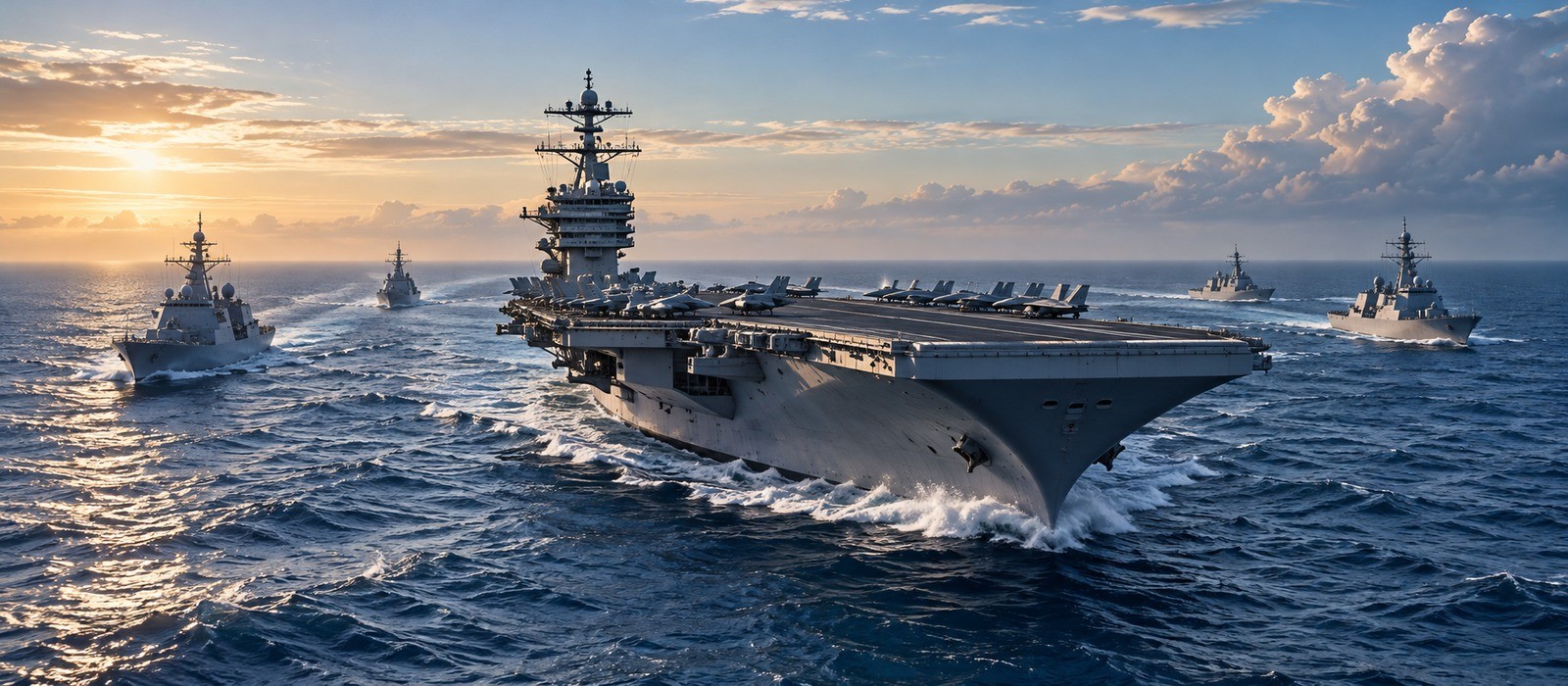


“The warship is therefore doomed to certain destruction at the hands of Bombardment Aviation.”
— Brig Gen Billy Mitchell, Airpower advocate, US Army Air1
“Aircraft carriers are indispensable combat platforms.”
— Adm Samuel Paparo, USN, 20242
Abstract: Debate over the survivability of large capital ships has re-emerged as satellite-enabled surveillance, long-range precision weapons, hypersonic systems and uncrewed swarms increase the risks faced by surface fleets. Using disruption to shipping through the Strait of Hormuz and US Operation Earnest Will in 1987-89 as contemporary and historical points of reference, this article argues that vulnerability in confined waters does not by itself establish the obsolescence of the carrier or other large warships. Control of a contested chokepoint requires persistent, integrated maritime and air power, supported by mine countermeasures, surveillance, surface escorts and access to adjacent operating areas. The article then places the present debate within the longer evolution of the capital ship, examining how expanding sensor, power, aviation, weapon and command requirements have driven growth in warship size. The article concludes that technological disruption has historically forced adaptation rather than automatic extinction and proposes further studies that test that proposition against earlier challenges, beginning with nineteenth-century torpedo-boat and Jeune École debates, to identify implications for future fleet design.
Introduction
As can be seen from the quotes above, the history of the last 100 years is replete with instances where the development of new technologies has threatened to render the large capital ship of the day obsolete, accompanied by much heated debate in strategic and naval circles. Today, amid another era of intense technological disruption, many commentators have similarly expressed doubts about the viability of large capital ships, specifically aircraft carriers, to survive attacks from long-range anti-ship and hypersonic missiles, supported by satellite-based detection and targeting.
The argument in brief is that satellite-based surveillance, particularly the explosion in low-cost, Low Earth Orbit (LEO) ELINT/EO/IR/SAR payloads, coupled with advancements in uncrewed aerial vehicles and high-altitude pseudo satellites, will make the surface of the oceans nearly transparent. This, coupled with the increased range and ballistic trajectory of land and air-launched anti-ship missiles, could make large capital ships vulnerable to early detection and targeting at long distances with salvos of missiles and drone swarms. The loss or even damage of such valuable platforms would be a major propaganda victory for the adversary, effectively making these large surface vessels a liability rather than an asset when pitted against a peer adversary.
This debate has intensified in recent times during the ongoing crisis in the Persian Gulf, when Iran, with most of its naval assets destroyed or in hiding, was able to close the Strait of Hormuz to commercial shipping, sending oil prices soaring and threatening an economic “crisis worse than two 1970s oil shocks put together.3 The inability of the US Navy to open the Strait at the time of writing, despite possessing arguably the most powerful surface fleet in the world, was touted by some as yet another example of the growing irrelevance of surface fleets in the face of new-age threats from the land. However, these arguments betray an incomplete understanding of the fundamentals of sea power, particularly in coastal waters, which have emerged from historical practice.
Fort Vs Fleet
The vulnerability of warships operating close to the coast in narrow and confined waters against a determined adversary has long been recognised. However large or capable the force of ships operating in narrow seas, the ever-present, multidirectional and multidimensional threat posed by the adversary in confined waters makes life extremely difficult even for the most blue-blooded of navies. Given the restricted sea-room and the range and potency of modern weapons, naval combat in coastal waters is likely to be highly intense and destructive. The growth of land-based airpower and drones in recent times has only amplified the threat. This is not a new problem. Naval commanders have long understood the dangers of fighting close to hostile shores. It was for this reason that no less an authority than the famous British Admiral Horatio Nelson allegedly said that “A ship’s a fool to fight a fort”.4 This was as true in the age of sail and cannon-shot as it is today in the era of missiles and drones.
Control of chokepoints has rarely depended solely on naval power; it has often required control of adjacent territory. It was therefore no wonder that Britain, which had the pre-eminent blue water navy of the 18th and 19th centuries, expended considerable blood and treasure to also gain strategic positions at or near major international chokepoints and waterways through which seaborne commerce and trade had to pass – the Straits of Gibraltar, Malta, the Suez Canal, Aden, Hormuz, Singapore and the Straits of Malacca. It is also not a surprise that the world’s navies are approaching the thought of convoying merchant shipping through the Strait of Hormuz in a contested environment with a degree of caution.
Attaining control of a narrow sea or strait is much more complex than an open ocean because it implies ability to strike the enemy both at sea and on the adjacent coast as well. The safe escort of friendly or neutral shipping across a contested strait would require ‘choke-point control’ of the seas and at least one adjacent shore. In the words of the maritime scholar Milan Vego, “superiority in the air is a prerequisite to achieve control of the sea (in a strait zone)”.5 In the absence of air bases in the Persian Gulf littoral, which is a certainty for all navies barring the US, this airpower and maritime strike capability to contest and gain control of the air over the Strait must necessarily emanate from the fleet, from on board those same much maligned aircraft carriers and surface ships.
Choke-point control cannot be achieved quickly – it requires persistent and capable maritime and air assets operating in close coordination. Land-based airpower operating distant from home airfields can at best augment but may not always replace the fleet air arm and surface fleet in this mission. This was also conclusively illustrated the last time that Iran threatened closure of the Straits during the Tanker Wars in the mid-1980s and the US Navy launched Operation Earnest Will in response. A short recap of that operation that seemed so distant a short while ago, but now appears increasingly relevant, would appear to be to fully understand the role of the surface fleet and carrier-borne aircraft in attaining ‘chokepoint’ control in contested waters.
-
Breaking the ‘Chokehold’. Nearly four decades ago, during the Iran–Iraq Tanker War, the United States confronted the challenge of ensuring safe passage of merchant shipping in the Persian Gulf through a major convoy operation known as Operation Earnest Will. The circumstances today are not identical, but the strategic problem is strikingly familiar. When Kuwait, a key Gulf partner, approached the US for assistance in reflagging its tankers under the US flag, the USN was tasked to escort these reflagged vessels from Kuwait across the Strait of Hormuz till Khor Fakkan anchorage in the Gulf of Oman. The USN launched Operation Earnest Will on 22 July 1987.6
-
Operation Earnest Will 1987. The force levels of the then US Middle East Force surged in mid-July 1987 to nine surface combatants, including three cruisers and a mix of destroyers and frigates. One Carrier Battle group operated in the north Arabian Sea accompanied by another battle group centred on the battleship USS Missouri. The surface combatants were tasked with the escort missions, whilst the battle groups in the Gulf of Oman were responsible for providing air cover for the escort group because the Gulf states refused permission for US air operations from their bases for political reasons. The episode thus demonstrated the value of carrier-based air power when political constraints denied access to otherwise geographically suitable land bases.
-
Threats. The USN assessed the threats in 1987 to be from F-4 Phantom air attacks, small fast attack boats, land-based Chinese ‘Silkworm’ missiles and mines, with the last three being considered the most dangerous. The same holds true today except that the aircraft are probably depleted, fast attack boats also include uncrewed swarms, the missiles are longer range with both cruise and quasi-ballistic variants, and the contact mines of 1987 are now augmented with influence mines. Drones and loitering munitions, however, are a new threat that was not faced in 1987. We shall look at the US response for each of the threats above in turn.
-
Force Protection. The threat from missile/air attack was mitigated utilising Saudi AWACS early warning assistance in the northern Gulf and carrier-borne AEW/EW aircraft in the airspace around the Strait of Hormuz. These AEW aircraft were particularly valuable to provide early warning of any missile launch. Night-time small boat ‘swarm attacks’ by fast attack craft called ‘Boghammers’ were addressed through extensive integral air surveillance both by day and night to create a force protection ‘bubble’ around the force and strike the boats whilst they were forming up at distance.The mining threat turned out to be the most potent threat and at the start of the operation, USN minesweeping capability was in a precarious state. It was only with the arrival of the Korean War-era wooden minesweepers in October 1987 that minesweeping efforts improved. This also coincided with their European allies sailing some modern minesweepers to the Gulf. Mines laid in the Strait and off anchorages by the Iranians were methodically cleared in the following months by the coordinated efforts of the US and Western navies.
-
Lesson from Earnest Will. A study of the Tanker wars of the 1980s provides many lessons for navies even today if analysed dispassionately and adapted to modern circumstances. The chief point to remember is that each of the force protection efforts of the USN detailed above was enabled by the complete air superiority enjoyed by the USN, and this in turn depended heavily on the integral aircraft operating from large-deck ships deployed to the region.
Is Big Still Beautiful?
Nevertheless, the argument that large capital ships are vulnerable is such a persistent one that it warrants some detailed analysis. Confusing the picture even more is the fact that the PLA Navy, the originator of the so-called Anti-access Area Denial (A2AD) doctrine (although the term is an external analytic construct rather than a Chinese one), is itself investing heavily in aircraft carriers, with three already built and a fourth one in the pipeline. And this fourth aircraft carrier is likely to be the largest warship ever built, based on contemporary reports, with a nuclear plant and tonnage more than 100,000 tonnes.7 How is it that the Chinese Navy, which loudly proclaims it possesses decisive ‘Carrier-killer’ sea denial weapons, is itself embarked on a massive carrier building programme, not to mention construction of large Landing Platform Dock ships and Type 055 mega-Destroyers? Are they hedging their bets or do they know something we don’t?
Size Does Matter
Capital ships, defined as the premier fighting instrument of the navies of the period, have changed over the years in tandem with technology. From HMS Victory, the sailing ship of the line of the 18th century Royal Navy to USS Gerald R. Ford, the latest supercarrier of the 21st century US Navy, capital ships have defined the way that navies have operated and fought. However, as the table below conclusively shows, one constant has been observed in the design of these ships of war – their size and displacement have consistently increased over the years:

Source: Compiled by the author from Britannica.com
Five important drivers can be identified for this growth in size: -
-
Sensor Requirements. Modern warships tend to have more capable and powerful sensor suites. Radars, sonars, electronic warfare suites and communication equipment have become ubiquitous.
-
Power Generation. Increasingly capable weapon and sensor complexes drive vastly greater power requirements. Whereas HMS Victory in 1765 had no electric machinery, a WWII battleship could generate 7.5 MW of power, a Cold-War era Carrier produced 64 MW of electric power and modern supercarriers generate over 100 MW of power.
-
Need for Aviation Facilities. The growth of shipborne aviation has required space for flight decks, hangars, fuel storage and maintenance.
-
Size and Complexity of Weapon Payloads. As more capable weapons have developed in the surface, undersea and air domains, warship size has grown to accommodate these force-multipliers.
-
Space for Command Functions. Requirements of Fleet Command and networked warfare have required larger operations rooms, computing infrastructure and communications arrays.
From ‘Fire on Sight’ to ‘Fire and Forget’
The expanding range of naval combat is another reason why each generation of capital ships has steadily gotten larger. In the age of sail, commanders fought within visual range of each other, with effective weapon ranges of 300 m. The advent of the industrial age saw gunnery ranges increase to 20 km by the early 20th century, with rapid improvements in fire control systems and range finders. The introduction of carrier-borne aircraft later that century saw strike ranges dramatically increase to 200-300 km in WWII and 600-800 km later. The carrier became the capital ship of the 20th century primarily because it could outrange armour-clad gunships.
The dawn of the missile age in the mid-20th century further improved engagement ranges well beyond the radar horizon to 500-600 km and the current networked warfare complex has seen weapon ranges grow well beyond 1000 km, augmented by satellites and uncrewed systems. Ships had to grow in size to support the endurance, sensors, weapons and aviation needed to operate effectively at those distances.
In the words of Professor Geoffrey Till, “As the demands placed upon warships increase, so too does the tendency for them to grow larger and more complex.”8 Size has historically also been an enabler of adaptation as we shall see later. In summary, the capital ship has grown larger not because navies favour grandeur, but because each generation of naval warfare demands more sensors, more power, more weapons and more endurance than the last.
We would do well to remember that the vulnerability of capital ships is not new. Each technological revolution has exposed new weaknesses - but it has also driven innovation in ship design, sensors, weapons and tactics. Size enables adaptation while simultaneously increasing cost and concentration risk. It would be worthwhile to test whether this historical pattern remains valid through a study of the past, when similar supposedly ‘existential’ threats were posed to surface fleets, and analyse those adaptations for insights into future fleet design going forward. After all, the ‘logic’ of naval warfare does endure although its ‘grammar’ may change from time to time.9
Endnotes
- William Mitchell, Our Air Force: The Keystone of National Defense (New York: E. P. Dutton, 1921), 68.
- S. J. Paparo, “Aircraft Carriers: Still Indispensable,” US Naval Institute Proceedings 150, no. 7 (July 2024), https://www.usni.org/magazines/proceedings/2024/july/aircraft-carriers-still- indispensable. Accessed 27 July 2026.
- John Power, “World in Energy Crisis Worse Than 1970s Oil Shocks Combined, IEA Head Says,” Al Jazeera, 23 March 2026, https://www.aljazeera.com/economy/2026/3/23/world-in- energy-crisis-worse-than-1970s-oil-shocks-combined-iea-head-says.
- The dictum "A ship's a fool to fight a fort" is commonly attributed to Admiral Horatio Nelson; however, no contemporary corroborating sources exist.
- Milan N. Vego, Naval Strategy and Operations in Narrow Seas, 2nd ed. (London: Frank Cass, 2003), 122.
- Harold Lee Wise, Inside the Danger Zone: The US Military in the Persian Gulf, 1987-1988 (Annapolis, MD: Naval Institute Press, 2007), chaps. 5-9.
- Monty Khanna, “Why China’s Fourth Aircraft Carrier Is Likely to Be Nuclear Powered,” National Maritime Foundation (Maritime India), 31 December 2025, https://maritimeindia.org/why-chinas-fourth-aircraft-carrier-is-likely-to-be-nuclear-powered/. Accessed 25 July 2026.
- Geoffrey Till, Seapower: A Guide for the Twenty-First Century, 3rd ed. (Abingdon: Routledge, 2013), chap. 6.
- James R. Holmes, A Brief Guide to Maritime Strategy (Annapolis, MD: Naval Institute Press, 2019), pg 65.
