




Note: The title of this article is innovated from the quote ‘Cooperate to Dominate’mentioned in the book “Five Point Someone” by Chetan Bhagat.
“Under the self-reliant India campaign, the country’s goal is to make India a major military power on its own, and to develop a modern military industry”
- Shri Narendra Modi1
Introduction
Atmanirbhar Bharat is the latest buzz word in government circles today. The initiative is especially relevant to the Ministry of Defence (MOD) and the three Services because of their high reliance on foreign imports. However, any well-intentioned policy is only as good as its implementation. Therefore, the success of this drive will depend on its adoption within the MOD, the three Services and public sector and private players.
True atmanirbharta will only come when we own the underlying technologies and the entire design and manufacturing ecosystem. Otherwise our efforts will be limited to licensed manufacturing of “Build to Print” equipment, which will continue our dependence on the benevolence of a foreign OEM and often a foreign government. With this background, this article aims to evaluate the developing ecosystem around defence innovation in India and aims to provide certain suggestions for implementing agencies to think about.
Indigenisation vs Innovation
Before we dive deeper into the theme, it would be good to deconflict two interlinked concepts which are sometimes used interchangeably: indigenisation and innovation. Indigenisation is “the act of making something more native; transformation of some service, idea, etc. to suit a local culture.”2 Innovation however, is “the introduction of new things, ideas or ways of doing something.”3 Hence, while indigenisation is about finding domestic solutions to replace an imported equipment/technology, innovation is trying make something new. To put it differently, innovation entails developing breakthrough technologies and owning the building blocks of the future.
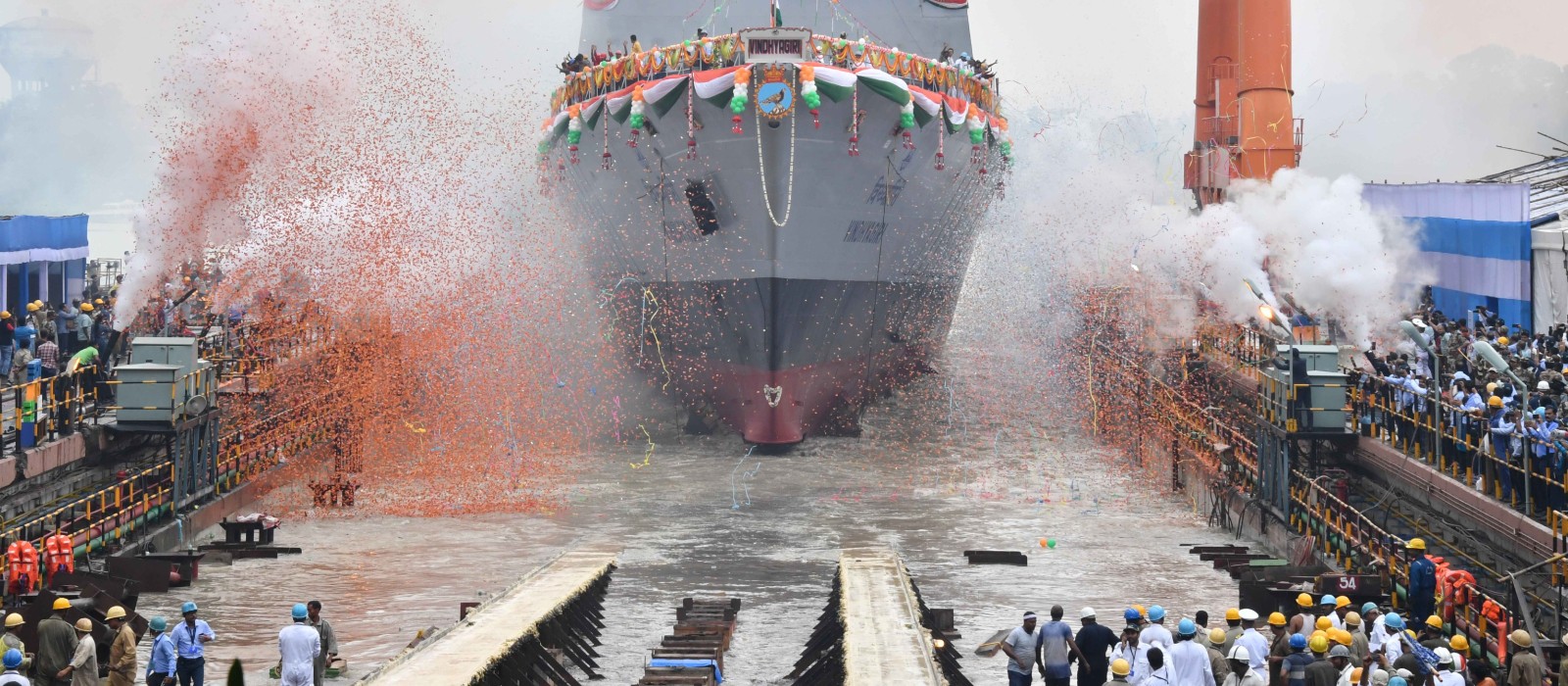
The Indian Navy (IN) has performed remarkably well on the indigenisation front and today almost all Naval vessels are built in Indian shipyards, with an ever-increasing domestic equipment profile. However, the service does not boast a similar record in undertaking meaningful innovations. There are a few exceptions, of course. One was the individual genius of Cmde Paul Raj, PhD (Retd) who was instrumental in developing indigenous sonars for the IN in partnership with the DRDO from the 1970s. He is well known for his innovations like MIMO wireless communications theory in later life.4 Niche organisations like WESEE have also been innovative. Hence, the focus of this article will be on the innovation ecosystem in defence, with a focus on aspects pertaining to IN and ways in which we can build up steam to surge ahead.
Where We Stand Today
Several initiatives have been taken in the past decade to reduce foreign dependence in defence procurement. For starters, the Defence Procurement/ Acquisition Procedures have been revised in 2013, 2016 and 2020. The rules have tweaked the ‘Buy’ and ‘Buy and Make’ categories to prioritise Indian Designed Developed and Manufactured items over the Buy (Global) category to promote procurement of Indian origin equipment.5 Further, a Strategic Partnership model has been envisaged to leverage foreign vendors’ expertise to develop a strong domestic defence industry.6 The government has even taken the bold step of placing a long list of items on a ‘negative import’ list, forcing the Services to look for domestic alternatives.7 Further, the latest Defence Acquisition Procedure (DAP) 2020 instructs the three Services to establish Innovation & Indigenisation Organisations within existing resources.8
At the apex level, a Defence Innovation Organisation (DIO) has been created by DPSUs HAL and BEL as a “not for profit” company, to support the MoD in building the entrepreneurship and innovation ecosystem in Defence in India. Subsequently, in 2018 the Innovations for Defence Excellence (iDEX) framework was launched as an executive arm of DIO.9 iDEX is functionally autonomous though it receives policy guidance and funding from DIO. iDEX defines its role as “developing an ecosystem to foster innovation and technology development in Defence and Aerospace by engaging innovators and entrepreneurs to deliver technologically advanced solutions for modernising Indian Military.”10
Salient Initiatives
As brought out above, IN has been an early adopter of indigenisation and has also put in place organisations to hasten innovation in the service. A few salient initiatives are listed below: -
-
Directorate of Indigenisation (DoI) at Naval Headquarters and Indigenisation Units at Commands to synergise all indigenisation efforts.
-
Technology Development Acceleration Cell (TDAC) focussing on imbibing new technologies and steering innovation efforts.
-
In order to synergise all indigenisation and innovation efforts, Naval Innovation and Indigenisation Organisation (NIIO) was formed in 2020 to ensure a methodical approach for interaction with academia and industry and to foster self-reliance in the service.11 The stated aim of NIIO is synergising the ‘Navy-Academia-Industry’ triumvirate for encouraging innovation and technology leapfrogging for the service.
-
As part of NIIO, IN also formalised a Naval Technology Acceleration Committee, that meets every six months, with participation of relevant stakeholders.
Catch Them Young
Any innovation requires engaging with the younger generations, especially students in premier educational institutions. Accordingly, IN has launched the Indian Naval Students Technical Engagement Programme which provides interested students with a five months online internship to work on naval problem statements. This initiative by the NIIO is being executed in partnership with Society of Indian Defence Manufacturers (SIDM) and the defence-oriented think tank bharatshakti.in.12
The Navy has also identified capable firms operating in the niche technology domains as partners for upcoming projects. MoUs have been signed with multiple firms like Tardid Technologies, Raphe Mphibr, Newspace Research and Technologies, Sagar Defence Engineering and Ancor Research Lab to name a few.13 These firms aim to focus on areas of mutual interest such as UAVs, artificial intelligence, autonomous & unmanned systems, electronic warfare and the like.14
IN has also evolved a novel ‘open-to-all’ innovation scheme named VISTAR to encourage all service personnel to share their innovations. This scheme has already resulted in numerous IPR applications being filed by naval personnel. The programme has yielded success stories such as the NavRakshak PPE (Personal Protective Equipment) designed by a serving doctor.15 Aadyant Oxygen Recycling System (ORS) by a specialist Naval diver is another example.16 Many of these innovations have applications for other Services and public agencies as well and IN has shared the designs for licensing and transfer of technology to MSMEs/Private Sector.
The novel iDEX initiative is fast evolving into a thriving innovation ecosystem.17 It runs periodic Defence India Startup Challenges, which have attracted several private and individual participants. iDEX aims to “Facilitate, Create and Empower” innovators by engaging with private enterprises, start-ups, R& D institutes and academia, while also providing them funding support. The organisation has already partnered with leading institutions which are spread all over the country viz., IISC, IITs, IIMs and is increasing its engagement.18 For this initiative, the Department of Defence Production was conferred with the Prime Minister's Award for Excellence in Public Administration, 2021.19
Challenges
Whilst many agencies have been created in the past decade, the results do not seem to be commensurate to the efforts. Various factors hinder development of a holistic innovation culture in the Services, while the arcane procedures present too many hurdles for emerging firms.
Scanty Information. The foremost among them is the paltry information in the open domain and lack of accessibility to service establishments. Even within the Services, few personnel are aware about these establishments, their mandates, what projects are they are pursuing and their contact details. NIIO/TDAC/DoI do not have any prominent digital presence via a website or social media handles to facilitate easy and two-way engagement with interested parties. With only basic contact details (mostly landline numbers and passive web-based forms) being available, initiating contact is often dependant on retired personnel/big manufacturers having access to corridors of Sena Bhavan/South Block.
IN has judiciously leveraged the Confederation of Indian Industry’s Virtual Exhibition Platform (CII-HIVE), for conducting digital conferences with industry partners and providing a good medium for two-way interaction. Similarly, in order to engage a wider audience, we need to have a functional and interactive web presence, while also providing a peek into our future requirements. It does not mean sharing our perspective plans, but providing calibrated information to instil interest in researchers and provide them with a start point for contacting the relevant Naval organisation(s).
Silos. Another hurdle is the tendency to work in silos. As can be seen above, there are a plethora of agencies doing similar work, with little or no coordination or experience/ data sharing between them. Ideally all agencies should be interlocking so that their projects reinforce each other, but that is seldom the case. For instance, DoI and TDAC come under different staff branches at NHQ and have minimal interaction/integration. The formation of NIIO aims to break these walls and synergise efforts of the above entities. However, NIIO itself remains a committee that meets occasionally with no permanent office/physical presence and little awareness even within the Navy. There is little information regarding its organisational hierarchy, planned goals, projects, timelines, processes or even details of NIIO committee members.
Letting In-House Talent go Under-Utilised. Employment of our captive expertise is another weak area presently. Despite the several MTech qualified officers in service, few are genuinely involved in R&D/ innovation. Posting fresh IIT graduates onboard ships/yards/HQs for routine duties just lets their knowledge become blunt, if not going waste. Resultantly, a majority of the MTech qualified officers rarely work in any technology innovation field during their entire service. Sadly, due to the low awareness and limited focus on innovation establishments, these billets are not viewed as an attractive career progression option, resultantly few officers volunteer to be posted in these organisations.
Lobbies do Exist. Defence innovation also threatens established players. Considering the defence budget is a zero-sum game, every contract won by a domestic private company/startup for the next gen weapon/equipment, leaves a smaller pie for DPSUs and foreign suppliers. Big money agendas and corporate politics are not unique to our country. There have been allegations in the United States of Defence Innovation Unit (DIU) funding being cut back due to lobbying by the established defence manufacturers, who see the innovation startups as a threat to their businesses.20 Similar hurdles can be expected in our system, with DRDO and DPSUs playing spoil sport to protect their monopoly on defence R&D and production.
Shortcomings in DIO. The question of services’ involvement in projects is an old bane which has seeped into new organisations as well. DIO has no representation from services listed in the organisational hierarchy, except for a few retired personnel.21 The organisation comprises primarily of bureaucrats, whose expertise in understanding defence requirements, or working with cutting edge tech is difficult to validate (at least no details are available on the website). It appears that DIO is either working in isolation, taking up projects that it deems fit without any user input; or user inputs are being sought in the legacy way via files and committee meetings.
iDEX is designed to break these bureaucratic shackles, as its website mentions, “CEO of iDEX will be selected and recruited by the DIO and will be a professional person of sound technical, scientific and engineering background with divergent knowledge and experience in innovation and research.”22 Despite this policy, the Chairman, CEO and COO are all civil servants and not industry veterans. Hence, despite a good start, iDEX may end up falling into the OFB legacy trap where products are manufactured more to suit the organisation, rather than the end user.
Lastly, there is little material on the evaluation parameters for innovation organisations. Evaluating success in a R&D establishment is always a challenge, as traditional metrics viz. number of successful projects, profitability, savings to exchequer, etc. are not suited to gauge successful innovation. With the lack of tangible/objective measures of success, there may not be visible signs for course correction and the organisations may lapse into feverish activity producing little results.
The Private Sector Should Make Itself Count More. While a lot has been said for the government agencies, private firms also need to up their game. They need to realise that defence innovation is expensive, ridden with dead ends and is not the data trove they expect from a web-based product suite. The user specifications are often extreme and testing process is rigorous. Hence, they need to recalibrate their development approach. They need to accept that if the products do not work as designed or are unpredictable, then operators won’t use them, services won’t adopt them and ministries won’t fund them, which will lead to a vicious cycle ending in dead projects.
The Road Ahead
The above constraints notwithstanding, the innovation journey is only at its beginning and we must embrace innovation robustly. With a few policy nudges in the right direction, we can significantly speed up our innovation journey. In this regard, we can take a leaf out of DIU’s book which is “focused exclusively on fielding and scaling commercial technology across the US military at commercial speeds.”23
Innovation is a high-risk venture which moves at a rapid pace. Hence, creating new organisations alone will be insufficient, unless augmented by commensurate modifications in the procurement philosophy. Our existing procurement process cannot keep pace with today’s tech ecosystem and sticking to these archaic procedures will only end up frustrating budding innovators. Most small firms do not have the resources or time to navigate a maze of offices and files. Therefore, it is vital that MoD create fast track procedures that innovation organisations can exercise to progress innovation related cases.
Creating Efficiencies. Recognising this constraint, the procurement process under the iDEX procedure of DAP 2020 has been simplified, such that the time taken from grant of AoN to contract signing is reduced to 22 weeks.24 This is a good step but certainly not enough as the AoN process itself needs an overhaul. This stage presently takes an inordinate time - often in months - due to a complex web of approvals required from multiple stakeholders. Further, it won’t be enough if we just fast track approvals for Proof of Concepts. While paying for a prototype will help a firm recoup the design investment, the project won’t be financially fruitful and may not encourage follow ups, until they get some tangible orders in quick time.
Tolerance for Failure! Innovative organisations must have a high tolerance for failures. These agencies will have to develop a risk-taking appetite similar to VCs, where one ground breaking project among several failed ones is acceptable. This is conceptually against our traditional policies which have obsessive focus on savings to the exchequer and on financial viability of projects prior to commencement. Instead what is required is the creation of new procedures and regulations which evaluate projects more on their technical merits & future potential than on rigid financial metrics. We also have to also be aware of the “sunk cost fallacy” which might drag us into chasing projects with limited prospects. Cutting your losses and closing down a promising yet elusive project is no easy task and will require evaluation frameworks/regulations to guide the innovation organisations in timely closure without ensuing legal complications.
“Buy where you can, build where you must” should be the mantra which entails integrating available solutions rather than building everything from the ground up for defence requirements. Focussing on projects with “dual-use nature” can be a force multiplier, in innovation parlance, as projects with commercial dual-use technologies will provide companies the liberty to use these patents for civilian products as well. MoD can also facilitate such dual-use ventures by providing them access to existing DRDO labs and their wide array of test equipment, which may be unaffordable for a start-up. The development costs of such projects can be offset as companies can recoup investment via sales in a larger market. This can result in faster product development and lower maintenance costs, as the equipment/service has a wider user base. Such dual use projects can also help achieve a secondary aim of developing niche technology for national use and for boosting our hi-tech exports.
At present, it appears as if innovation organisations are trying to attempt everything. From the limited information available in the open domain, one cannot ascertain any defined focus areas, instead proposals seem to be sought from diverse fields such as engines, UAVs, communication, AI etc. Such a spread will result in these agencies having to deal with several vendors, multiple specialisations and testing multiple products. The administrative resources required for that will be challenging and may prove to be beyond the capacity of Services/MoD. Hence, it is imperative that we determine focus areas that can yield maximum benefits for the Services. It does not mean ignoring other areas of innovation, just that the focus areas will be prioritised within the available financial and manpower resources.
Service organisations also need to have a wider national presence. VAdm G Ashok Kumar (Retd) captured it well in his column where he wrote, “in so far as innovation was concerned, free, open, and regular interaction with the industry was understood to be an inescapable requirement.”25 Presently, DIO, DoI and TDAC are all based at New Delhi (though Indigenisation Units exist at Commands as well). While the top governance can indeed be driven from Delhi, we need satellite units with local presence in major manufacturing hubs. This has been historically done with DPSUs which have collocated service institutions such as CQAEs and Naval Liaison Cells. Also, we need to have functional units at innovation hubs such as Bengaluru and not necessarily co-locate them with Command/Area HQs. These small cells can be formed under the aegis of NIIO and report directly to them. Sanctioning new units is a challenge which can be overcome by expanding the scope/charter of existing units such as Headquarters Naval Technical Group, Naval Liaison Cells and other similar organisations.
We also need to temper our obsession with secrecy. For instance, VAdm G Ashok Kumar (Retd) writes that “VISTAR has resulted in medical innovations, such as Nebulizer, low-cost digital stethoscope and many others; and, dual-use items such as deck paint and marine life-jackets. But the details of many successful innovations by the NIIO have not been publicised by the Navy for apparent reasons.”26 We need to appreciate that every defence innovation or project need not be secret. Being extremely frugal with open source information, kills the spirit of innovation and will mute interests of participating firms. Concentric sets of specifications could be a solution for dual-use projects, wherein the wider global specifications for civilian use would be in the public domain, while a few esoteric features catering to military specs are classified.
VAdm G Ashok Kumar (Retd) also mentions that particulars of most of the dual-use innovations by naval personnel are available from various press releases and tweets.27 But innovative ideas do not spread by press releases alone. We have to open source the designs at least for items such as paints, life jackets and nebulisers and put them on a website for all to use, thereby providing manufactures with a readymade template, reducing their costs and ultimately facilitating large scale manufacturing of these products and in turn aim to reduce procurement cost of these products.
Lastly, at this stage IN as a service should focus on achievable projects, within relatively short time frames. We should deliberately avoid moon-shot projects which require expensive infrastructure, large budgets, complex development, long timelines and are often beyond the developmental capacity of fledgling firms. Such projects will also require a commensurate service manpower to monitor, which may not be available in the present HR constrains. In future, once we reach maturity in incubating technology innovations, similar to what we have today with ship design, we can graduate to more ambitious projects.
HR Management
Talent deficits in the MoD and Services presents one of the bigger impediments to imbibing future technology for defence applications. It is no wonder that many innovative firms start with limited resources, yet produce remarkable products, due to the single-minded focus and passion within their team members. Hence, all the funding will be of little use if we cannot man these institutions with the required human resource. The biggest factor to ensure quality output from these establishments in by manning them with personnel who are passionate innovators and are motivated by solutions they develop.
The US DIU’s annual report brings out its HR focus as, “we attract talent from all of the Services in a mix of active-duty personnel, veterans, reservists, and commercial tech executives.”28 It is critical we imbibe a similar philosophy and reduce bureaucratic stranglehold on innovation agencies. Such establishments need domain experts in crucial appointments, who are qualified to imagine, buy, build, evaluate and use modern technologies.
To begin with iDEX should be headed by a technocrat, as initially envisaged and indicated on their website. Preferably the incumbent should be someone from the private sector who has experience of working with advanced technologies and managing such product developments & people. The organisation should have a healthy mix of domain experts, serving personnel and officials from MoD.
The service component in innovation organisations should be predominantly from a younger age group, as they often relate to modern technology better. These personnel should also get actively involved during the development cycle, rather than be limited to project management and monitoring. This process will ensure that when the product is operationally inducted, we already have a trained manpower to operate and maintain this hi-tech equipment.
In their report on AI, the US National Security Commission emphasised the importance of talent, stating “The AI competition will not be won by the side with the best technology. It will be won by the side with the best, most diverse, and tech-savvy talent.”29 Unfortunately, Services have a handicap in competing with the private sector to attract the best technical talent. Hence, attracting the right people and employing them as contractors/ consultants will be the vital factor in developing an innovating culture. We have to make it attractive for bright, young individuals to take pride in solving national security challenges. This will require talent - scoping via non-traditional means and tweaking our legacy contract structures to leverage the domestic start-up ecosystem and academic communities.
Within IN, MTech should not be the default mid-career course for technical officers. Instead, officers who are not inclined towards technology development should be offered alternative courses to ensure mid-career upskilling in their field of interest. However, officers volunteering for MTech should be posted for a two/ three-year stint with an industry partner, NIIO or training establishments and be associated with a suitable naval project. In this way, officers genuinely interested in imbibing emerging technologies will volunteer for MTech and help drive innovation in their respective field of study.
Conclusion
Esoteric technologies are the new global battlegrounds, with major international powers locked in a spiralling hi-tech competition. Our adversaries are focussed on building strategic technologies by investing heavily into R&D and human resources. Adm R Hari Kumar voiced these sentiments during Raisina Dialogue 2022, “we are in a contested world because of the conflict and the challenge posed by technologies that are emerging.”30 Therefore, long term national security aims necessitate accelerating the adoption of commercial technology throughout the military and growing the national security innovation base. For that to fructify, MoD and the three Services need to prioritise and hasten technology adoption while discarding older developmental practices.
This will not be possible by merely increasing R&D budgets or creating a new organisation without suitable leadership and firm mandates. Innovation will be expensive, yet it may yield little unless there is a significant change in mindset of MoD, the Services and the private industry. This will require marrying top-down leadership with bottom-up innovation to induct operationally relevant technologies in a reasonable time frame. For this we need leadership from the top, firm policy support from the ministry and a whole of government approach to lead the technology battle. A focus on dual-use technologies is vital which can potentially reap multiple benefits for the nation. Such technologies, when developed, can be progressively transferred from defence to the private sector for large scale manufacturing. In the long term this can create a large number of skilled jobs and also aid in boosting India’s defence and other exports.
The Indian Navy took a leap of faith in the 1960s in setting up the Directorate of Naval Design, and the results are for all to see. It is time we take a similar approach towards innovation as well which will ensure future ships, submarines and aircrafts field breakthrough technologies which have been developed domestically. The initiative to inculcate design capability transformed the Indian Navy from ‘buyers’ Navy to a makers’ Navy.’ The time is ripe to innovate our way into becoming an Atmanirbhar Navy.
Endnotes
-
Krishn Kaushik, “PM Push to Atmanirbhar Bharat: Goal is to Make India Major Military Power,” Indian Express, 16 October 2021. https://indianexpress.com/article/india/pm-narendra-modi-atmanirbhar-bharat-military-power-7574181/, accessed 20 April 2022.
-
“Indigenization.” https://en.wikipedia.org/wiki/Indigenization, accessed 23 April 2022.
-
Oxford Learner’s Dictionaries. https://www.oxfordlearnersdictionaries.com/definition/english/innovation #:~: text= innovation-, noun, or%20ways%20of%20doing%20something, accessed 20 April 2022.
-
Ritu Jha, “The Man You Should Thank for High-Speed WiFi and 4G,” Rediff.com, 06 February 2014. https://www.rediff.com/business/slide-show/slide-show-1-the-man-you-should-thank-for- high-speed-wifi-and-4g/20140206.htm, accessed 30 May 2022.
-
Ministry of Defence, Government of India, “Defence Acquisition Procedure, 2020.” https://www.mod.gov.in/dod/sites/default/files/ DAP2030new.pdf, accessed 21 April 2022.
-
Ibid.
-
Rajat Pandit, “MoD Announces Another List Progressively Banning Imports of 107 Components of Weapon Systems & Platforms,” Times of India, 24 March 2022. https://timesofindia.indiatimes.com/india/mod-announces-another-list-progressively-banning-imports-of-107-components-of-weapon-systems-platforms/articl eshow/90423081.cms, accessed 23 April 2022.
-
Ministry of Defence, Op Cit., n. 4.
-
“Defence Innovation Organisation.” https://idex.gov.in/sites/default/files/2022-04/PE_Adversiment1805.pdf, accessed 23 April 2022.
-
“IDEX.” https://idex.gov.in/, accessed 20 April 2022.
-
Indian Navy, “Hon’ble Raksha Mantri Shri Rajnath Singh Launches Naval Innovation and Indigenisation Organisation.” https://www.indiannavy.nic.in/content/hon%E2%80%99ble-raksha-mantri-shri-rajnath-singh-launches-naval-innovation-and-indigenisation, accessed 18 April 2022.
-
Ministry of Defence, “Naval Technology Acceleration Council (NTAC) Meeting,” 23 March 2022. https://pib.gov.in/PressReleasePage.aspx?PRID=1808821, accessed 20 April 2022.
-
“Tardid Technologies (@Tardidtech),” Twitter, 09 April 2022. https://twitter.com/Tardidtech/status/1512706 027619299333, accessed 19 April 2022.
-
G Ashok Kumar, “NIIO & Technology Leapfrogging,” 02 December 2021. https://www.iadb.in/2021/12/02/ niio-technology-leapfrogging/, accessed 22 April 2022.
-
Ministry of Science & Technology, Government of India, “Agra-Based Company Bags NRDC License for Manufacturing Nav Rakshak PPEs,” 27 June 2020. https://pib.gov.in/PressReleasePage.aspx?PRID=1634795, accessed 17 April 2022.
-
Indian Navy, “Oxygen Recycling System Designed by the Indian Navy to Mitigate the Current Oxygen Crisis.” https://indiannavy.nic.in/content/oxygen-recycling-system-designed-indian-navy-mitigate-current-oxygen-crisis #:~:text=The%20ORS%20is%20designed%20to,CO2)%20produced%20by%20the%20body, accessed 19 April 2022.
-
IDEX, Op Cit., n.9.
-
IDEX, Op Cit., n.9.
-
“Doordarshan (@DDNewslive).” https:// twitter. com/ DDNewslive/ s t a tus/ 1517038594774519808 ? ref_src=tws rc%5Etfw%7Ctwcamp%5Etweetembed%7Ctwterm%5E1517038594774519808%7Ctwgr%5E %7Ctwcon%5Es1_&ref_url=https%3A%2F%2Fwww.latestly.com%2Fsocially%2Findia%2Fn ews%2Fprime-ministers-awards-for-excellence-in-public-administration-2021-innovations-for-latest-tweet-by-dd-news-3615433.html, accessed 23 April 2022.
-
Steve Blank , “As Silicon Valley Tries to Enlist, The Pentagon Strangles Innovation,” War on the Rocks, 15 April 2022. https://warontherocks.com/2022/04/as-silicon-valley-tries-to-enlist-the-pentagon-strangles-innovati on/, accessed 21 April 2022.
-
“iDEX.” https://idex.gov.in/who-is-who, accessed 22 April 2022.
-
“iDEX.” https://idex.gov.in/about-dio, accessed 22 April 2022.
-
Defence Innovation Unit, US Department of Defence. https://www.diu.mil/about, accessed 18 April 2022.
-
“Defence Ministry Announces Major Changes in Military Acquisition Procedure,” NDTV, 25 April 2022. https://www.ndtv.com/india-news/defence-ministry-announces-major-changes-in-military-acquisition-procedur e-2919489?, accessed 27 April 2022
-
Kumar, Op Cit., n.14.
-
Kumar, Op Cit., n.14.
-
Kumar, Op Cit., n.14.
-
Defence Innovation Unit, US Department of Defence, Annual Report FY 2021. https://assets.ctfassets.net/3nanhbfkr0pc/5JPfbtxBv4HLjn8eQKiUW9/cab09a726c2ad2ed197bdd2df343f385/Digital_Version_-_Final_-_DIU_-_2021_ Annual_Report.pdf, 4, accessed 27 April 2022.
-
National Security Commission on Artificial Intelligence, Final Report. https://www.nscai.gov/wp-content/uploads/2021/03/Full-Report-Digital-1.pdf, 123, accessed 27 April 2022.
-
“Raisina Dialogue (@raisinadialogue),” Twitter, 27 April 2022.https://twitter.com/raisinadialogue/status/ 1519172989203681280, accessed 27 April 2022.
