


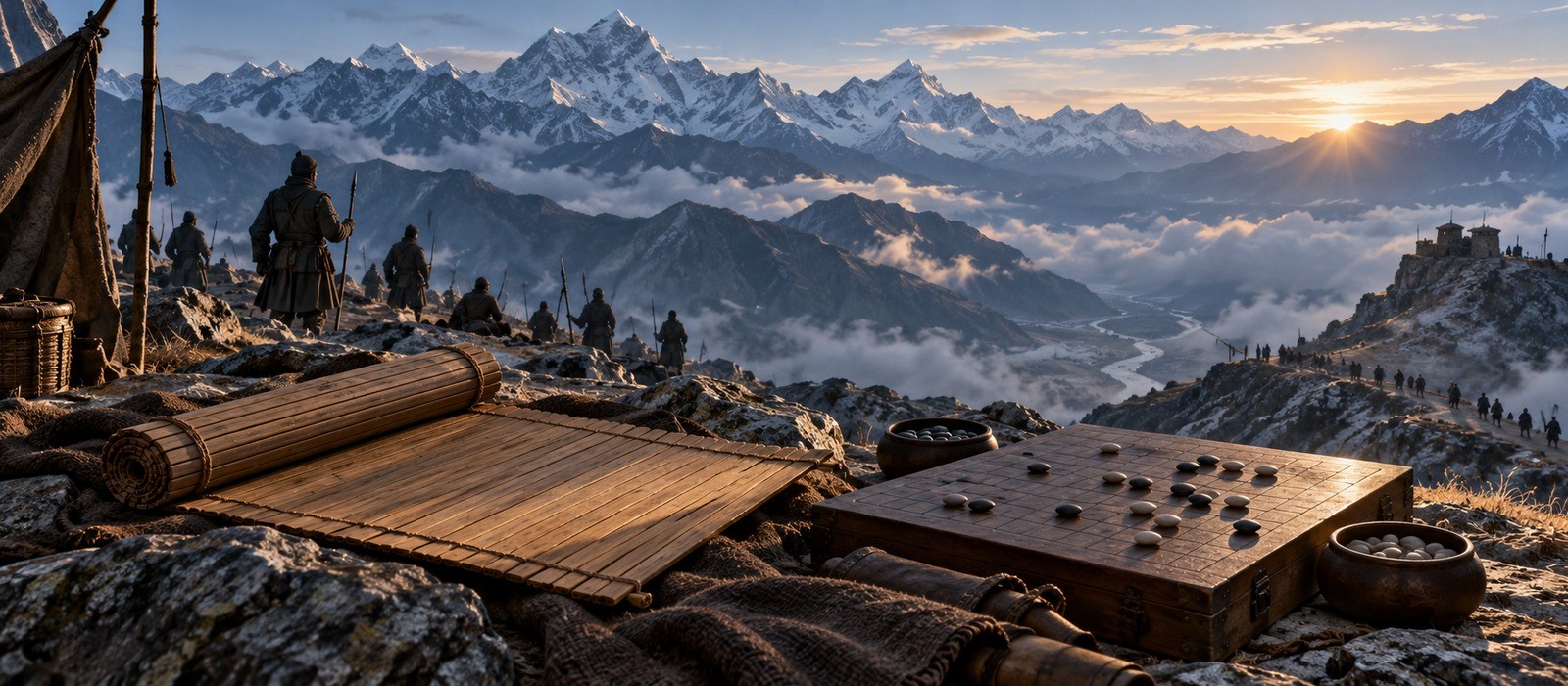


“The different measures suited to the nine varieties of ground; the expediency of aggressive or defensive tactics; and the fundamental laws of human nature; these are things that must most certainly be studied.”
– Sun Tzu, Art of War (p.65)1
Introduction
The title of an essay writing competition organised by the Indian Army Headquarters Northern Command in November 2022 reads as ‘Future Battlefield: Need for the Techno Commanders.’ The theme revolves around the concept that ‘contact and kinetic operations have passed on their primacy to non-contact and non-kinetic’ and that ‘the exponential outcome of technology integration has led to new warfighting methodology - attrite enemy without fighting and defeat enemy well before the onset of kinetic warfare.’
The interesting fact is that the problem, we as armed forces are seeking to understand and resolve, was already echoed by the Chinese General Sun Tzu, 2500 years back! Sun Tzu in his military classic, The Art of War, said that a skilful General attacks by stratagem,
“To fight and conquer in all your battles is not supreme excellence; supreme excellence consists in breaking the enemy’s resistance without fighting.”
“In war, the victorious strategist only seeks battle after the victory has been won, whereas he who is destined to defeat first fights and afterwards looks for victory.”
This makes one ponder... are we still dealing with the problems of the past? Are we trying to seek solutions for the future? Are we overestimating the status of weapons and technology? Does the key to our problems lie in the past? Sun Tzu offers implications to the solution of the above- mentioned dilemma in the chapter ‘The Sheathed Sword,’ wherein, he says,
“The sheathed sword describes the analysis and preparation for war while considering the physical, economic, and psychological aspects and use of non-destructive methods like stratagem over destructive ones.”
The concept note of the essay competition also states that the “exponential outcome of technology integration has led to new warfighting methodologies” and that “technology has assumed an altogether new and disruptive dimension.” But has it done so? The ongoing Russia - Ukraine conflict is the latest example of a conventional war, wherein, most of the powerful militaries of the world are either directly or indirectly involved. However, one may think, what has been the disruptive factor in this modern-day war, which did not exist in previous conflicts? Tanks, aircraft, ships, missiles, satellite surveillance, cyber warfare etc, all have been used during previous conflicts; with obvious exceptions of improved speed, range and effectiveness of these weapons and platforms. Even drones, such as ‘Firebee,’ were used during the Vietnam war, the US invasion of Afghanistan in 2001 and the Azerbaijan - Armenia war of 2020. This leads to a conundrum for military leaders - are ‘future wars’ really going to be very different from what they used to be in the past? Or are they the same death and destruction wrapped in newer wrappers of technology?
Centre of Gravity. Technology is a tactical aspect and will continue to evolve. It is once in a blue moon that development of revolutionary technology such as radar, nuclear weapons etc. decisively changes the outcome of a war. Despite this, world militaries inevitably continue to focus more on technological capabilities than on cultivating strategic thinking of its military leaders. One reason for this could be that pursuing advanced technology is more glamorous as compared to developing strategic thinking. Between a game of Chess and a virtual war-game simulation, which would be a preferred choice for a modern-day military leader? However, it is pertinent to note that the one factor which has always remained constant in any war and will continue to be so, is the man/ woman behind the machine/weapon. Even unmanned crafts/weapons are controlled/programmed by a human. Thus, the Centre of Gravity for all warfare as is evidenced through history and in future, will always remain the soldier and his psychology.
Strategic Culture. Professor Alastair Iain Johnston, an expert in Chinese Foreign Policy and International Relations at Harvard, defines Strategic Culture as “consistent and persistent historical patterns of the way states think about the use of force to achieve political ends.” The way different states conduct politics and strategy are not uniform; they differ in orientations, attitudes, predispositions and proclivities. In his book, Cultural Realism-Strategic Culture and Grand Strategy in Chinese History, he has researched the effect of Strategic Culture on Chinese decision-makers with encouraging results. This means that deeply rooted cultural preferences exert a significant influence on strategic choices made by a nation.
Factors Influencing Strategic Culture. The tactical disposition of available technology by higher leadership in China would depend on the thought process of decision-makers, which is influenced by generations of cultural conditioning. Thus, it is prudent that military leaders of rising world powers (such as India), should focus on understanding the psyche of their counterparts, whilst enhancing their strategic thinking, to stay ahead in the game. Strategic culture is developed over generations and is influenced by popular literature and teachings, which in the case of China includes Sun Tzu’s Art of War, Confucius and The Seven Military Classics, among other eastern philosophies.
Sun Tzu’s Art of War. As a proof of concept, the ingenious theory of cultural conditioning is explored in this article by reviewing Chinese actions during the 1962 Indo-China conflict through the lens of Sun Tzu’s Art of War. Sun Tzu, a Chinese General believed to have lived in 300 BC, wrote the timeless masterpiece on warfare and statecraft, which was translated by US Journalist James Clavell. The book provides an excellent philosophical read and is considered relevant even today. Clavell states that Sun Tzu is obligatory reading in the Russian political-military hierarchy and has been the source of Mao Tse-tung’s Little Red Book of strategic and tactical doctrine.2
The USI paper, ‘The Real Story of China’s War on India, 1962’ by Mr A K Dave IP (Retd) has provided a concise analysis of the diplomatic and intelligence aspects of the 1962 conflict. The narrative is akin to a primary source as he has represented the Intelligence Bureau (IB) in the Joint Intelligence Committee (JIC) during the 1962 conflict and has based his research primarily on the papers issued by the Government of India, viz ‘History of the Conflict with China, 1962.’ Further, relevant extracts are taken from books and articles by renowned authors who were closely associated during the unfolding of the 1962 conflict.
This article aims to deduce the influence of Strategic Culture on Chinese actions during the 1962 conflict, primarily focusing on principles of the Art of War. The structure broadly consists of an overview of Sun Tzu’s teachings and the Indo-China border dispute, followed by the genesis and course of the 1962 conflict viewed through the lens of Sun Tzu’s teachings. The author has used his judgment to bring out in this article, how Chinese actions in the 1962 conflict seemed influenced by Sun Tzu’s teachings. Further, we cannot absolutely affirm that the Chinese leaders were exclusively influenced by the Art of War alone. The influence of other military philosophies and various other factors of space, time and force cannot be neglected. Here, the Art of War represents all such philosophies, which combine to form the strategic culture.
Overview of Sun Tzu’s Art of War
Art of War consists of thirteen chapters. Chapters One, Two and Three pertain to “Laying Plans,” “Waging War” and “The Sheathed Sword,” which describe the analysis and preparation for war, while considering the physical, economic and psychological aspects and use of non-destructive methods like stratagem over destructive ones. Chapter Four, “Tactics,” discusses real situations that could occur in a war and the methods to deal with each. Chapter Five, “Energy,” discusses ways for maintaining the energy of soldiers. Chapter Six, “Weak Points and Strong,” is about military tactics, such as the time to advance or to retreat, the tactics of outflanking and using scattering on the battlefield to create a false appearance to confuse the enemy. How to defeat your enemy with fewer troops is a core topic in this chapter.
Chapters Seven, Eight and Nine, “Manoeuvring,” “Variation in Tactics” and “The Army on the March” respectively introduce principles and methods for transforming disadvantages into advantages and how to adjust strategies for different enemies. Chapters Ten and Eleven, “Terrain” and “The Nine Situations,” mainly discuss how to take advantage of geography. Chapter Twelve, “The Attack by Fire” refers to the use of fire in war scenarios, which has evolved to have a modern connotation. Chapter Thirteen, “The Use of Spies” introduces five kinds of spies who can serve as the eyes and ears of an army.
Border Dispute and Conflict of Interests in 1962
A historical territorial dispute has existed between China and India over the Tibet Plateau (Ladakh region). India claimed Aksai Chin based on various treaties signed between Indian/British rulers and the erstwhile Tibetan government. Notable among these was the treaty of Chusul signed between the Tibetans and Gulab Singh (ruler of Punjab, J&K) in 1842.3 Another important treaty was with the British in 1904 during the Anglo- Tibetan convention of Lhasa.4 Subsequently, China captured East Turkestan in 1949. The border dispute with China flared up after the tripartite Shimla convention of 1914, signed between Tibet and British India, as the Chinese representative refused to sign it. This agreement outlined Tibet into inner and outer Tibet and China was denied interference in Inner Tibet. It also designated the McMahon line as the demarcated border between India and Tibet.5 China claimed that the demarcation of the McMahon line illegally included parts of Tibet (claimed by China) into British India. Post-formation of the Chinese Communist Party (CCP) in 1949, China stated that Aksai Chin was a disputed territory.
Laying Plans - Chinese Approach to Border Dispute
The Utmost Priority. Sun Tzu says that a country should place national security above any other issue. He says,
“The Art of war is of vital importance to the state. It is a matter of life and death, a road either to safety or ruin. Hence, under no circumstances can it be neglected.” – Sun Tzu, Art of War (p.9)
The Chinese leadership, according to Sun Tzu’s teachings, realised the significance of the Tibet region towards its sovereignty and national security. China perceived India (with assistance from the US) as a threat to its rule in Tibet.6 Thus, the Chinese had an unwavering commitment towards resolving their territorial claim of Tibet, if required, by force. This was evident from the words of Chinese Deputy PM, FM and member of Politburo, Marshal Chen Yi, on 03 Aug 62 on air in Switzerland, “No power on earth could make China withdraw from its territory.”7 Further, Chinese Premier Zhou Enlai officially expressed that “India was naïve to expect China to negotiate regarding national security.”8 Enlai’s surprise indicates that a non-negotiable stance on national security is such an obvious perspective of China that India should have known it. The fact that this perspective is a mirror image of Sun Tzu’s teaching indicates that Strategic Culture as influenced by Sun Tzu shaped Chinese decision-making, and the awareness of this correlation could have helped us judge the Chinese response to Nehru’s ‘Forward Policy’ better.
Calculations. Sun Tzu says that consequences of war are devastating for any country, whether victorious or defeated. Thus, all factors and strategies need to be carefully evaluated to prevent undue death or destruction. He says,
“The General who wins makes many calculations in his temple before the battle is fought. The general who loses a battle makes few calculations beforehand.” – Sun Tzu, Art of War (p.11)
In 1949-50, China annexed Tibet. India provided asylum to Dalai Lama in 1959, which greatly annoyed the Chinese.9 Mao Zedong suspected that Nehru had devious plans w.r.t Tibet with US assistance, as Nehru strongly advocated autonomy of Tibet instead of Chinese sovereignty over it. India’s rise as a democratic nation and Nehru’s popularity in the non-aligned movement further irked China. Finally, China sensed the rising Geopolitical tensions on both Taiwan’s front (along with Japan and the USA) and India’s front due to the ‘Forward Policy.’ Hence, China carefully undertook these strategic calculations, as also advised by Sun Tzu, and decided to secure the Indian border by use of force. Chinese Premier Zhou Enlai announced that the goal of Beijing was to “punish India’s aggressiveness and create conditions for possible future negotiations.”10
Subduing the Opportunistic Neighbour. China also appreciated that the Soviet Union (the opportunistic neighbour), could take advantage of China’s conflict with India by opening another front with China.
“Never forget, when your weapons are dulled, your ardour dampened, your strength exhausted, and your treasure spent, other chieftains will spring up to take advantage of your extremity.”– Sun Tzu, Art of War (p.12)
Moscow was displeased with Chinese aggressive acts along the Indian border and Khrushchev prevailed upon Chinese leaders to settle the conflict with India through negotiations.11 However, assessing that the Soviet Union (the other chieftain) was in the thick of a Cold War with the West (which led to the Cuban Missile Crisis of October 1962), the Chinese strategically and diplomatically subdued the Soviets, such that they did not directly support India in the Indo-China conflict till December 62.
Perception Management. Sun Tzu advocated the use of combinations of direct and indirect methods in designing tactics or strategies. Direct methods are straightforward tactical or diplomatic actions, but indirect actions are deceptive and unconventional ways to achieve strategic goals. Thus, Sun Tzu says,
“In all fighting, the direct method may be used for joining battle, but indirect methods will be needed to secure victory.” - Sun Tzu, Art of War (p.21)
China progressively lodged direct protest notes with the Indian government, whilst indirectly garnering international support. The success of this indirect strategy is evident from the fact that the Australian author Neville Maxwell has titled his book India’s China War, despite Chinese encroachment into Indian territory. Citing that China was defending against India’s assertive border approach, he stressed that India should ‘unequivocally and publicly withdraw all fictitious and false claims on Chinese territory.’12 In 1956, China began its policy of steady encroachment in Ladakh and NEFA, nudging India to inevitably defend its territory, under the incorrectly titled ‘Forward Policy.’ Concurrently, China waged a psychological campaign in setting the international stage that India had no case for its defined boundary and that India was the aggressive party. These events are textbook examples of the use of Direct and Indirect strategies, as advocated by Sun Tzu.
Deception. One of the most prominent teachings of Sun Tzu is the use of deception in warfare, to the extent that he says
“All Warfare is based on Deception.” – Sun Tzu, Art of War (p.11)
This was evident in Chinese actions, as within two months of adopting the Five Principles of Peaceful Coexistence, namely Panchsheel (the Peace Proposal), in 1956 and projecting a friendly approach towards India, China started intrusions across the Indian border. Chinese Premier Zhou Enlai gave the impression to Nehru that China would recognize the McMahon Line, but did not make any absolute commitment. On the other hand, in January 1959, China through an official note conveyed that the Xinjian-Tibet highway (increased preparations) had been built within Chinese territory (Aksai Chin) as no formal delimitation or treaty existed. Knowledge of Sun Tzu’s teaching could have enabled us to be open to the possibility of ulterior motives of China. On the contrary, heeding the counsel of Sun Tzu could have helped us decode the enemy’s deception,
“Humble words and increased preparations are signs that the enemy is about to advance. Peace proposals unaccompanied by a sworn covenant indicate a plot.” - Sun Tzu, Art of War (p.44)
Targeting the Higher Leadership. On 07 November 1950, a month after China’s new communist regime invaded Tibet, India’s deputy PM Sardar Vallabhbhai Patel wrote to PM Nehru acknowledging that “The Chinese government has tried to delude us by professions of peaceful intentions (wrt Tibet issue). Even though we regard ourselves as friends of China, the Chinese do not regard us as their friends.”13 Nehru had supported China’s entry into the UN, but the Chinese seemed to have remained suspicious of the US-India threat in Tibet. It seems that the Chinese adopted the following strategy when dealing with the enemy’s highest leadership.
“A whole army may be robbed of its spirit; a Commander-in-Chief may be robbed of his presence of mind.” – Sun Tzu, Art of War (p.33)
This strategy is witnessed on numerous occasions, for example, Beijing pretended to treat Nehru as a friend. Post the Panchasheel agreement, Nehru even promoted the slogan “Hindi-Chini Bhai-Bhai.” After the Geneva conference of 1954, the Chinese People’s Daily wrote, “India and China are fighting against the old colonialism, side by side.”14 Such false narratives and assurances led to a lack of preparedness due to the complacency that the Chinese will not attack India. Later when they did attack, it left Nehru feeling shocked and betrayed, which could have affected his presence of mind and decision-making.
Duration of War. Sun Tzu was strictly against prolonged campaigns and laying siege. He said,
“In all of history, there is no instance of a country having benefited from prolonged wars. It is only one who is thoroughly acquainted with the evils of war who can thoroughly understand the profitable way of carrying it on.” – Sun Tzu, Art of War (p.13)
The Chinese campaign in 1962 was short and swift, following Sun Tzu’s principle. China considered the economic consequences of prolonged war and the logistics and operational difficulties involved due to inclement winter weather setting in shortly. China thoroughly planned for a prolonged duration, but executed the actual war within a short span (19 October - 21 November 62), after which it withdrew unilaterally.
Inclement Weather. Sun Tzu explains that at the tactical level, the considerations of time, space and force need to be carefully compared with that of the enemy. He says,
“Art of War is governed by five factors, namely Moral Law, Heaven, Earth, the Commander, Method and discipline. Out of which, Earth signifies terrain and Heaven signifies night and day, cold and heat, times and seasons. A general who carefully evaluates these factors will be victorious, as to with whom lies the advantage derived from Heaven and Earth!”
Retired Subedar Kapur Singh, a 1962 conflict veteran recalls, “Chinese counterparts had superior quality guns and ammunition, had the advantage of numbers at high altitude and were also native to the hilly region.” According to him, the Indian soldiers were freezing in extreme weather while the Chinese were comfortable. In the high-altitude battle zones, even food and water were luxuries. On one occasion, they got food after 10 days of trekking in the hilly region.15 This recount is a testament to the fact that the Chinese had better evaluated and prepared for the inclement weather (Heaven), in keeping with Sun Tzu’s teachings.
Able General. Sun Tzu placed substantial weightage on the competency and knowledge of a General in the outcome of any war and thereby, the security and stability of the country. He stated,
“The Commander stands for virtues of wisdom, sincerity, benevolence, courage, and strictness.” – Sun Tzu, Art of War (p.9)
“The natural formation of a country (terrain) is a soldier’s best ally.” - Sun Tzu, Art of War (p.53)
China appointed the most capable and best-suited general, Zhang Guohua, who was well-versed in Tibetan culture, to lead the campaign. He possessed vast experience being part of all major Chinese conflicts since 1929 and was in charge of the annexation of Tibet in 1950-51.16 Thus, China followed Sun Tzu’s guidance and appointed their most ‘able general’ who was well acquainted with the terrain involved in the Indo-China conflict, as compared to other generals.
Restrict Intelligence. Sun Tzu emphasised harnessing non-kinetic means such as intelligence gathering, whilst denying the same to the enemy. He advised that,
“On the day you take up your command, block the frontier passes, destroy the official tallies, and stop the passage of all emissaries either to or from the enemy’s country.” – Sun Tzu, Art of War (p.72)
Chinese seemed to have followed this counsel, because after the annexation of Tibet, China made it impossible for the Indian Consulate General and Trade Agencies to function inside Tibet. The staff were left without even a wireless communication facility. Whereas Chinese trade agents had free access to the local Tibetans and Chinese nationals for trade, intelligence and covert activities in India.
Secrecy of Plans. Sun Tzu proposed a way to keep own forces on their toes, whilst denying enemy spies within own troops to effectively communicate intelligence in time. He suggested,
“To prevent treachery, your arrangement should not be divulged beforehand. Confront your soldiers with the deed itself, never let them know of the design.” – Sun Tzu (p.69)
Chinese Commanders did not reveal the real intentions of political leadership to their soldiers before the battle, to mislead possible spies. Prior commencement of the war, the soldiers were informed that their government was making all efforts to resolve the dispute peacefully and that the Chinese would not be the ones to fire the first shots at the border. However, Mao Zedong later declared that “We must fight the inevitable war with India.” The Chinese made substantial infrastructure along the border with troop build-up, but the efficacy of maintaining the secrecy of plans by the Chinese was evident from the words of Prime Minister Nehru in his address to the Principle Staff Officers at AHQ on 03 November 1962, where he said, “We did not have an idea of the massiveness of their (Chinese) preparations.”17
Build-up to the War
Provocation till Revelation. Sun Tzu advocates carefully probing the enemy to assess his capacity, capability and response and to devise own strategy accordingly.
“Rouse him to reveal himself, to find out his vulnerable spots. Carefully compare and analyse the opposing army to our own. When able to attack we must seem unable, when using our force, we must seem inactive. Violent language and driving forward as if to attack are signs that enemy will retreat.” – Sun Tzu, Art of War (p.28)
This way, you would deduce the enemy’s strengths and vulnerabilities, while keeping the enemy guessing. A similar strategy was employed by the Chinese. Their encroachment inside the border led to multiple armed skirmishes on various border posts, i.e. Ladakh and NEFA sector. It is pertinent to note that on numerous occasions Chinese troops approached Indian posts/patrols or surrounded a post shouting aggressively (driving forward with violent language), only to retreat later. The Chinese had earlier also objected to the establishment of an Assam Rifles Post at Khenzamane in 1959 by surrounding it and then withdrawing after a few days. It seemed like a strategy to assess the strength and capabilities of the Indian troops at various locations. Once confident of overcoming Indian retaliation, the Chinese forces overran our post at Longju, NEFA on 26 August 1962 and Kongka LA in October 1962, just east of our post at Hot spring. China claimed both areas were within Chinese territory, while they lay 40-50 km inside Indian territory.
The Trigger Point. Chinese fortified both their Eastern and Western flanks along the Indian border before the attack. The Indian posts set up under the wrongly named “Forward Policy” were non-aggressive in nature. Thus, Mao waited and watched for any significant aggressive move by India. This aligned with the following principle of Sun Tzu -
“To secure ourselves lies in our own hands, but the opportunity of defeating the enemy is provided by the enemy himself” – Sun Tzu, Art of War (p.19)
However, even the Chinese sympathiser, Australian Journalist Neville Maxwell quoted in his book that, “To say that the Indian troops in the Western sector launched a general attack from their puny posts was grotesque.”18 Setting up of the Dhola post on 04 June 1962, 4 km South of Thangla, north of the McMahon line by transposition, was used as a major incident (or the opportunity of defeating the enemy) by the Chinese to justify commencement of the war.
Phase I of Hostilities: 19 October - 16 November 1962
Shuai-Jan. Sun Tzu says that a skilful tactician may be likened to the Shuai-jan, a snake that is found in the Chang mountains, for the following unique feature,
“Strike at its head, and you will be attacked by its tail; strike at its tail, and you will be attacked by its head; strike in its middle, and you will be attacked by head and tail both. Asked if an army can be made to imitate the Shuai-jan, answer yes.” – Sun Tzu, Art of War (p.63)
Heeding this advice, on the night of 19/20 October 1962, the Chinese launched simultaneous attacks on eastern and western fronts (head and tail) of the Indo-China border, under the pretext that India has launched a full- scale offensive. Overwhelmed by the multi-front attacks, the offensive in the Western sector more or less stopped at their claimed line of 1960, with the Chinese overcoming the resistance shown by various Indian posts by 24-28 October 1962. This resulted in victory for the Chinese while preventing possible enemy regrouping.
Hold out Baits. Sun Tzu advises offering the enemy suitable tempting propositions, especially after gaining some leverage. Accordingly, China repeatedly offered Nehru to consider a ceasefire, but on Chinese terms.
“A clever combatant by holding out advantages to him (enemy), he can cause the enemy to approach of his own accord by enticing him with a bait.” – Sun Tzu, Art of War (p.25)
However, Nehru was resolved towards the withdrawal of Chinese troops till the pre-aggression line, before any negotiations could take place. On 12 November 1962, Zhou Enlai’s again put forth a peace proposal (bait) to India, to give up its claim on the Akshai Chin; in return of which, China would forego claims in the NEFA region. The same was rejected by Nehru who was unwilling to cede any part of Indian territory, convinced that the claim of China in both regions was false.
Phase II of Hostilities: 17 November - 21 November 1962
Use of Spies. This aspect of Sun Tzu’s teaching is perhaps the most relevant even today. He says that a nation should not hesitate to spend on intelligence and explains its significance as follows: -
“What enables the wise sovereign and the good general to strike and conquer, and achieve things beyond the reach of ordinary men, is foreknowledge. Now, this foreknowledge cannot be elicited from spirits; it cannot be obtained inductively from experience, nor by any deductive calculation. Knowledge of enemy’s disposition can only be obtained from other men (spies).” – Sun Tzu, Art of War (p.77)
Accordingly, it seems that the Chinese had acquired intelligence of Indian preparations for Phase II of the conflict, which commenced on 17 November 1962. Thus, they proactively started executing counter-measures between 10-15 November 1962 to encircle the Indian forces. This was evident when the Indian forces commenced their operation on 17 November 1962 as they found themselves surrounded by the Chinese 166th Reg, while the Chinese 165th Reg attacked adjoining Indian Posts on 17 November 1962.
Enemy Within. Per Sun Tzu’s teachings, the Chinese leveraged every possible opportunity to implode the Indian side using their influence on the Indian people. Sun Tzu says,
“Spies are a most important element in war because upon them depends an army’s ability to move.” – Sun Tzu, Art of War (p.82)
“Use inward spies (with vested interests in enemy’s country) to disturb the harmony and create a breach between the sovereign and his ministers.” – Sun Tzu, Art of War (p.78-79)
The Chinese Communist Party pressurised the Communist Party of India (CPI) to instigate a ‘Peasant’s armed revolution’ for ‘People’s Democracy’ in India.19 China also instigated the Indian media to spread propaganda and create turmoil against the Indian government, especially Nehru.20 Accordingly, the Communist Party of India propagated that ‘it was Nehru who had sanctioned the attack on the Chinese and the Chinese had given him a suitable rebuff.’21 It was also observed that the details of critical high-level political-military meetings were promptly reported by the newspapers, which meant there was an inward (internal) spy within the government.
Domain Awareness. The adequate knowledge of the enemy and his ‘Heaven and Earth’ i.e. season and terrain of operation is crucial for making tactical dispositions. He says,
“When in difficult country, do not encamp. In a country where high roads intersect, join hands with your allies. Do not linger in dangerously isolated positions. In hemmed-in positions, you must resort to stratagem.” – Sun Tzu, Art of War (p.37)
“When envoys are sent with compliments in their mouths, it is a sign that the enemy wishes for a truce.” -Sun Tzu, Art of War (p.48)
After achieving it’s tactical/strategic objectives, the Chinese tried to appease Nehru to concede the Chinese territorial gains. When Nehru rejected the same, China chose a ceasefire on 21 November 1962, before the advent of peak winters.22 Continuing to hold ground in a ‘dangerously isolated position’ in a ‘difficult country (adversary’s)’ could have rendered Chinese troops vulnerable to attack (similar to German forces in the battle of Stalingrad in WW II). Thus, to avoid the likelihood of a ‘hemmed-in’ situation while holding the gains on the ground, China resorted to stratagem and ordered a unilateral cease-fire.
Conclusion
India may not want to counter China but would wish to manage Chinese assertiveness. This will help India engage more meaningfully with China. To achieve this, in-depth knowledge of China’s psyche developed over generations of cultural conditioning is critical.
Knowledge of Sun Tzu’s Art of War and other such prominent eastern philosophies could be effectively utilised for understanding Chinese decision-making patterns, especially in the military sector. Detailed back-testing can be performed on the concepts derived from the study of strategic culture, and the same should be extrapolated to predict China’s behaviour in various disputes/conflicts in the future.
As Alastair Iain Johnston has said, “How we think today is unconsciously influenced by the cultural conditioning over generations.” Thus, tactically our adversary might produce advanced weapons, but strategically, his philosophical way of thinking will determine whether and how he might employ them.
One might argue that our adversary knows that we are studying his guiding philosophies and doctrines and may not follow them. However, that too is part of his deceptive nature, which can be understood from his philosophies. On similar lines, India needs to study its warfare and statecraft philosophies (such as Kautilya’s Arthashastra). First, to better understand our cultural conditioning and secondly, to baulk at enemy plans, who are certainly studying them with similar motives.
What is more important than knowing what the enemy is up to or trying to counter (tactical), is to predict what the enemy might do in the future (operational), which will require deciphering how he thinks (strategic). This strategic objective can only be achieved by exploiting the pattern of the enemy’s thinking, which is his strategic culture and the source code of his strategic culture are the guiding philosophies such as Sun Tzu’s Art of War. As Sun Tzu said,
“Know Yourself, Know Your Enemy, A Hundred Battles, A Hundred Victories.” – Sun Tzu, Art of War (p.18)
Endnotes
-
Sun Tzu and James Clavell ed., The Art of War (New York: Delacorte Press, 1983), 65.
-
Ibid., 2.
-
MW Fisher, RA Huttenback and LE Rose, Himalayan Battleground (Vienna: Frederick A. Praeger, 1963).
-
P Fleming, Bayonets to Lhasa (Oxford: Oxford University Press, 1986).
-
Atlas of Northern Frontier of India (New Delhi: Ministry of External Affairs, 1960).
-
Roderick MacFarquhar, The Origins of the Cultural Revolution: The Coming of the Cataclysm, 1961–1966 (New York: Columbia University Press, 1999), 304.
-
AK Dave, The Real Story of China’s War on India, 1962 (New Delhi: USI of India, 2006),19.
-
Neville Maxwell, India’s China War (Hongkong: Joint Publishing, 1971), 299.
-
PK Banerjee, My Peking Memoirs of the Chinese Invasion of India (Delhi: Clarion Books, 1990), 53-54.
-
Maxwell Op Cit., n. 8, 473.
-
CV Ranganathan and Vinod C Khanna, India and China: The Way Ahead After “Mao’s India War (New Delhi: Har-Anand Publications, 2000), 18.
-
Banerjee, Op Cit., n. 9, 51-52.
-
Ian Cardozo ed., The Indian Army: A Brief History (New Delhi: USI, 2005).
-
Maxwell, Op Cit., n. 8, 291.
-
“Veteran of 1962 War Relives Tense Moments on India-China Border,” The Times of India, 27 June 2020. https://timesofindia.indiatimes.com/city/gurgaon/veteran-of-1962-war-relives-tense-moments-on-india-china-border/articleshow/76653587.cms, accessed 20 October 2022.
-
Melvyn C Goldstein, A History of Modern Tibet Vol. II: The Calm Before the Storm : 1951-1955 (USA: University of California Press, 2009), 292-299.
-
DK Palit, War in High Himalayas (Haryana, South Asia Books, 1992), 278.
-
Maxwell, Op Cit., n. 8.
-
Dave, Op Cit., n. 7, 3.
-
Mohit Sen, A Traveller and the Road: The Journey of an Indian Communist (Delhi: Rupa & Co, 2003), 216.
-
Ibid., 217.
-
Maxwell, Op Cit., n. 8, 474.
