


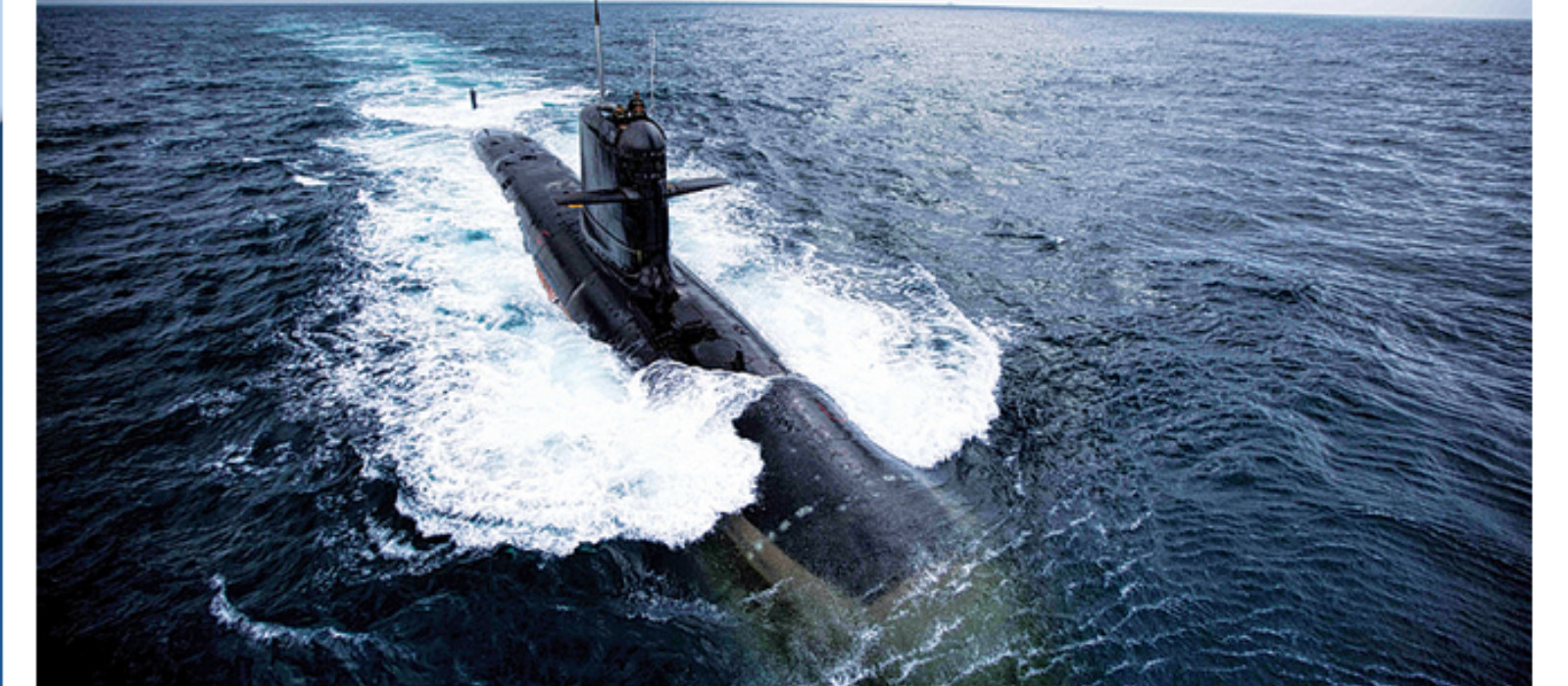


“The only thing that ever frightened me during the war was the U-boat peril.”
Winston Churchill, Prime Minister of United Kingdom, 1946
Introduction
Submarines have come a long way from Bushnell’s Turtle of 1776. Their potential having been established by the destruction they caused in various wars, nations have since hastened to acquire submarines to provide the much-needed cutting edge to their respective Navies. Though spelt out in the Indian Navy’s (IN) expansion plan of 1945, India speeded up submarine acquisition only in 1965, after the Rann of Kutch incident with Pakistan and Indonesian intrusions into Nicobar Islands in the Bay of Bengal.1 Since Britain remained non-committal, India went ahead and procured submarines from Russia from 1965 onwards and later acquired more of these from Germany and Russia in the 1980s.2
The changing threats in the IOR and the pressing need to replace older submarines as well as the desire to attain self-sufficiency in submarine design and construction, brought the focus on indigenous submarine construction in the 1990s. Accordingly, approval was accorded by Cabinet Committee on Security (CCS) in 1999 for indigenous construction of twenty-four conventional submarines by 2030.3
Indigenous submarine construction is, of course, a shield against sanctions and an important capability to have. Indigenous submarine construction invigorates the private industry, creates job opportunities and prevents outgo of foreign exchange, as well as catalyses the economy in several ways.
India has been operating submarines since the 1960s and has indigenously built submarines since the early 1980s. However, the progress made thereafter, has been less than encouraging. It is worth diagnosing the reasons that have stymied Indian efforts and halted the march to attain self-sufficiency in the field of submarine construction. It is equally important to draw out a suitable way ahead to ensure this ambitious programme succeeds.
This article examines the state of indigenous submarine construction programme, attempts to identify the problems it faces and suggests recommendations to help achieve the development and sustenance of indigenous submarine design and construction capabilities.
Universal Challenges of Submarine Design and Construction
Submarine design and construction is a niche capital-intensive industry. Somewhat akin to the manufacture of advanced jet engines, this capability is currently restricted to a handful of nations; USA, Russia, South Korea, North Korea, China, UK, Germany, France, Spain and Japan.4
A submarine designer can design a ship but not vice versa, due to the complexities involved. Riding on parametric relation of a proven design, the design process requires repeated visits to the drawing board to achieve accurate weight assessment. The ‘limited volume’ design has to factor a large number of concept and technology studies, stealth features, multiple hull-forms and multi-role capabilities.5 A new design, entails testing in a wind tunnel, water tunnel, towing tanks and further complemented by Computational Fluid Dynamics (CFD) for establishing submarine characteristics. This requires an insightful understanding of the submarine’s intended role and interactions amongst hundreds of operational features making submarine design complex and highly challenging.6 Crystallisation of submarine design conservatively takes 13-15 years and involves investment of millions of dollars.7 Not surprisingly, submarine designs are not shared by shipyards, to preserve competitive advantage and to retain customer dependence for posterity.8
Atrophy of Skills Due to Design Gaps. As per a study undertaken by General Dynamics Electric Boat, a premier USA submarine yard, it takes approximately 5-10 years for developing 639 types of unique competencies that are considered essential for designing a submarine. Wide gaps between consecutive submarine programmes can easily damage competencies and design skills; the ‘wider gaps’ or ‘valleys’ become ‘valleys of death’ and kill these skills. These rare skills are inutile for any other industry and hence, atrophy quickly. Re-learning the unlearned skill imposes tremendous cost penalty by way of time overruns and re-work due to mistakes, incorrect translation of drawings into structures and system fittings. This has a debilitating, multiplier effect on a submarine programme, as was evident in the delayed delivery of the second Virginia-class submarine, the USS Texas, due to the ten-year hiatus between two successive submarines.9
Experienced and Trained Workforce. A submarine construction environment indoctrinates freshers into a world of totally different work ethics. Complicated procedures and zero-margin for error make for a steep learning curve.10 A candid admission by Adm John Richardson (Retd), CNO of the US Navy, sums up the problems of amateurish workforce being faced by the US Navy’s latest strategic submarine programme “..greenhorn work-force issues are threatening to mar the Columbia program before it really gets off the starting blocks..”11 UK’s Astute Submarine programme almost got derailed in 2006, as the yard’s trained work force fell dangerously close to the minimum required for keeping the construction activities barely afloat. The Australian Collins submarine follow-on programme got straddled with similar issues even before the first steel was cut.12 The human element is an irreplaceable pivot around which the success of a submarine programme hinges.
Submarine Industrial Base (SIB). The equipment used onboard submarines needs to be fail safe. It is specially ruggedised to high shock standards, is qualified for operating under specific conditions of water ingress and needs to have exceptionally high reliability. The complexity therefore, demands unique abilities from the industry that builds and supports them. Globally, only a few equipment manufacturers can comply with such strict norms. All submarine building nations have a formidable SIB riding on a strong foundation of technology and innovation, built over years of R&D and government support. It is definitely a great challenge to create such a domestic industry that can provide comprehensive lifetime product support for any submarine construction programme.
Over-Reliance on Software. Excessive use of software and experimentation cannot really substitute the very important human interfaces and this can have serious ramifications. Amongst other factors, the non-bespoke software contributed to a budget overrun by several hundred million pounds and a three-year time overrun for UK’s Astute Submarine Programme, which was retrieved later only with the assistance of design engineers and project managers from USA.13
Global Perspective: Constructing Submarines
Forging Technical Ventures. A submarine construction programme invariably runs into billions of dollars and spreads over many decades, thus making it an expensive and risky proposition for any nation. Acutely conscious of these risks, countries like Brazil, Australia, etc. opt for partnering with established submarine builders. The host nation, gets access to advanced designs, manufacturing technologies and latest construction techniques, which can then be ploughed back to develop the country’s industrial base. This model has been favourably exploited by China’s ship building industry.14
Sustaining/ Retaining Design Capabilities. Whenever submarine skill-sets are seen to be in danger of atrophying, national governments have responded to avert the loss. The US submarine industry has thrived thus far, courtesy incisive government policies as seen in the Seawolf and Virginia Programme’s split design between Electric Boat and Newport News. Likewise, the UK Government pledged unstinted support for its submarineconstruction programme in its Defence White Paper of 2005.15 Governments are pledging multi-year commitments and concluding international contracts and ramping up infrastructure for boosting up indigenous submarine industry.16 Such calibrated policy actions are needed to enable this industry to survive and bring strategic value to a country that does so.
Nurturing Not More Than One-Two Shipyards. Large initial investment, prohibitive life cycle cost and requirement of massive logistics and support services, deter nations from acquiring submarines. The limited demand for new submarines cannot support too many submarine yards across the globe. Having understood the economics of demand supply mismatch, the USA has limited the design and construction of submarines to only two of its shipyards: General Dynamics’ Electric Boat and Northrop Grumman’s Newport News. Similarly, in South Korea, submarines are constructed at Hyundai and Daewoo shipyards and Japan undertakes construction of its submarines at Mitsubishi Industries and Kawasaki Heavy Industries only. Likewise, in UK, Germany, France and Spain, submarine construction is by a single yard/ group (Fig 1).

Fig. 1: No of Yards Developed for Submarine Construction in Various Countries
For a very small market, a larger number of submarine yards could become an existential threat. On the contrary, a limited number of yards imply shorter time gaps in construction orders and minimal likelihood of ‘famines’ i.e., periods of lean orders. Moreover, it is relatively easy to support or bail out 1-2 shipyards, during the ‘do nothing’ period, if the need arises.
Consistent Loading of Submarine Yards. We do not have the option of halting submarine construction and then expecting the industry to continue existing for years ‘doing nothing.’ Having understood these intricacies, the US follows the philosophy of overlapping submarine designs, between two consecutive design cycles, so as not to risk loss of niche skills.

Fig. 2: Overlapping Design Cycle of US Submarine Programme Since 1967.17
UK tries to follow a construction frequency of 22 months and China constructs one submarine each year to keep its industry alive.18 On the other hand, Japan, besides constructing a submarine every year, also tests a new submarine design every 10 years.19 France plans alternate new submarine designs, interspersed with mid-life modernisation of older submarines and thus, avoids ‘valleys’ and ‘peaks.’20 These governments therefore ensure that their submarine yards remain always loaded and the skilled workforce is always ‘doing something’ instead of ‘doing nothing,’ so that the unique skills that have been mastered over many years are not unlearnt (Fig 2).
Maintaining and Incentivising a Robust SIB. A robust SIB is a sine qua non for a healthy submarine programme. This has been proven in both UK and USA, where a good SIB has played a sterling role in supporting submarine programmes. These governments have ensured the industry’s survival through lean ‘equipment-order phases’ and have not hesitated to loosen their purse strings to dole out fiscal packages.21 Equal importance, if not more, is being accorded for improving efficiencies using schemes like the UK’s Submarine Enterprise Performance Programme, by awarding long-term contracts for the purpose of sustaining skill-sets.22 Needless to say, national commitment by way of financial support perpetuates a sustainable culture for a robust SIB, which is vital for a healthy submarine programme.
Where do We Stand: A Reality Check
India has been relying on foreign technology in the niche fields of submarine design and construction. It has been seeking partners from amongst reputed foreign shipyards to advance its indigenous submarine programme since the 1970s. The capability of a nation to successfully build submarines is governed by numerous factors: a nation’s research and design capability, prowess within private industry, design and build capability of shipyards and government commitment. India scores sub-optimally on almost all of these parameters.
Indian Shipyards. India’s quest for developing indigenous submarine design and construction capabilities dates back to December 1981 with the signing of a contract with HDW, Germany. Accordingly, two submarines were built at Mazagon Dockyard Limited (MDL), Mumbai, between 1984-94.23 MDL has also been constructing Scorpene submarines, jointly with Naval Group (NG), France, commencing 2005.24 Though India has been involved in submarine construction since the 1980s, we have unfortunately, not had a single 100% indigenous submarine project till date.
Submarine Design Capability of MDL. With nil follow-on submarine construction and design orders, the limited design capabilities acquired by MDL in the 1980s, through the HDW contract, eroded quite fast. The trained manpower was lost to other projects; a few even leaving for foreign shores. Later, MDL went about looking for joint ventures for submarine design and construction in 1997 and again in 1999, with global submarine building shipyards. This vindicates the assumption that by 1997, MDL had lost the design skill-sets, so thoughtfully invested into and developed earlier in the 1980s. MDL did not benefit from its long association (2005-2020) with NG, France despite having built 04/06 contracted submarines.
Submarine Design Capability Within IN. In the USA, it is the Navy which is the final approval authority for submarine design and acceptance of construction drawings. Success of this model is solely credited to a strong competent team available in the US Naval technical community, which questions guides and certifies yard decisions. However, such technical authority that can adjudicate and provide objective evaluation of submarine design and also mentor shipyards, is conspicuously missing in the IN. This is corroborated by the way in which Scorpene Project P-75 had progressed earlier and P75(I) is progressing now, awaiting a suitable design partner.25
Submarine Manufacturing Capability and Skills of Shipyard. Submarine construction requires personnel with exceptional skill levels in various trades and workmanship that conforms to stringent ‘build-norms.’ Shipyards in the past have paid heavy penalties for poor workmanship. Lead boats of Seawolf and Dreadnought submarine programmes, were besieged with welding issues, despite the builders, General Dynamics Electric Boat and Vickers shipyard at Barrows, having built over 140 submarines between them.26 Both MDL and L&T are currently engaged in submarine construction and hence, can be assumed to possess specialist construction and manufacturing skills and hopefully would be in a position to undertake construction activities, when required. However, augmentation of manpower would be needed, while keeping in mind that submarine manufacturing skills, culture and work ethics are difficult to imbibe and the learning period could extend over a few years.
Infrastructure of Shipyards. A submarine yard requires hugeinfrastructure, adequate covered dry dock facility, outfitting jetties, heavy duty cranes, radiography facility, automated welding, plate bending etc. In MDL, a dedicated ‘East Yard’ for submarine construction activities was created in 1982-83. This has been further augmented recently, in May 2016, under the Rs 153 Crore modernisation project of MDL, which would now enable MDL to have a parallel submarine assembly line.27 On the other hand, L&T has already designed, constructed and delivered over fifty OPVs and other ships at their Kattupalli shipyard. It can be assumed that infrastructure necessary for submarine construction is available with our shipyards and augmentation, if required, can be undertaken and is not likely to pose a hurdle.
India’s SIB. Indian SIB was under-developed and thus, ill-prepared to support the first two submarines that were constructed at MDL in the 1980-90s. All major equipment required for constructing the submarines, electrical and engineering, were contracted from the OEM, HDW. Since then, there have been some positive developments in the capabilities of India’s SIB. However, dependence still remains on foreign OEMs, spread over Russia, Germany, France etc. for some critical equipment. SIB, our achilles heel, was unable to substitute Naval Group, France for supplying equipment for Scorpene Project P-75, in 2005 either. Several entry barriers for this industry like large capital investment, specialised test facilities, uncertainty of orders, low production rates, high standards of quality assurance and a highly qualified and skilled workforce, pose a huge deterrent for new entrants.
Various Committees have been constituted in the past to study the issues afflicting the Indian industry. One such, the ‘Vijay Kelkar Committee,’ had in 2005, put forward major proposals aimed at developing and unleashing the potential of India’s industrial base. Amongst many other proposals, the committee’s recommendations were accreditation and fostering Raksha Udyog Ratnas (Industrial Jewels) from amongst credible public sector firms and re-organisation of ordnance factories. These were quite revolutionary and would have given the much-needed push to the Indian industry. However, not much has progressed on the recommendations, neither has the government accepted many of the other proposals.28 While oft repeated pronouncements of ‘Make in India’ initiatives do convey the government’s intent, not giving credence to studies undertaken by various committees raises a question mark on the government’s seriousness at invigorating and shaping the industry.
Research and Development. Defense Research and Development Organisation (DRDO), the nation’s premier research agency, has often been accused of falling short of providing timely, innovative and futuristic technologies to defence services, its prime customer. There never was felt a greater need to shift from the hitherto dogmatic approach of DRDO, and allow SIB to leverage the intellectual capital, resource and well-equipped laboratories of DRDO. Recommendations of ‘Kelkar Committee’ and ‘Shri Rama Rao Committee’ for revamping DRDO and encouraging R&D amongst the private industry, once implemented, will allow parallel development of a DARPA-like model to boost R&D activities; thus, impacting development of indigenous technologically advanced submarine equipment.29
Contract Management. Indigenous submarine programmes have been stymied by perfunctory contract management and bureaucratic dithering. Abrupt truncation of the HDW contract in 1985 is emblematic of how our complex bureaucratic procedures have the propensity of burying an entire industry. A similar story of delays was played out with the protracted contract negotiations from 2002-2005 for P-75, even as the project cost escalated from Rs 12,609 Crore to Rs 15,447 Crore. The usual explanations for the delays were the novelty, uncertainty and complexity of the contract. The Request for Proposal (RFP) for P-75(I) is yet to be floated even twenty years after having been approved, by the CCS. The UK MoD was perceived as a “bureaucratic dinosaur having mountains of documentation, endless committees, slow decision making and ill equipped for effective management” in the 1990s by the defence suppliers.30 Going by the delays in Indian defence procurements, the description aptly fits our bureaucracy as well. Lack of accountability, responsibility and insouciance is pervasive in defence contract dealings. There is a need to put an end to the bureaucratic endemic of indecision and strong risk aversion.
We need to honestly admit that we aren’t good at managing defence contracts. Our ineptness at handling big ticket defence contracts was even flagged in CAG Report 4 of the 2007 Union Government - Defence Services
- Performance Audit - Army and Ordnance Factories, which had specifically stated “a specialised cadre pool of acquisition managers should be developed by imparting suitable training in different areas of acquisition viz. project management, contract negotiations, contract management; and exposure to professional best practices of procurement.” Small steps in this direction had been taken in 2011 when Institute for Defense Studies and Analysis (IDSA) had prepared and submitted DPR for defence acquisition training in 2012, on the recommendations of the then Defence Minister.31 However, the file does not seem to have evoked any substantive action.
Policy at the National Level for Skill Retention. Retaining submarine design and construction capabilities requires consistency and predictability of policies and construction orders, as the industry cannot survive on a ‘start-stop-start’ model. With P-75(I) getting further delayed, MDL will be without any construction order, once the ongoing P-75 programme’s last submarine is delivered in 2022. Atleast a decade is required to develop an indigenous design and typically another 8-10 years to translate the design effort from blue print into construction. It is therefore, difficult to expect the submarine industry of any nation to survive for so many years ‘doing nothing.’32 With billions of dollars at stake and with each submarine programme spread over many decades, it is essential that we put in place a structured ‘national submarine policy’ for steering these programmes.
Ipso facto, the ongoing P-75 contract has not aided in creating design capabilities at MDL, possibly because the underlying MoU is based on TOT for ‘construction’ only, with no mention of ‘design’ transfer to the Indian side. This single oversight of not including the TOT of design in the project P-75 has resulted in setting our indigenous submarine programme back by almost 15-20 years. While we can keep mulling over past omissions, it is equally important that such lapses are taken note of and are avoided in future contracts.
Conclusion
It is quite evident that a submarine programme has deep interlinkages with a nation’s intellectual reservoir, research and development capabilities, initiatives of private industry, design and build capabilities of yards and an unflinching governmental support. Globally, national governments are stepping in, incentivising and rallying behind their industry for developing, retaining and sustaining unique skills sets. Our indigenous submarine construction programme remains a distant dream as daunting bottlenecks stand in the way. There are a number of structural and technical gaps that need to be made good. The situation is further exacerbated by the inadequacy of SIB, inept contract handling, insufficiency of R&D and irregularity of procurement policy/ orders, amongst other contributing factors. Submarine construction is totemically linked to a nation’s willpower, as it demands exacting resources and long-term big-budget commitment. While a coherent response and concurrent actions would yield results, multiplier effects to boost indigenous submarine construction programme would be largely dependent on a committed central leadership.
Recommendations
For India to achieve the national goal of designing and constructing submarines indigenously, coordination at multiple fronts is required. This necessitates a revamping of the existing apparatus and the way business gets conducted at various levels. A slew of conceptual, structural and procedural changes are required to be earnestly implemented. Strong decisions are required to be taken including reforms to the existing setups, restructuring organisations, facilities, policies and processes. A few recommendations for the IN, Shipyards and GoI have been prepared and delineated here, which if implemented, would hopefully aid in bringing indigenous submarine programmes to fruition.
Actions by IN
Special Status for Submarine Construction Programme. A submarine construction programme runs into billions of dollars, the success of which demands uninterrupted commitment of central and state machinery over many years. The IN should push for a special status for its submarine construction programme, which would signal long term commitment of the government and allow for quicker policy formulations, decision making, fund allocations, etc.
Develop a Strong Design Directorate. Responsibility for safety and time bound completion of a submarine programme will always remain with the IN. It will need to carry the risks and manage these risks in a ‘hands-on’ way. The IN will need to develop its own resident expertise so as to assume the role of design authority to approve design proposals of the builder. To manage a strong prime contractor, the Submarine Design Directorate would need to develop technical authority to be able to challenge decisions of the builder.
Develop a Talent Pool of Specialists. The IN should identify talented candidates, seek out mentors from within the country (not likely), or from abroad (possible), and put the selected candidates through the training grind to equip them with specialised skills and create multi-disciplinary core teams, including training abroad.
Formulate HR Policies for Skill Retention. The success of a submarine programme is greatly dependent on availability of an experienced and qualified professional workforce. The IN should tweak existing HR policies so that vertically trained personnel are retained to tenet specialist billets of its submarine programmes, with career progression being protected.
Introduce Submarine Design in University Curriculum. Submarine design is not taught in any Indian university. The IN should raise this proposal with appropriate authorities to introduce this as a subject in an Indian university, at BTech and higher-level specialisation.
Leverage Project P-75(I). Project P-75(I) has thrown up a slew of encouraging prospects. The IN should align its ambitious indigenous submarine construction programme with timelines of P-75(I), the contract should include Transfer of Technology (TOT) of both, submarine design as well as construction. Thereafter, it should identify suitable officers possessing the required aptitude and prepare a long-term strategy for leveraging the knowledge gained though the TOT.
Support to Sustain SIB. In the absence of an innovative and technologically capable SIB, an indigenous submarine construction programme is unlikely to produce the desired results. The IN should leverage the government’s clarion call of Atmanirbhar Bharat Abhiyan (self-sufficient India) and conceive targeted schemes and initiatives like the UK’s ‘Submarine Enterprise Performance Programme’ and USA’s ‘National Sea Based Deterrence Fund’ to provide funding, direction and assurance to our nascent SIB.
Actions by Shipyards
Forging Technical Ventures. For a faster learning curve, the most effective option is for our shipyards to forge joint ventures with reputed global submarine construction yards.
Hunting and Hiring. If we cannot develop the skills, we may as well buy them, as done previously by Australia in 1994 and in 2006.33 Global economic recession has heralded a slowdown in the global submarine industry, creating a pool of jobless, albeit, highly skilled and experienced workers. Our shipyards should proactively scout from within this talent pool, carpe diem, employ them on their rolls and leverage their skills.
Sustaining Minimum Critical Mass. Shipyards should identify personnel with critical skills that would constitute the ‘minimum critical mass.’ This ‘minimum critical mass’ and their skills should be preserved and not allowed to atrophy. A mechanism should be in put in place to ensure that their capabilities are available whenever required. Further, suitable implementable plans and strategies should be put in place to sustain them continuously, even through lean periods
Bring in Efficiency. Shipyards would need to thoroughly and critically evaluate the downsizing of its work force and retooling of construction processes. They should make themselves more efficient in this era of scarce budget allocations. Bloated and inefficient shipyards would end up costing the Navy more, affecting funding for other programmes.
Actions by Government
Nurturing Not More Than 1-2 Shipyards. Established submarine constructing nations have limited their submarine construction activities to only 1-2 shipyards. There is no justifiable reason for us to be doing things differently. The GoI has identified MDL and L&T for the submarine programme, P75(I). It is imperative that we look no further, focus on these two shipyards only, designate L&T as Raksha Udyog Ratna (as proposed by Kelkar committee) and develop them into resilient world class submarine yards on the lines of Electric Boat, Hyundai or Daewoo, to meet all our future indigenous submarine programmes.
Consistent Construction Policy. We need to emulate the model followed by nations like USA, Japan or UK, wherein submarines construction frequency of 10- 22 months is followed as a safeguard against skill loss due to ‘boom & bust’ cycles. Our government should also enunciate a 30-40 year submarine design and construction programme, as is being followed by other nations. Consistency and predictability of construction orders would help IN, shipyards and SIB to plan long-term skill, capability and capacity management.
Contract Management. With no dedicated project manager and no single-point accountability, the importance of defence contract negotiations cannot be over-emphasised. It is necessary that a new Defence Acquisition Cadre be constituted and all defence contracts be their responsibility. Within the cadre, each defence contract be assigned, by name, to permanent project managers so as to bring in better accountability for omissions and commissions, if any, during the currency of the contract.34
Research and Development. SIB is severely handicapped by poor support from indigenous R&D initiatives. Revamping of DRDO and re-organisation of the ordnance factory boards proposed by the Kelkar Committee and Rama Rao Committee need urgent implementation. Equally expedient is setting up of a DARPA-like model, which would provide the much-needed trigger to design and development of technologically advanced submarine equipment.
Creation of Special Purpose Vehicle (SPV) for Submarine Programme. For achieving indigenous submarine construction, shipyards, SIBs, R&D, IN design directorates and decision makers should have coherence. An autonomous SPV, equipped with financial powers and authority, comprising experts drawn from related fields, needs to be created that would synergise the efforts of the various stake holders. The SPV would create a conducive environment and ensure access to financial, human, and research resources, provide political support and aid the inflow of foreign technologies. It would frame and implement policies, provide vision and coordinate all aspects of submarine capability development. The SPV would ensure equitable loading of shipyards to preclude ‘feast’ and ‘famine’ situations and help sustain niche skill sets. Moreover, the funding of SPV will be over and above the naval budget allocation akin to National Sea Based Deterrence Fund and Submarine Enterprise Performance Programme of US and UK respectively.
Endnotes
-
Shruti Pandalai, “Recounting 1965 War Diplomacy and Great Games in the Subcontinent,” Journal of Defence Studies vol. 9, no. 3 (2015, July-September).
-
GM Hiranandani, Transition to Eminence (New Delhi: Lancer, 2005), 37. https://www.indiannavy.nic.in/sites/default/files/Transition-to-Eminence.
-
Ranjit Rai, “Indian Navy’s Second Submarine Line Will Witness Strong Competition,” Indian Strategic, May 2011. www.indiastrategic.in/topstories1019.htm, accessed 09 June 21.
-
S Navaneethe Krishnan, Prosperous Nation Building Through Shipbuilding (New Delhi: Knowledge World, 2013), 108.
-
Ministry of Defence, US Government, Navy Report on New Attack Submarine, 21 July 1992.https://fas.org/man/dod-101/sys/ship/docs/920721-cr.htm, accessed 12 October 2020.
-
Harry A Jackson, “Fundamentals of Submarine Concept Design,” SNAME Transactions vol. 100 (1992), 419-448.
-
John F Schank et al., Sustaining US Nuclear Submarine Design Capabilities (Santa Monica: RAND Corporation, 2007), 2.
-
John F. Schank et al., Learning from Experience- Vol IV, Lessons from Australia's Collins Submarine Program (Santa Monica: RAND Corporation, 2011), 50.
-
Schank et al., Op Cit., n.7, 87.
-
“Beyond Artful: Government and Industry Roles in Britain's Future Submarine Design Build and Support, Whitehall Report 3-07,” The Royal United Services Institute, 12. https://rusi.org/publication/whitehall-reports, accessed 12 October 2020.
-
David B Larter, “As CNO Richardson Departs, US Submarine Builders Face Pressure,” Defense News, 22 August 2019. www.defensenews.com/naval, accessed 10 September 2020.
-
Anthony Galloway, “Submarine Fleet Tipped to Cost $225b to Build and Maintain,” The Sunday Morning Herald, 29 November 2019.
-
Schank, Op Cit., n.8, 44.
-
Richard A Bitzinger, Arming Asia: Technonationalism and its Impact on Local Defense Iondustries (London: Routledge Taylor and Francis Group, 2017), 63.
-
Ministry of Defence, Government of UK, Defence Industrial Strategy Defence White Paper, December 2005. https://assets.publishing.service.gov.uk/government/uploads accessed 13 October 2020.
-
Department of Defence, Government of Australia, Defence White Paper, 2016. https://defence.gov.au/WhitePaper, accessed 23 November 2020.
-
Schank et al., Op Cit., n.7, xvii.
-
Office of US Intelligence, “China Ship Submarine Construction Plan Trends,” Federation of American Scientists, 06 February 2020. https://fas.org/irp/agency/oni/, accessed 06 November 2020.
-
Peter Coates, “Japanese Submarine Developments Through to 2030, Soryu Table,” Submarine Matters, 13 March 2020. http://gentleseas.blogspot.com/2020/03/japans-29ss-submarine-research-program.html, accessed 06 November 2020.
-
Birkler et al., The US Submarine Production Base: An Analysis of Cost Schedule and Risk for Selected Force Structures (Santa Monica: RAND Corporation, 1994), 167.
-
“Contracts for June 22, 2020,” US Department of Defense. https://www.defense.gov/Newsroom/Contracts/Contract/Article/2228273//, accessed 13 October 2020.
-
“MOD Awards £800 Million Submarine Propulsion Contract,” 13 February 2013. https://www.gov.uk/government/news/mod-awards-800-million-submarine-propulsion-contract, accessed 23 February 2021.
-
US Naval Intelligence Support Centre, “Submarine Construction in Germany,” 25 April 1983. https://apps.dtic.mil/dtic/tr/fulltext/u2/a129008, accessed 12 October 2020.
-
“Launching of the Vela, the Fourth Indian SCORPENE-class Submarine Entirely made in India,” European Defense Review, 06 May 2019. https://www.edrmagazine.eu/launching-of-the-vela-the-fourth-indian-scorpene-class-submarine-entirely-made-in-india, accessed 12 October 2020.
-
Press Information Bureau, EOI for six P 75(I) Submarines for Indian Navy. https://pib.gov.in/Pressreleaseshare.aspx?PRID=1575065/, accessed 13 October 2020.
-
General Accounts Office, United States, Report to Congressional Requetsers, Navy Ships Status of SSN 21 Design and Lead Ship Construction Program, November 1992. https://www.gao.gov/assets/160/152785, accessed 13 October 2020.
-
“Raksha Mantri Shri Manohar Parrikar Inaugurates IMAC, a Navy-CG Joint Operations Centre,” Indian Navy, 23 November 2014. https://www.indiannavy.nic.in/content/honorable-raksha-mantri-shri-manohar-parrikar-inaugurates-submarine-assembly-workshop-mdl, accessed 28 May 2020.
-
Ministry of Defence, Government of India, “Indigenisation of Defence Production, Public Private Partnership,” Thirty-Third Standing Committee Report 2008-09, December 2008.
-
“Revamping DRDO and Defence PSU,” Indian Defence News, 30 December 2019. http://www.indiandefensenews.in/2019/12/revamping-drdo-and-defence-psus, accessed 07 November 2020.
-
Kincaid and Ports, Changing the Dinosaur's Sports (London: Whitehal, 2008), 22.
-
Vinay Kaushal, “MMRCA Mess and the Need for Professionalism in the Defence Aquisition Process,” IDSA Issue Brief, 22 February 2019. https://idsa.in/issuebrief/mmrca-professionalism-in-def-acq-vkaushal-220219, accessed 13 October 2020.
-
Galloway, Op Cit., n.12, 92.
-
Galloway, Op Cit., n.12.
-
Kaushal, Op Cit., n.32.
