




Introduction
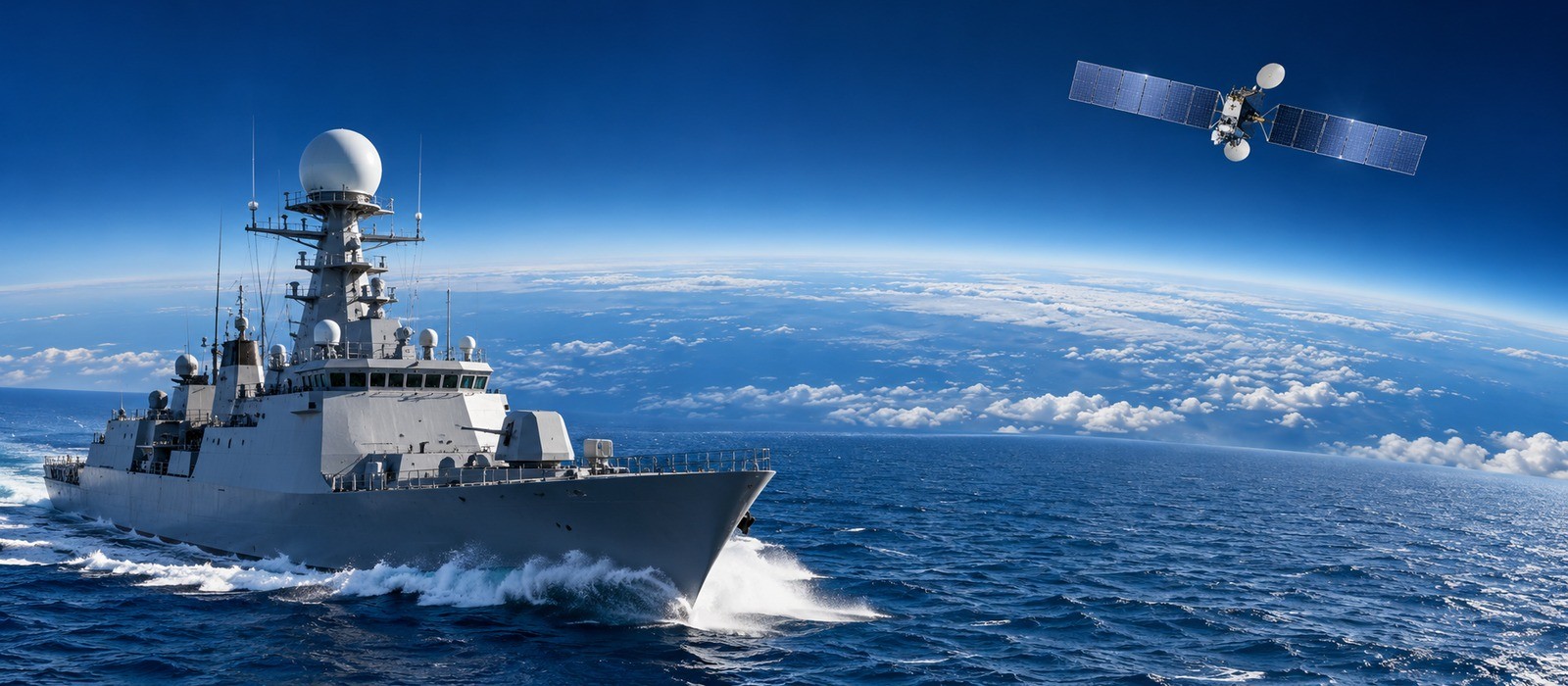
The tryst of the Indian Navy (IN) with a dedicated Defence Communication Satellite began on 30 August 13 with the successful launch of GSAT-7 by the Indian Space Research Organisation (ISRO) from French Guiana under Project Rukmani.1 With this landmark event, the IN joined an elite group of Navies that possessed the capability to conduct operations using dedicated communication satellites.
The reach of GSAT-7 has profoundly impacted the tempo of naval operations. Rukmani provides a multi-band (Satellite Communication) SATCOM capability on UHF, S, C and Ku bands for the surface, sub-surface and air assets of the IN. With this capability, near real-time communication is feasible over voice, video and data applications along the maritime Indian footprint spanning almost the entire Indian Ocean Region (IOR) to effectively meet strategic communication needs.
Whilst Project Rukmani heralded IN into a new era of indigenous SATCOM communications, the prognosis is that there are numerous newer and disruptive technologies still to be developed in terms of space-based satellite communications systems, with more powerful processors, new encoding capabilities, and new user terminal capabilities. These can make user systems more mobile, versatile, responsive and powerful in terms of performance while simultaneously lowering costs.2
Requirements
Commercial Satellites for Military Purposes. The militarization of space has become a known fact today with a proliferation of dedicated military satellites in use. Their usage generally encompasses Command and Control of strategic forces, secure voice communication, wideband and high capacity communications in support of the intelligence community, headquarters, the National Command Authority and beyond-the-horizon communication between mobile forces and their varied components. Many countries exploit their commercial satellites for some, or all, of their telecommunications and broadcasting needs. In addition to the USA and Russia, organizations such as NATO utilise both military and commercial satellites for military purposes.3
Network Centric Operations. IN is a multi-faceted force with diverse elements spread across the surface, sub-surface, air, intelligence, unmanned, space and cyber domains. A Network-Centric capability, therefore, becomes an undisputable backbone of IN operations. With a need for communication to percolate to the lowest echelons, the first imperative is to increase the reach of SATCOM, and not be restricted to only certain platforms. It needs to be available with every element and unit across the three Services. Lessons from various exercises indicate that seamless communication among various stakeholders during joint operations/ exercises such as amphibious operations poses a serious challenge to command, control and coordination. Last mile connectivity, which includes ground/landing forces/special forces on remote islands where each soldier is netted in through SATCOM will be a force multiplier for such operations and coordination with units at sea through satellite phones are a critical necessity.
Interoperability with Sister Services and Foreign Navies. With the integration of the Services (Army, Navy and Air Force) for joint operations gaining momentum, the need for SATCOM requirements deserves impetus. Interoperability at various levels - be it with Para-military forces (territorial/coastal exercises) or sister Services of armed forces (joint exercises) or foreign navies (multi-national exercises) - can be augmented greatly with SATCOM as the backbone. The instances of operating with disaster relief forces like NDRF during floods in Kerala (in the year 2018), wherein, the Southern Naval Command was steering rescue operations proved a great challenge due to lack of communication with the forward deployed rescue teams. Satellite phones at the tactical level were the need of the hour then, even now and will be so in future. Our future SATCOM should, therefore, be of global standards and common to all security forces and government agencies of the country.3 Further, the IN regularly operates and exercises with foreign navies as a Preferred Security Provider in the IOR and beyond. The use of SATCOM will provide a convenient, speedy and easy-to-use communication means to overcome any last-minute challenges requiring apex or tactical-level intervention.
Unmanned Technology. UAV uplinks and downlinks, streaming video, high-definition imagery and weapon systems, which are increasingly dependent on significant quantities of data, are the new norms. A case in point is the induction of the Sea Guardian (MQ 9B Reaper) with an endurance of more than 40 hours, which has enhanced the Intelligence Surveillance Reconnaissance (ISR) and Battle Damage Assessment (BDA) capabilities of the IN. Unmanned technology being acquired in the form of UAVs, drones, etc. will also pose a mandatory requirement for higher bandwidths.
SATCOM on the Move. Seamless coordination has emerged as a challenge in multi-agency exercises like Kavach, which include a number of stakeholders viz. IN, Coast Guard, Ministry of Home Affairs, Ministry of Fisheries and the Ministry of Shipping. It has been observed during these exercises that seamless coordination was a challenge. The actors involved were spatially dispersed along the Indian coast as well as in government offices. Coordinating and controlling all these organisations, including the smallest unit in the remotest area as part of the action grid, required hassle-free, 24x7 communication. Keeping the myriad operation centres all across the country updated with developing situations in real time is quintessential. Rapid speed and connectivity has become need of the hour in order to update all stakeholders with a continuous and uninterrupted flow of information from multiple nodes and to support decision-making at higher levels. These can be achieved through Satellite on the Move (SOM) terminals. The increased importance of mobile communication in diverse conditions and with low-power terminals along the coastline for coordinated operations is a critical requirement that can be met with a cohesive and inclusive SATCOM policy.
Challenges
Decisive Planning. After looking at the varied requirements of SATCOM by the IN and other maritime security agencies, the challenge now lies in making the best use of commercial and military satellites depending on the operation and actors involved. For internal operations with internal actors, commercial SATCOM may prove to be a better option provided the nature of operations is not compromised. The accessibility to SATCOM by civil actors and better services due to competition among commercial firms etc. will facilitate smoother command, control and coordination of such operations.
Security. The idea of the military using commercial satellite technology raises questions about security, control and coverage, and costs. In many ways, today’s satellites are digital processors in the sky and specialized software defines how they perform and defines their communication capabilities. When it comes to security concerns, new waveforms and advanced modems with certified and enhanced military security protocols can be incorporated into existing terminals to deter attack or interference.4 Issues of security can be addressed with these improved modems and network management tools.
Envisaged Bandwidth Requirements
Communication Band. Satellite Communication is based on a specific range of frequencies. For maritime SATCOM, frequencies from 1Ghz to 30 Ghz (L, C, X, Ku and Ka bands as per the old nomenclature system) are being used (Fig 1). Though the services offered by Project Rukmani encompass most of these bands, optimum exploitation with uninterrupted services, especially when higher bandwidths are required, is seldom achieved. Some of the unutilised bands for SATCOM include X and V. Although the C band is better resistant to rain fade, the X band can also be explored to avail additional bandwidth at lower capacities.

Fig 1: Satellite Communication Bands as per the Old Frequency Nomenclature5
C and Ku Band. The primary exploited bands of Rukmani include C and Ku onboard surface platforms. However, at present, the applications are being exploited at meagre rates. To meet demand for seamless communications, the minimum bandwidth envisaged includes 1-3 Mbps for Voice, 3-5 Mbps for Data (catering for sharing of high-quality photos and video clips) and 5-25 Mbps for Video (catering for HD streaming/ multi-node video conferencing etc.). Another important factor to cater for optimisation of SATCOM bandwidth is the management of Internet Protocol (IP) infrastructure, which has huge technical implications. Implementation of the latest networking tools will have a huge impact on the optimisation of available bandwidths.
UHF SATCOM. The exploitation of UHF SATCOM has been restricted subject to the limited number of available links. Currently, GSAT 7 carries UHF x C, C x UHF and limited UHF x UHF transponders. The UHF transceiver operates in Demand Assigned Multiple Access (DAMA) and Permanent Assigned Multiple Access (PAMA) configurations. Increasing the number of UHF x UHF transponders and utilising better network access configurations instead of DAMA and PAMA would enhance the optimisation of UHF SATCOM bandwidth. Higher frequency bands typically give access to wider bandwidths but are also more susceptible to signal degradation due to ‘rain fade’ (the absorption of radio signals by atmospheric rain, snow or ice). Congestion has become a serious issue in the lower frequency bands because of satellites’ increased use, number and size. Newer technologies are being developed by commercial manufacturers so that higher bands can be used.6
High Throughput Satellites (HTS). Considered to be the latest development in maritime SATCOM, HTS services will soon become available on Ku and Ka bands. A high throughput Satellite reuses the same frequency over multiple beams within its coverage area or footprint. This implies that it can offer more bandwidth with the control that's needed to deliver it. Traditional VSAT satellites use a single beam over the entire footprint and the bandwidth capabilities therein are limited. HTS services will introduce a significant amount of new satellite throughput capacity for maritime users. The technology may be considered for naval operations too. The advent of HTS and the proliferation of smaller satellites in Low Earth Orbit (LEO) and Medium Earth Orbit (MEO) are set to impact every domain of the telecommunications sector. It is believed that in the future majority of traffic will be over LEO satellites using the HTS concept.
SATCOM Constellation - Geostationary Equatorial Orbit (GEO) Vs MEO Vs LEO
GSAT 7/GSAT 7R. While GSAT-7 and GSAT-7R are both geostationary satellites, GSAT-7R has greater bandwidth and transponder capacity. Since they are stationary with respect to Earth, they are more vulnerable to attack. Satellites in LEO constantly keep moving and provide a lesser propensity for being attacked with anti-satellite weapons. Across the globe, the launching of more satellites in LEO is gaining importance as they are more affordable and provide extensive services due to increasing competition between service providers. Firms such as One Web and Spacex are launching large constellations of LEO communication satellites with a data transfer capacity of terabytes per second.7
LEO Vs GEO Constellation. LEO and GEO/Geosynchronous Orbit (GS0) satellites are the two extremes when it comes to altitude. LEO satellites are small and their orbits are close to the Earth. So, the rockets needed to launch them are also smaller and cheaper. The disadvantage of LEO satellites is that a large number of satellites are needed to cover any specific geographical area. LEO satellites orbit the Earth many times per day. As each satellite flies over the coverage area, another one must follow behind it, ready to take over the communication, once the first satellite has passed. This also adds to the network complexity as many ground stations are needed to communicate with all these satellites. They also need to use different frequencies to avoid interfering with each other’s communication. Compare this with a GEO satellite, which is stationary above the area that needs coverage and will stay there. While GEO satellites are bigger and more expensive to deploy, the network operator can gradually add to their coverage as the network grows. This holds true, especially for the IN as new technology is embraced in the operational domain in conjunction with sister services.
MEO Constellation. MEO satellites are commonly used for geographical positioning information like GPS, GLONASS and Galileo. GPS satellites generally have an altitude of about 22,000 km, which gives them an orbital period of 12 hours. If one compares this to Global Star's altitude of 1,414 km, it is evident that much more fuel is needed to propel a satellite that far. The satellite will also need to be bigger to transmit a stronger signal, and the communication latency will be higher. These are some trade-offs that therefore have to be considered when designing a constellation.8
Considering the present requirement of IN operations, GEO satellites are more conducive, but optimisation of bandwidths for satellite communication needs more focus. The future roadmap of IN SATCOM could progress on developing the GEO constellation with the incorporation of the latest technologies and network management tools. However, leveraging the benefits of LEO constellation satellites, through stringent military protocols, for the exploitation of commercial satellite communication still remains a viable option. This can help meet the near future demands of operations involving higher bandwidths and better capacity for satellite communication. While the GEO constellation could form the primary SATCOM, the exploration of utilising commercial LEO constellations for redundancy during wartime contingencies can be considered as a backup plan. Additionally, the possibility of merging military payloads with commercial satellites under stringent military protocols can also be considered.
Recommendations
SATCOM is undoubtedly the future of wireless communication. It is evident from the fact that global companies like OneWeb, GlobalStar, 03B et al are investing extensively in LEO and MEO-based SATCOM.9 Most countries of the world are already exploiting commercial satellites for military purposes. The increasing demand for bandwidth and excessive competition among global players to race ahead in SATCOM would pose a greater challenge for the operation of exclusive military satellites. In addition, alternatives to exploit commercial satellites for military purposes are growing with time.10 The use of Starlink in the ongoing Russia-Ukraine conflict is an apt example of the same.
Considering aspects of technological development and optimal exploitation of SATCOM for real-time strategic communication, the roadmap of IN SATCOM could include the following: -
-
Investing more in GEO constellations with robust IT infrastructure. As a lesser number of satellites would cover the entire area of operations and interest, it could be feasible to incorporate more additions to the network to keep pace with growing demands.
-
Establishing a protocol for merging military applications with commercial technology, especially to exploit features of high capacity (terabytes per second) of LEO constellations for ISR, Disaster Relief, Carrier Operations, etc.
-
Undertake Research and Development towards using military payloads in conjunction with commercial satellites and development of new waveforms.
-
A suitable replacement for UHF SATCOM for better utilisation of the UHF band. In this regard, the management of IP infrastructure too could be explored for optimisation of bandwidth usage. This would enable increased bandwidth of C and Ku bands to support 1-3 Mbps for voice, 3-5 Mbps for data and 5-25 Mbps for video.
-
Inclusion of the HTS system in the future roadmap of IN SATCOM.
Conclusion
Satellite Communication technology has achieved remarkable efficiency and increase in performance in the last five decades. These developments have occurred in parallel with significant advancements in IT and telecommunications systems that include Artificial Intelligence (Al), Machine Learning (ML), Cloud computing, etc.11
As national economies become increasingly global with the infusion of human enterprise, the need for effective wireless interconnection via satellite communications will expand exponentially. As brought out earlier, the increased utilisation of space systems of manned, unmanned and planetary bodies will require improved space communication systems. It is a fact that technology experiences exponential advancements driven by innovations. But the other drivers of change for SATCOM could inter alia, include the following: -
-
New service demands in both civilian and defence-related markets.
-
Restructuring of commercial satellite organizations through acquisition, merger and regulatory changes.
-
Allocation and reallocation of frequencies.
-
Convergence between various satellite applications markets - in terms of technology as well as structural integration.
-
Constraints in orbital configurations and orbital debris.12
-
Increased human activities in outer space could prove to be a significant shaper of growth in satellite systems over the next 20-30 years.
The IN is well placed to leverage the unending transformations in SATCOM, enhancing its C4ISR capabilities to protect its maritime interests and preserve a ‘Rules Based Order’ in its Areas of Interest.
Endnotes
-
J Chan and R Dalbello, In Data Shanng to Improve Close Approach Monitoring and Safety of Flight, ed. JN Pelton (Jakhu: Space Safety Regulations and Standards).
-
JN Pelton, “Telecommunications for the 21st Century,” Scientific America vol. 278, no. 4 (1998), 80 - 85.
-
“Interplanetary Communications Action Requirements, Analysis,” The European Space Agency, 325. telecom.esa.int/telecom/www/object/index.cfm?fobjectid=29, accessed 10 November 2022.
-
JN Pelton, Future Trends in Satellite Communication (Chicago: International Engineering Consortium, 2005).
-
L Ippolito and JN Pelton, “Satellite Technology: The Evolution of Satellite Systems and Fixed Satellite Services”, ed. JN Pelton, RJ Oslund and P Marshall, Communications Satellites: Global Change Agents (Mahwah: LEAAssociates, 2004).
-
JN Pelton, Basics of Satellite Communications (Chicago: International Engineering Consortium, 2006).
-
A Hagar, “Quantum Computing,” Stanford Encyclopaedia of Philosophy (2007).
-
C Hoeber, “Annual Satellite Update,” AIAA Annual Review of Satellite Communications.
-
T Lida and JN Pelton, “The Next Thirty Years” Satellite Communications in the 21st Century: Trends and Technologies, ed. T Lida, JN Pelton and E Ashfor (Reston: American Institute of Aeronautics and Astronautics, 2003).
-
DK Sachdev, Business Strategist: for Satellite Systems (Norwood: Artech House, 2004).
-
T Lida and Y Suzuki, “Satellite communications R&D for the Next 30 Years in Proceedings of the 19th AIAA International Communications Satellite Systems Conference,” Toulouse, vol. 233 (2001, April).
-
Op Cit., n.9.
