


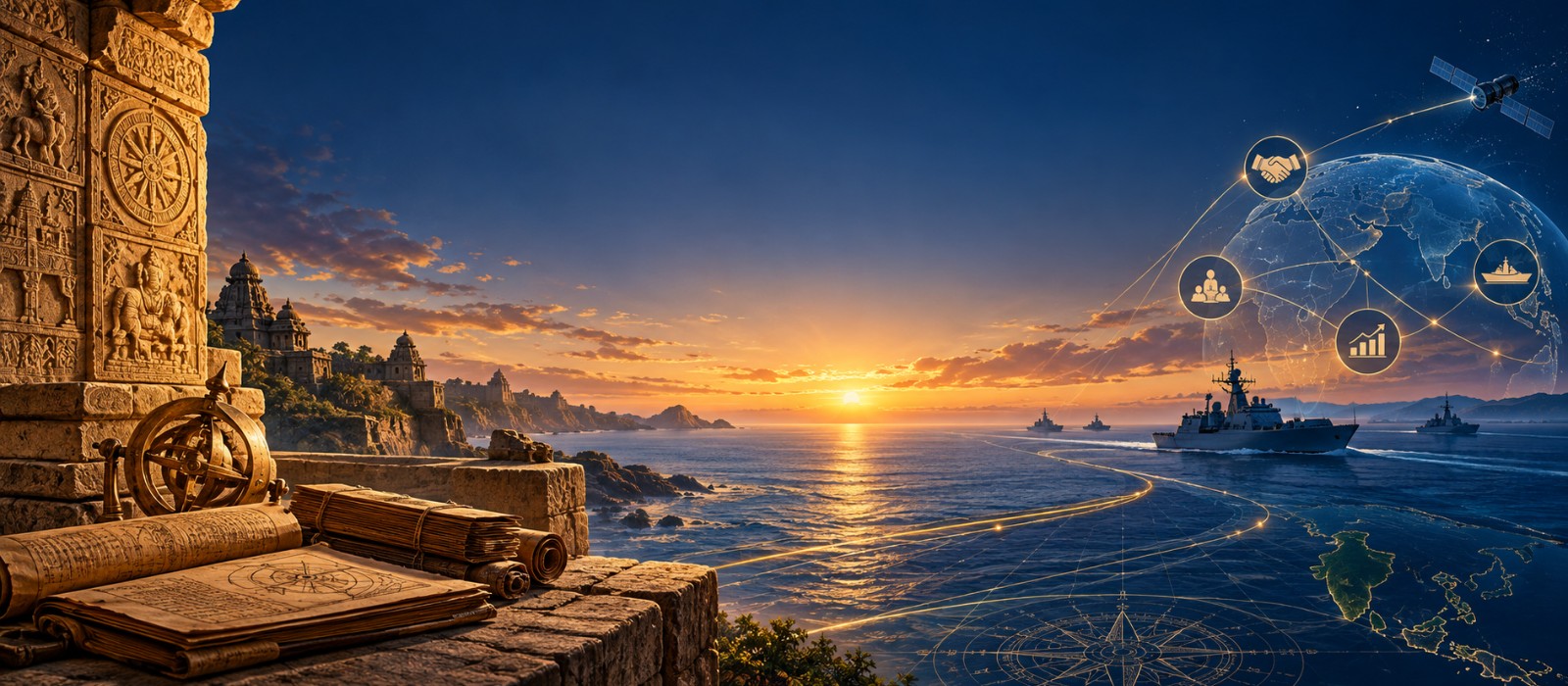


This disquisition is a transcript of the valedictory address delivered by the current Chief of the Naval Staff, Indian Navy at the College of Defence Management, Secunderabad earlier this year.
Introduction
This address seeks to highlight a subject that transcends time, philosophies, thought processes and facts. I hope that it triggers a mental quest to seek our past and find answers for the present and future challenges to our national security. My views can be considered exploratory, subject to debate and scrutiny - in line with the ethos of the Indian Ancient Knowledge System. They will be covered in four parts, covering the aspects of national security, the Indian Ancient Knowledge System, it’s application in DIME, and the enduring attributes of this Knowledge System.
National Security
National Security, as enunciated in our Joint Doctrine, is ‘protection, preservation, and promotion of national interests against internal and external threats or challenges.’ ‘National Security’ is seen as an ‘umbrella’ that creates a conducive internal and external security environment for unhindered socio-economic development of our nation.
Such security also encompasses economic security, energy security, environmental security, food security, etc, or in other words, meeting the ‘needs’ of the state as a whole, along with the ‘needs’ of citizens, as described in Maslow’s hierarchy of needs. Additionally, while ensuring National Security in its physical sense, we must also factor security of our nation as a ‘concept’ or an ‘idea’ as well. The ‘idea’ of India has withstood innumerable existential crises since the ages. Protecting the enduring ‘idea’ of India, that acts as a glue holding our nation together, should remain a key National Security imperative.
In pursuit of a holistic National Security, the various constituents of National Power, such as Diplomacy, Information, Military, and Economy or DIME have been studied in detail. While it may appear that these are a recent development, the fact is that, our ancient texts are replete with theories and examples of using ‘DIME.’
It thus, goes without saying that to be ‘secure,’ we need to be ‘strong’ as a nation. As Thucydides said, “the strong do what they can and the weak suffer what they must.” And it is in this context, understanding our ancient knowledge system could prove to be crucial.
Indian Ancient Knowledge System
Students of Indian history have oft referred to ‘ancient’ as a time period prior the Indian medieval age. Restricting ourselves to this period provides a boundary to the vast subject at hand, but we could view events that occurred later as well, wherein influence of the Indian Ancient Knowledge System is evident as in case of Cholas, Akbar and Shivaji.
Use of the term ‘System’ brings with it a sense of organization and rules to include a definitive interplay between its components. Therefore, when we associate the term System with Indian Ancient Knowledge, it could, apart from the written work, also encompass long standing Indian traditions passed verbally from one generation to the other. Accordingly, we have a wide range of literature and traditions that encompass our ancient knowledge system. Be it,
-
Darshanas or the philosophical point of views; Vidya or the knowledge sources including Vedas; 64 Kalas or Art Forms and skills;
-
Epics and stories such as Ramayana, Mahabharata, Puranas, etc;
-
Spiritual contents such as Bhagvad Gita, Upanishads, etc;
-
Treatise on state/ governance/ politics/ warfare such as Arthashastra, Thirukural, Niti-Prakashika, Niti-Sara, etc; and
-
Processes such as Gurukul, Shrutis or verbal transmission of knowledge.
We can also draw inspiration from Vedic practices of transmitting otherwise complex knowledge in the form of simple stories as in Puranas or even Panchatantras.
Diplomacy
In application of this knowledge system to DIME components, let me begin with ‘Diplomacy’ as a tool for National Security. The epic Mahabharata is a graphic account of real-life situations and the complex challenges they present to leaders at every level. In his book The India Way, in the chapter titled ‘Krishna’s Choice,’ Dr S Jaishankar brings out how certain elements of modern international relations could also be found in Mahabharata like accepting tactical compromises for strategic gain, promoting regime change, ensuring balance of power or shaping the discourse.
Dr. Jaishankar draws on two characters in Mahabharata who choose variants of non-alignment that make them marginal to the great war at Kurukshetra. Krishna’s brother, Balarama, opts out of the conflict by taking a long pilgrimage during the war. He comes back angered by its outcome and yet, unable to influence it in any way. Rukmi of Vidarbha stays out of the war, as he overestimates his value to both sides and ends up accepted by neither. Today, as we witness tendencies of hedging, can we foresee the consequences of non-aligning?
Mahabharata can thus, act as a good reference when we formulate our diplomatic choices.
Information
Coming to ‘Information’ as a tool for National Security, in Indian history, spying is as old as the Rigveda and had developed as an intricate and sophisticated administrative science. Manu has in fact, described five classes of spies with their various guises.
Kautilya proposed a detailed hierarchical network for an espionage system, while the Arthashastra described two types of espionage - sansthah or stationary spies and sancharah or roaming spies. Thirukkural, verse 583, reads ‘There is no better way to victory for a king than deploying spies on surveillance and gathering credible intelligence.’
As we look at our intelligence network today, can we draw parallel with structures of the past? Would it be far-fetched to visualize malicious network hardware with inbuilt backdoors as ‘stationary spies,’ and the phishing data bytes as ‘wandering spies?’
Military
Next is the most visible enabler for ensuring National Security - the use of military power. My first point about military concerns is about choosing the type of warfare to be pursued. Epics have always insisted on selecting Dharmayuddha or righteous war over Kutayuddha or unrighteous war. This has had a profound impact on the way we in India look at war. Our present day doctrines essentially propagate defence of our national interests and not expansionist gains as the rationale for use of military power. However, our adversaries are not necessarily abiding to Dharmayuddha. Kautilya recommends that if the enemy practiced Kutayuddha, the defender must also resort to it. Thus, our ancient knowledge system advises us to remain cognizant of an unethical war that the enemy may wage and be ready to respond to it quid pro quo.
For my second point, ‘capability development,’ I will refer again to the Mahabharata. Just before the war, both Arjuna and Duryodhana went to Sri Krishna, the King of Yadavas, to convince him to join the war from their respective sides. Awakening from sleep, Krishna sees Arjuna, who tactically chose to sit at the foot of the bed first, and Duryodhana, who sat at the head of the bed, later. As the King of Dwaraka, Krishna, offers Arjuna to choose between his army and himself. Arjuna chose him and Duryodhana got the army. What was the basis of Arjuna to choose a single person over the entire army when the armies of the Pandavas and Kauravas were in the proportion of 7:11? As we are aware, this decision proved to be the difference between the victor and the vanquished. For us, this episode could guide us in our debates over count versus capability amid budget constraints and the rising power of our potential adversaries. It is imperative for us to seek capability advantage to overcome asymmetries that exist in numbers; be it on land, over sea, in air, and even in space and cyberwarfare. We could choose ‘decisive and out of the box’ over ‘more of the same and run of the mill.’
Economy
In acquiring these capabilities, ‘economic might’ remains the prime driver. This has been written in the ancient texts, and practiced by our ancestors. Keeping the economy central to the security of kingdom is epitomised by the Medieval Chola Empire with an export-based economy driven by maritime trade with Southeast Asia to the East and the Gulf region to the West - and the use of a navy to protect and expand trade.
It would not be wrong to assume that the Cholas must have derived a lot from the ancient knowledge system to govern their kingdom efficiently. As a Naval Officer, what comes to mind, is that the kingdom was a classic example of the Mahanian Maritime Virtuous Cycle that espouses a symbiotic relation between maritime trade and naval strength - a defining attribute of maritime powers of today. As India looks more to the seas for economic prosperity, building commensurate maritime resources and maritime power are a must to ensure economic security.
Enduring Nature of Indian Ancient Knowledge System
Having taken a look at the knowledge system and its application to various tools of national power, we can now try and analyse their enduring nature. Let us go to 17th century Maharashtra when Chhatrapati Shivaji Maharaj established the Maratha empire against extraordinary odds.
First, he established a welfare state and fulfilled the role of a ‘Rajyogi’ - a King who establishes his legitimacy through people centric policies. In an era when feudalism was a norm and a set practice, he returned land to the farmers - a vital step in ushering a truly welfare state. Second, he utilized and focussed on all the seven organs of State as elucidated in the Arthashastra namely Raja, Amatya, Janapada, Durga, Kosha, Sainya and Mitra.
The reason why I quoted Chhatrapati Shivaji Maharaj is that his success points us in the direction of an enduring nature of the Ancient Indian Knowledge System even in its verbal form. Chhatrapati Shivaji did not receive formal education in statecraft. He is said to have learnt the intricacies of society, state and security through his cognition of epics like the Ramayana and the Mahabharata narrated by his mother.
This ‘collective wisdom,’ founded on verbal communications, guided Chhatrapati Shivaji to carve an independent welfare state as envisaged by Kautilya - without probably reading Kautilya. This brings out the transcending nature of the impact of Indian Ancient Knowledge System.
Thus, there is more to our knowledge system than meets the eye. How it shapes what we think, how we think and why we think contributes to our collective consciousness, a glue that binds us as a nation amidst apparent diversities.
Intangible Influence of Knowledge System in Nation Building
Let me now share certain thoughts on intangible influences of the Indian Ancient Knowledge System that impact our security.
The first factor is the collective consciousness that we as a society have for our nation as one entity. Kautilya’s imagination of India as an expanse from the Himalayas to the seas, the Mauryan empire’s expanse covering the Indian subcontinent, the Marathas decision to take on the outsider Ahmad Shah Abdali at Panipat are but a few examples of this facet.
The second factor is the tendency to look beyond ‘Self.’ A common ritual practiced in India is the recitation of ‘Mantrapushpanjali,’ at the end of domestic social functions. These shlokas seek blessings not for personal gains, but rather for the society at large and the kingdom as a whole.
The third factor is the focus on Dharma or righteous duties. The spirit of dharma is deeply enmeshed in our psyche. To elaborate, I will refer to a Harvard Business Review Study titled ‘The Ordinary Heroes of the Taj’ that tried to identify rationale behind the selfless behaviour of Taj staff during the 26/11 terror attacks. What emerges is that Taj employees across functional hierarchy, across communities, and across all age groups put themselves in harm’s way to protect the guests. It’s a telling example of the deep-rooted influence of the Indian Ancient Knowledge System among ordinary citizens of our nation.
Our military history is also replete with similar acts of valour and selfless acts.
Conclusion
Therefore, an in-depth study of our Ancient Knowledge System, keeping in mind present day realities, is a must, to draw meaningful inferences that could positively impact our approach to National Security. It would definitely aid us in deriving ‘ends’ that we never thought of, formulating novel ‘ways’ to attain ends being pursued, and inventing ‘means’ that have not been considered yet.
I wish to recommend certain works that I came across for reading - first, a collection of essays edited by Kanti Bajpai, Saira Basit and V Krishnappa titled India’s Grand Strategy; second, The India Way authored by Dr S Jaishankar; third, a compilation of Dr Rabrinath Tagore’s essays titled Nationalism; fourth, War in Ancient India by VR Ramchandra Dikshitkar and fifth, The Difficulty of Being Good by Gurcharan Das.
I would conclude by quoting the code of the warrior enunciated in the Bhagwad Gita that has profound meaning for us: -
“I am a Warrior. Defending my nation is my righteous duty. I will train my mind, body and spirit to fight. Excel in all devices and weapons and war, present and future. Always protect the weak. Be truthful and forthright. Be humane, cultured and compassionate!
Fight and embrace consequences willingly! God give me strength that I ask nothing of you!” Jai Hind. Sam No Varunah.
