


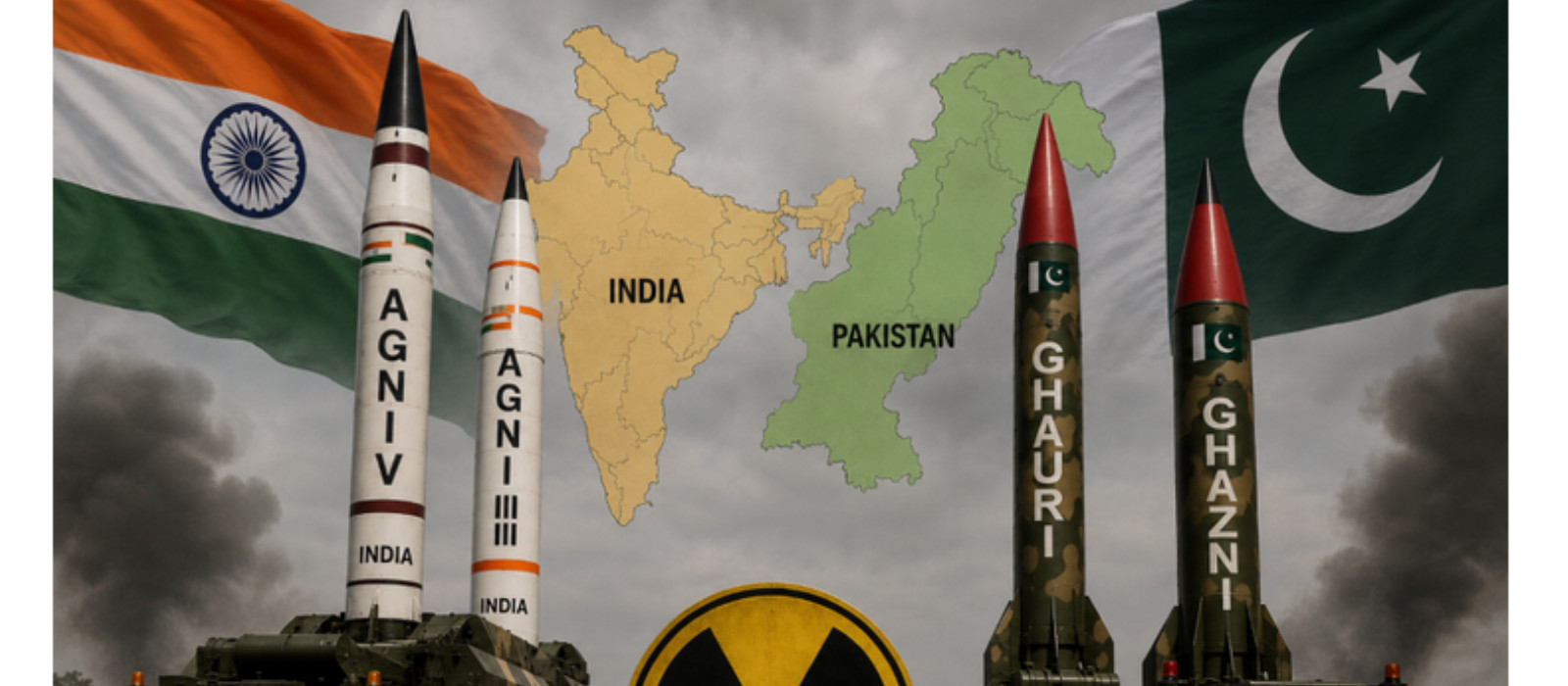


India and Pakistan have fought largely conventional wars bereft of the apocalyptical shadow of a nuclear war in 1947, 1965 and 1971. After the nuclear tests by India and Pakistan in May 1998, nuclear weapon capability has conferred Pakistan with the ability to push sub-conventional boundaries of warfare against India, while brandishing the threat of escalation with the use of nuclear weapons. India’s restraint and Pakistan’s subsequent defeat in the Kargil War did not deter Pakistan’s utilisation of non-state actors, leading to attacks on the Indian parliament in December 2001 and the Kaluchak Army camp in May 2002. While Pakistan seeks to neutralise India’s conventional superiority by expanding the sub-conventional space under the nuclear umbrella, India seeks to explore the space for conventional military operations to deter Pakistan’s proxy-war strategy while managing escalatory risks. India has a stated No First Use (NFU) nuclear policy coupled with a stance of massive retaliation in response to a nuclear attack, while Pakistan maintains a nebulous concept of red-lines linked to the use of nuclear weapons. Consequently, India and Pakistan’s conventional and nuclear strategies could intersect and create circumstances of nuclear escalation, either by accident or design. Under these circumstances, what are the possible options that India might have to deter Pakistan’s sub-conventional warfare strategy while cementing its conventional superiority? Can a cohesive, limited war strategy be an effective tool to deter Pakistani sub-conventional warfare strategy? Could an effective limited war strategy be an answer to the India-Pakistan security conundrum?
The idea of limitation in the scope of war has historically been linked to the limiting devastation from war and can be traced back to the Peloponnesian wars. According to Thucydides, King Archidamus of Sparta alluded to the idea of not driving the enemy to despair, as it might harden the enemy’s will.1 The notion that wars need not be fought for the complete devastation of the enemy but can be constrained by the limited political objectives has been consistently theorised from the 1800s to the 21st Century. Political objectives and the desired end state are the foundational pillars of war.
A limited war is fought for limited political objectives whereas total war is fought for the complete devastation of the enemy, with correspondingly unlimited objective of a regime change. The limiting factors in a total war might be the finite nature of the means, both material and human, to overcome the resistance of the enemy.2 Arguably, the First World War and the Second World War can be classified as total wars. However, most of the wars fought in the 20th and 21st Century have been limited.
Nuclear Deterrence and Limited War
Nuclear weapons, by their destructive potential, are weapons for deterrence. The ability to wage war with nuclear weapons provides, “some measure of deterrence, dissuasion and national assurance.”3 Colin Gray has argued that “Nuclear weapons can work directly on the source of the real action in world politics, in the minds of policymakers. To win this 'engagement' can be to win the war.”4
A nuclear doctrine is the philosophy that structures nuclear strategy and quantifies its utility and manner of employment. Therefore, a nuclear doctrine could articulate the contours of nuclear weapons capability and its employment ranging from the type of weapons, delivery systems, command and control setup, targeting etc. A doctrine could further provide clarity on the intentions of the adversary.5
India’s draft nuclear doctrine was released on 17 August 1999.6 The doctrine affirms that India’s development of nuclear weapons is to deter the threat and usage of nuclear weapons against India. The doctrine affirms that India will not be the first to initiate a nuclear attack, but will respond with punitive retaliation should deterrence fail. India would maintain credible minimum deterrence, primarily focussed on retaliation. As India’s nuclear weapons capability is predicated on retaliation, the survivability of nuclear weapons is of paramount importance. The doctrine upholds that India will not use nuclear weapons against states that do not possess nuclear weapons and are not aligned with nuclear powers.7 The draft nuclear doctrine was never superseded in the public domain by an official document, however, a press release with certain clarifications was issued in 2003.8
The draft nuclear doctrine had envisaged a punitive response to a nuclear strike; however, this was eventually replaced with “massive retaliation”.9 The primary criticism for “massive retaliation” is that the credibility of nuclear deterrence has not been enhanced by replacing the word “punitive” in the draft nuclear doctrine with the word “massive” in the official version. Furthermore, “massive retaliation” excludes the option of a graduated response to a nuclear attack while increasing the likelihood of an enhanced first strike to neutralise the effectiveness of “massive retaliation.”10
Nuclear strategists have argued that NFU is detrimental to national security as it makes India a passive observer. As survivability is linked to the NFU stance, it mandates a larger arsenal. A key consideration in questioning India’s NFU stance is that there is no guarantee that India can weather the first strike.11 Contrarily, a NFU stance shifts the prerogative of escalation onto the adversary while steering clear of brinkmanship. India’s NFU stance arguably, reduces Pakistan’s insecurity by removing the threat of pre-emptive nuclear attack by India. NFU also supports recessed deterrence wherein the warhead and the delivery system are in de-mated condition.12
Pakistan has not released any official nuclear doctrine; however, the contours of its nuclear doctrine can be gauged from numerous statements by government and military officials. Some elements of the Pakistani nuclear doctrine that can be gleaned from these sources are - deterrence of India’s conventional and nuclear aggression, the realisation of credible minimum deterrence, retaining the capacity to retaliate if deterrence fails, building a nuclear triad and providing security from consequences of employing non-state actors. Some other concepts such as credible minimum deterrence, not subscribing to NFU and utility of nuclear weapons when the security of Pakistan is threatened have also been reiterated by policymakers.13
The primary aim of Pakistan’s acquisition of nuclear weapons is the neutralisation of the conventional advantage of the Indian armed forces, while the secondary aim is to create enabling circumstances to further Pakistani security interests at the sub-conventional level. As an inferior military power, the rejection of NFU is in line with the notion of creating instability in nuclear deterrence. A first use doctrine also affords Pakistan the ability to deter a conventional attack by lowering the nuclear threshold.
The ambiguity in Pakistan’s so-called nuclear red-lines is founded on the determination that well-defined articulation of such lines will enable India to recalibrate its nuclear doctrine. Notwithstanding, in an interview in 2002, Gen Khalid Kidwai, head of Strategic Plans Division (SPD) articulated four instances of Pakistani nuclear threshold red-lines - loss of large territory (space threshold), destruction of a large part of the land or air forces (military threshold), economic strangulation (economic threshold) and political destabilisation (domestic threshold).14 Additionally, Pakistan policymakers have envisioned a ‘defensive’ and ‘catalytic’ utility of nuclear weapons. The ‘defensive’ utility pertains to deterrence while the ‘catalytic’ utility pertains to the belief of attracting international attention in an Indo-Pak crisis by crying ‘nuclear-wolf.’15
Limited War Ideology
The Kargil War cemented the notion that limited war under the nuclear overhang was conceivable.16 George Fernandes, as Defence Minister, was the first Indian political leader to articulate a concept of limited war. Speaking at a seminar at IDSA in 2000, he argued that methods of employment of military power had undergone significant changes, and India had grasped the dynamics of limited war along with the attainment of nuclear weapon capability.17
Gen VP Malik, who was the Army Chief during the Kargil War, suggested that there was space for conventional operations between the sub-conventional and nuclear dimensions of war. However, he cautioned that such a course of action would be predicated on adept management of the escalation ladder through an efficient politico-diplomatic arrangement.18
The nuclear tests of 1998 invigorated Pakistani military discourse in Low-Intensity Conflict (LIC). The Pakistan Army Green Book of 2000, emphasised that nuclear capability had provided strategic parity with India and had reduced the prospect of conventional war while creating space for war with limited aims, confined to the disputed areas. The 2002 edition of the Pakistan Army Green Book was devoted to LIC. The notion that the nuclearisation of South Asia had provided Pakistan with strategic stability while freeing space for action at the sub-conventional level, was a common thread running through the entire volume.19
In 2004, the Pakistan Army Green Book was written around the topic of limited war. The volume encapsulates Pakistan’s limited war strategy. Contributors to the publication also supported the idea of limited war and theorised that Pakistan should strive to obtain maximum gains in the early stages of the conflict before any form of diplomatic intervention. Expectedly, the contributors unanimously linked such a limited war to the so-called freedom struggle in Kashmir.20 A survey of Pakistani military discourse since the attainment of nuclear weapons capability establishes a ‘positive correlation’ between the nuclearisation of the subcontinent and Pakistani efforts at the intensification of sub-conventional activity in Kashmir.21
Pakistan supports the use of Tactical Nuclear Weapons (TNWs). Its development of TNWs, while countering India’s conventional capability asymmetry, seeks to negate doctrines such as the ‘Cold Start’ and counterbalance the development of ballistic missile systems by India.22 However, the use of low-yield short-range TNWs to counter an Indian conventional offensive on the battlefield close to its border would mean TNW employment in the proximity of its troops and populace on Pakistani soil.23 During the Cold War, the use of TNWs was contemplated by NATO to counter a possible Russian invasion across Europe. To test this course of action, in June 1955, Operation Carte Blanche was conducted. The results estimated two million German deaths.24 Based on the prospect of death and devastation on the Pakistani side, the use of TNWs is more sabre-rattling than actual combat capability. Furthermore, the use of TNWs has numerous command and control challenges as the weapons can no longer be maintained in de-mated condition. Nevertheless, Pakistan’s development of TNWs does alter the conventional balance of force between the two countries, building on the deterrence it seeks from the possession of nuclear weapons.
In Apr 2002, the Chief of the Army Staff unveiled the ‘Cold Start’ concept that would enable the Indian Army to carry out a swift retaliatory conventional strike on the Pakistan Army, before any form of diplomatic intervention. ‘Cold Start’ could support a war with limited political objectives, below the nuclear threshold. ‘Cold Start’ “envisaged the creation of smaller division-sized “Integrated Battle Groups” (IBGs) comprising mechanised, infantry and armoured elements. Supported by the IAF, the offensive into Pakistan would take place along multiple axes to capture maximum territory. The key determinants of the success of the ‘Cold Start’ concept would be the speed of mobilisation and operations. The speed of the action and the breadth of the attack would result in the capture of 50-80 km of swath of territory. The simultaneity of holding and pushing through would disrupt the enemy’s ability to respond.25
Pakistan academics argue that India’s articulation of ‘Cold Start’ has led to the development of TNWs.26 Notably, Pakistan conducted its largest exercise Azm-e-Nau (New Resolve) from 2010-2013, to gauge its ability to counter an attack on the lines of ‘Cold Start’ and concluded that the offensive could be stymied by conventional forces. Pakistani strategists have also argued that the military geography of the Pakistani Army’s deployment will neutralise the so-called early mobilisation advantage of the Cold Start. Overall, there is consensus among Pakistani strategists that “Cold Start” destabilises Pakistan’s nuclear strategic deterrence against conventional Indian superiority.27
Strangely, in September 2010, the Indian Army effectively disowned Cold Start, when Army Chief Gen V.K Singh suggested that ‘Cold Start’ was neither a doctrine nor a strategy, but a term that was “bandied about by think tanks and media.” Nevertheless, the Indian Army continues to pursue the desire for quick mobilisation and speed of action under the garb of “proactive strategy.”28
The Indian Army Land Warfare Doctrine - 2018 (LWD-18) was unveiled in December 2018.29 The LWD-18 highlights the inclination of our neighbour to exploit the uncertainty of nuclear escalation to engage in unconventional operations.30 The LWD-18 underscores the relevance of deterrence, punitive response, swift operations in case of any contingencies and the deployment of IBGs.31 The incorporation of the concept of IBGs in LWD-18 is indicative of the operationalisation of the ‘Cold Start’ concept. Analysts have inferred that India will utilise 8 to 10 IBGs and each of them could comprise of “four to six battalions of infantry and armoured units, two to three artillery regiments, an engineers’ unit, an integrated signals unit and dedicated integral logistics,” and not every division will be converted to an IBG.32 In the recent past, the Indian Army has carried out drills of extracting IBGs from 17 Corps and deploying to forward areas further cementing the premise that IBG is central to countering Pakistan’s strategy of increased sub-conventional action under the nuclear umbrella.33
Limited War Strategy and Conflict
The Kargil War can be viewed as a very limited war in terms of objectives, means, geographical extent and the nuclear dimension of escalation. The Kargil intrusions were perceived by Pakistan as a military operation that would put Kashmir in the spotlight. It was believed that tactical actions in Kargil would have favourable strategic effects. Pervez Musharraf has placed on record that Prime Minister Nawaz Sharif had agreed to the limited objectives. However, it was the mismanagement by the government that led to the eventual failure of the Kargil Operation.34 The Indian assessments of the limited Pakistani objectives as per the Kargil Committee report are broadly in line with the limited aims professed by Pakistan while suggesting that the Kargil War was also aimed at avenging the loss of Siachen. Pakistan banked on the threat of nuclear escalation caging an Indian response and hoped for early intervention by the international community in halting the operations with Pakistan in a favourable position.35 Similar to the limitations in the objectives, the means employed and the geographical area of the conflict was also limited.36
In late May 1999, Pakistan’s Foreign Secretary Shamshad Ahmed, provocatively warned that Pakistan may use “any weapon” to preserve its territorial integrity. The statement is indicative of Pakistan’s effort to shape international perception by suggesting the likelihood of nuclear escalation. Jalil Jilani, a former Director-General for South Asia in Pakistan's Ministry of Foreign Affairs has opined that nuclear weapons played a central role in the Kargil War by raising the stakes in the international community.37 However, Timothy Hoyt while analysing the nuclear threats emanating from both sides has concluded that notwithstanding the nuclear posturing, neither side feared the actual use of nuclear weapons. Nevertheless, it did add a measure of restraint in the responses of both sides.38 Additionally, nuclear weapon capability on both sides had not been adequately operationalised.
On the morning of 13 Dec 2001, militants attacked the Parliament House. leaving 12 people including 5 attackers dead, while injuring 18 others.39 The evidence linked the attackers to Pakistan based terror groups; Lashkar-e-Taiba (LET) and Jaish-e-Mohammed (JEM).40 India accused Pakistan of orchestrating the attack and demanded decisive action against the leadership and finances of the terror outfits. Pakistan and the spokesperson of LET denied any involvement and the Pakistani government sought an impartial enquiry. Upping the ante, on 01 Jan 2001, India demanded the extradition of 20 wanted criminals, which included those involved in the Parliament House terror attack. Pakistan refused extradition and sought evidence to try the offenders in Pakistan. An incensed India cut off diplomatic ties and mobilised its military. On 18 Dec 2001, Operation Parakram was initiated with the mobilisation of the strike corps and the concentration of naval assets on the western seaboard.41
Operation Parakram wound down in October 2002, with the jury out on the success of Indian coercive diplomacy. Some analysts have argued that Pakistani nuclear deterrence and political dithering, when India had the advantage in January 2002, were the key factors for India not gravitating from posturing to action despite Pakistan not meeting Indian demands. However, the precise influence of nuclear deterrence is difficult to gauge.42 It has also been argued that India’s frustration with the management of Pakistani nuclear deterrence during Operation Parakram led to the replacement of “punitive” in the 1999 draft version of India’s nuclear doctrine with “massive” in the 2003 version.43 Operation Parakram had significant doctrinal implications, the foremost amongst them was the realisation that the long mobilisation time for the Indian Army from peace-time positions allowed the adversary to shore up defences, thereby negating the prospects of a quick debilitating offensive. It was therefore, imperative that the Indian Army developed an offensive capability that could be kick-started at short notice eroding Pakistan’s policy of seeking refuge under the umbrella of potential nuclear escalation.
The distant location of the ‘Strike Corps’ and extended mobilisation time was the undoing of Operation Parakram. The Operation was launched on 18 Dec 2001. However, the ‘Strike Corps’ took three weeks to mobilise.44 It was evident that the arrangement of layered ‘offensive defence’ was unsuitable as a military option as deterrence by punishment for a terror attack. The military response had to be rapidly scalable to maximise tactical gains in a limited period.
In the recent past, the use of IAF to respond to a Pakistan aided terror attack at Pulwama is a shift to deterrence by punishment. It marks a significant departure from the earlier approach of applying diplomatic and economic pressure post a terror attack. Tellis has argued that the risks of escalation in a limited conflagration were managed adroitly in the aftermath of the Balakote airstrikes. However, the near-perfect “uncoordinated coordination” witnessed post-Balakote airstrike cannot be left to fate for instances in the future. Furthermore, the Indian attempt at couching the attack with legalese such as “non-military pre-emptive action” diminishes its deterrent value.45
It may be argued that the release of LWD-18 can be equated with political sanction for limited war doctrine. However, there appears to be an almost negligible articulation of the limited war concept amongst the political hierarchy. India’s ripostes to terror attacks, with land-based surgical strikes and penetrative airstrikes have notably altered the deterrence stability equation between the two nations. It has engendered a competing element of Indian unpredictability against Pakistani efforts to play up the ambiguity of an unpredictable nuclear threshold. Balakote may not have reset the playing field of the strategic competition between the two nations, but it has certainly reshaped its contours. However, Pakistan’s proclivity to use non-state actors for terror attacks in India is unlikely to be diminished by such actions. Therefore, Indian military planners will have to conjure up responses to future instances akin to Pulwama, while duly recognising the risks of escalation as a result of Pakistani response.
Is there Space for Limited War under the nuclear overhang?
Building on the concepts of nuclear deterrence during the Cold War, political scientist Glen Synder postulated the “Stability-Instability paradox.” He argued that stability at the nuclear strategic level would lead to instability at the conventional level. Kapur examined this assertion in the South Asian context and concluded that contrary to the “Stability - Instability paradox,” it was in fact “Instability - Instability paradox” that had led to increased sub-conventional engagements by Pakistan. He opined that maintenance of instability at the nuclear strategic level reinforced Pakistan’s conventional deterrence and enabled it to engage India sub-conventionally while threatening nuclear escalation if India responded conventionally.46 Meanwhile, Rajagopalan has argued that Pakistan’s strategy of fomenting terrorism in Kashmir under the nuclear umbrella is more aligned with Thomas Schelling’s theory of “Brinkmanship” rather than the “Stability- Instability paradox.”47 Irrespective of the applicability of a form of deterrence theory, there is conclusive evidence of Pakistani inclination to undertake sub-conventional actions centred on Kashmir. The inclination for such activities is founded on the premise of matching capability at the nuclear strategic level.
Many strategists and senior Indian Army officers are of the view that the so-called red lines of Pakistan’s use of nuclear weapons are principally abstract to create ambiguity and realistically, Pakistan will primarily respond conventionally to any Indian aggression till a nuclear threshold such as considerable loss of territory is breached.48 Despite all the bravado around Pakistan’s nuclear first-strike stance, the balance of capability and survivability would always weigh in favour of India. Therefore, Pakistan’s threat of use of nuclear weapons is akin to “committing suicide due to the fear of death.”49 The space for a limited war under the nuclear overhang would be in direct correlation to the scale of the political objectives. The scaling upwards or downwards of the political objectives during a conflict would not necessarily alter the limited war strategy.
Rational Deterrence
Deterrence is predicated on possessing the appropriate military capability to enforce an unacceptable cost to the adversary. The effectiveness of deterrence is a function of capability and credibility. While the former is easier to gauge, the latter is intangible and conditional on the perception of the adversary.50 India continues to develop the capacity to address the truncated scope of a limited war. However, showcasing capability and conveying credibility have not been accorded due priority. The insistence of Pakistani academics and military planners that the Indian expansion of capability for limited war alters the balance of deterrence is a clear suggestion of its deterrent effect. The questions of whether a limited war strategy will reform Pakistan’s use of non-state actors and force it to act against such outfits cannot be conclusively answered. Nevertheless, an effectively articulated limited war strategy backed by appropriate capacity can foster peace by nurturing stability at the conventional level of war. A limited war strategy has to be framed as a prelude to diplomacy. For deterrence to work, political will must be supported by the willingness to take the risk, backed by a robust capability founded on a sharp understanding of the adversary’s perception. An effective limited war strategy could support deterrence by punishment, provided the signalling of intent and matching capability are recognised by both parties.
Limitation of Objectives
Future wars between India and Pakistan could be limited in terms of the objectives just as earlier wars have been but for the 1971 East Pakistan theatre in not maximising military effort. War termination could assume the form of a negotiated settlement. The objective from a Pakistani perspective could be limited to gains in Kashmir, while from an Indian perspective it could be deterring Pakistan by increasing the cost of harnessing non-state actors and maintaining the status quo. Such limitation of objectives needs to be conceptualised by the political hierarchy and translated to equivalent military objectives, mere articulation of limited objectives may define the logic of war, but not limit its grammar.
The limits in a limited war have to be enforced by complementary structures and guaranteed by safeguard mechanisms during the application of military power. The on-scene commander cannot afford to be divorced from the larger political purpose of the war. “While these statements maybe truisms, nevertheless they merit consideration.” The consequences of military over extension beyond the pre-decided limitation in objectives need to be recognised and factored in the execution of war plans. Academics have argued that controlling an advancing army is easier said than done. Loss of life and materiel is likely to collapse supporting structures that limit objectives.51 However, such assertions are mere conjecture and not supported by evidence. The possibility of the political leadership expanding the political and military objectives contrary to the advice of the military leadership also cannot be ruled out. “There have been instances when the military leadership has often urged limiting or shrinking objectives depending on the friction experienced, while the political leadership may urge expanding political and military objectives.” The formulation of operating norms, effective politico-military communication and monitoring mechanisms could calibrate the application of combat power and manage the prospect of over extension in a limited war. In the Indo-Pak context, considering that places such as Sialkot and Lahore are a mere 15 and 25 kilometres from the border, territory grab would have to be shaped towards areas such as deserts that may impact the escalation threshold to a lesser degree.
Another key imperative originating from limitation in objectives is that of the negotiated settlement. The government and the political leadership will have to grasp the import of pursuing a negotiated settlement, which might mean not capitalising on a military advantage and making an acceptable peace offer that seeks conflict termination rather than painting the adversary into a corner.
Managing Escalation
As steam release valves vent pressure, communication channels and Confidence Building Measures (CBMs) can actively release escalatory pressure. A nuclear war, irrespective of the comparative scale of devastation would be catastrophic for both India and Pakistan. The prospect of “not war, not peace” scenarios not transiting to an all-out conflict can be managed by instituting lines of communication and building on the promise of CBMs from the Lahore Declaration of 1999. CBMs may not address the seed of the dispute, but could limit escalation. Nuclear risk reduction measures between the two nations set against the Lahore Declaration could also significantly contribute to managing the risk of nuclear escalation. The scope of the non-attack list and missile test notifications could be expanded.
While Pakistan would cry ‘nuclear wolf’ at the first opportunity, but even as a revisionist state, running under the military writ, Pakistan is unlikely to press the “self-destruct” button by engaging in a nuclear weapons exchange.52 Herman Kahn developed a 44 rung escalation ladder terminating in nuclear destruction and argued that the side that least fears an escalation can achieve escalation dominance.53 If India seeks escalation dominance it must create more conventional steps on the escalation ladder below the nuclear threshold. India must possess favourable asymmetry of capability at these conventional steps. Once escalation dominance has been achieved there should also be an incentive for Pakistan to de-escalate by descending the ladder.
Escalation management can be supported by scenario building based on triggers that might lead to limited war. The triggers for a limited war could be developed into scenarios with a range from best to worst-case. These have to be thereafter, merged with military plans with stages tagged for de-escalatory measures in the political and military domains.
The presence of open communication lines can significantly reduce the uncertainty of intent and limit the risk of escalation. While we have a functioning line of communication between the DGMOs of the two sides, we could develop channels of communication at appropriate government levels to address the risk of nuclear escalation. The communication channels can be developed based on the nuclear de-escalatory measures enumerated in the Lahore Declaration of 1999. In the recent past, the hysterical media coverage during the Balakote strike stirred up the nation and perhaps played on the minds of both the military and political leadership. The government would need to develop a media strategy to address the construct of limited war, especially when faced with loss of life and materiel.
Tool Box for Limited war
A limited war under a nuclear threshold is predicated on the limitation of objectives and can be executed by developing the right tools across military and political domains. The first and foremost pre-requisite is a clear understanding of limited war. The political leadership must grasp the idea of negotiated peace and limitation in objectives. The framing of political higher directives must comprehend the symbiotic relationship between the political end-state and military capacity and capability. Management of escalation must be governed by political primacy instead of military possibilities. The flow of information and the decision-making process for the management of escalation must be outlined and rehearsed. Favourable war termination will also require political acumen to cash in on diplomatic capital.
Political and military leadership need to develop military responses based on triggers such as a large-scale terror attack or intrusions akin to Kargil. These graduated military responses might transition to limited war. The use of economic tools, diplomatic coercion and short and sharp military options such as covert operations, long-range missile strikes and limited airstrikes could achieve certain political objectives without warranting a limited war. We must continue to develop the capacity to hit without posturing. However, military planners must recognise that such actions will draw a response, much like Balakote, and escalation management mechanisms would have to be in place before execution. The effectiveness of our military response to a counter sub-conventional level action would depend on our ability to retain the moral high ground by sharing conclusive evidence of the trigger for action and highlighting the effectiveness of our response. The targeting of terror camps in Pakistan can be justified under UN Security Council Resolution 1373, which mandates countries to combat terrorist threats operating in and from their territory.54 Accordingly, India could justify a strike on a terror camp in Pakistan as an act of self-defence. The risk of escalation would depend on the degree of penetration. Precursory actions in response to potential limited war triggers provide a time-cushion for transitioning to limited war. This interlude can also be used to signal intent and enforce compliance.
Premature articulation of the so-called ‘Cold Start’ strategy led to Pakistan developing a counter-narrative and capabilities. A proactive strategy needs to be brought to its logical conclusion by reorganising and equipping to reduce mobilisation time, and practising to perfect its execution. Deterrence centred on an effective limited war strategy has to matched by capability and credibility. Presently, the deficiency is on both counts. Furthermore, a limited war strategy has to be reflected across all the three services and accordingly, must be articulated as a joint strategy with the support services working in concert with the fundamental terrestrial push. The capabilities required to further a limited war strategy from initial countering of the trigger to the war must be accorded due priority. Capabilities such as Intelligence Surveillance Reconnaissance (ISR), Battle Damage Assessment (BDA), long-range strike, covert action, drones and small air package thrusts can shape the battlespace and the narrative before a limited war.
The doctrinal precepts of limited war are not reflected adequately in the doctrines of the three services. The understanding of limited war is also divergent. While the Indian Naval Doctrine equates it with a limitation in means, the Indian Army doctrine has no mention although it does capture operational concepts such as employment of IBGs, and the Indian Air Force doctrine obliquely refers to limitations in objectives in a limited war. A common understanding across the three Services would enable unity of effort. A common articulation in the public domain will also signal capability and intent supporting deterrence. The armed forces must also recognise the criticality of management of escalation and develop appropriate communication and support structures both within the country and with the adversary. The hotline between the DGMOs can be expanded to release escalatory pressure by including field formations and heads of strategic forces. However, it must be recognised that communication channels can clarify intentions and quell tensions, but they may also be used for deception.
The success of a limited war strategy is founded on the precept of limitation of political objectives and the communication of these limitations to the adversary. “The articulation of limited war objectives, in effect, may lead to the formulation of unwritten laws of conflict, thereby reducing the risk of escalation.”55 The conventional space under the nuclear overhang will always remain intangible and untested until a conflict. The ambiguity of this space brings to fore the security conundrum of fighting effectively within its boundaries. The political-strategic objectives provide the logic for war while the military strategy provides the grammar to test the logic on the field. The proactive strategy may not have been tested, but the relevance of its applicability has been established theoretically. Since its pronouncement, as “Cold Start “earlier, the operational and tactical landscape has been altered unfavourably for Pakistan. An effective limited war strategy queries the relevance of the Pakistani strategy of pushing the boundaries in the sub-conventional domain by threatening nuclear war. However, the risks of escalation in a limited war cannot be discounted. These risks would be shaped by the perceptions and underlying beliefs of the adversary. Nevertheless, irrespective of the indeterministic nature of the threshold of escalation, there exists the possibility of its management by adept communication and signalling. The military means of executing a limited war requires a joint approach complemented by capability and capacity across the three arms. In its absence, the expression of a limited war strategy will ring hollow.
Endnotes
-
Thomas C. Schelling, Arms and Influence (New Haven: Yale University Press, 2008), 192.
-
Robert E. Osgood, Limited War: The Challenge to American Strategy (Chicago: University of Chicago Press, 1970), 2-4.
-
Michael Krepon et al., Deterrence Instability and Nuclear Weapons in South Asia (Washington, D.C: Stimson Center, 2015), 16.
-
Colin S. Gray, Modern Strategy (New York: Oxford University Press, 1999), 323.
-
Manpreet Sethi, Nuclear Strategy: India’s March towards Credible Deterrence (New Delhi: K W Publishers, 2009), 120-21.
-
Prakash Menon, The Strategy Trap: India and Pakistan under the Nuclear Shadow (New Delhi: Wisdom Tree, 2018), 81.
-
“Draft Report of National Security Advisory Board on Indian Nuclear Doctrine.” https://mea.gov.in/in-focus-article.htm?18916 Draft+Report+of+National+Security+Advisory+Board+on+Indian+Nuclear+Doctrine, accessed 29 July 2020.
-
Menon, Op Cit., n.6, 83.
-
Menon, Op Cit., n.6, 86.
-
Menon, Op Cit., n.6, 142-43.
-
Sethi, Op Cit., n.5, 133.
-
Sethi, Op Cit., n.5, 134-38.
-
Menon, Op Cit., n.6, 49-50.
-
Sethi, Op Cit., n.5, 62.
-
Ashley J. Tellis, C. Christine Fair and Jamison Jo Medby, Limited Conflicts under the Nuclear Umbrella: Indian and Pakistani Lessons from the Kargil Crisis (California: Rand, 2001), 49.
-
D. Suba Chandran, Limited War, Revisiting Kargil in the Indo-Pak Conflict (New Delhi: India Research Press, 2005), 87-88.
-
“Inaugural Address by Raksha Mantri.” https://www.idsa-india.org/defmin5-2000.html, accessed 19 August 2020.
-
VP Malik, “Indo-Pak Security Relations: Kargil and After,” The Indian Express, 21 June 2002.
-
C. Christine Fair, Fighting to the End: The Pakistan Army’s Way of War (New York: Oxford University Press, 2014), 238-39.
-
Ibid., 240-241.
-
Fair, Op Cit., n.19, 243.
-
Ghazala Yasmin Jalil, “Tactical Nuclear Weapons and Deterrence Stability in South Asia,” Strategic Studies vol. 34, no. 1 (2014), 57.
-
Ibid., 63.
-
David O. Smith, The US Experience with Tactical Nuclear Weapons: Lessons for South Asia (Washington, D.C: Stimson Center, 2013), 9.
-
Ibid., 164-66.
-
Ghazala Y. Jalil, “Tactical Nuclear Weapons and Deterrence Stability in South Asia,” Strategic Studies vol. 34, no.1 (2014), 59.
-
Masood Ur Rehman Khattak, “The Indian Army’s Land Warfare Doctrine-2018: A Critical Analysis,” IPRI Journal vol. 20, no. 1 (2020, June), 108-109.
-
Ibid., 79.
-
“India’s Pakistan-Specific Land Warfare Doctrine: An Overview,” South Asian Voices, 15 March 2019. https://southasianvoices.org/indias-pakistan-specific-land-warfare-doctrine-an-overview/, accessed 10 September 2020.
-
Indian Army, “Land Warfare Doctrine - 2018,” 3.
-
Ibid., 4-13.
-
Himanil Raina, “Integrated Battle Groups Are India’s Response to Pakistan,” The National Interest, November 2018. https://nationalinterest.org/blog/buzz /integrated-battle-groups-are-indias-response-pakistan-36402, accessed 10 September 2020.
-
Sandeep Unnithan, “The New Strike Strategy,” India Today, 05 October 2019.
-
Cheema Chari and Cohen, Four Crises and a Peace Process, 128.
-
“The Kargil Review Committee Report,” 12 April 2000, 90-91.
-
D. Suba Chandran, Limited War, Revisiting Kargil in the Indo-Pak Conflict (New Delhi: India Research Press, 2005), 78.
-
S. Paul Kapur, “Ten Years of Instability in a Nuclear South Asia,” International Security vol. 33, no. 2 (2008), 76.
-
Timothy D. Hoyt, “Kargil: The Nuclear Dimension,” Asymmetric Warfare in South Asia: The Causes and Consequences of the Kargil Conflict, ed. Peter R. Lavoy (New York: Cambridge University Press, 2009), 156-57.
-
“Suicide Squad Storms Parliament; 5 Militants Killed; Army Deployed,” The Hindu, 13 December 2001.
-
“Police Claim Clinching Evidence,” The Hindu, 15 December 2001.
-
Chari and Cohen, Op Cit., n.34, 152-53.
-
Kapur, “Ten Years of Instability in a Nuclear South Asia,” 81 and Chari and Cohen, Op Cit., n.34, 173.
-
Toby Dalton and George Perkovich, “India’s Nuclear Options and Escalation Dominance,” Carnegie Endowment for International Peace, 19 May 2016, 12.
-
Walter C. Ladwig, “A Cold Start for Hot Wars? The Indian Army’s New Limited War Doctrine,” International Security vol. 32, no. 3 (2007), 161.
-
Ashley J. Tellis, “A Smoldering Volcano: Pakistan and Terrorism after Balakot,” Carnegie Endowment for International Peace. https://carnegieendowment.org/ 2019/03/14/smoldering-volcano-pakistan-and-terrorism-after-balakot-pub-78593, accessed 02 September 2020.
-
S. Paul Kapur, “India and Pakistan’s Unstable Peace: Why Nuclear South Asia is Not like Cold War Europe,” International Security vol. 30, no. 2 (2005), 141.
-
Rajesh Rajagopalan, “What Stability-Instability Paradox?,” SASSU Research Paper, 04 February 2006, 11.
-
S. Paul Kapur, " Revisionist Ambitions, Capabilities, and Nuclear Instability,” Inside Nuclear South Asia, ed. Scott Douglas Sagan (California: Stanford Security Studies, 2009), 198.
-
Menon, Op Cit., n.6, 52.
-
Ghazala Yasmin Jalil, “Tactical Nuclear Weapons and Deterrence Stability in South Asia,” Strategic Studies vol. 34, no. 1 (2014), 50.
-
George Perkovich and Toby Dalton, Not War, Not Peace? Motivating Pakistan to Prevent Cross-Border Terrorism (New Delhi: Oxford University Press, 2016), 90.
-
Zachary S. Davis, The India-Pakistan Military Standoff: Crisis and Escalation in South Asia (New York: Palgrave Macmillan, 2011), 75.
-
Herman Kahn, On Escalation: Metaphors and Scenarios (New York: Frederick A. Praeger, 1965), 290.
-
“United Nations Security Council Resolution 1373 (2001),” United Nations Security Council Counter-Terrorism Committee. https://www.un.org/sc/ctc/resources/databases/recommended-international-practices-codes-and-standards /united- nations-security-council-resolution-1373-2001/, accessed 12 December 2020.
-
Himadri Bose, “Russo-Japanese War: An Examination of Limited War Strategy,” Journal of Defence Studies vol. 14, no. 3 (2020, September), 45.
