


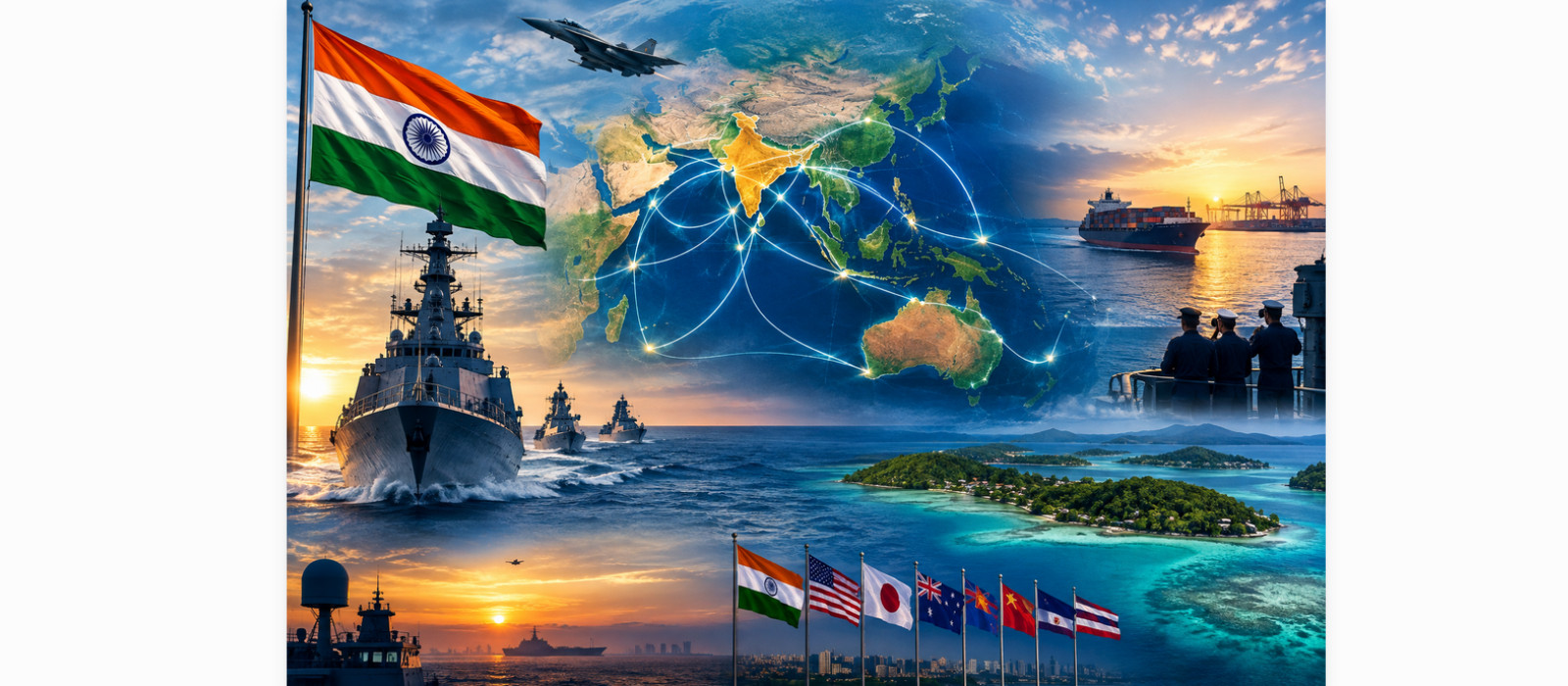


The pursuit of security, stability and prosperity has always shaped the geostrategy of great powers. Lesser ones remain bound by the reality “...right, as the world goes, is only in question between equal powers; while the strong do what they can and the weak suffer as they must.”1 With a new ‘Great Game’ gathering momentum in Asia and India declaring its intention to be a significant player, the Indian Ocean (IO) and the needs of securing this vital frontier must be assessed from a ‘great power’ perspective. Failure to do so when European powers used control of the maritime commons to establish themselves in Asia, resulted in colonial darkness. Failure to do so with authoritarian China on the rise risks a similar fate.
This article delves into: -
-
Why the Indo-Pacific has emerged as the primary theatre of global geopolitical contestation and where the Indian Ocean fits in it.
-
The implications of the current Indo-Pacific ‘Great Game’ for India’s rise.
It does so under the following heads: -
-
The Indo-Pacific and the Indian Ocean
-
China’s thrust
-
America’s dilemma
-
India’s conundrum
-
Conclusion
The Indo-Pacific and the Indian Ocean
Oceans have two geopolitical attractions. The first is resources. UNCLOS 1982 and the advance of technology gave nations vast resource areas. Disputes about ownership of resources were inevitable, and it was only a matter of time before they spread to the high seas. In the absence of binding and enforceable dispute settlement, might has increasingly become the arbiter of the outcome, as in the South China Sea.
The other is as a ‘Global Common’ connecting nations. Though traditionally free to use, they need ‘maintenance’ to ensure they remain a mare liberum (open seas) and are not transformed into a mare clausum (closed seas).2,3 This maintenance encompasses three broad purposes. The first (benign purpose) is providing succour to users in distress, as well as aid to victims of natural/ political disasters. The second (constabulary purpose) comprises enforcing compliance with international law relating to sanctions, non-proliferation, illicit traffic (in arms, ammunition, drugs and people), piracy, terrorism, environmental pollution, illegal fishing etc. The third (military purpose) is projection of military power to ‘hot spots,’ enabling intervention to deter escalation of regional disputes to a level that jeopardises the international transportation system, as well as for stabilisation of an area. This last purpose necessitates Freedom of Navigation.4
Only a few nations possess the capacity to provide such maintenance. Those who can do so regionally become regional powers. Those who can do so on a global scale become great powers. Geography determines the areas they are prepared to contest to maintain sea lanes on their terms. During the colonial period, the most economically productive sea lanes ran across the Atlantic and Indian Oceans, so it was natural that these were contested. Following WW II, Europe and North America between them accounted for 66% of the world GDP till 1990.5 Great power contestation thus, focused on the Atlantic, while the Indian Ocean became a strategic backwater.
Asia, which accounted for just 20.7% of world GDP (nominal) in 1980, will generate 37.78% in 2021 and 40.06% by 2025.6 North America’s share shrank to 27.3% in 2021 and will reduce to 25.9% by 2025.7 The share of Europe too declined to 25.32% in 2021, and is projected to dip to 24.19% by 2025.8 In PPP terms, Asia already accounts for a greater share of world GDP (45.3%) than Europe and North America combined (40.71%).9 It is thus, natural that the oceans that bound Asia (the Indian and the Pacific, hence, the Indo-Pacific) should become the key focus for great power contestation. Political understanding of this reality led the USA to proclaim America’s Pacific Century and to ‘pivot’ to Asia.10,11
Within Asia, the economic boom has returned the IO and the South China Sea (SCS) to the heart of the global trading system. Energy from the world’s largest source of exportable hydrocarbons flows through it to power the economies of India, China, Japan and others, who constitute the Asian economic miracle. The IO connects industries of South, East and Southeast Asia with markets in Europe and the Atlantic coast of the Americas. Trade flows through the IO now exceed those through the Atlantic or Pacific. In 2018, the IO connected 12 of the 16 members of the trillion-dollar club.12 By 2033, 21 of the 25 members of the trillion-dollar club of that time will rely on it for trade connectivity. In comparison, only 12 such nations will depend on the Atlantic and 13 on the Pacific.
From the connectivity perspective, the Pacific (and Atlantic) will remain far more important than the IO for the USA. For Asia Pacific nations including China, the IO and Western Pacific constitute their energy highway and connection to markets, but the Pacific enables USA access for stability. Both are thus, vital. For India and its freedom, however, the IO is economically central and strategically existential, while the Pacific and Mediterranean are less so. This reality must govern India’s strategic thought.
China’s Thrust
Geopolitical concerns about China’s emergence on the world stage were expressed by Sir HJ Mackinder and Samuel Huntington, among others.13,14 The statements, “China is using economic inducements and penalties, influence operations, and implied military threats to persuade other states to heed its political and security agenda,” and “China has mounted a rapid military modernisation campaign designed to limit USA’s access to the region and provide China a freer hand there” vindicate the strategic foresight of both.15
China, which had for long hidden its strength and bided its time, is now “obsessed with expanding Chinese rights to whatever extent possible, even at the cost of roiling regional tensions.”16 Xi Jinping’s vision of global supremacy encompasses a three phase strategy.17 The first is catching up to USA and playing a key role in global affairs. The second is leading the world as an equal partner (with USA). The third is assuming the leadership role.18 An equal partnership - the present stage - necessitates China becoming Asia’s unquestioned leader. This requires subduing potential Asian competitors and establishing unquestioned dominance over Asia’s two maritime connectors: the Western Pacific and Indian Ocean.
Politically, China’s seizure and militarisation of the SCS islands and the imposition of its domestic law over exploitation of SCS resources gives it a secure springboard into the Indian Ocean and “the ability to control the South China Sea and cut off the flow of trade, finance, and communications in South East Asia.”19 It is now pushing ASEAN states into granting it de facto veto authority over who they can partner with for security and resource exploitation. Its lack of respect for treaty law is visible in its flouting a binding award by the Permanent Court of Arbitration,20 disregard of treaty commitments under various articles of UNCLOS, as well as of Article 3 of the Sino-British Joint Declaration on Hong Kong.21 It is now ramping up pressure over the Senkaku Islands, using ‘Grey Zone’ measures including its recent Coast Guard law.22 It could try to forcibly take control over Taiwan before the end of the decade.23 This successful strategic approach can be expected to extend to the IO as China’s power grows.
Economically, China’s GDP (PPP) in 2019 was over $24.1 trillion, compared to $20.8 trillion for the USA.24 It is the only major world economy to show growth in 2020.25 Some project that it’s nominal GDP will overtake that of the USA in 2026, two years earlier than anticipated.26 It is the world’s top trading nation, displacing the USA, and does not hesitate to deny its market to coerce others. Australia provides the most recent example.
China imported 506 million tonnes of crude and 96.56 million tonnes of natural gas in 2019.27,28 About 80% of this transited through the Indian Ocean.29 Its resource interests in Africa have been extensively documented; these too must pass through the IO en route to China. So must its exports destined for Africa, Western Europe, the Middle East, South Asia and the USA. The IO is the focus of the Maritime Silk Road. The attendant investment (and the returns this provides), the markets it develops for China’s exports and the employment it provides to Chinese populace are all critical interests. It is thus, only a matter of time before a strategically insecure Beijing focuses on establishing its unchallenged writ in the IO, where strong constituencies in its favour have already been created.
Militarily, it possesses the world’s largest navy, coast guard, maritime militia, merchant fleet and fishing fleet, all of which are increasingly visible in the IO. It has abandoned “the traditional mentality that land outweighs the sea” and visibly attaches great importance “to managing the seas and oceans and protecting maritime rights and interests.”30 China is conscious that it needs to secure its Sea Line of Communication (SLOCs) from source to destination and cannot free-ride on provision of these public goods by others, particularly in the IO. So it has effectively brought military-ruled Pakistan into its strategic orbit, established its first overseas base in Djibouti and created a network of dual use facilities that will provide logistic and maintenance support for forward deployed maritime forces throughout the IO. A marine expeditionary force of 100,000 personnel, backed by extensive high volume sea and air lift capability, will help secure its expanding interests in the IO.31
These realities directly impact the power balance in the IO. Lee Kuan Yew had observed, “the size of China’s displacement of the world balance is such that the world must find a new balance. It is not possible to pretend that this is just another big player. This is the biggest player in the history of the world.”32 China’s growing displacement also impacts the IO, where India’s dominant geographic position, social and cultural linkages with the peoples of the IO rim, reasonably well-developed maritime capability and aspirations to be an Asian pole are all affronts to the China dream. The recent Ladakh crisis was not just a territorial grab, but also an attempt to damage India’s international credibility, as in 1962. It did not succeed, but China’s leaders have shown the ability to persevere. They will explore other areas in which to diminish India’s growing international clout, exploiting opportunities in the ‘Grey Zone,’ available in plenty in the IO. India can either act decisively to re-establish the balance, or fade back into the strategic insignificance that was its choice for at least five decades after 1962.
America’s Dilemma
At the turn of the century, in what commentators now acknowledge was a mistake, the USA accorded China “permanent normal trade relations” status.33 The intent was to incorporate “the biggest player in the history of world” into the US-led global order as a “responsible stakeholder.”34 The decision, however, opened the floodgates for investment into China and launched the economic boom that turned its economy into the industrial powerhouse it is today.
That a rising China could eventually challenge the US-led world order did not escape strategic thinkers. Apart from Mackinder and Huntington, Andrew Marshall foresaw that China’s military modernisation threatened US military power projection (and primacy) in the Asia-Pacific.35 The April 2001 EP-3 Aries incident made clear the hard-line attitude of China’s leadership as well as its intention to bring the near seas under its authority.36America’s 2001 Defense Strategy Review conceptualised a two-pronged strategy, comprising economic incentives to lure China towards prosperity, and balancing mechanisms (spelt out in the Quadrennial Defense Review of 2001) to hedge against authoritarian tendencies.37,38 Hedging included creation of the Quad, increasing “aircraft carrier battle group presence in the Western Pacific,” and home-porting an additional three to four surface combatants and guided cruise missile submarines in that area.”39 Thus, the American pivot to Asia began during the Bush presidency, long before Obama claimed political credit for it.40
However, 9/11 and the need to enlist China’s support for the ensuing ‘war on terror,’ as well as issues such as climate change created a distraction. Overconfident about the power disparity, successive administrations, focused on wooing China through the economic prong, and sidelined balancing. So, Obama’s 2015 National Security Strategy talked of “managing competition from a position of strength.”41 But, the US defense budget (in constant dollars) declined from a high of $752.3 billion and 4.8% of GDP in 2011 to $633.8 billion and 3.5% of GDP in 2015.42 Meanwhile, China’s defence spend rose from $138 billion to $214 billion.43 The deployable strength of the US Navy declined from 289 ships in 2012 to 271 in 2015, even as the PLA (Navy) enhanced its ability to control the near seas and deny access to the USA.44,45 It is noteworthy that till 2015, the US Maritime Strategy was still “A Cooperative Strategy for 21st Century Seapower,” signifying focus on cooperation rather than competition. Allies (or “vassals and tributaries”) in Europe and East Asia, hooked on US security, blindly followed suit.46
When Trump assumed office, he faced three realities. The first was that liberal internationalism was out of tune with the current age.47 Having reinvented its authoritarian system, China had become the global engine of growth, attracting even traditional US allies like the Philippines and Thailand. Parts of Europe, Africa and South Asia, are also in its orbit, displacing the USA as the largest trading partner for much of Eurasia. The second was that rapid narrowing of the power gap had resulted in China asserting itself through economic and ‘Grey Zone’ coercion, while remaining below the threshold for conflict, a strategy for which the USA had no counter. The third was that China’s military growth and area denial capability had substantially eroded US ability to maintain access to allies and frontline states in East Asia, resulting in loss of influence and insecurity. This would be brought out through successive Institute of South East Asian Studies (ISEAS) State of South East Asia Survey Reports and allies repeatedly seeking assurances regarding the applicability of Article 5 commitments to disputed islands.48
These realities dictated acknowledgement that the strategic path adopted by the USA was incapable of maintaining American primacy; the necessity of an alternate strategy that could do so; and gaining buy-in for it from all stakeholders. It is to Trump’s credit that he started the USA on this path, even though through questionable methods. The new strategic direction became visible in Rex Tillerson’s address at the Centre for Strategic and International Studies (CSIS) in October 2017.49 He called out China for undermining the international rules-based order even as “India operated under a framework that protected other nations’ sovereignty.”50 Trump’s speech at the Asia-Pacific Economic Cooperation (APEC) CEO’s Summit at Da Nang a month later reiterated the change of tack.51 The National Security Strategy of December 2017 stated for the first time, “a geopolitical competition between free and repressive visions of world order is taking place in the Indo-Pacific region.”52 A prematurely declassified US Strategic Framework for the Indo-Pacific spelled out the chosen strategic path.53
Strategy formulation is, of course, a time-consuming process. The strategy for the last US great power competitor, the Soviet Union, started with the Truman Doctrine in March 1947.54 It transitioned through National Security Council Paper NSC 68 in April 1950.55 It went through Project Solarium leading to NSC 162/2, which formalised the strategy of containment in October 1953.56 The situation today is far more complex, particularly due to China’s deep economic linkages not just with the USA, but also with its allies and partners in the Asia-Pacific.
Biden’s Interim National Security Guidance follows the changed direction initiated by Trump. However, action to resource the strategy has been patchy and overly reliant on military-led confrontation without the ability to deploy overwhelming power. There is also the ever present conflict between business and security interests. Having not only allowed the Chinese dragon out of a well-constructed pen, but also enabled its growth to uncomfortable dimensions, America’s dilemma lies in finding ways to at least balance its burgeoning power, if not corral it again, while it gets its act together and shapes a coherent strategy for the future.
A yawning chasm exists between America’s political vision and the means available to realise it. The gap encompasses the impact of, among others: -
-
Demonstrated strategic myopia and delusions regarding the ‘End of History’ during the unipolar period, which prioritised populism and liberalism above the needs of strategic balancing, allowing China to narrow the capability gap.
-
The continued retention of unipolar dogma and habits in a world visibly trending towards multi-polarity.
-
Vested interests including those of a military-industrial complex that generate excessive dependence on military measures to deal with a great power competitor and downplay numerous other US capabilities, notwithstanding the Cold War lesson that military conflict with a peer great power in a nuclear era is unthinkable.
-
China’s A2AD and growing military might that generates acute discomfort about a conflict amongst countries.
-
The continued inability to find a way to effectively deter ‘Grey Zone’ coercion without risking a war that many in the USA itself acknowledge is unwinnable.
-
The credibility gap created by the US disregard for international law (as for example in non-ratification of UNCLOS) and penchant for regime change through coercion or subterfuge, or unilateral sanctions based on the use of domestic law to override international commitments and agreements. Examples of the former range from Egypt (1952), Iran (1953), Guatemala (1954), Libya (2011) and Syria (2012), while examples of the latter include threats and actions under CAATSA and the Nordstream II pipeline.
As is evident from the Anchorage meeting between Blinken, Sullivan, Yang Jiechi and Wang Yi, China has no intention of submitting to US diktats. Earlier unipolar delusions and dreams of incorporating China as a responsible stakeholder lie in tatters. An effective counter-strategy, depending primarily on allies and partners in Asia will be needed. The recent Quad Summit and Lloyd Austin’s visit to India are steps in the right direction. However, whether Biden possesses the sagacity and strategic clarity required to overcome past shortcomings and deliver on his Indo-Pacific commitments remains to be seen. A long road lies ahead.
India’s Conundrum
India has long been accused of being sea-blind. PM Modi’s SAGAR vision of March 2015, however, displays strategic clarity for India to: -57
-
Safeguard the mainland, islands and defend India’s interests while ensuring a safe, secure and stable Indian Ocean Region (IOR).
-
Deepen economic and security cooperation with maritime neighbours and island states and build their capacities.
-
Focus on collective action, with those who live in the region assuming primary responsibility for peace, stability and prosperity.
-
An integrated and cooperative future for the IOR.
Vision alone, however, is never enough to bring about prosperity or peace. It must be translated to reality in the face of ever-present challenges to both security and stability. The challenges must be assessed, suitablestrategies developed, resources allocated, structures created and responsibilities assigned.

Table 1: Ocean-Going Warship Strength - India and China58
It is the challenges to stability posed by revisionist nation states within the IO that pose the existential challenge to India’s regional power aspirations. These must be the first concern. Others including the revisionist challenge outside the IO are important, but not existential. The maritime power asymmetry against China is brought out in Table 1. To overcome this asymmetry, it becomes necessary to assess the extent of support that can be expected from partners, including the Quad.
The Trump administration’s National Security Strategy states, “we will deepen our strategic partnership with India and support its leadership role in Indian Ocean security and throughout the broader region.” A desired end state identified in the declassified US Strategic Framework for the Indo-Pacific is, “India remains preeminent in South Asia and takes the leading role in maintaining Indian Ocean security, increases engagement with Southeast Asia, and expands its economic, defense and diplomatic cooperation with other US allies and partners in the region.” The Pentagon’s Indo-Pacific Strategy Report of June 2019 describes the challenges faced by the IOR as including “terrorism, transnational crime, trafficking-in-persons, and illicit drugs,” but does not touch upon coercive challenges. It describes the areas of maritime security collaboration with India as encompassing “domain awareness, HADR, counter-piracy, counter-terrorism, and other transnational issues.”
Reading into the above words, limiting perceived challenges in the IOR to constabulary ones is significant. Moreover, conceding the lead role in any sea-space it considers vital, is something that the USA has never done or is likely to do. The conclusion is that the USA does not consider the IO as vital. Given the nuclear factor, it would be unrealistic to expect the USA to risk entanglement in potential conflict stemming from Chinese coercion in the IO. Diplomatic, intelligence, technological and even materiel support may be forthcoming, but military support must be considered unlikely.
Add to this the fact that while there is substantial writing in American think tank space about enhancing US conventional deterrence in the Asia Pacific, there is practically none about doing so in the IO. There is the occasional plea for the USA to take up a greater role in the IO, but little visible action.59 Calls for restoration of the US First Fleet have yet to be acted on.60 The inescapable conclusion is that the USA is comfortable outsourcing concerns about IO stability and security to India.
The situation with other Quad partners is no different. Japan, constrained by Article 9 of its constitution and dependent on the USA for its own security, is hardly likely to countenance involvement of its own volition in a military adventure, in the faraway IO. The India-Japan Vision 2025 statement talks loftily of principles underlying the partnership, strengthening the bilateral defence relationship and SLOCs in the SCS, but stops short of making any commitment towards security of India’s interests in the IO.61 The India-Australia vision for maritime cooperation speaks of challenges such as “terrorism, piracy, drugs and arms smuggling, irregular migration, people smuggling, trafficking in human interests in the IO beings, poaching in maritime species, narcotics trafficking and IUU fishing,” but is silent on coercive challenges from nation states.62 Exercise Malabar indicates that there may be a possibility of future growth in the security relationship with the three partners, but this would be contingent upon India becoming an ally and surrendering its vaunted strategic autonomy.
India must, therefore, accept that the primary responsibility to defend its interests in the IO will have to be borne by itself. Help from other partners is welcome, but cannot be depended upon. The conundrum India faces is deterring the game of ‘chicken’ China uses to attain its ends while remaining below the threshold of conflict, in multiple domains. This will impact not just India’s territory, but also that of IO nations, and is crucial to India’s regional interests. It must be played in a highly trafficked international highway, passing through a global no-man’s-land, where smaller nations would find it easier to submit than to risk their nation being turned into a battleground. It must be played without allowing escalation to a level where China’s asymmetric military power advantage, industrial capacity (including shipbuilding) and economic might would prove decisive.
Significantly, India’s existing maritime security strategy, although aware of the prospect of grey zone coercion, does not provide guidance on deterring it.63 The mission-based deployment pattern of the Indian Navy and its “first responder” approach to frequent humanitarian crises in the IO indicate that the leadership is alive to the needs. However, presence alone will not suffice. There is need to also develop the ability to scale it up sufficiently to prevent a fait accompli, which would be well-nigh impossible to overturn. Eastern Ladakh was only a precursor of what will happen with a more assertive China.
India must, therefore, build two distinct IO security architectures. The first, intended to enhance its regional influence, involves mechanisms to tackle non-traditional challenges to security (challenges from nature/ accident and sub/ non-state actors), as well as from regional disputes not involving great powers. This will necessarily be multilateral and can be based on structures such as Indian Ocean Rim Association (IORA) and Indian Ocean Naval Symposium (IONS), which are already in existence. The second is to dissuade/ deter coercive action by a revisionist great power. Unless India is willing to compromise its strategic autonomy and enter into an alliance, it must depend primarily on its own capability for this purpose. While the help of other nations must be welcomed, allowing it to become a crutch in India’s security calculations could be as dangerous as the ‘forward policy’ of 1962 and risk the same strategic surprise and diminution in India’s influence.
Visible progress has been made in the articulation of a holistic vision, establishment of domain awareness structures, mechanisms for extended reach and maintenance of an ocean-wide presence. However, as brought out by this author separately, there is a large gulf between stated IO policy and provision of the resources required for its execution.64 The causes are well-known. The outcome is that visible gaps remain in India’s maritime capability that an adversary can and will exploit. Having withstood China’s coercion in Ladakh without allowing the situation to drift into a catastrophic conflict, it would be a folly to continue leaving these gaps.
Conclusion
The rise of Asia has turned the Indo-Pacific into the primary theatre of geopolitical contestation. For Eurasia, it has returned the IO to its former position in the ‘Maritime Silk Road’ that brought prosperity to all its users. So long as Asia remains dependent on hydrocarbons for energy, this status will not change. For the USA, however, the IO is mainly a transit corridor between INDO-PACOM and CENTCOM.
China, confident of its ability to deter and prevent US intervention on its Pacific front, will necessarily turn to establish its dominance over the IO. The foundations to turn this space into an eventual Chinese lake, by way of a secure South China Sea springboard, strengthened relationships throughout the IO littoral, a long-term maritime presence and a string of dual use ports, have been laid. The USA’s focus will remain on countering China’s advances across the Pacific (Asian allies constitute the strategic beachhead to keep the fight confined to Asia), but that of India must be balancing China’s strategic gains in the IO. Continuing to treat it as a strategic backwater, risks incurring the same consequences as when British power established itself in this space. Focused on its territorial security and not yet alive to the brewing challenge to the security of its future prosperity, India has a lot of catching up to do.
It needed a maverick like Trump to realise that China could not be socialised and turned into a responsible stakeholder. He started the process of adoption of a balancing strategy that would constrain its vaulting ambition. Given the unprecedented expansion of China’s maritime power and its ‘Grey Zone’ strategy, the USA will be stretched to counter it even in the Western Pacific. Even another maverick would find it difficult to divert resources to defending the IO. This is probably why India may continue to have the lead role in this space. The most India can reasonably expect is diplomatic and intelligence support, technological assistance, and measures to extend its reach.
However, India is yet to politically grasp that while external powers have an interest in defending common (constabulary) interests in the IO, they will be of little help in the coming game of maritime “chicken.” This is a game in which its own capability will matter, not the illusory promise of help. India must balance its preponderant focus on territorial security with investment in securing its future prosperity, which depends on its ability to stand up to future coercion. So like China, India too must abandon its overwhelming focus on territorial defence and strengthen its ability to do heavy lifting throughout the IO, just as it had to do in Ladakh. As in Ladakh, both presence and the ability to scale up power quickly will prove crucial.
While India’s political leadership has grasped this reality, the requisite strategy has yet to be formulated and resources to enable it allocated. Vested interests, China’s machinations and dogma conspire to focus India’s attention on land. Strategies take time to develop and execute, as the US experience proves. Whether India continues to rise or falters in the years ahead will depend largely on whether its line Ministries - Defence, Finance and External Affairs - can be made to conceptualise and execute an integrated security strategy.
Endnotes
-
Thucydides, “The History of the Peloponnesian War,” Project Gutenberg, 07 February 2014,153. https://www.gutenberg.org/files/7142/7142-h/7142-h.htm, accessed 15 October 2020.
-
Hugo Grotius, Commentary on the Law of Prize and Booty (Indianapolis: Liberty Fund, 2006). https://oll.libertyfund.org/title/ittersum-commentary-on-the-law-of-prize-and-booty, accessed 20 October 2020.
-
The counter argument adduced by John Selden, to substantiate the claim by certain nations to exclusive ownerships of areas of the open sea or ocean.
-
Lalit Kapur, “Freedom of Navigation: Different Strokes for Different Folks,” DPG Policy Brief vol. 3, no. 4 (2018, March). https://www.delhipolicygroup.org/uploads_dpg/publication_file/freedom-of-navigation-different-strokes-for-different-folks-1083.pdf, accessed 20 November 2020.
-
“Real GDP Growth,” International Monetary Fund, 2021. https://www.imf.org/external/datamapper/NGDPD@WEO/OEMDC/ADVEC/WEOWORLD, accessed 15 December 2020.
-
Ibid.
-
Op Cit., n.5.
-
Op Cit., n.5.
-
Op Cit., n.5.
-
Hillary Clinton, “America’s Pacific Century,” Foreign Policy, 11 October 2011.https://foreignpolicy.com/2011/10/11/americas-pacific-century/, accessed 11 October 2020.
-
Statement by President Obama to Australian Parliament, made on 17 November 2011. https://obamawhitehouse.archives.gov/the-press-office/2011/11/17/remarks-president-obama-australian-parliament, accessed 15 December 2020.
-
Author’s research.
-
HJ Mackinder, “The Geographical Pivot of History,” The Geographical Journal vol. 23, no. 4 (1904, April), 314.
-
Samuel P Huntington, “The Clash of Civilizations,” Foreign Affairs (Summer, 1993). https://www.foreignaffairs.com/articles/united-states/1993-06-01/clash-civilizations, accessed 05 December 2020.
-
“National Security Strategy of the United States of America,” The White House, December 2017. https://trumpwhitehouse.archives.gov/wp-content/uploads/2017/12/NSS-Final-12-18-2017-0905.pdf, accessed 05 December 2020.
-
Feng Zhang, “Chinese Thinking on the South China Sea and the Future of Regional Security,” Political Science Quarterly vol. 132, no. 3 (Fall, 2017), 448.
-
Liu Mingfu, “The World is Too Important to be Left to America,” The Atlantic, 04 June 2015. https://www.theatlantic.com/international/archive/2015/06/china-dream-liu-mingfu-power/394748/, accessed 05 December 2020.
-
Ibid.
-
Admiral Philip S Davidson, “Keynote Address at CSIS Third Annual China PowerConference,” Center for Strategic and International Studies, 29 November 2018.https://csis-website-prod.s3.amazonaws.com/s3fs-public/publication/181130_Keynote%20 Address%20by%20Admiral%20Philip%20S.%20Davidson_0.pdf, accessed 05 December 2020. 20 South China Sea Arbitration, PCA Case No.2013-19, Permanent Court of Arbitration, 12 July 2016. https://www.pcacases.com/pcadocs/PH-CN%20-%2020160712%20-%20Award.pdf,accessed 20 November 2020.
-
“Sino-British Joint Declaration,” Chinese Government’s Official Web Portal, 14 June 2007. http://english1.english.gov.cn/2007-06/14/content_649468.htm, accessed on 20 November 2020.
-
The law permits the PLA Coast Guard to use force to ensure that China’s jurisdiction prevails even in disputed territory.
-
Mallory Shelbourne, “Davidson: China Could Try to take Control over Taiwan in Next Six Years,” USNI News, 09 March 2021. https://news.usni.org/2021/03/09/davidson-china-could-try-to-take-control-of-taiwan-in-next-six-years, accessed 15 March 2021.
-
“World Economic Outlook database,” International Monetory Fund, October 2020. https://www.imf.org/en/Publications/WEO/weo-database/2020/October, accessed 21 January 2021.
-
“China Remains World’s Largest Trading Nation in Goods: Customs,” CGTN, 29 January 2021. https://news.cgtn.com/news/2021-01-29/China-remains-world-s-largest-trading-nation-in-goods-customs-Xr9Viim84U/index.html#:~:text=China%20maintained%20its%20position %20as,country's%20customs%20regulator%20said%20Thursday, accessed 05 October 2020. 26 Evelyn Cheng and Yen Nee Lee, “ New Charts Shows China Could Overtake the US as the Worlds Largest Economy Earlier than Expected,” CNBC , 31 January 2021 . https://www.cnbc.com/2021/02/01/new-chart-shows-china-gdp-could-overtake-us-sooner-as-covid-took-its-toll.html, accessed 15 February 2021.
-
“China’s 2019 Annual Crude Imports Set Record for 17th year,” Reuters, 14 January 2020. https://www.reuters.com/article/us-china-economy-trade-crude/chinas-2019-annual-crude-imports-set-record-for-17th-year-idINKBN1ZD0CI, accessed 15 October 2020.
-
Cindy Liang, “China’s Dec 2019 Gas Import Growth Slows on Weak Demand, Higher Domestic Production,” SP Global, 15 January 2020. https://www.spglobal.com/platts/en/market-insights/latest-news/natural-gas/011520-chinas-dec-2019-gas-import-growth-slows-on-weak-demand-higher-domestic-production, accessed 10 October 2020.
-
Estimate by Author Based on Media Reports.
-
“China’s Military Strategy,” The State Council, The People’s Republic of China, 26 May 2015. http://english.www.gov.cn/archive/white_paper/2015/05/27/content_281475115610833.htm, accessed 15 November 2020.
-
Captain Michael A Hanson, “China’s Marine Corps is on the Rise,” USNI Proceedings vol. 146/4/1406 (2020, April). https://www.usni.org/magazines/proceedings/2020/april/chinas-marine-corps-rise, accessed 15 November 2020.
-
Graham Allison, “The Thucydides Trap: Are the US and China Headed for War?,” The Atlantic,24 September 2015. https://www.theatlantic.com/international/archive/2015/09/united-states-china-war-thucydides-trap/406756/, accessed 15 February 2021.
-
Reihan Salan, “Normalising Trade Relations With China was a Mistake,” The Atlantic, 08 June 2018. https://www.theatlantic.com/ideas/archive/2018/06/normalizing-trade-relations-with-china-was-a-mistake/562403/, accessed 15 February 2020.
-
Briefing by Deputy Secretary of State Robert B Zoellick to National Committee on US-China Relations, made on 21 September 2005.https://2001-2009.state.gov/s/d/former/zoellick/rem/53682.htm, accessed 20 December 2020.
-
Nina Silvoe, “The Pivot before the Pivot: US Strategy to Preserve the Power Balance in Asia,” Quarterly Journal: International Security vol. 14, no. 4 (Spring, 2016).https://www.belfercenter.org/publication/pivot-pivot-us-strategy-preserve-power-balance-asia, accessed 20 November 2020.
-
“China-US Aircraft Collision Incident of April 2001: Assessment and Policy Implication,” Congressional Research Service, 10 October 2001.https://crsreports.congress.gov/product/pdf/RL/RL30946, accessed 15 February 2021.
-
US Government, “Hearing before the Committee on Armed Services United States Senate,” Defence Strategic Review, 21 June 2001. https://www.govinfo.gov/content/pkg/CHRG-107shrg82316/html/CHRG-107shrg82316.htm, accessed 11 December 2020.
-
Department of Defense, United States of America, Quadrennial Defense Review Report, 30 September 2001. http://www.comw.org/qdr/qdr2001.pdf, accessed 11 December 2020.
-
Statement by President Obama to the Australian Parliament, made on 17 November 2011. https://obamawhitehouse.archives.gov/the-press-office/2011/11/17/remarks-president-obama-australian-parliament, accessed 11 December 2020.
-
Ibid.
-
“National Security Strategy,” The White House, February 2015. https://obamawhitehouse.archives.gov/sites/default/files/docs/2015_national_security_strategy_2.pdf, accessed 11 December 2020.
-
“Military Expenditure by Country, in Constant (2018) US$ m 1988-2019,” SIPRI, 2020. https://www.sipri.org/sites/default/files/Data%20for%20all%20countries%20from%201988%E 2%80%932019%20in%20constant%20%282018%29%20USD.pdf, accessed 20 November 2020.
-
Ibid.
-
Erin Duffin, “Total Deployable Battle Force Ships of the U.S. Navy for the Fiscal Years 2011 to 2021,” Statista, 05 March 2021. https://www.statista.com/statistics/239316/total-deployable-battle-force-ships-of-the-us-navy/, accessed 20 April 2021.
-
“China Naval Modernization: Implications for U.S. Navy Capabilities - Background and Issues for Congress,” CSR Report L33153, Congressional Research Service, 17 December 2020. https://crsreports.congress.gov/product/pdf/RL/RL33153/247, accessed 20 April 2021.
-
Zbignew Brzezinski, The Grand Chessboard (USA: Basic Books, 1997), 6-23.
-
Walter Russel Mead, “The End of the Wilsonian Era,” Foreign Affairs (2021, January/February). https://www.foreignaffairs.com/articles/united-states/2020-12-08/end-wilsonian-era, accessed 20 April 2021.
-
“State of Southeast Asia Survey,” ISEAS Yusof Ishak Institute. https://www.iseas.edu.sg/category/articles-commentaries/state-of-southeast-asia-survey/, accessed 20 April 2021.
-
“Defining Our Relationship with India for the Next Century: An Address by US Secretary of State Rex Tillerson,” Center for Strategic and International Studies, 18 October 2017. https://csis-website-prod.s3.amazonaws.com/s3fs-public/publication/171018_ An_Address_by_U.S._Secretary_of_State_Rex_Tillerson.pdf, accessed 20 April 2021.
-
Ibid.
-
Remarks by President Trump at APEC CEO Summit, made on 10 November 2017. https://trumpwhitehouse.archives.gov/briefings-statements/remarks-president-trump-apec-ceo-summit-da-nang-vietnam/, accessed 25 October 2020.
-
Op Cit., n.16.
-
“US Strategic Framework for the Indo-Pacific,” The White House. https://trumpwhitehouse.archives.gov/wp-content/uploads/2021/01/IPS-Final-Declass.pdf, accessed 20 April 2021.
-
“The Truman Doctrine 1947,” Office of the Historian. https://history.state.gov/milestones/1945-1952/truman-doctrine, accessed 05 December 2020.
-
“National Security Council Paper NSC-68 1950,” Office of the Historian. https://history.state.gov/milestones/1945-1952/NSC68, accessed 05 December 2020.
-
“Report to the National Security Council by the Executive Secretary,” Office of the Historian,30 October 1953. https://history.state.gov/historicaldocuments/frus1952-54v02p1/d101,accessed 05 December 2020.
-
“Modi’s SAGAR Speech,” Press Information Bureau, 12 March 2015.http://www.pib.gov.in/newsite/erelcontent.aspx?relid=116881, accessed 15 December 2020.
-
CRS Report RL 33153, Congressional Research Service, 09 March 2021, https://crsreports.congress.gov/product/details?prodcode=RL33153, accessed 20 April 2021.
-
Aman Thakkar and Arun Sahgal, “US-India Maritime Security Cooperation,” Center for Strategic and International Studies, October 2019. https://www.delhipolicygroup.org/uploads_dpg/publication_file/us-india-maritime-security-cooperation-1206.pdf, accessed 15 December 2020.
-
Megan Eckstein, “SECNAV Bratiwaite Calls for New US 1st Fleet Near Indian, Pacific Oceans,” USNI News, 17 November 2020. https://news.usni.org/2020/11/17/secnav-braithwaite-calls-for-new-u-s-1st-fleet-near-indian-pacific-oceans, accessed 15 December 2020.
-
Ministry of External Affairs, Government of India, “Joint Statement on India and Japan Vision 2025: Special Strategic and Global Partnership Working Together for Peace and Prosperity of the Indo-Pacific Region and the World,” 12 December 2015. http://www.mea.gov.in/bilateral-documents.htm?dtl/26176/Joint_Statement_on_India_and_Japan_V ision_2025_Special_Strate gic_and_Global_Partnership_Working_Together_for_Peace_and_Prosperity_of_the_IndoPaci fic_R, accessed 15 December 2020.
-
Ministry of External Affairs, Government of India “Joint Declaration on a Shared vision for Maritime Cooperation in the Indo-Pacific Between the Republic of India and the Government of Australia,” 04 June 2020. https://mea.gov.in/bilateral-documents.htm?dtl/32730/Joint_ Declaration_on_a_Shared_Vision_for_Maritime_Cooperation_in_the_IndoPacific_Between_t he_Republic_of_India_and_the_Government_of_Australia, accessed 10 October 2020.
-
Ensuring Secure Seas: Indian Maritime Security Strategy [New Delhi: IHQ MoD (Navy), 2015].
-
Lalit Kapur, “Operationalising SAGAR: Bridging the Gap Between Policy and Execution,” Delhi Policy Group, 11 July 2020. https://www.delhipolicygroup.org/publication/policy-briefs/operationalising-sagar-bridging-the-gap-between-policy-and-execution.html, accessed 10 October 2020.
