




Lt Cdr Abhishek Kesari's essay provides a good understanding of submarine telecommunication cables, their growing strategic significance to economic functioning, and efforts required to encourage unhindered access to internet for India in peace and war. In doing so, the author recommends involvement of government agencies to ensure security of this critical infrastructure. This commentary aims to provide more details to help better-informed decision making.
Today, submarine cables are central to globalisation and economic growth. As brought out aptly by the author, what began as an experiment to transmit a telegraph message between the Old and the New world in 1858, has slowly but steadily grown into a maze of cables criss-crossing the oceans. The resulting network is so intertwined (to ensure redundancy since cable breaks are natural) that any interruption in functioning of these cables can cause an internet slowdown. With 97 to 99% of internet traffic supported by submarine cables, they have rightly been recognised as ‘critical communication infrastructure’ by the UN General Assembly.1 The author however misses out the fact —— perhaps due to word limit restriction - that while new generation optic-fibre cables are added, obsolete ones continue to lie on the ocean floor, with some handed-over to scientists for operating Ocean Observatories,2 as their removal is uneconomical.
When discussing threats, the author seems to focus more on unintentional damage by earthquakes rather than clearly identifying that these cables are prone to damage by both intentional (dropping/ dragging of anchor or physical cutting) and unintentional (aging, earthquakes or fouling in a dragging anchor) actions alike. Damage can impact services like banking, airlines, e-commerce, and stock market thereby affecting the economy and security of connected nations. Since cables support voice and data of civilian and military requirements alike, geopolitical gameplays have brought to fore security related concerns.
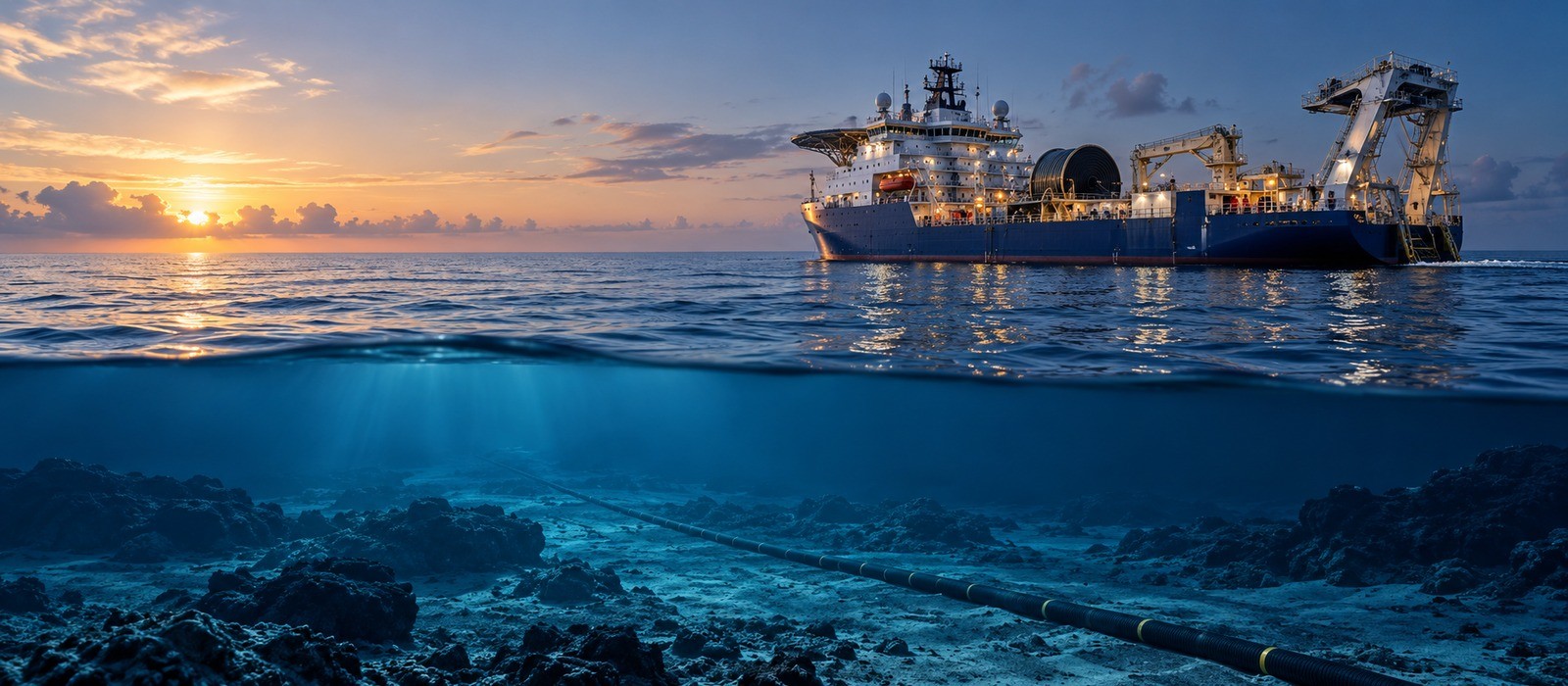
Ownership of these cables is another important aspect that has allowed their phenomenal growth; however, the author highlights this critical facet only in passing. It is important to mention that since 1858, when the first cable was laid, till today, these cables are privately owned wherein the project from cradle-to-tomb is handled by private entrepreneurs. The ownership, operation and subsequent maintenance of this infrastructure are the sole responsibility of these entrepreneurs. Since these cables transgress maritime boundaries, necessary administrative approvals and licences are essential for laying, operating and repairing activities which may vary from one country to another. Hence, while the internet and telecommunication infrastructure are commercial, it must adhere to the law of the nation where they operate. When in waters of national jurisdiction, the operators need to follow rules laid by that nation while in areas beyond national jurisdiction they need to adhere to UNCLOS. Being a specialised activity, cable laying and repairing is undertaken by privately owned specialised ships that are strategically positioned to allow mobilisation within 24 hours, but at a cost. This notwithstanding, governments realise the importance of this infrastructure and need for their security. With warfare slowly shifting to the cyber domain, evolving geopolitics and changing threat-landscape have forced some nations to develop cable cutting devices possibly to cripple the economy and military of their adversary while forcing others to look at means to provide security to the cables of interest.3
The legal regime for protecting a submarine cable has come a long way from the original 1884 Convention for Protection of Submarine Cables to the 1982 UNCLOS. Article 113 of UNCLOS obligates States to create an offence for the breaking or injury of a cable beneath the high seas or EEZ by their nationals or by a ship flying their flag, if such break was done wilfully or through culpable negligence. However, this provision has not been enacted into legislation by many states. The stipulated obligation is towards offence by nationals and ships flying one's own flag while UNCLOS remains silent on ships flying flag-of-convenience and terrorists or foreign nationals. Even with rising importance of cables, no review of this legal mandate has occurred. Additionally, there is no one responsible for law and policy on submarine cables, either in the UN or at the national level for most countries, that can set a national policy or look at ambiguities in the international legal regime. The disconnect is visible while granting licence and repair permissions, multiple agencies are involved with the lead time varying from 15 to 55 days to commence repairs.4 Even though legal and functional infirmities exist, the author has mentioned these using a broad-brush by referring to a web article of the National Maritime Foundation rather than incorporating them to strengthen his rationale for enhanced security.
Relevance to India
For a country like India, with a target of becoming a Viksit Bharat (Developed Nation) and the third largest economy, digitalisation is essential for economic and societal activities. The Indian IT enabled Services (ITeS) industry excels globally and requires uninterrupted connectivity to customers overseas. Any disruption can be problematic and economically distressing. This requires adequate protective measures for these submarine cables, an aspect that has been flagged aptly by the author.
The author does point out that India has 14 submarine cable systems either landing or transiting through its maritime zones5 along with 20 existing and planned cable landing sites (CLS). He could have examined data on the number of cable faults observed annually in jurisdictional waters of India and the high turn-around time required to address these faults, which is important for ensuring minimal disruptions in connectivity. Studies show that annual cable faults in Indian EEZ and Territorial Sea are largely at one or two repairs per year, but the mean time for repairs is a global second highest at nearly 50 days. This is attributed to several factors including clearances from various agencies spanning immigration, customs, economics, and safety and environmental concerns for vessels and personnel associated with repairs. However, delays, where cable repair companies must spend months and millions of dollars in processing permits can be counter-productive and may deter operators from linking their network to India. If this happens, internet speed in India would reduce drastically to impact its economic and social interests. Hence, existing cable repair philosophy needs review by balancing economic and security needs.
International Trends
In the last few years, security of submarine cables has been in the news. Accidental damage of cables in the Red Sea by the Houthis due to anchor dragging by a listing ship,6 damage to two Swedish cables in the Baltic Sea in mid-November 20247 by either a Chinese8 or a Russian merchant ship'9 and Taiwan charging Chinese vessels for damaging their submarine cables are some events that demonstrate increased possibility of nations to damage others’ submarine cables.10 The development of a subsea cable-cutter11 and subsequent development of a cable-cutter UUV12 by China13 makes it increasingly and more likely that submarine cables will be targeted in conflict as well as in the ‘grey zone.’ All this is part of cyber warfare in any case.
Security Mechanisms
By and large, cables are laid along common shipping routes that are loosely called International Shipping lanes. This prevents their damage from most anchoring ships. However, prevention against intentional damage requires collaborative mechanisms such as the “Quad Partnership for Cable Connectivity and Resilience’ through policy and action. As cable faults in EEZ and TS (Territorial Sea) are common, they need to be minimised through *Protective Zones’ as designated by Australia and New Zealand and rightly emphasised by the author. However, to maximise benefits, public awareness and education of coastal communities is essential.
CLS are another weak link, as rightly flagged by the author; however converting them into fortresses could make them more visible targets. Owners realise the importance of this infrastructure and associated cost of down-time and take adequate care to ensure appropriate security which may not be visible to the naked eye. This said, opportunities like establishing an Undersea Cable Maintenance Base14 should not be lost as it provides a means of developing greater influence within the region, and acquiring capacity and capability for cable repairs when required without dependence on an external agency thereby reducing the internet black-out window ‘created’ by the adversary.
Involving the Indian Navy or any other government agency for security of cable infrastructure -- as recommended by the author - should be avoided as it is contrary to the existing ethos of freedom of the internet.15 However, mechanisms for utilisation of services of specialised personnel, if required, should remain to instil faith in owners and operators during exigencies. Additionally, if threat to cables of interest is envisaged in international waters, the Indian Navy can be tasked to patrol the route as a deterrent.
The submarine cable map is an open-source document with an intention to provide information to mariners to avoid dropping an anchor inadvertently. This is akin to nautical charts used by mariners for safety of ships from known hazards. If a mariner decides to ground an oil tanker using nautical charts to cause environmental damage, it is against the practise ethos of due diligence. Similarly, submarine cable maps making cables vulnerable, as mentioned by the author, is against the requirement of due diligence against which security mechanism can never be established.
Effective management and understanding existing legal framework of submarine cables is possible only if a dedicated agency is established that can oversee this infrastructure. The Telecommunication Bill of 2023 not acknowledging the importance of submarine cables for telecommunication and internet can only be attributed to ‘maritime blindness’ which will change as policymakers realise the growing importance of the maritime domain for well-being and economic growth of India.
As we surround ourselves even more with digital equipment, dependence on internet and telecommunication will only increase. This will increase importance of these submarine cables and hence demand for security which to date has maintained neutrality and freedom. To ensure that neutrality and freedom continues, suitable international governance needs to be established. With the US and China vying to control standards of the digital world, an independent grouping of India and like-minded nations can come together outside existing regional or international mechanisms to initiate a debate on security of submarine cables. Efforts by Sri Lanka in this direction16 are praiseworthy but need be taken to a logical conclusion. While these efforts are difficult, they are not unachievable.
Endnotes
- United Nations, “Oceans and Law of the Sea,”" Adopted by the UNGA,UN Doc. A/RES/66/231,http://www.un.org/en/ga/search/view_doc.asp?symbol=%20A/RES/66/231.
- Nitin Agarwala, “Green Cables - Development, Opportunities and Legal Challenges: Part I," Maritime Affairs: Journal ofthe National Maritime Foundation of India, vol 14. no. 2 (2018): 49-
- Patent, “A Towed Submarine Cable Cutting Device and its Cable Cutting Method,” 2020, CN111203499A, https://patents.google.com/patent/CN111203499A/en.
- Ajnali Sugadev, “India's Critical Position in the Global Submarine Cable Network: An Analysis of Indian law and Practice on Cable Repairs,”’ Indian Journal of International Law, (2017).
- These include: FLAG Europe-Asia (FEA), India-Middle East-Western Europe (IMEWE), SEACOM /TGN Eurasia (TGNEA), Bay of Bengal Gateway (BBG), Gulf Bridge International Cable System (GBICS) / Middle East North Africa (MENA), SAFE,WARF Submarine Cable, Bharat Lanka Cable System, i2i Cable Network (12icn), Tata TGN-Tata Indicom, Europe India Gateway (EIG), FALCON, Sea-MeWe-3 (SMW3), Sea-Me-We-4 (SMW4).
- Dan Swinhoe, “The Houthis and the Red Sea: A New Risk to Subsea Cables,” Data Centre Dynamics, April 16, 2024, https://www.datacenterdynamics.com/en/analysis/the-houthis-andthe-red-sea-a-new-risk-to-subsea-cables/.
- Ryan Browne, “Undersea Cable Cuts in the Baltic Sea are Stroking Geopolitical Tensions - here's What is Going On,” CNN, November 28, 2024, https://www.cnbc.com/2024/11/28/ explainer-baltic-sea-undersea-cable-cuts-stoke-geopolitical-tensions.html.
- Miranda Bryant, and Pjotr Sauer, “Swedish Police Focus on Chinese Ship after Suspected Undersea Cable Sabotage,” The Guardian, November 20, 2024, https://www.theguardian.com/ world/2024/nov/20/sweden-denmark-undersea-cable-sabotage-navy-investigation.
- Sarah Shamim,"Did a Russian ‘Shadow Ship’Cut the Finland-Estonia Undersea Baltic cable?,"Al Jazeera, December 27, 2024, https://www.aljazeera.com/news/2024/12/27/did-arussian-shadow-ship-cut-the-finland-estonia-undersea-baltic-cable.
- Reuters, "Taiwan Charges Chinese Captain with Damaging Undersea Cables,” The Guardian, April 11, 2025, https://www.theguardian.com/world/2025/apr/11/taiwan-charges-chinesecaptain-with-damaging-undersea-cables.
- Patent, “A Towed Submarine Cable Cutting Device and its Cable Cutting Method."
- Stephen Chen, “China Unveils a Powerful Deep-Sea Cable Cutter That can Reset World Order,” South China Morning Post, March 22, 2025, https://www.scmp.com/news/china/science/article/3303246/china-unveils-powerful-deep-seacable-cutter-could-reset-world-order?module=perp etual_scroll_0&pgtype=article.
- Erin L. Murphy and Matt Pearl, “China's Undersea Power Play: The PRC's New Subsea https://www.csis.org/analysis/chinas-underwater-power-play-prcs-new-subsea-cable-cuttingship-spooks-international.
- “Sri Lanka Exploits India's Inefficiency to Anchor Subsea Cable Ambulance Fleet," LIRNEasia March 30, 2014, http://lirneasia.net/2014/03/sri-lanka-exploits-indias-inefficiencyto-anchor-subsea-cable-ambulance-fleet/.
- Internet freedom is an umbrella term that encompasses digital rights, freedom of information, the right to Internet access, freedom from Internet censorship, and net neutrality.
- Embassy of Sri Lanka, “Sri Lanka Launches the Submarine Cable Protection and Resilience Framework," July 15, 2021, https://srilankaembassy.fr/en/content/707-sri-lanka-launchessubmarine-cable-protection-and-resilience-framework.
