


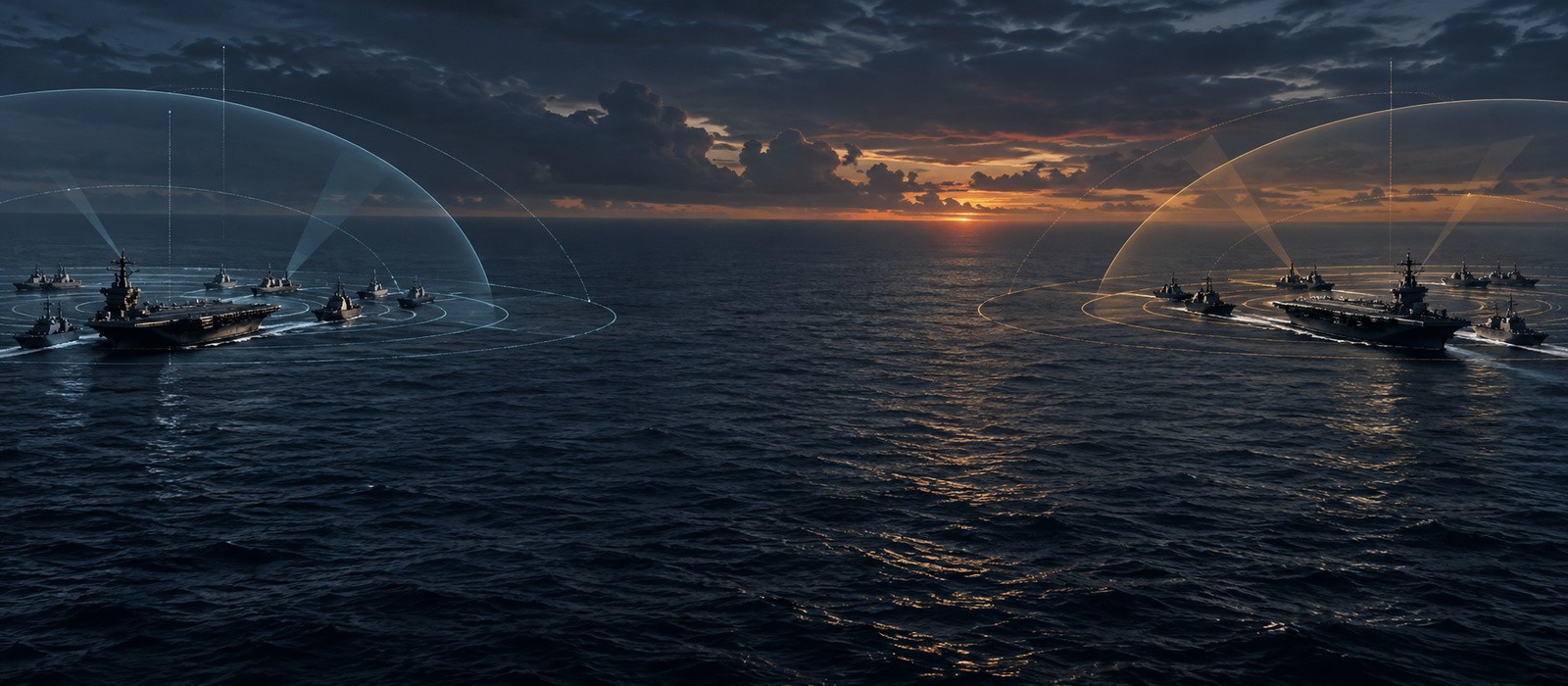


Indian Naval Despatch Spring 2023 - Volume 4 No. 1. “Small May be More Lethal: Indian Naval Force Structuring Considerations” byCdr Rohan Kulkarni.
Cdr Rohan Kulkarni’s essay is well written and extensively researched with mathematically derived tactical solutions towards countering a numerically and technologically superior adversary, China in our case. The concept of inducting smaller ships in lieu of larger platforms is clearly understood from the article, which is adequately supported by mathematical deductions in favour of the argument.
The Hughes Salvo Model used by him to propose a way ahead for the future structuring of the Indian Navy (IN) clearly determines that numerical superiority in combat would be very important in overcoming challenges against an assertive China. He cites the example of the Moskva, the Russian Cruiser and flagship, that suffered a serious missile attack in the Black Sea on 13 April 2022, and uses the model to highlight some of the likely underlying factors responsible for the ship’s sinking even when fitted with state-of-the-art Anti-Missile Defence (AMD) systems. The author mentions the possibility of lapses in training, alertness and crisis management onboard, compounded with ignorance of the developing situation and finally the reduced staying power of the ship to be primary reasons for her sinking.
The induction of smaller ships in the future force would benefit the IN to attain numerical superiority and somewhat reduce the life-cycle costs for smaller vis-a-vis larger ships. The author utilises the model and provides an example in the article to determine the Fractional Exchange Ratio (FER) showing that “if one force is twice the other force, keeping factors like scouting effectiveness, training etc. as constant for both forces, the other force needs to have twice the offensive, defensive and staying power to achieve parity.”
The choice between the more conventional methodology of induction of large warships and the incorporation of smaller ships in lieu is a difficult one given the current geopolitical scenario and operational requirements. The IN has had, in any case, a combination of larger destroyers and frigates as well as smaller frigates and corvettes. With China in our backyard and striding to dominate the Indian Ocean Region (IOR), retaining the status of a regional superpower demands maintaining a large force level that has more numbers of larger ships capable of operating at extended ranges. The Chinese are building a large number of frigates and corvettes, and so are the RN and the USN with newer classes that are smaller than the current large ones. Of course, even large ones are being built.
On applying the insight provided by the author in the article and integrating it with the limited specialist experience that I have with a service of 13 years, I agree with his view and acknowledge the requirement of a larger force to tackle the issue of China in the IOR. The Chinese warships however possess an overwhelming strike capability that necessitates the induction of larger ships in IN with a massive strike and defence capability in numbers equivalent to or more than the smaller ships currently. In view of the aforesaid, the following points could be borne in mind:
- With missile defence systems across all navies improving rapidly with technology advancements, the primary issue identified is the wide disparity between the missile carrying capacity of a ship and the required Weight of Attack against a larger ship for disabling/ destroying it in combat. Additionally, the induction of Type 055 destroyers of the Chinese Navy with Universal Vertical Launch Systems (UVLS) has deepened the offensive and defensive capability of the adversary significantly. The current force levels with the IN demand faster induction of warships with the capability of delivering a larger strike package, which would inevitably entail induction of destroyers/ cruisers as part of the future fleet of the Navy. With ‘Make in India’ at the forefront, the availability of indigenised technology, better than Chinese weapon technology, is not a far-fetched goal, as the brightest minds in the nation are working hard to achieve excellence in the related fields. However, numerical superiority in terms of weapon-carrying capability vis-à-vis Chinese ships would mandate an equivalence in the near future that can be achieved by the induction of new-age warships.
- Induction of smaller ships with limited offensive/ defensive capabilities would increase the requirement for the number of ships that would result in equivalent cost implications as in the case of a destroyer and above. As an example, a destroyer fitted with Medium Range Surface-to-Air Missiles (forward and aft) and a Short-Range Surface to Air/ Missile defence system, would require a larger missile package fired by the adversary as compared to a frigate with Medium Range Surface-to-Air Missiles (only forward) and a Short-Range Surface to Air Missile system. Also, the Surface-to-Air Missiles carrying capacity of a destroyer would be roughly 1.5 times higher than that of a frigate and below class of ship enabling a destroyer to fend off more numbers of inbound SSMs in a saturation attack. This would entail positioning additional smaller ships in lieu of larger ships to enhance the defence capability of the formation. For increasing the offensive capability (increasing missile capability through UVLS), smaller ships might not be able to incorporate a massive Surface to Surface Missile launch system due to space constraints. Therefore, in order to attack a large formation comprising Renhai and Luyang III ships of the Chinese Navy screening the main body during combat, the requisite number of frigate/ corvette equivalent platforms would result in a large formation of ships that would be easy to detect by enemy scouting, and might have inherent command and control issues to conduct a saturation attack, given the inherent problems arising from lack of data and information/ intelligence in war.
- The smaller ships are likely to possess better stealth capability and would be more difficult to detect in a spread formation/ when acting independently during a particular operation thereby reducing the efficacy of enemy scouting. However, the defence capability of smaller ships would be limited to AMD/ restricted Area Defence due to the paucity of space for fitment of full-scale Area Defence weapons (Medium Range/ Long Range Surface to Air Missiles and associated radars) available with destroyers and above class of ships. Further, if detected and identified correctly, the enemy consort platform would be able to close the ship/ formation with lesser hesitation and would be able to provide precise targeting data to the enemy and/or undertake a self- attack given limited/ nil Area Defence capability with the smaller platforms (given that the range of air-launched Anti-Shipping Missile (AShM) would be surely higher than that of an Anti-Missile Defence weapon). Also, the air element available with larger ships would be reduced with smaller ships, which may hamper operations at sea. This, in turn, may have an equivalent cost implication as that of a larger warship capable of undertaking multi-dimensional offensive operations including self and area defence simultaneously.
Induction of smaller platforms may improve the cost issues faced currently. However, in the longer run and considering the tactical requirements during combat, the combination of smaller and larger ships would be able to shape the outcome of combat in our favour. Therefore, it is opined that a mixed bag would enable IN to meet the multi-faceted requirement of operations in combat.
